Bamboo Memory Foam Mattress: A Friendly Guide

You know that feeling when you wake up and immediately start negotiating with your mattress? Maybe you kicked the covers off half the night because you were too warm. Maybe your shoulder feels cranky. Maybe your bed just feels tired, even if you are too.
A lot of folks start shopping for a mattress right at that point. They don’t want gimmicks. They want something comfortable, cooler, supportive, and built to hold up. That’s where a bamboo memory foam mattress starts getting interesting.
For Milwaukee families, that matters. We get humid summer nights, cold winter bedrooms, and plenty of real life in between. Kids climb into bed. Dogs take over the corner. One partner sleeps hot while the other wants every blanket in the house. A mattress has to work in actual conditions, not just in a brochure.
If you're sorting through options and feeling a little lost, you're not alone. Mattress shopping can get confusing fast. Terms blur together. Every brand says it sleeps cool. Every bed claims support. That’s why it helps to start with the basics and build from there, just like we do when we talk with neighbors in the showroom. For more broad sleep tips before you shop, take a look at how to have a good night sleep.
Your Guide to Better Sleep Starts Here
A bamboo memory foam mattress sounds fancy, but the idea is pretty simple. It takes the contouring feel that people like in memory foam and pairs it with bamboo-based materials that are meant to help with breathability, moisture control, and freshness.
That combination solves a common complaint. Traditional foam can feel cozy at first, then too warm later. Some sleepers also worry that foam will feel stuffy or overly sinky. Bamboo versions are designed to answer those concerns with better airflow and a more comfortable sleep surface.
Why people start looking at this mattress type
Most shoppers who ask about bamboo memory foam fall into a few groups:
- Hot sleepers: They’re tired of waking up warm and flipping the pillow all night.
- People with pressure point pain: They want cushioning around shoulders, hips, or lower back.
- Couples: They want less movement traveling across the bed when one person turns over.
- Value-minded shoppers: They want a mattress that feels good now and still performs years later.
That last point matters more than people think. A mattress isn't just about the first five minutes you lie down on it. It's about whether it still supports you months and years from now.
Sleep gets better when your mattress matches the way your body actually rests, not the way an ad says it should.
Why bamboo gets so much attention
Bamboo itself isn't there as a hard structure. No, you’re not sleeping on chopped-up stalks. In mattresses, bamboo usually shows up in the cover, in bamboo-derived fibers, or as bamboo charcoal infused into foam.
That’s why this category has grown in popularity. It combines soft-touch comfort with practical performance. If your current mattress leaves you too warm, achy, or just not rested, this is one of the smarter categories to explore.
What Exactly is a Bamboo Memory Foam Mattress
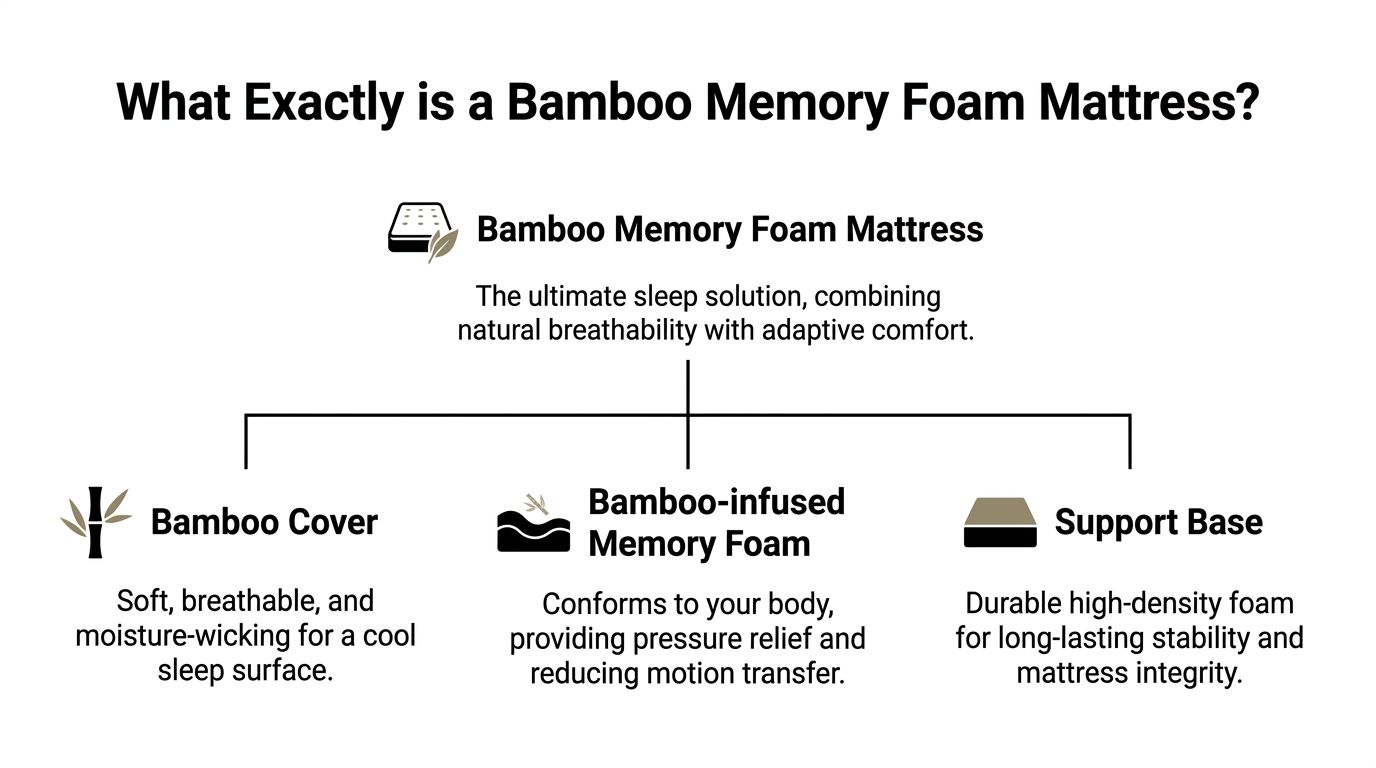
Imagine a bamboo memory foam mattress as a layer cake. Each layer has a job. One touches your skin. One cushions your body. One holds everything up.
Here’s a visual that makes that breakdown easier.
If you enjoy mattress history and how today’s materials evolved, the history of mattresses from straw mats to memory foam is a fun read.
The cover
The top fabric is often a bamboo-blend cover. This is the part you feel first when you sit or lie down. It’s usually soft, smooth, and cooler-feeling than many basic synthetic covers.
Bamboo fibers are known for breathability and moisture handling. That’s one reason shoppers who sleep warm often notice a difference right away on the surface feel. The cover can’t do all the cooling on its own, but it helps create a less stuffy first impression.
The comfort layer
The “memory foam” component is a key feature. A quality bamboo memory foam mattress often uses foam that contours around the body, especially under heavier areas like shoulders and hips.
Some models add bamboo charcoal-infused memory foam. That sounds technical, but the concept is straightforward. Bamboo charcoal-infused memory foam is created by burning bamboo at high temperatures to produce activated charcoal powder, which is then mixed into the foam. This process introduces microscopic porosity that enhances moisture absorption and odor neutralization, with independent lab tests showing significant VOC reduction, as explained by this bamboo foam mattress breakdown.
The support base
Under the comfort layer sits the support core, usually high-density foam. This bottom section keeps the mattress stable and helps prevent the soft upper layers from collapsing too far.
Think of it this way. The top layers help you feel cradled. The bottom layer keeps your spine from dipping out of alignment. You need both.
Here’s a simple way to picture the three parts:
| Layer | What it does | Why it matters |
|---|---|---|
| Bamboo cover | Feels soft and breathable | Helps the surface feel cooler and drier |
| Memory foam comfort layer | Contours to the body | Cushions pressure points and reduces motion transfer |
| Support base | Adds structure and stability | Helps the mattress hold shape and support you evenly |
What confuses people most
The biggest misunderstanding is the word “bamboo.” People sometimes think the mattress is packed with plant pieces or built like a bamboo floor. It isn’t.
Most of the time, bamboo appears in one of these forms:
- Bamboo-derived fabric in the cover
- Bamboo charcoal blended into foam
- Bamboo-based textiles paired with memory foam construction
Another common question is safety. Many shoppers want low-odor materials and better indoor air quality. That’s why certifications like CertiPUR-US® and OEKO-TEX® matter. They help you sort through which models use tested materials instead of just nice-sounding marketing words.
Practical rule: Don’t judge a bamboo memory foam mattress by the label alone. Check what part of the mattress actually includes bamboo, and what the support core is made from.
When you understand the layers, the whole category gets a lot less mysterious.
Amazing Benefits and Honest Trade-Offs
Some mattress categories sound better on paper than they feel in real life. Bamboo memory foam usually catches people’s attention because the benefits translate into everyday sleep problems. That’s the key.
Here’s the comfort side of the story first.

If you're comparing cooling features more broadly, gel memory foam mattress vs memory foam helps explain how different foam technologies try to manage heat.
Why hot sleepers get curious fast
Cooling is a huge reason people try this mattress type. Bamboo memory foam mattresses excel in breathability, as bamboo fibers are 3-4 times more absorbent than cotton, which helps wick moisture away. That can help counter the heat retention issues that up to 70% of traditional foam users report, according to this explanation of bamboo mattress breathability.
That doesn’t mean every bamboo mattress feels icy cold. It means the materials are working to move moisture and reduce that trapped, swampy feeling many people dislike in older foam beds.
Pressure relief that feels different from springs
Memory foam responds slowly and molds around the body. For some sleepers, that feels like a gentle cushion around the joints instead of pressure pushing back up at them.
This can be especially helpful if you notice discomfort in these spots:
- Shoulders: Common for side sleepers
- Hips: Another pressure point area
- Lower back: Often tied to uneven support
- Partner disturbance: Foam usually absorbs movement better than a springy surface
A bamboo memory foam mattress can also feel quieter and more settled than an innerspring. If one person gets up early, the other person may notice less disruption.
Freshness and comfort in the real world
Many bamboo-based materials are popular because they feel cleaner and less stale over time. Shoppers who care about odor control, moisture management, or allergy-friendly materials often like this category for that reason.
That said, “hypoallergenic” doesn’t mean magic. You still need a clean mattress protector, washable bedding, and a good bedroom routine. The mattress helps, but your habits matter too.
Some of the happiest shoppers aren’t looking for luxury buzzwords. They just want to stop waking up hot and sore.
The honest trade-offs
No mattress type works for everybody. Bamboo memory foam has a few things to keep in mind.
- It may feel less bouncy: If you love the springy lift of a classic coil bed, foam can feel slower and more cushioned.
- You might notice a new mattress smell at first: Many foam mattresses have a temporary odor when first unpacked. Certified foams help address safety concerns, but it’s still smart to air the room out.
- The feel can be very model-specific: One bamboo memory foam mattress may feel plush and contouring. Another may feel firmer and more lifted.
That last one trips people up all the time. “Bamboo” tells you something about the materials. It doesn’t tell you everything about the firmness, support, or overall comfort level.
A good fit still comes down to your body, sleep position, and what kind of feel you enjoy night after night.
Who Sleeps Best on a Bamboo Mattress
Some mattresses are easy to describe in a showroom but harder to match to real people. Bamboo memory foam is easier when you think in terms of sleepers, not specs.
Here are a few of the people who tend to connect with it right away.

For a deeper look at matching mattress feel to body posture, the best mattress for your sleep position is a helpful next step.
The hot sleeper
This shopper usually starts with one complaint. “I’m tired of sleeping warm.”
They don’t necessarily want an ultra-firm mattress or a complicated high-tech bed. They just want less heat buildup. A bamboo memory foam mattress often appeals to them because the surface and comfort layers are built to manage moisture and airflow better than older, basic foam constructions.
The side sleeper with sore shoulders
Side sleepers often need cushioning where the body presses hardest into the mattress. That usually means the shoulder and hip.
A quality bamboo memory foam mattress often features a layered construction such as a 2-inch, 2.5 lb/ft³ visco-elastic comfort layer over a 6-inch, 2 lb/ft³ high-density base, and that setup can relieve pressure on the hips and shoulders by 30-50% compared to traditional innersprings, according to this layered mattress example from Rest Therapy.
That kind of contouring can feel like a relief if your current mattress pushes back too hard.
The couple who wakes each other up
This is a big one. One person rolls over. The other person wakes up. Repeat all week.
Foam tends to absorb movement rather than bouncing it across the bed. That can make bamboo memory foam appealing for couples, especially when one person is a restless sleeper and the other is a light sleeper.
The senior or caregiver shopping for gentle support
Older adults often want comfort without feeling swallowed up by the mattress. They may also care more about easier movement, steady edge feel, and softer pressure relief for sensitive joints.
For that shopper, bamboo memory foam can be a nice middle ground. It offers contouring and cushioning, but the better versions still have a strong base underneath. The result can feel supportive without feeling harsh.
The shopper who wants heavier-duty support
Not all foam mattresses are built the same. Some are too light in the base and lose their shape too quickly. Others feel much steadier.
If you need a mattress for a larger body type, a guest room that gets frequent use, or a household that wants long-term value, focus less on the bamboo label and more on the support build underneath it. Dense base foam and solid edge construction matter a lot here.
The best match isn’t based on age alone or sleeping position alone. It’s the mix of body type, pressure points, and the feel you like when you lie down.
How to Choose Your Mattress Like a BILTRITE Pro
You lie down in our showroom for 30 seconds and think, "This feels nice." Five minutes later, your shoulder starts talking back or your lower back feels unsupported. That is the moment the actual mattress test begins.
After helping Milwaukee families choose mattresses for generations, we can tell you that a good pick usually comes down to a few practical checks. Fancy wording on a tag does not help much if your body disagrees.
Start with what is underneath
With bamboo memory foam, shoppers often focus on the top comfort story first. We get it. The cover feels soft, and the memory foam gets all the attention. But the support layers underneath do the long-term heavy lifting.
A mattress works a lot like a house. Fresh paint matters less if the foundation is weak. In the same way, a soft, pressure-relieving top layer will not save a mattress that lacks steady support underneath.
In our showroom, we encourage people to ask simple questions: Does the mattress keep your spine in a more natural line? Does it feel stable when you change positions? Does it still feel supportive after a few minutes, not just the first few seconds?
What to check in the showroom
Testing a mattress well is different from giving it a quick sit. Give yourself a little time and pay attention to these body signals:
- Shoulder comfort: Side sleepers should feel cushioning, not upward pressure.
- Hip balance: Your hips should settle in slightly, not drop too far.
- Lower back support: Back sleepers should notice gentle contact under the lumbar area.
- Ease of movement: Roll once or twice. Some foams hug closely, while others let you move more freely.
- Edge feel: Sit and lie near the side. A steadier edge can make the whole mattress feel more usable.
One small tip from our floor team. Bring your usual pillow feel into the test, or at least mention what pillow height you use at home. Sometimes a mattress feels off when the actual issue is that your head and neck are sitting at the wrong angle.
Firmness is personal
"Medium" is not a universal feeling. A lighter side sleeper and a larger back sleeper can lie on the same mattress and describe it two different ways. That does not mean one of them is wrong. It means bodies read pressure differently.
This quick guide gives you a starting point:
| Sleeper type | Often likes | Why |
|---|---|---|
| Side sleeper | Medium to medium-soft feel | More cushioning at shoulders and hips |
| Back sleeper | Medium to medium-firm feel | Better balance of contour and support |
| Stomach sleeper | Firmer feel | Helps keep hips from sinking too low |
| Combination sleeper | Responsive medium feel | Easier to change positions |
A starting point is not the final answer, though. Your body shape, joint sensitivity, and comfort preference still matter more than the label.
Pay attention to the cover and materials
The cover is the part your sheets sit on and your body feels first. A bamboo-blend cover often feels smoother and a bit more breathable than a basic synthetic knit, which can be helpful if you sleep warm or dislike that clammy feeling some fabrics create.
Material certifications are worth checking too. They give you a clearer picture of what is in the mattress and help you sort through vague marketing claims. In the showroom, we are happy to explain what a certification does and does not tell you, in plain English.
If a mattress feels good for one minute but uncomfortable by minute five, trust minute five.
The best choice usually feels calm and easy. Your body settles in, your joints are not fighting the surface, and you are not wondering whether you can live with it. For more help after you bring one home, our mattress maintenance and cleaning tips to extend its lifespan can help you protect that investment for the long haul.
Keeping Your Mattress Happy for Years to Come
A good mattress doesn’t take a ton of work, but a little care makes a real difference. If you buy a solid bamboo memory foam mattress and then put it on the wrong base or never protect it, you’re making the materials work harder than they should.
That’s avoidable.
For more practical upkeep habits, mattress maintenance cleaning tips to extend its lifespan gives a solid overview.
The simple habits that matter most
Here are the maintenance moves that help:
- Use a mattress protector: This helps defend against spills, sweat, and daily wear.
- Put it on the proper foundation: A mattress needs the support system it was designed for.
- Rotate when recommended: Even high-quality foam benefits from even wear.
- Keep bedding breathable: Heavy, heat-trapping layers can cancel out cooling benefits.
- Let it air out after setup: Fresh airflow helps with any temporary unpacking odor.
None of that is complicated, but it adds up.
Why durability is a big selling point
With proper care, a quality bamboo memory foam mattress can last 8-10 years, significantly longer than many conventional mattresses, according to this durability reference from Consumer Reports and related sleep analysis. That same guidance also notes that flip-able, 2-sided designs can extend useful life even further by promoting even wear.
That matters for comfort, but it also matters for value. Replacing a mattress too soon is frustrating. It’s also expensive.
Why two-sided construction gets people excited
Many mattresses today are one-sided. You sleep on the same surface every night and rotate it as needed. That’s common, but it isn’t the only option.
A flip-able, 2-sided mattress gives you another way to spread wear more evenly. For shoppers who care about durability, that’s a feature worth paying attention to. If the model is designed for it, flipping and rotating can help the mattress stay more balanced over time.
A short care checklist
| Habit | Why it helps |
|---|---|
| Protector | Shields the surface from moisture and stains |
| Proper base | Prevents sagging from poor support underneath |
| Rotation | Distributes wear more evenly |
| Ventilation | Helps the mattress stay fresher after setup |
A mattress is one of the hardest-working pieces in your home. Taking care of it doesn’t have to be fancy. It just needs to be consistent.
How Bamboo Compares to Other Mattress Types
A bamboo memory foam mattress isn’t the “right” choice for every person. It’s one flavor in a bigger mattress menu. Comparing it to other common types usually makes the decision easier.
Here’s a simple side-by-side look.
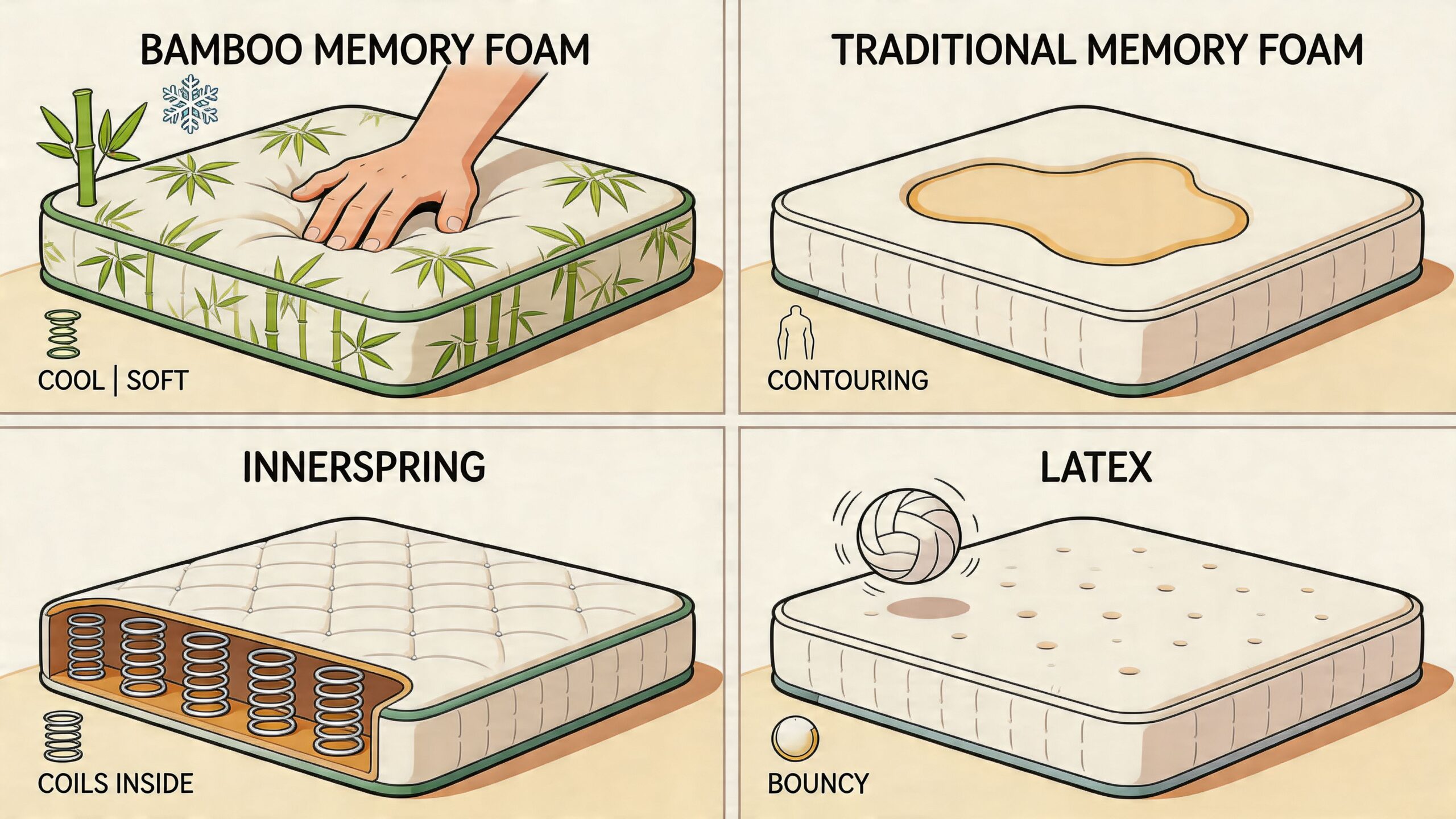
Bamboo memory foam versus traditional memory foam
This is the closest comparison. Both use contouring foam and both can reduce motion transfer well.
The difference is that bamboo versions are usually aimed at improving breathability, moisture handling, and overall freshness. If you like the pressure relief of memory foam but worry about heat, bamboo memory foam is often the more appealing branch of that family.
Bamboo memory foam versus innerspring
Innerspring mattresses have a more lifted, bouncy feel. Many people grew up sleeping on them, so they feel familiar right away.
Bamboo memory foam tends to feel quieter, more body-contouring, and less reactive. If you want pressure relief and less partner disturbance, foam usually has an advantage. If you love a classic buoyant feel and easy movement, innerspring may still be your preference.
Bamboo memory foam versus hybrid
Hybrids combine foam layers with a coil support core. That usually creates a mix of contour and bounce.
Some sleepers prefer hybrid because it feels a bit more “on top of” the bed instead of “in” the bed. Others prefer bamboo memory foam because it offers a calmer, more cushioned feel with less motion transfer.
Bamboo memory foam versus latex
Latex often feels springier and more responsive than memory foam. It can also feel very supportive and durable.
Bamboo memory foam usually offers deeper contouring and a slower, more cradling response. Latex fans often want buoyancy. Memory foam fans often want pressure relief and a hug-like feel.
Quick feel comparison
| Mattress type | Typical feel | Often chosen for |
|---|---|---|
| Bamboo memory foam | Contouring, quieter, cooler-feeling than basic foam | Pressure relief and moisture management |
| Traditional memory foam | Deep contour, slow response | Motion isolation and body-hug feel |
| Innerspring | Bouncy, lifted, familiar | Easy movement and classic support feel |
| Hybrid | Balanced, responsive, supportive | Mix of contour and spring |
| Latex | Buoyant, responsive, supportive | Lively feel and resilient support |
The helpful mindset here is not “Which mattress wins?” It’s “Which feel helps you sleep best?” Those are two very different questions.
Find Your Family's Best Sleep at BILTRITE
A bamboo memory foam mattress can be a smart choice for a lot of sleepers. It brings together contouring comfort, better breathability, and practical everyday support in a way that makes sense for busy households.
If you sleep hot, share a bed, or wake up with pressure point aches, this category is worth trying in person. Reading helps. Lying down helps more.
At BILTRITE, helping Milwaukee families sleep better is part of our family story. We’ve been serving the community since 1928, and as a fourth-generation family-owned business, we still believe mattress shopping should feel helpful, relaxed, and honest. Our mattress department has over 60 models to try, and our team brings over 400 years of combined experience to the showroom.
We’re proud of our affordable, better-quality focus, our strong selection of USA-made products, and the fact that we don’t do high-pressure selling. We’d rather help you find the mattress that feels right for your body, your sleep style, and your budget. We’re also proudly closed on Sundays and Mondays so our team can spend time with their families.
Enough reading about sleep. Come test the feel for yourself in Greenfield.
Common Questions We Hear in the Showroom
Is a bamboo mattress actually made from wood
No. You’re not sleeping on anything hard or woody. In a bamboo memory foam mattress, bamboo usually appears as a fabric component in the cover or as bamboo charcoal blended into foam layers.
Will it feel too firm or too soft
It depends on the model. Bamboo memory foam mattresses come in a range of feels, from more cushioned to more supportive. The bamboo part tells you about the material story, not the exact firmness.
Is the new mattress smell safe
Some new foam mattresses have a temporary odor after unpacking. That’s common. Many shoppers look for CertiPUR-US® certified foams because those certifications give more confidence about what’s in the mattress. Good ventilation during setup also helps the smell fade.
Is bamboo memory foam good for couples
Often, yes. Many couples like foam because it absorbs movement better than bouncier mattress types. That can mean fewer sleep disruptions when one person changes position.
We’d love to help you sort through the options in person at BILTRITE Furniture-Leather-Mattresses. Visit our Greenfield showroom, try different bamboo memory foam mattress models for yourself, and talk with our friendly team. We’ll help you find a comfortable fit without the pressure.