OPEN MONDAY, NOVEMBER 23 10AM TO 6PM!
GREBE'S DONUT GIVEAWAY MONDAY, NOVEMBER 23 ONLY!
BLACK FRIDAY + SMALL BUSINESS SATURDAY DEALS ON NOW!
NO CREDIT CARD FEES!
1000's of Items IN-STOCK + 500 Mattresses!
Largest selection of USA Made Furniture & Mattresses + Amish Made!
FREE In-Store Design Services!
BUY LOCAL & LOVE YOUR HOME!
Tuesday-Thursday 10am to 6pm | Friday 10am to 7pm | Saturday 10am to 5pm | Sunday Closed To Be With Family & Friends | Monday Showroom Closed
5430 West Layton Ave, Greenfield - Metro Milwaukee
The laptop has claimed the middle of the desk. Mail is piled beside it, homework is waiting, and a science project needs somewhere to dry. A desk that looked roomy in a photo can feel awfully small once family life moves in.
An Amish furniture desk deserves the same practical inspection as any other hardworking piece. Beautiful grain is a lovely start. The better questions concern what's underneath, what can be repaired, and whether a person can sit comfortably when the workday runs long.
An Amish furniture desk is a desk built in an Amish woodworking shop, commonly from hardwood. The name describes a community of makers, not a single factory, construction specification, or decorating style. A simple writing desk and a substantial drawer-filled desk can both be Amish-made without sharing the same dimensions or details.
For a family choosing a shared workspace, that distinction matters. Say the desk handles school assignments in the afternoon and household bills after dinner. Deep storage might help with paperwork, but oversized drawer pedestals could leave too little room for a parent and child to sit together.
A tradition, not a uniform look
Amish woodworking is strongly associated with the Midwest and Pennsylvania. The Young Center's Amish population profile reports that Ohio, Pennsylvania, and Indiana contain about 61 percent of Amish church districts, helping explain those regional connections.
That background gives the furniture context, but it doesn't replace a close look at the actual desk. The guide to where Amish furniture is made offers a useful introduction to the communities behind the craftsmanship.
Start with the job: A family desk should suit the people and tasks before anyone settles on a stain color.
A sensible shopping order
A manageable inspection follows a clear sequence:
Confirm the materials. Identify which parts are solid wood, including the less-visible components.
Examine the connections. Look at drawer corners and the joints supporting the base.
Test the working position. Match the usable opening to the chair, legs, and equipment.
Check the room. Allow space for the furniture, the seated person, and everyday movement.
No woodworking vocabulary test is necessary. A tape measure, a careful look, and straightforward questions can reveal far more than a label alone.
Solid Wood Checks and How the Top Moves
Showroom checks for a solid-wood Amish desk
Where to look
Solid-wood sign
Warning sign
Desktop edge
Board lines and visible end grain
Thin face layer or repeating printed grain
Drawer box
Solid sides with interlocking corners
Stapled or cam-locked composite box
Framed panels
Panel sits so it can move in the frame
Panel glued tight with no room to move
Top attachment
Clips, buttons, or screws in slotted holes
Screws locked across the full width
Finish wear
Surface can be spot-sanded and renewed
Coating that cannot be repaired locally
Slides and pulls
Hardware that can be replaced
Fasteners trapped in a crumbling core
The table provides clues, not a verdict from across the room. An edge treatment can conceal a core, and a carefully matched veneer can look convincing. Material identification starts with looking and ends with confirmation of the construction.
The U.S. Forest Service's examination of Amish furniture production describes the tradition's nearly all-solid-wood approach as relatively uncommon within the broader furniture industry. That's a meaningful distinction, but it's still sensible to identify the desktop, drawer fronts, drawer sides, backs, and bottoms separately.
Follow the grain around the edge
Solid lumber has grain that relates to the board's structure. Look across the top, follow the edge, and inspect the underside where accessible. Board joints and end grain can help explain how the surface was assembled.
A veneer is a thin layer of real wood over another material. A printed wood-look surface is different again. Neither should be mistaken for thick lumber because the surface has a handsome grain pattern.
The guide to telling whether furniture is real wood can help a shopper recognize those distinctions. The useful question isn't whether every hidden component matches the top. It's whether the construction has been described accurately and suits the intended use.
Drawer construction offers another place to look closely.
Why a solid top needs breathing room
Wood is hygroscopic, meaning it absorbs and releases moisture as surrounding conditions change. Most dimensional movement happens across the grain rather than along a board's length.
The furniture-manufacturing training manual illustrates this with a 42-inch-wide solid-wood table that can change roughly 3/8 inch in width over a year, and explains that a 3 percent moisture-content change can produce about a 1 percent width change. Those examples describe wood movement, not a guaranteed amount for every desk.
That small-looking change matters when the top is attached to a base. Think of a fitted waistband that has no give. Something has to strain when the material underneath expands.
Clips, wood buttons, and correctly oriented slotted screw holes can hold a desktop down while allowing cross-grain movement. A framed solid panel also needs room inside its frame. Floating doesn't mean loose or poorly fitted; it means the maker has allowed for normal changes.
USDA-based wood-moisture guidance recommends approximately 8 percent moisture content for interior furniture wood in most U.S. regions, with individual boards commonly between 6 and 10 percent. A shopper won't establish that history by touching the finished top, so a construction question is more useful than guessing from thickness.
Consider the finish and the room
Solid wood can offer material for future sanding and refinishing, but repairability also depends on the finish. A spot repair may remain visible, and some damage calls for refinishing the whole surface. Confirm the finish type and whether a local furniture refinisher can renew it before assuming every scratch will disappear.
Placement matters, too:
Avoid concentrated heat. Keep the desk away from radiators and heating vents.
Watch strong sunlight. A window that bakes the surface isn't a gentle location.
Remove standing moisture. Wipe spills promptly rather than leaving water beneath a cup or plant.
Choose steady conditions. Avoid rooms with extreme humidity swings.
Seasonal movement is normal. The goal is a desk designed and positioned to accommodate it.
Joinery and Drying That Carry Daily Use
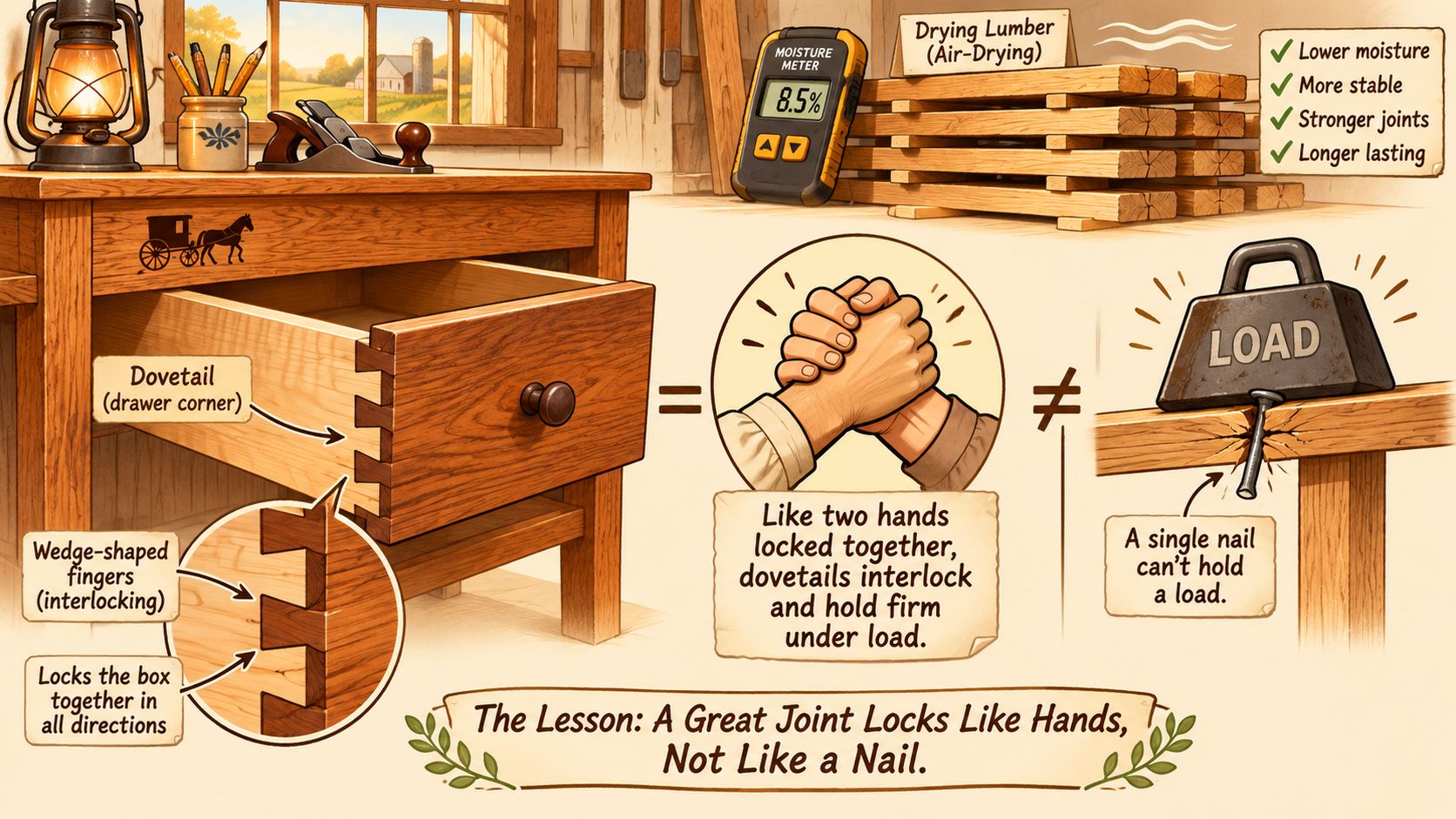
A well-made drawer corner works a little like hands with fingers interlocked. The connection has a shape that helps hold the parts together. It doesn't depend on a small fastener doing all the work.
Traditional Amish construction often uses dovetails and mortise-and-tenon joints, as described in this overview of Amish furniture-making methods. These connections matter where family members repeatedly pull, push, lean, and load.
Everyday household furniture gets plenty of activity, whether the room is devoted to work or family chores.
Questions that reveal the construction
What holds the drawer corners together? Open a drawer far enough to inspect the corner, with assistance if removal is necessary. Dovetails look like interlocking wedge-shaped fingers. Their shape helps resist separation as the drawer is pulled open.
The workmanship matters as much as the name. Look for close-fitting connections, intact wood, and a drawer that travels without scraping or twisting. Decorative-looking joinery doesn't excuse a drawer that binds.
How do the legs connect to the supporting rails? The rails beneath the top are often called aprons. A mortise-and-tenon joint fits a wood tongue into a matching pocket, helping connect those supporting parts.
The explanation of what a mortise-and-tenon joint is makes the shape easier to recognize. A shopper needn't take furniture apart. A visible example or a clear explanation of the connection is enough to start a useful conversation.
What wood was used, and how was it dried? Oak, cherry, maple, walnut, and hickory are hardwoods associated with Amish furniture construction. This description of Amish furniture preparation explains kiln drying and the sequence of selecting, flattening, squaring, cutting, joining, sanding, and finishing lumber.
Preparation matters before the finish
Kiln drying lowers moisture before boards become furniture components. Proper preparation helps reduce the risk of later warping and cracking, but a drying claim isn't a promise that wood will never move.
A strong-looking finish can't make up for a poorly fitted joint underneath.
A practical inspection also includes a gentle stability check on a level showroom floor. The base shouldn't rack noticeably when normal hand pressure is applied. Any unexpected movement deserves an explanation before purchase.
These checks aren't about memorizing shop terms. They help distinguish a desk that merely looks substantial from one whose drawers and supporting connections have been thoughtfully made.
Legroom and Desk Size for Real Work
Measure the usable opening, not just the outside width. A broad desktop can still leave a cramped seat when drawer pedestals occupy both sides. A center drawer can lower the opening, while a modesty panel can interrupt the space needed farther back.
The OSHA workspace guide provides the following benchmarks: approximately 20 inches minimum knee width, 17 inches knee-level depth, 24 inches foot-level depth, generally 20 to 28 inches of under-desk height, and a monitor viewing distance of at least 20 inches. These are fit checks, not a guarantee that a particular desk will accommodate every person.
Clearances to measure on an Amish desk
Fit check
Benchmark
Where to measure
Knee width
About 20 inches minimum
Open space between pedestals or aprons
Knee depth
17 inches
Depth before a drawer, apron, or modesty panel
Foot depth
24 inches
Room at foot level, not just at the knees
Height under the top
20 to 28 inches
Clearance above the thighs in the intended chair
Monitor distance
At least 20 inches
Eyes to screen, with room remaining for keyboard and mouse
Sit before deciding
The chair changes the fit. A thick seat cushion, raised armrests, or a taller seated position can create interference that a standing inspection misses. The most useful test happens in the intended chair or a comparable one.
Begin with the feet supported and the shoulders relaxed. Bring the chair toward the desk as though typing, then check whether the thighs, knees, or armrests contact anything. A person shouldn't have to perch at the seat's edge to reach the keyboard.
Check the approach. The chair should move into a working position without striking the base.
Test actual tasks. Typing, handwriting, and reaching for paperwork can reveal different problems.
Check the exit. The seated person needs room to move back and stand without catching a drawer pull.
Fit the equipment to the person
A fixed hardwood top doesn't automatically rule out a comfortable workstation. An adjustable chair, suitable keyboard surface, or monitor riser may help establish a usable arrangement. Elbows should stay near the body, wrists should align with the forearms, and feet should remain supported.
Those accessories still need inspection. A keyboard tray takes space beneath the top, and a monitor riser occupies desktop area. Adding equipment without measuring can trade one problem for another.
For a shared desk, consider the taller person's knee space and the shorter person's foot support separately. Where wheelchair access is needed, measure the actual chair, armrests, approach, and turning space rather than relying on a general household fit test.
A custom-size discussion should begin with chair height, monitor arrangement, and required clearance. Attractive proportions come afterward. Even beautiful wood can't make a shallow top useful when a laptop, notebook, and mouse have nowhere comfortable to sit.
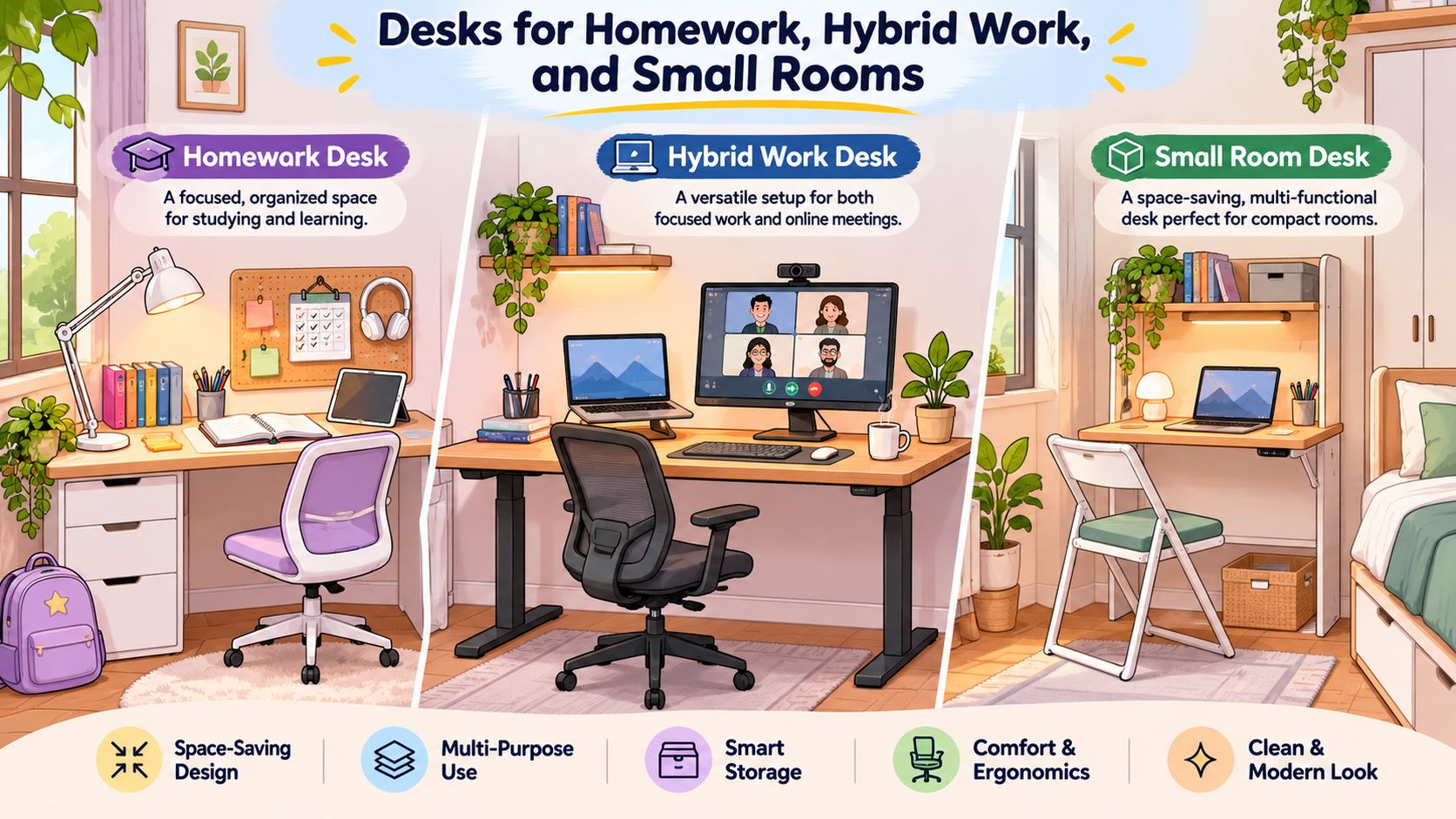
Desks for Homework, Hybrid Work, and Small Rooms
A desk used for homework may need room for notebooks and supplies. The same desk might later hold a laptop for work or paperwork for household bills. Choose by the tasks it must handle, then check whether its construction and proportions suit everyday use.
Match the setup to the household
Homework and bills. Keep a clear writing area and storage within reach for pencils, chargers, and paperwork. A drawer can help organize supplies, provided it doesn't become a catchall that gets in the way. Families planning a schoolwork corner can browse these kids' desk ideas.
Hybrid work. Arrange the monitor, keyboard, mouse, and paperwork before settling on a desktop. Plan the cable route so cords won't catch in moving drawers or call for improvised holes through finished wood. A monitor-arm clamp also needs an approved attachment point, suitable top thickness, and clearance below.
Apartments and shared corners. A compact desk can make a work area fit into a smaller home without crowding its main uses. A simple rectangular top may serve occasional side-by-side work better than a cluster of trays and storage towers. Check that the chosen shape still supports the household's daily tasks.
Size and price need context
Desk dimensions vary by design. Published Amish open-desk listings commonly show widths from about 54 to 72 inches, a useful range to keep in mind when comparing a desk with the available wall and circulation space. Confirm the dimensions of the particular desk before choosing a length.
Price also depends on the specific piece and its features. Compare the full specification, including size, storage, wood, finish, and hardware. For a desk that may need repair later, ask how replacement parts and repair options fit into the purchase. Custom choices should suit the room while leaving a comfortable working opening.
Durability needs a repair plan
An imm cologne article on durable furniture reports that 95.5 percent of respondents in a 2025 furniture-consumer survey considered durability important or very important, while about 19 percent were willing to pay more for sustainability. It also discusses a repair study in which 74 percent of desks and office chairs remained unrepaired.
Those findings don't predict how long an Amish desk will last. They point to a practical difference: choosing furniture for durability and having a way to repair it are separate matters.
Ownership check: Keep the wood species, finish information, hardware identification, and care instructions with the purchase paperwork.
Ask whether replacement slides and pulls are available and who can assess finish damage. A desk is easier to maintain when its parts and care details are known, rather than relying on a general promise of longevity.
Come Try a Desk in Our Greenfield Showroom
A desk may look right in a photograph, yet feel cramped once you sit down. In the showroom, you can check drawer reach, thigh clearance, and how the desk fits your chair before choosing.
BILTRITE is a fourth-generation, family-owned business serving Metro Milwaukee since 1928. It has carried Amish furniture made in Holmes County, Ohio, since 2008. The store's focus on affordable, better-quality furniture makes it practical to consider how a desk is built as well as how it looks.
Bring the measurements that matter
You don't need a polished floor plan. A rough sketch and a few details can help narrow the choices:
Room information. Note the available wall space, door swings, nearby furniture, and the route into the room.
Chair information. Bring the seat height and check whether armrests can slide beneath the desk.
Work information. List the equipment and supplies that need to stay on the surface.
Ownership questions. Ask about finish care, replacement hardware, and possible repair needs.
Custom furniture options include wood, finish, and hardware choices, though availability depends on the particular piece. Bring your questions along so you can discuss which options suit your room and daily work.
Leave room for a careful decision
A visit lets you examine the grain, open and close drawers, and test the seated fit in person. Those simple checks can help you judge whether the desk works for your chair, equipment, and space.
The store is closed on Sundays and Mondays. During opening hours, take time to compare practical details and ask questions. There's no need to decide on the spot.
BILTRITE offers USA-made and Amish-made furniture, including solid-wood choices for home workspaces. Bring your room measurements and chair details to BILTRITE Furniture-Leather-Mattresses in Greenfield to try a desk and ask about its construction.