3 DAY MATTRESS SALE! THURSDAY - FRIDAY - SATURDAY!
98TH ANNIVERSARY SALE-A-BRATION ENDS SATURDAY, NOVEMBER 7TH AT 5PM!
NO CREDIT CARD FEES!
1000's of Items IN-STOCK + 500 Mattresses!
Largest selection of USA Made Furniture & Mattresses + Amish Made!
FREE In-Store Design Services!
BUY LOCAL & LOVE YOUR HOME!
Tuesday-Thursday 10am to 6pm | Friday 10am to 7pm | Saturday 10am to 5pm | Sunday Closed To Be With Family & Friends | Monday Showroom Closed
5430 West Layton Ave, Greenfield - Metro Milwaukee
A laptop sits on the dining table, bills spread across a kitchen counter, and homework keeps moving from room to room. A dedicated spot sounds simple until a family tries to fit a desk, chair, screen, books, and chargers into one corner without blocking a door or making the room feel crowded. That's where desks and hutches earn their keep. The desk provides the work surface. The hutch moves storage up the wall. The catch is that height, reach, screen position, and stability matter long before finish or hardware does.
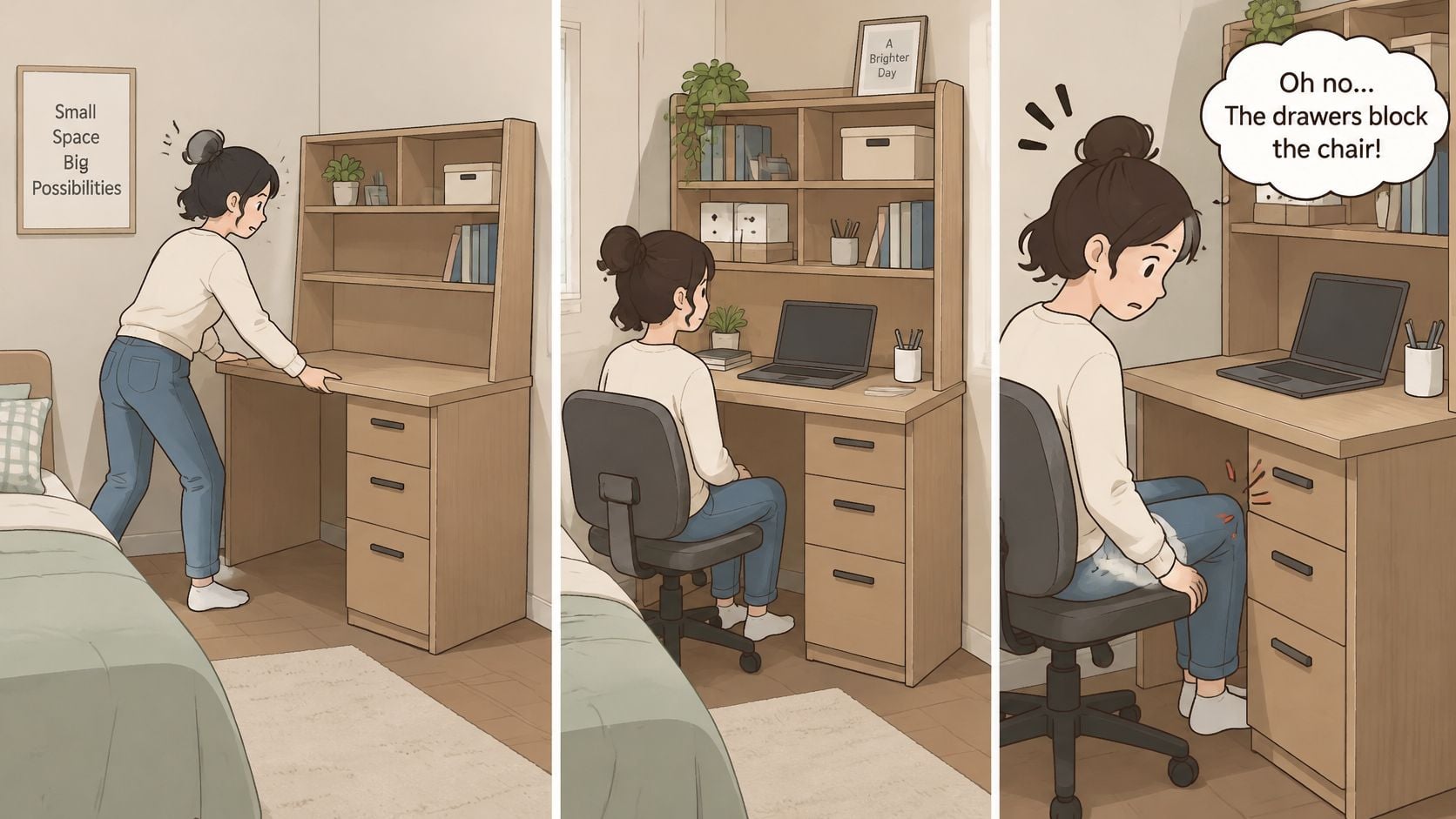
Say a buyer squeezes a handsome desk into a bedroom corner, slides the chair in, and discovers the drawers block one knee while the hutch shelf forces the monitor too close. The piece looked right. The measurements didn't. Desks and hutches work best when the type matches the job first, then the room.
Comparing the Main Types
Type
Best for
Storage
Space needed
Writing desk with hutch
Paperwork, bills and homework in a family room
Open shelves and drawers above
Medium wall run
Computer desk with hutch
Monitor and laptop work with books nearby
Shelves above screen height
Deep surface, 24 inches or more
Corner desk with hutch
Small rooms and bedroom corners
Shelves on the angled return
Corner footprint
Armoire-style secretary
Formal rooms where doors hide clutter
Doors, cubbies and drawers
Tall, needs wall anchoring
Height-adjustable desk
People who alternate sitting and standing
Keep the hutch off or shallow
Free-standing run
A writing desk with hutch suits paper, mail, and homework because shelves keep reference material close without demanding much screen depth. A computer desk with hutch needs a deeper top and enough open height for the monitor. Otherwise the lowest shelf pushes the screen forward and steals wrist room. Corner designs use awkward floor space well, though the angled return has to leave a clear knee well on the side where the chair sits.
An armoire-style secretary fits a living room or formal space where work should disappear behind doors at day's end. Those doors calm the view, but they add weight up high and need swing room. A height-adjustable desk serves alternating sitting and standing, yet a tall hutch riding on a moving top raises stability concerns. Separate wall storage or a low, shallow shelf usually makes more sense there.
Three Questions That Narrow the Choice
What work happens here: Paperwork needs flat sorting space. Computer work needs depth, screen clearance, and cable access.
How many people share it: Shared use argues for adjustable seating and storage that doesn't depend on one person's reach.
How much wall run is free: Measure past baseboards, outlets, heat registers, and door trim, not just blank wall.
Practical rule: Open shelves keep daily items reachable but show every pile. Doors hide clutter but add weight, hardware, and swing space.
Before comparing finishes, shoppers can write down the top two tasks the desk must support. That short list points to one or two rows in the table and prevents a tall storage piece from solving the wrong problem. Shoppers drawn to raised storage can also compare proportions with an Amish furniture hutch to see how shelf height and closed storage change the look.
Measure Your Space and Set Desk Height
Start with the room, then measure the person. Tape the wall run, ceiling height, and the total footprint on the floor, including space for the chair pulled back. A chair that bumps a bed, radiator, or opening door every time someone stands up will annoy its user daily. Mark outlets too, since a hutch back can cover the only convenient plug.
Next, check the path into the room. Doorways, stair turns, and hallway corners decide whether a one-piece unit can arrive at all. A two-piece desk and separate hutch often handle tight turns better. Note windows as well. A tall hutch placed under or beside one can block light and leave the work surface in shadow.
Depth Comes Before Width
Width looks impressive in a showroom. Depth decides comfort at a screen. A design reference for compact workstations recommends 24 to 27 inches of desk depth for laptop work, increasing to about 30 inches for dual monitors, with daily-use items kept within 16 to 18 inches of reach, according to a compact office desk design guide. A workstation study likewise cited 120 centimeters by 90 centimeters for computer work performed by one person in the Jordan Journal of Mechanical and Industrial Engineering workstation analysis.
Measurement
Reference value
Why it matters
Desk depth for laptop work
24 to 27 inches
Room for laptop, wrists and papers
Desk depth for dual monitors
About 30 inches
Room for two screens without crowding
Desk size for one-person computer work
About 120 by 90 centimeters
Starting footprint for monitor and keyboard
Under-desk knee depth
About 17.6 inches
Keeps knees clear of drawers
Under-desk foot depth
About 24 inches
Lets feet sit flat or rest on a footrest
Under-desk width
About 20.8 inches
Room for legs and chair arms
Reach for daily-use items
16 to 18 inches
Keeps frequent items in easy reach
Setting Height and Clearance
There's no single desk height that fits every body. The U.S. Occupational Safety and Health Administration desk guidance recommends the monitor sit at least 20 inches from the eyes, with the keyboard approximately at elbow height and adjustability spanning about 22 to 30 inches for seated work and 36 to 46.5 inches for standing work. Its purchasing guidance also specifies minimum under-desk clearances of approximately 17.6 inches for knee depth, 24 inches for foot depth, and about 20.8 inches of width.
Measure the usable opening, not the outside frame. Drawers, modesty panels, cable trays, and hutch supports can all intrude. A fixed-height desk fits a wider range of people with an adjustable chair, a keyboard tray, or a footrest, so feet stay supported and shoulders stay relaxed instead of creeping upward toward the keys.
A quick sit test settles most questions. Feet rest flat, upper arms hang comfortably, wrists stay straight, and the screen sits far enough back under the hutch. The lowest shelf shouldn't crowd the top of the monitor or cut across the user's sightline. A detailed walkthrough of how to measure for a home office desk helps shoppers record wall, chair, and clearance numbers before visiting a showroom.
Hutch Stability and Safe Shelf Loading
A hutch moves weight upward, and that changes what the desk has to resist. A row of hardbacks on the top shelf sits far above the floor, so a swinging door or a loaded drawer has more force to tip the whole unit forward. Empty floor models hide this. A unit that feels planted with bare shelves can feel loose once they carry binders, paper, and a printer.
Standards give shoppers a practical question to ask. ANSI/BIFMA X6.5-2022 covers residential and home-office desks, tables, and storage products, and ISO 19682 sets out test methods for desk and table stability, strength, and durability, as the ANSI/BIFMA furniture standards descriptions lay out. The U.S. Consumer Product Safety Commission advises anchoring furniture such as bookcases to the wall and placing heavier items on lower shelves or in lower drawers. Ask whether the hutch you are considering ships with a wall-anchoring kit, and check that the kit's screws will reach a stud where the unit will sit.
Five Checks Before Loading a Hutch
Test the base: Look for a broad, rigid base that doesn't rack side to side.
Confirm anchoring: Wall hardware should fasten into studs, not just drywall.
Read shelf ratings: Ask what each shelf can carry and whether pins and supports match that rating.
Load low first: Printers, reams of paper, and dense reference books belong at the bottom.
Respect the top shelves: Don't store equipment up high unless the maker rates the shelf for that load.
Zone
Suitable contents
Avoid
Lowest drawers and shelves
Printer, binders, reams of paper, reference books
Items that need a step stool to reach
Middle shelves
Books, files, boxed supplies
Heavy electronics unless the maker rates them
Top shelves
Light decor, baskets, lightweight boxes
Heavy books, equipment, anything requiring a lift
Base and wall
Anchor kit fixed into wall studs
Skipping anchors in homes with children or pets
Homes with children, pets, or uneven floors need more care than the load chart suggests. A child hanging on an open door, a dog bumping a leg, or a unit rocking on an old floorboard adds forces that static shelf weight never accounts for. Level the piece first, anchor it during setup, and recheck the hardware after every move. Anchoring is part of assembly, not an optional extra.
A slight wobble at the top of an empty hutch becomes a bigger problem once shelves fill. Fix the wobble before loading anything.
Open every door and drawer at once during a showroom test, then lean lightly on the top rail while they stay open. That single action shows whether clearances work, whether the unit creeps or twists, and whether the back feet lift off the floor. Reach and stability get settled here, long before finish color enters the conversation.
Solid Wood, Veneer and Engineered Materials
Material decides how a desk ages, how it handles a spilled coffee, and whether damage can be repaired. Two pieces with the same silhouette can behave very differently after years of homework, laptop heat, chair bumps, and shelf loads. Shoppers should ask what the top, sides, shelves, and drawer boxes are made from, because those parts take different kinds of wear.
Material
Strengths
Trade-offs
Solid wood (oak, maple, cherry, pine)
Can be refinished, strong, ages well
Heavier, costs more, moves with humidity
Wood veneer over plywood
Stable, shows real grain, lighter
Deep damage is hard to repair
Engineered wood (MDF, particleboard)
Flat, affordable, consistent
Screws loosen; water swells it
Metal frame with wood top
Slim, modern lines
Top scratches and shows wear faster
How Each Material Holds Up
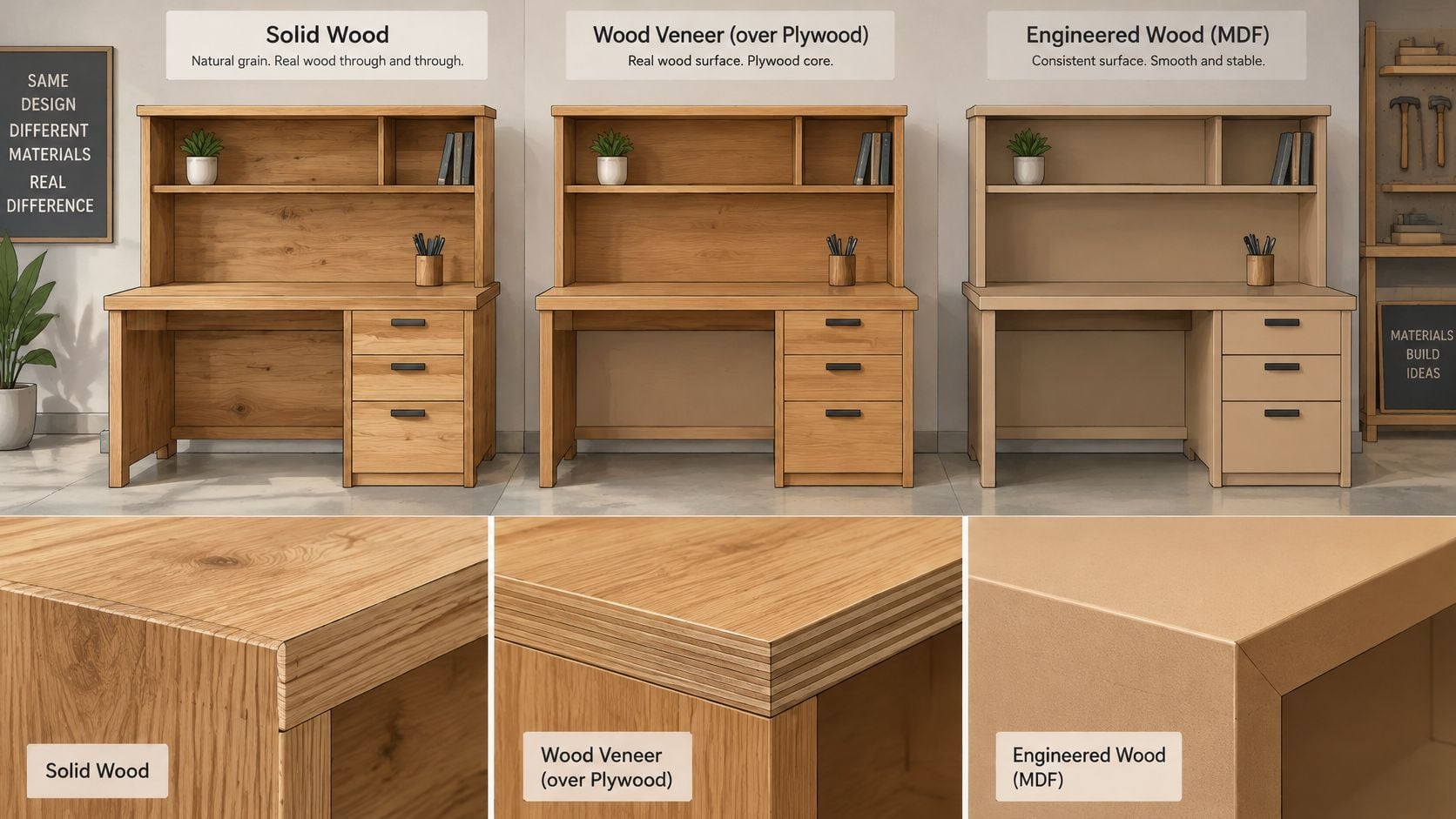
Solid wood handles daily knocks well and can often be sanded and refinished when edges wear or a top takes scratches. It feels substantial under loaded shelves and ages with character. The trade-offs are weight, higher cost, and seasonal movement as indoor humidity changes. Wide tops need construction that allows that movement, or gaps and sticking drawers follow.
Wood veneer over plywood shows real grain while the plywood core stays stable and lighter. It's a sensible choice for wide panels and hutch backs. A shallow surface mark may touch up fine, but damage that cuts through the thin veneer layer is difficult to hide. Edge banding quality matters, since peeled edges usually show first at corners and around the knee well.
Engineered wood such as MDF and particleboard gives a flat, consistent, lower-cost panel. MDF paints smoothly and suits light-duty shelves. Particleboard depends heavily on its surface layer and fasteners. Screws can loosen after repeated moves, and water that reaches the core swells it. A coaster habit and gentle moving matter more with these materials.
A metal frame with wood top keeps the profile slim and can suit a smaller room visually. Check welds, leg rigidity, and how firmly the top attaches. A thin top may scratch or flex under a monitor arm, so the work surface deserves as much scrutiny as the frame.
Wood remains a common choice in this category. Mordor Intelligence estimated the United States home-office furniture market at USD 6.5 billion in 2025, with wood representing 41.35% of the market, in its United States home-office furniture market report. That same estimate placed the mid-range price segment at 51.25%, which fits shoppers balancing durability against budget.
Buying check: Open a drawer and look at the corners, runners, and underside of the top. Construction details reveal more than a polished showroom front.
USA-made and Amish-made solid wood desks appeal to families who want a piece built for daily use and possible refinishing later. That doesn't make every other material a poor choice. A light-use homework desk, a paper-heavy home office, and a formal secretary place different demands on shelves and surfaces. A side-by-side explanation of solid wood furniture versus veneer helps shoppers match repair expectations to the material before ordering.
Ask about drawer joinery, shelf thickness, back construction, and finish type. Then view the grain and color in person. Wood tone shifts under home lighting, and a finish that looks warm in a photo can read much darker against a north-facing wall.
Customize Your Desk and Hutch
Custom choices work best after measurements settle the size and layout. A beautiful finish won't fix a shelf that crowds a monitor, and handsome hardware won't help if door swing blocks the chair. Start with function, then choose the details that make the piece belong in the room.
Wood selection sets grain, weight, and how the surface responds to daily use. Oak shows a pronounced grain. Maple reads smoother and lighter. Cherry brings warmer color that deepens over time. Pine feels casual and marks more easily. Shoppers who expect homework, crafts, and frequent moves should weigh hardness and repairability as heavily as color.
Finish, Hardware and Hutch Shape
Finish controls tone and sheen. A lighter finish can keep a tall hutch from dominating a bedroom or apartment living room. A darker finish suits a study and hides minor dust less well than many buyers expect. Bring a photo of flooring, trim, and nearby furniture. Matching every wood tone exactly isn't necessary. Keeping undertones compatible usually looks calmer.
Hardware seems small until hands use it dozens of times a day. Pulls should allow a comfortable grip without catching clothing. Knobs suit light drawers and smaller doors. Longer pulls give better hold on wide file drawers. Test hardware with a full grip rather than fingertips, especially for anyone with limited hand strength.
Hutch shape changes both storage and sightlines:
Open shelves: Books, baskets, and daily supplies stay visible and easy to grab.
Closed doors: Papers and chargers disappear, though doors need clearance and add upper weight.
Mixed storage: A few doors with open center shelves balance access and a tidy view.
Low hutch: One shelf adds storage while preserving light and a more open wall.
A four-step order keeps decisions manageable. Choose the material for the workload, pick a finish that sits well with the room, select hardware that feels good in hand, then confirm shelf spacing and door style against the actual monitor, binders, and storage boxes. Shelf heights should accept the tallest book or file intended for them, with a little finger room above.
BILTRITE Furniture-Leather-Mattresses offers custom furniture options that let customers choose fabric, leather, wood, finish, and hardware. Shoppers considering a coordinated desk, chair, or nearby storage piece can review custom solid wood furniture options and bring room photos and measurements for an in-store conversation. Free in-store design services are also available for shoppers planning a dream piece or dream room.
Matching a Desk and Hutch to Your Household
A small apartment makes the desk decision for you. When one nook has to hold homework, bills, and a shared laptop, a slim writing desk with a hutch earns its footprint by lifting schoolbooks and mail off the dining table. Closed upper doors hide the paper piles from the living area. Two measurements decide whether it works: whether the unit can be anchored, because little hands pull on doors and drawers, and whether a homework chair can slide back without hitting the sofa.
A couple sharing one computer desk runs into a different constraint. Both users need the same monitor at different heights during the day, so a deeper top, an adjustable chair, and a monitor set below the lowest hutch shelf matter more than extra cubbies. Cable routing behind the hutch keeps chargers off the work surface. Measure each person seated: feet supported, wrists level, without moving the whole setup between shifts.
For a senior or a caregiver, access beats maximum storage every time. Everyday items belong on lower shelves and in drawers that open without a hard pull. A clear knee well, a comfortable seated height, and a chair that's easy to enter and leave deserve priority over capacity. Top shelves can hold light decor or seasonal items rather than supplies needed daily. Reach from a seated position settles it: if an item requires standing on tiptoe, it doesn't belong in the hutch.
A decorator may start with proportion, finish, and hardware, which is reasonable in a formal room where the desk serves occasional writing and display. Even then, sightlines matter, since a tall hutch can anchor a wall or crowd artwork, windows, and door trim. Judge it from the doorway and from the main seat, not from standing directly in front of it.
Sit in the chair, face the screen, reach for the shelves, then walk to the couch or doorway and look back. That sequence tests work comfort and room balance in one pass.
Three checks carry across every household: anchor the unit, protect chair room, and confirm seated reach. Run them in that order before you fall for a finish.
Flexibility helps when routines change. A desk that later works as a writing table, homework station, or display piece stays useful after a job or school stage ends. Answer four questions before buying. Who uses it, what happens there, how often, and where will it sit for the next several years? Honest answers prevent excess storage from becoming permanent clutter.
Caring for Your Desk and Hutch Over Time
Routine care keeps a desk steady, drawers smooth, and the finish intact. Most of it takes minutes. Problems usually start small, with a loose screw, a ring of moisture under a mug, or a shelf that begins to sag under books it shouldn't carry.
A Simple Care Routine
Dust weekly: Use a soft, dry cloth and lift objects rather than dragging them across the top.
Clean spills promptly: Wipe wood with a barely damp cloth, then dry it right away. Skip harsh sprays.
Control the setting: Keep indoor humidity steady and place the desk away from heaters and direct sun.
Check hardware: Inspect screws and wall anchors twice a year and after any move.
Maintain drawers: Clean the runners and lubricate them only as the maker advises.
Touch up early: Address small scratches on solid wood with matching products before edges wear further.
Heat and sunlight deserve respect. Laptops run warm, but a desk shouldn't sit tight against a radiator or in a strong band of afternoon sun. Finish can fade unevenly under a hutch shadow line, especially on cherry and other woods whose color develops with light exposure. Felt pads under printers, lamps, and storage boxes prevent grit from grinding into the surface.
Warning signs call for unloading first and investigating second. A wobble at the top of the hutch, a shelf that bows, a door that suddenly rubs, or a drawer that drops on one side can signal loose fasteners or excess load. Remove weight, check shelf pins and anchors, and tighten hardware gently. Over-tightening engineered panels can strip the hole and make the repair worse.
Moving day needs a plan. Empty every shelf and drawer, remove a separate hutch when the design allows, and lift from the base instead of pulling by the top. Dragging a loaded or assembled unit twists joints and loosens backs. Guidance on wood furniture maintenance covers cleaning and finish care for shoppers who want a longer checklist. Steady habits protect the piece far better than an occasional deep clean.
Test Your Desk and Hutch in Our Greenfield Showroom
A hutch is a height, reach, and stability decision before it is a finish choice. In person, shoppers can sit at the desk, pull the chair in, open drawers, test door swing, grip the hardware, and check whether the lowest hutch shelf clears a monitor. They can judge finish color under real light and put a hand on the top shelf to feel how stable the piece is when loaded.
Bring the wall run, ceiling height, monitor dimensions, chair measurements, and a photo of the room. A tape outline from home helps too. Those details turn a showroom visit from browsing into a fitting session. BILTRITE Furniture-Leather-Mattresses carries small scale furniture suited for apartments, condos, small homes, and senior living residences, so compact desks can be compared beside fuller-size office pieces.
The family-owned business has served Greenfield and Metro Milwaukee since 1928. Free in-store design services are available, and design consultants help with a dream piece or dream room. USA-made and Amish-made solid wood options can be compared in person, and most furniture can be customized to personal style and comfort, including fabric, leather, wood, finish, and hardware. The showroom is closed on Sundays and Mondays, so plan a Tuesday through Saturday visit.
At the Greenfield showroom, sit down, open every drawer, talk through the measurements, and check the reach from chair seat to top shelf. Shoppers can compare USA-made and Amish-made solid wood pieces, small-scale options, and custom wood, finish, and hardware choices in person at BILTRITE Furniture-Leather-Mattresses. Bring room measurements and monitor dimensions, test chair fit and storage reach, and use free in-store design help to choose a desk that works comfortably every day.