King Hickory Chairs and Solid Wood Seating Guide


A living room chair can look like a simple purchase until the household starts using it every day. One person wants a soft place to read, another needs firm support for getting up, and the family still needs furniture that can handle movie nights, pets, guests, and narrow doorways. Then the word “hickory” appears, creating an easy confusion. King Hickory chairs and solid hickory wood chairs are related only by part of their name. They're different furniture experiences, built from different materials for different kinds of comfort.
Table of Contents
- Understanding Your Seating Options
- The Craftsmanship Behind King Hickory Upholstery
- Solid Hickory Wood and Amish-Made Alternatives
- Sizing Your Space and Finding the Right Fit
- Longevity and the Reality of Furniture Repair
- Experience the Comfort in Our Greenfield Showroom
Understanding Your Seating Options
A shopper might walk into a showroom searching for “a hickory chair” and picture a warm, solid-wood seat with a rustic grain. Another shopper might mean a generously padded lounge chair covered in fabric or leather. Both choices can be American-made, but they answer different needs.
King Hickory began manufacturing upholstered furniture in 1958 in Hickory, North Carolina, within the historic Catawba Valley furniture-manufacturing region. By 2026, that represents approximately 68 years of continuous operation. The family-owned company has focused on upholstered fabric and leather furniture, not primarily on mass-market case goods. Its location grew partly from proximity to Appalachian hardwoods, a regional resource used for furniture frames and woodworking. The company's documented furniture history helps explain why its identity is tied to domestic upholstery, skilled labor, and the Hickory furniture cluster.
Solid hickory wood seating follows another path. The material itself becomes the visual feature, with visible grain, a firm sitting surface, and a more architectural presence. These chairs can suit dining rooms, reading corners, covered living spaces, or households that prefer wood over fabric.
A useful way to sort the choices is to ask what the chair must do each day:
- For lounging: Upholstered King Hickory chairs offer cushions, padded backs, and fabric or leather surfaces.
- For a firm perch: Solid wood seating gives a more upright feel and a clear view of the wood's grain.
- For flexible decorating: Upholstery offers more options in color, texture, and softness.
- For a wood-centered room: Amish-made solid hickory furniture adds a handcrafted, natural character.
The broader lounge furniture guide can help shoppers place a chair within the room's overall seating plan. The key is simple: King Hickory refers to an upholstered furniture brand, while solid hickory describes a wood material and construction style.
The Craftsmanship Behind King Hickory Upholstery
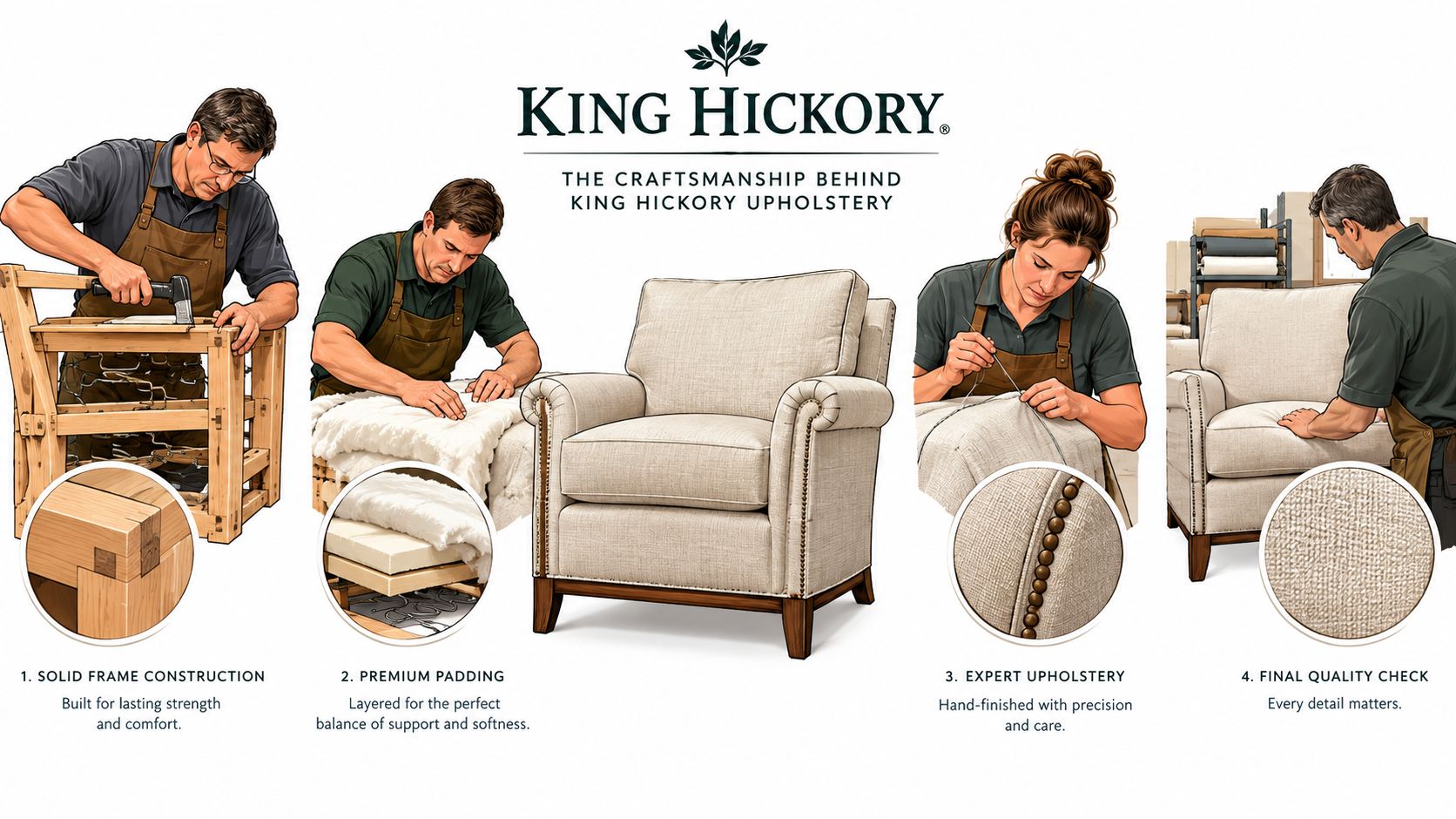
Soft upholstery shouldn't be mistaken for delicate construction. With King Hickory chairs, the materials beneath the fabric or leather determine how the chair handles repeated sitting, shifting, and daily use.
Start with the frame
The frame uses 7/8-inch hardwood plywood joined with mortise-and-tenon construction, according to the manufacturer's craftsmanship information. A mortise-and-tenon joint fits one component into another, creating an interlocking connection. That approach distributes load across the joint instead of depending mainly on fasteners.
The frame is the chair's skeleton. Upholstery can hide it, but it can't compensate for weak connections underneath. A shopper comparing chairs should ask what the frame is made from, how the joints are formed, and whether the construction suits the household's level of use.
Look below the cushion
The standard seating platform uses eight-way hand-tied, double-cone springs made from high-carbon tempered steel. Each spring is secured in multiple directions to the frame and neighboring springs. That arrangement helps control sideways movement and creates a more consistent path for weight than a minimally supported cushion deck.
The springs don't make the chair feel stiff by themselves. Instead, they work with the cushion and upholstery to create a supportive base. Some models also include a spring front edge, which the manufacturer identifies as a feature intended to extend cushion life where the design permits.
Practical rule: A beautiful fabric tells shoppers about the chair's appearance. The frame, spring platform, and cushion construction tell them more about how it may feel after years of use.
Match the cushion to the household
King Hickory specifies high-resiliency polyurethane seat cushions, while some chair models offer Comfort Down cushions. Back cushions may be fiber-filled and channeled to limit movement and sagging. Those choices affect the balance between structured support and a softer, more relaxed sit.
Anyone comparing upholstery should also review the guidance in this upholstery materials resource. Fabric and leather each bring different cleaning and aging considerations, so the surface should match the household's habits. A chair used for quiet reading may need a different cushion feel from one shared by children, guests, and pets.
Solid Hickory Wood and Amish-Made Alternatives
Solid hickory wood seating creates a different first impression. Instead of inviting someone to sink into a cushion, it presents a firm, tactile surface with visible grain and a straightforward relationship between material and structure. For shoppers who enjoy natural wood, that honesty can be the main attraction.
Hickory works well for furniture that needs a strong, substantial presence. Its grain can vary from piece to piece, so each chair has visual character rather than a perfectly uniform surface. Warm finishes can emphasize the grain, while deeper finishes can create a more traditional or rustic appearance.
Upholstery and wood side by side
| Feature | Upholstered seating | Solid hickory wood seating |
|---|---|---|
| Sitting feel | Cushioned, yielding, and available in different support levels | Firmer and more upright |
| Visual character | Defined by fabric, leather, color, and tailoring | Defined by grain, finish, and joinery |
| Maintenance focus | Cleaning the cover and caring for cushions | Dusting, protecting the finish, and managing spills |
| Best room roles | Living rooms, reading areas, conversation spaces | Dining rooms, accent areas, and wood-focused interiors |
| Lifestyle fit | Useful when softness and lounging matter most | Useful when durability, firmness, and natural material matter most |
Amish-made furniture adds another layer of appeal. Skilled artisans build these pieces around careful woodworking, visible craftsmanship, and a focus on long-term use. The result doesn't need to look old-fashioned. A clean profile and warm finish can fit a traditional room, a casual home, or a more modern space that needs natural texture.
Shoppers can explore Amish-made hickory furniture while paying attention to the details that matter in person. Run a hand across the finish. Look at the grain. Check how the chair supports the back and how the seat meets the frame.
Solid wood isn't automatically the right choice for every room. It's the right choice when a household values a firm feel, visible craftsmanship, and a material that remains part of the room's design.
A wood chair can also age gracefully, but it still needs sensible care. Keep moisture from sitting on the finish, use suitable cleaning methods, and avoid treating a finished surface like an outdoor product. Upholstered chairs need their own care routine, so neither category is maintenance-free.
Sizing Your Space and Finding the Right Fit
A chair can feel comfortable in a showroom and still create trouble at home if its dimensions haven't been checked. Fit has two parts: the chair must fit the room, and the seat must fit the person.
King Hickory lists approximate dimensions for individual models. The Loft Chair, model 3201-TZW-L, measures approximately 34 inches wide, 37 inches deep, and 36 inches high, with a 34-inch seat width, 23-inch seating depth, and 19-inch seat height. Those measurements suggest a compact single-seat footprint, but the 23-inch seat depth still needs to be compared with the user's body.
A separate chair-and-a-half model measures 60 inches wide, 44 inches deep, and 38 inches high, with a 33-inch seat width and 27-inch seating depth. That difference shows why the product label alone isn't enough. A chair-and-a-half can become the visual center of a room and may require careful delivery planning.
Compare seat depth before choosing a style
The manufacturer's Sit Lab organizes seating by depth. The Bentley is listed at 21 inches, the Benson at 23 inches, the Winston at 24 inches, and the Whitney at 25 inches. A Whitney RAF one-arm chair is listed at approximately 38 inches high, 33 inches wide, and 42 inches deep, with a 19-inch seat height, 25-inch seat width, and 25-inch seating depth. The product listing also gives an approximate 25-inch arm height. These figures are available through the Whitney seating listing.
| Seat Depth | Model Example | Best For |
|---|---|---|
| 21 inches | Bentley | A more upright sitting position |
| 23 inches | Benson | A balanced everyday fit |
| 24 inches | Winston | Shoppers wanting additional lounging depth |
| 25 inches | Whitney | A deeper, more relaxed seated posture |
A deeper seat may feel luxurious, but it can encourage slouching if the user's knees and back don't align comfortably. A shallow seat may support a more upright posture but leave less room for relaxed lounging. The right choice depends on the person's seated knee-to-back length, not just on the chair's appearance.
Measure the delivery route
Before visiting a showroom, measure the chair's intended location and the path to reach it. The furniture measuring guide is a useful starting point.
- Measure the room area. Record the available width and depth, then leave room for nearby tables, walking paths, and any required motion.
- Measure the entrance. Check the front door, interior doors, hallways, and elevator openings.
- Check turning points. A chair may pass through a doorway but fail at a tight corner or stair landing.
- Account for the full piece. Use overall width and depth, not just seat dimensions. Include arms, backs, and reclining movement where applicable.
- Bring the measurements along. A written plan or phone photo can help a salesperson assess the fit before delivery.
Longevity and the Reality of Furniture Repair
A heavy chair can have strong bones and still become difficult to maintain. That distinction matters because structural longevity and serviceability aren't the same thing.
An upholstered chair combines wood, metal, foam, fabric or leather, and adhesives. Those materials don't all age at the same rate, and they don't all follow the same repair process. A frame may remain sound while the cushion loses resilience, the cover wears through, or a spring needs attention.
Recent consumer evidence offers useful context. A 2025 survey found that 77% of Europeans wanted to repair products before replacing them, while 64% had done so, with repair cost and perceived repairability identified as barriers in the furniture repair white paper.pdf). Those figures describe consumer attitudes and behavior broadly, not the repairability of every King Hickory model.
Ask what can actually be replaced
A shopper considering long-term ownership should ask specific questions rather than relying on a general “built to last” message:
- Cushions: Can the seat or back foam be replaced without rebuilding the entire chair?
- Springs: Can a damaged spring or support component be reached and repaired?
- Covers: Can the chair be reupholstered, and does the design make that process practical?
- Materials: Will the selected fabric or leather suit the household's cleaning habits?
- Frame: Is the frame sound enough to justify new upholstery and cushions?
- Hardware: Can glides, feet, or other accessible components be replaced?
A chair can be durable and still be expensive to repair. The remaining value lies in the frame, comfort, design, and the cost of skilled labor.
Use a simple repair decision
Reupholstery often makes more sense when the frame remains strong, the chair fits the user well, and the design still works in the room. Replacement may make more sense when the frame is compromised, the proportions no longer suit the household, or repair costs approach the value of a comparable new chair.
The decision should also consider emotional value. A family chair with a familiar shape may deserve repair even when a purely financial comparison points elsewhere. For a newer chair, shoppers can protect future options by choosing replaceable-looking components, asking about service support, and keeping the original model information.
Solid wood seating has a different maintenance profile, but it isn't immune to wear. The finish can be renewed, joints can require attention, and exposed surfaces can collect marks. The wood furniture maintenance guide offers practical care principles for preserving the surface and finish.
Experience the Comfort in Our Greenfield Showroom
A chair can look right on a product page and still feel wrong after ten minutes at the table. In the showroom, you can test seat depth, arm height, cushion response, and back angle with your own posture instead of guessing from measurements.
Sitting in both styles also clears up a common source of confusion. King Hickory refers here to an upholstered furniture brand, with cushioning and fabric or leather covering. Solid hickory wood and Amish-made chairs use a different construction, with firm support and visible grain. One may suit someone who prefers a little cushion give, while the other may work better for a household that values a harder seat and exposed wood. The right choice follows your comfort, routine, room, and care expectations.
Use a simple showroom check:
- Sit back fully and see whether your feet rest naturally.
- Check that the seat supports your thighs without pressing behind the knees.
- Rest your arms, read, and stand up to test arm height.
- View upholstery textures and wood finishes in ordinary room lighting.
- Ask how cushions, covers, or other components can be serviced later.
- Confirm the delivery route before choosing a deep or oversized chair.
BILTRITE Furniture-Leather-Mattresses is a fourth-generation, family-owned business serving Metro Milwaukee since 1928. Its showroom includes affordable, better-quality furniture, along with USA-made, Amish-made, and solid-wood options. Shoppers can also find small-scale pieces for apartments and heavy-duty furniture for active households. The mattress department offers over 60 models, with practical guidance for other rooms in the home.
Sales associates bring over 400 years of combined experience. They help shoppers compare comfort, materials, and fit without pressure. The store does not sell online and closes on Sundays to protect family time, so visiting the Greenfield showroom remains central to the buying experience.
BILTRITE Furniture-Leather-Mattresses offers USA-made and Amish-made seating, solid wood furniture, upholstered pieces, small-scale options, heavy-duty furniture, and in-store guidance. Visit the Greenfield showroom to test seat depths, feel wood finishes, discuss repair and delivery questions, and choose seating that suits your home.