Dining Chair Styles: A Complete Guide for 2026


Saturday night at the dining table has a way of exposing every furniture decision at once. One chair feels a little too low, another takes up too much room, and someone always ends up angled sideways because the table edge and chair arms don't quite agree. That's why dining chair styles matter so much, they shape how a room looks, how people sit, and how easily a family can move around the table.
A chair can be lovely and still feel wrong in the room. It can match the finish of the table and still crowd the walkway. In Metro Milwaukee homes, where dining spaces often have to work hard in smaller footprints, the right chair is usually the one that balances comfort, fit, and daily use without making the room feel cramped.
BILTRITE Furniture has been helping local families sort through those choices since 1928, and the trick is never just picking something pretty. It's about finding seating that works for real meals, real bodies, and real rooms. For readers who want a starting point, this dining chair guide from BILTRITE is a useful companion while comparing styles in person.
Why Dining Chair Styles Matter for Your Family
A family table shows the truth quickly. If the chairs are too bulky, people bump elbows. If they sit too low, knees feel pinched. If the backs rise too high or the arms spread too wide, dinner starts to feel like a seating puzzle instead of a meal.
The chair changes how the room works
Chair design has shifted a lot over time, from a sign of status to a daily household piece. Ancient Egypt shows chair-like seating in tomb paintings from around 3100 B.C., medieval Europe often reserved chairs for the head of the household, and the 17th century brought upholstered seats before design leaders of the 18th century helped shape the styles that still influence dining rooms now. A historical chair timeline helps show that long change. That history matters because today's shoppers are really choosing between formality, comfort, and how a room moves.
A chair that looks right on its own can still fail if it steals walking space from the people using the room.
Families usually spot the problem during everyday use, not on delivery day. A chair that fits the eye but not the table edge makes the whole room feel tight, while a better-proportioned seat keeps meals easy and movement natural. Style and scale belong together.
The practical test is simple
The best dining chair choice starts with how the room gets used. A busy weeknight dinner, a holiday spread, and a quick breakfast all ask for slightly different things from the same set of chairs.
- Comfort for longer meals: A seat that supports the body well keeps people at the table longer without fidgeting.
- Clear movement around the table: A chair that doesn't block walkways helps the room work in daily life.
- A look that fits the home: A chair can set the tone, whether the room leans traditional, farmhouse, or modern.
BILTRITE's family-first approach fits that kind of decision-making. The store stays closed on Sundays and Mondays for family time, and that matches the same philosophy that puts real use ahead of showroom flash. When a chair works for the family, it earns its place. For readers who want a starting point, the BILTRITE dining chair guide is a useful companion while comparing styles in person.
Understanding Side Chairs and Armchairs
A dining room in Metro Milwaukee often has to work harder than it looks. A table may share space with a buffet, a doorway, or a path to the kitchen, so the chair choice has to support daily movement as well as family meals. That is why it helps to start with function, not finish. Side chairs are the armless seats that usually run along the sides of the table, while armchairs are commonly used at the heads for a more formal look (functional chair categories). The difference changes how many people fit, how formal the table feels, and how much elbow room the room gives. For readers comparing broader style groups, this dining room style guide from BILTRITE helps connect chair shape to the rest of the room.
Start with the seat, not the style tag
A chair's fit should line up with the table before anyone worries about whether it looks rustic or contemporary. The measurements are a bit like the rails on a good sled, they keep the whole setup moving in the right direction. For standard dining chairs, the most widely cited ergonomic band is a seat height of about 18 inches or roughly 45 cm, with a seat width of 16 to 20 inches and a seat depth of 15 to 18 inches (ergonomic dining chair dimensions). Allowing at least 6 inches between chairs helps preserve elbow clearance and reduces crowding at the table (same source).
Practical rule: if the seat is too high, low, wide, or deep, the chair can feel wrong even when the finish is beautiful.
A second useful range comes from classic interior guidance. Side chairs are usually 18 to 23 inches wide, seat height is 16 to 21 inches, average seat height is 18 to 19 inches, and a typical overall chair height is about 34 to 38 inches (dining chair sizing guide). Those numbers help shoppers compare a chair to the table before they fall for a shape that will not work.
Use the measurements as a quick showroom check
The best habit is to check fit in the same order every time.
- Seat height first. It should relate comfortably to the table height so legs have room.
- Seat width and depth next. Narrow chairs can work beautifully in tight rooms, while deeper seats can feel more lounge-like.
- Arm clearance last. Arms often make a chair feel larger than it looks from across the showroom.
A useful legroom target is about 25 to 30 cm, or 10 to 12 inches, between the seat and the underside of the tabletop (space-planning guidance). That gap matters because a chair can look right and still feel awkward if knees and table edges keep meeting each other.
In smaller homes, side chairs often earn their keep. They tuck in more easily along a narrow wall or in a compact nook, while armchairs can still make sense at the ends if the room has enough clearance for open movement. The goal is the same either way, a dining set that feels comfortable at mealtime and still leaves the room easy to cross.
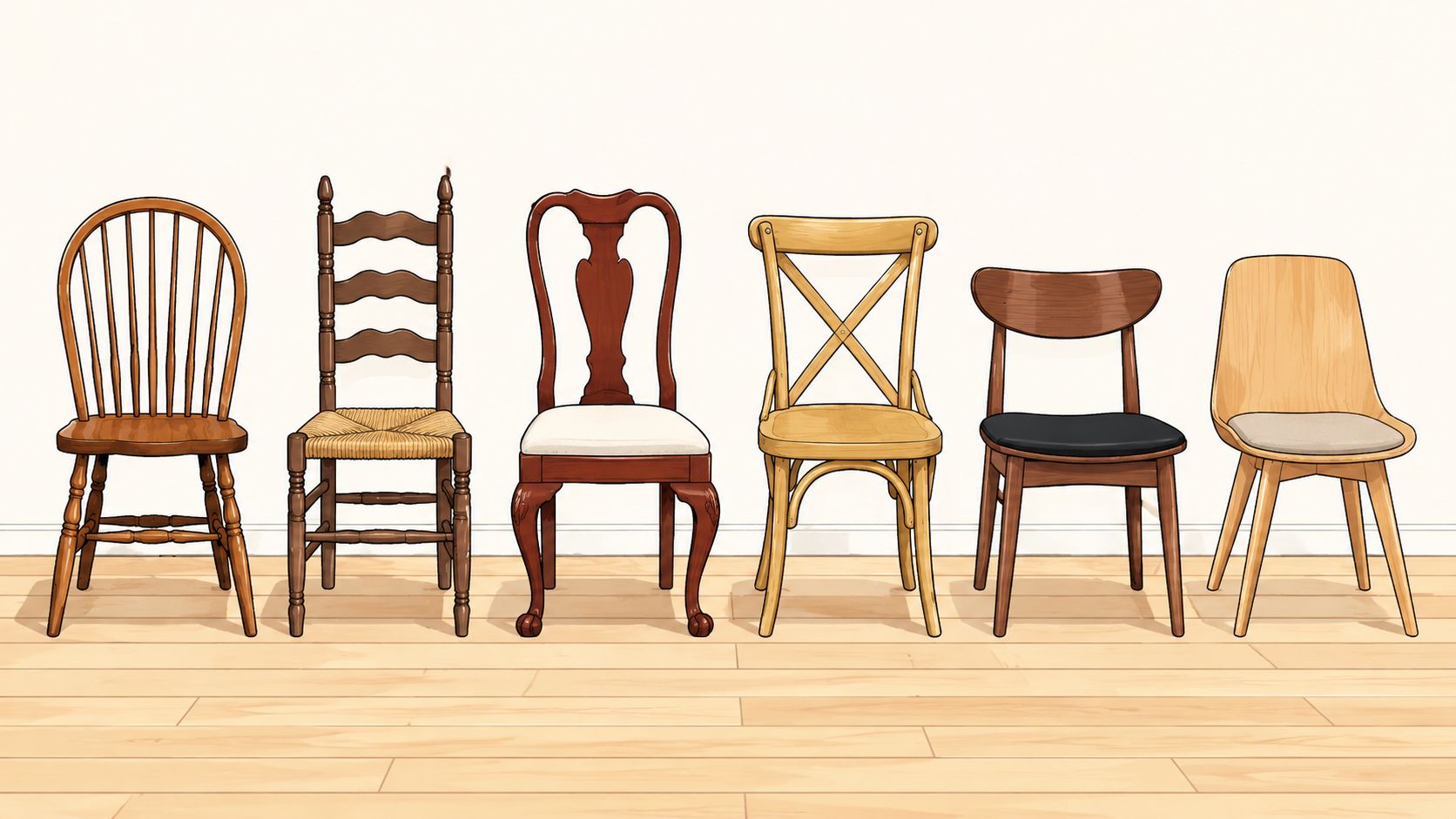
Exploring Popular Dining Chair Style Families
A dining chair can look simple from across the room and still say a lot about the era, shape, and build behind it. In a Metro Milwaukee home, that matters because the chair has to do two jobs at once, fit the room and feel good at the table. A Parsons chair is usually armless and upholstered, while a Windsor chair stands out for its rounded top backrest and exposed slats (style identifiers). Once you know those visible cues, the style names become much easier to sort.
Traditional forms carry the strongest historical markers
One of the clearest classic examples is the Windsor chair, a style rooted in 18th-century England and still recognized for sturdy, economical construction (historical style reference). Queen Anne dining chairs are tied to the 1700 to 1755 range and are marked by curved cabriole legs and shell carvings, while Federal and Hepplewhite chairs are dated 1790 to 1820 and are described with shield- or oval-shaped backs and tapered, reeded legs (historical style reference). Chippendale is named after Thomas Chippendale, an 18th-century English craftsman, which gives that family a personal rather than purely stylistic origin (historical chair overview).
These traditional forms often suit rooms that already lean formal or heritage-inspired. The goal is not to make the room feel old. It is to give the table a sense of gravity and structure that feels intentional.
Farmhouse and rustic shapes usually read more relaxed
Modern guides group farmhouse and rustic chair types into families such as Cross Back, Ladder Back, Live Edge, Turnbuckle, and Reclaimed Wood (style family taxonomy). These chairs often use visible structure as part of the design, which gives them a more casual, grounded feel.
A ladder-back or slat-back chair uses horizontal slats across the back, while a splat-back chair uses a centered vertical back panel or rod. That detail changes how open or dense the chair looks in the room, which can matter in a compact dining area where visual clutter adds up fast.
Modern and contemporary chairs lean on clean lines
The same style guide groups modern and contemporary dining chairs into forms such as Parsons, Keyhole Back, Open Back, Floating Arm, Wraparound, Tub, and Barrel (style family taxonomy). These chairs usually emphasize smooth lines, simple profiles, and a calmer visual footprint.
For homeowners comparing options, the easiest question is whether the chair's back reads solid or open, upright or curved, upholstered or exposed. That one question often narrows the field quickly, and it helps explain why a chair that looks modest on the showroom floor can still feel right in a tighter Milwaukee dining room. For a broader visual tour of common looks, this guide to dining room styles is a useful place to compare the main families side by side.
How Materials and Construction Affect Comfort and Durability
Style gets attention first, but materials decide how the chair behaves after years of meals, homework, and holidays. A chair can look delicate and still be sturdy. A chair can also look heavy and still be easy to move. Construction details tell that story.
Upholstery, wood, and mixed frames do different jobs
A published dining-chair specification sheet shows how different builds create different priorities. One steel-frame, wood-leg chair lists 50 to 55 kg/m³ foam density in its specifications and weighs about 7 kg, while a solid-ash model measures 51 cm wide, 57 cm deep, 99 cm high, has a 47 cm seat height, and weighs 6.4 kg unpacked (chair specification sheet). Those figures show the tradeoff clearly. Upholstered, steel-framed chairs usually aim for cushioning and stiffness, while solid-wood chairs often keep the design simpler and can be lighter at similar size.
Foam density matters because it affects how well a seat keeps its shape over time. Higher-density foam and a rigid frame usually help a chair hold its form and support regular use, while lower-density cushioning can feel softer at first but lose structure sooner. Families notice that difference when a chair still feels steady after frequent use.
Weight changes the feel of the whole dining set
Chair weight affects more than delivery day. It changes how easy the chair is to pull out, how firmly it sits on the floor, and how often family members move it around.
Heavier chairs often feel more planted and substantial. Lighter chairs are easier to reposition and may suit smaller rooms better. Mixed-material chairs can balance a softer seat with a firmer frame.
BILTRITE's upholstery resources are useful for shoppers thinking through care and comfort details, especially when comparing fabric, leather, and mixed builds in person through its upholstery materials guide. A chair should match the way a family lives, not just the color on the sample card.
Families should ask one simple question
What will this chair go through in a normal week? That answer points toward the right build. A household with kids may want easy-to-manage surfaces and solid construction, while a quieter dining room might prioritize upholstered comfort and a softer look.
Planning for Small Spaces and Tight Layouts
A dining chair can look perfectly proportional on the showroom floor and still cause trouble at home. In a Metro Milwaukee apartment, an older bungalow, or a compact kitchen, the same chair may block a doorway, crowd a corner, or make a narrow table feel tighter than it should. That is why space planning has to come before the style decision.
Measure the room in the order people move through it
Start with the table edge, then the chair, then the walking path. A practical layout usually leaves about 24 inches per chair along the table edge, about 36 inches of clearance behind seated chairs, and around 25 to 30 cm, or 10 to 12 inches, between the seat and the underside of the tabletop for legroom. Those measurements make daily use easier because they reduce the chance of chairs bumping each other or scraping a wall, which is the kind of problem families notice fast in a small room.
A chair can be the right style and still be the wrong size for the room.
Painter's tape on the floor is one of the simplest shopping tools a family can use. Mark the chair footprint before buying, then check how much room remains for the backs of chairs, the seat depth, and any arms or curved backs. That quick test shows whether the room will still feel open once people are seated, and it helps avoid the common surprise of a chair that looks modest until it is paired with the table.
Some chair profiles are naturally easier in tight layouts
Armless chairs usually fit better than bulky armchairs when every inch matters. Slim legs tend to look lighter than thick, blocky bases, and open-back styles let more of the wall and table stay visible, which can help a room feel less crowded.
Room shape changes the choice too. A narrow pass-through dining area usually benefits from chairs that tuck in cleanly, while a square breakfast nook may have a little more flexibility. Families who want to compare compact proportions can use BILTRITE's small-space dining room selection as a starting point for seeing how different chair shapes fit smaller rooms.
Bulkier upholstered chairs and wide armchairs can still be comfortable and welcoming. They just ask for more space around the table and more room for people to stand, turn, and slide in without bumping the chair beside them. That does not make them poor choices, only better matches for rooms that can give them breathing room.
The best chair in a small home often feels quiet before anyone sits down. It fits the room, leaves a clear path, and still gives the family the comfort they want at the table.
The Value of USA-Made and Amish-Crafted Solid Wood Chairs
A family walks into the dining room expecting a chair to do one job, then quickly learns the room asks more of it. The chair has to pull out cleanly, fit under the table, stay comfortable through supper, and still leave enough space for people to move around it. That is where USA-made and Amish-crafted solid wood chairs stand out in Metro Milwaukee homes, especially where square footage is tight and every inch has a job to do.
Craftsmanship shows up in the details people use every day
A good solid wood chair does not need attention to prove itself. It feels steady when pulled out, sits level, and keeps working through repeat use without depending on extra parts to carry the load. That is why these chairs fit so naturally into family dining rooms, where comfort and reliability matter as much as appearance.
The phrase Amish-made usually points to handcrafted furniture with careful wood selection and construction. A helpful way to sort through the showroom is to look for the store's Amish-made and solid wood identifiers while comparing pieces, so the choices stay clear instead of turning into guesswork. For readers who want a little background before they shop, BILTRITE's Amish furniture guide explains the basics of Amish craftsmanship in plain language.
Solid wood is a long-view purchase
Families who want furniture that stays in the house for years often look for materials that can handle the rhythm of daily life. Solid wood has a straightforward appeal because it is easy to understand, easier to inspect, and less dependent on layered shortcuts. It also works with many dining chair styles, from traditional frames to cleaner modern shapes.
BILTRITE's dining room and chair selections fit that mindset because the store focuses on better-quality furniture, much of it USA-made or Amish-made, with room to compare finishes and construction in person. For shoppers who want to judge the label with confidence, that kind of side-by-side viewing helps turn a general claim into something they can see and feel.
A chair built well enough to pass from one season to the next is usually worth more than a chair that only looks right on day one.
The bigger point is simple. Families are not just buying a seat. They are choosing part of the room's daily rhythm, and solid wood gives that rhythm a steadier beat.
Visit BILTRITE in Greenfield to See Styles in Person
Dining chair shopping gets clearer once the chairs leave the page and enter the room. In person, the differences are obvious. One seat feels narrow in a helpful way, another feels too deep, and a back that looked subtle online suddenly reads much taller beside the table.
BILTRITE Furniture-Leather-Mattresses has served Metro Milwaukee since 1928, and the showroom at 5430 West Layton Avenue in Greenfield gives families a place to test chairs, compare materials, and ask practical questions without pressure. The team brings more than 400 years of combined experience, so shoppers can talk through fit, finish, and room layout with people who deal with those choices every day.
Closed Sundays and Mondays for family time, BILTRITE keeps the experience grounded in the same values many customers are trying to build into their own homes. That matters when the goal is not just buying a chair, but finding seating that fits the room, the table, and the way the family lives.
Ready to sort out dining chair styles with real help and real chairs to try? Visit BILTRITE Furniture-Leather-Mattresses in Greenfield and see how different seats feel around the table. The showroom carries dining furniture, solid wood options, and helpful guidance for families who want to choose with confidence.