Double Reclining Sofas: A Friendly Buying Guide


Movie night is ready, one person wants to stretch out, the other wants to sit upright, and the old sofa insists that everyone share the same position. Double reclining sofas solve that everyday tug-of-war by giving two people separate reclining seats within one sofa frame. The result is shared seating without shared discomfort, provided the sofa fits the room and both seats fit the people using them.
For a Metro Milwaukee family choosing furniture, the details matter just as much as the cozy first impression. Wall clearance, footrest travel, delivery access, upholstery, controls, and seat height can determine whether a sofa feels like a welcome addition or a living-room obstacle. BILTRITE has served the community as a fourth-generation, family-owned furniture business since 1928, so the goal is simple: help shoppers test the practical details before they commit.
Table of Contents
- Why Double Reclining Sofas Work for Two People at Once
- Measuring Your Space for Wall Clearance and Footrest Extension
- Choosing Between Power and Manual Reclining Mechanisms
- Testing Ergonomics and Independent Seat Comfort
- Navigating Upholstery Choices and Come-Apart Delivery
- Experience the Comfort in Our Greenfield Showroom
Why Double Reclining Sofas Work for Two People at Once
A couple settles in for a long movie. One person raises the footrest and leans back, while the other keeps both feet on the floor to read or answer a message. A standard sofa can make those choices compete for the same space. A double reclining sofa gives each person a separate reclining seat within one shared frame.
That arrangement suits couples and families with different comfort preferences. The left seat can recline while the right remains upright, so each person controls their own position without placing two separate chairs in the room. Some designs include a center console, while others leave the middle more open. Look past labels such as “dual” or “double,” and confirm that each seat moves independently.
A century of reclining furniture
The mechanism has a long history. In 1928, Michigan inventors Edward M. Knabusch and Edwin J. Shoemaker developed and patented a wooden reclining chair. Their design moved the seat forward as the back tilted rearward, a basic motion later used in upholstered recliners, reclining loveseats, and double reclining sofas. The development is documented in this history of reclining furniture.
By 1929, the inventors had made 13 units for a furniture exhibition and received more orders than they could fill. They patented an upholstered mechanical model in 1930, and reclining sofas became part of wider furniture expansions during the 1960s. Those developments show how the modern double recliner grew from a mechanism refined for household seating over time.
The everyday advantage
A double reclining sofa can give a family room more flexibility without adding several bulky chairs. One person may prefer firm, upright support, while another wants a deeper lounge. The same sofa can accommodate both preferences during television, family visits, or rest after work.
Shared construction still deserves a close test. Sit in one position while the neighboring seat operates. Watch the frame and center area for shifting, lifting, twisting, scraping, or other movement. A stable sofa should let one mechanism work without making the other seat feel unsettled.
Practical rule: A sofa that feels comfortable with both seats closed still needs to pass the one-seat-at-a-time test.
At BILTRITE, associates help shoppers work through that test without rushing the decision. The store does not sell online, so the showroom visit gives couples a chance to sit in both places, operate each side, and discuss how the sofa will function at home. The right double reclining sofa should support both people comfortably and fit the room's daily use.
Measuring Your Space for Wall Clearance and Footrest Extension
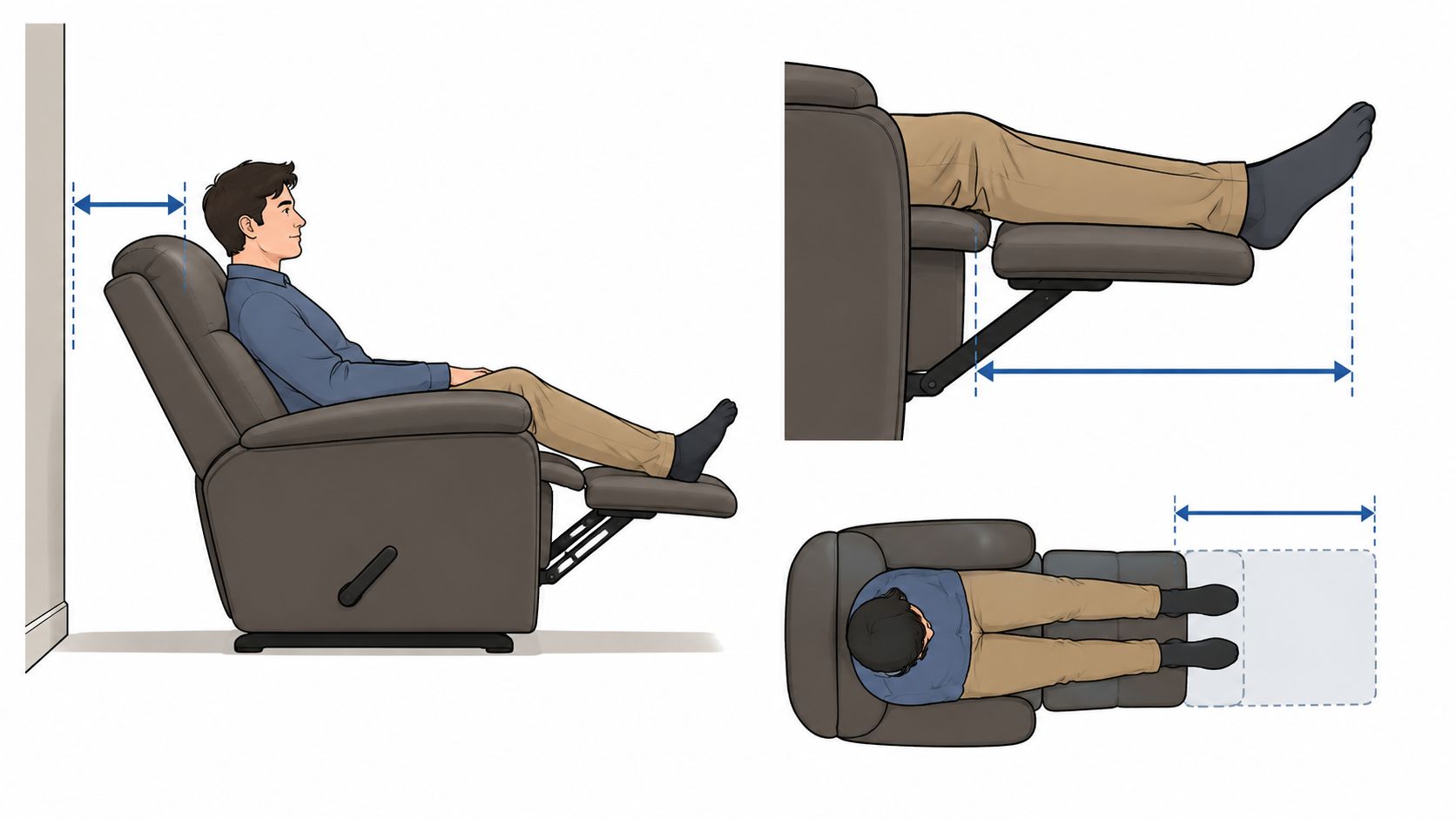
A sofa can fit beautifully against a wall when closed and still create a traffic jam when both footrests extend. Measuring only the closed width and depth misses the part of the furniture that changes most during use. The room needs to accommodate the frame, rear clearance, forward extension, nearby tables, doors, and walking paths at the same time.
Start with the closed footprint
Measure the sofa's total width, closed depth, and height. Then measure the wall where it will sit, the distance to the nearest coffee table, and the width of every walkway beside and in front of it. Shoppers can bring those figures to the showroom along with doorway, hallway, stairwell, and elevator measurements. A sofa dimensions guide can also help organize the measurements before a showroom visit.
Traditional reclining designs generally need about 10 to 18 inches between the sofa back and the wall when fully reclined. Wall-hugger or zero-wall designs reduce rear clearance to roughly 2 to 4 inches by moving the seat forward as the back reclines, as explained in this reclining sofa clearance guide.
Measure the moving footprint
The key measurement is the sofa's maximum front-to-back depth with the footrest open. Mark that distance on the floor with painter's tape, then walk around it as if the room were in use. Check whether the extended footrests reach a coffee table, block a hallway, interfere with a door, or leave too little space for someone to pass.
A product-specific example makes the issue clear. One 87-inch-wide double reclining sofa measures 39 inches deep and 43 inches high when closed, but reaches 66.5 inches in full extension and calls for 3 inches of rear clearance, according to its listed product dimensions. Those figures aren't universal, but they show why closed dimensions alone aren't enough.
Use this quick measuring sequence:
- Measure the wall: Record the usable wall length and the rear clearance required by the chosen mechanism.
- Measure the room forward: Mark the maximum open depth from the wall or sofa back.
- Check circulation: Keep doors, walkways, tables, and access to other seating clear.
- Measure delivery access: Record the narrowest doorway, turn, stair landing, and elevator opening.
- Bring every measurement: A showroom associate can compare the room figures with the exact sofa's closed and open dimensions.
Wall-hugger designs save rear space, but they don't make space planning unnecessary. The room gives up less space behind the sofa and more space in front of it. Ask whether a listed depth is measured from the frame, the wall, or the headrest, and whether it describes one seat extended or both seats fully open.
Choosing Between Power and Manual Reclining Mechanisms
The choice between power and manual reclining comes down to control style, room planning, and household habits. A manual seat typically uses a side lever, pull strap, or handle, with the user's body weight helping change the backrest position. A power seat uses a motor and controls connected to an AC/DC adapter, so the sofa needs a practical relationship with a compatible outlet.
Neither mechanism automatically suits every household. A manual sofa can keep the floor free of a power cord, while a powered model may make gradual adjustments easier for someone who finds a lever or strong body-weight shift difficult. The exact controls, motor design, electrical requirements, and available features vary by model.
Power and manual at a glance
| Feature | Power Recliner | Manual Recliner |
|---|---|---|
| Operation | Button-controlled motor movement | Lever, strap, or handle-assisted movement |
| Room planning | Requires outlet access and safe cord routing | No operating cord is needed |
| Adjustment feel | Typically allows controlled powered movement, depending on the model | Relies more on body position and mechanical release |
| Household check | Inspect cords, heat, noise, moving gaps, and pinch protection | Inspect levers, footrests, frame stability, and closing movement |
| Best starting question | Can the controls and outlet work safely in this room? | Can each user operate the mechanism comfortably? |
A powered sofa should sit close enough to an appropriate outlet for the cord to reach without crossing a walking path. The cord shouldn't run beneath moving components or where children and pets can tug, chew, or trip over it. The exact adapter and electrical specifications should always guide placement.
Safety belongs in the decision
Reclining furniture has moving parts beneath the seat and around the folding footrest. CPSC materials identify entrapment concerns beneath lift mechanisms and in the opening between the seat and movable footrest. An industry guideline cited in those materials limits that opening to no more than 5 inches, as described in this recliner entrapment safety material.
Families should keep children and pets visible when closing a footrest and return it to the closed position when the sofa is unattended. U.S. tip-over data recorded 17,800 emergency-department-treated tip-over injuries per year during 2020–2022, and furniture accounted for 83% of tip-over injuries and deaths, according to this furniture tip-over safety guidance. That figure isn't specific to double reclining sofas, but it reinforces the need to manage cords, stability, and access around moving furniture.
For a closer look at available seating categories, shoppers can review power reclining seating options. In the showroom, each user should operate the controls, observe the footrest closing motion, and check whether the stationary side remains stable while the other side moves.
Testing Ergonomics and Independent Seat Comfort
Soft cushions can feel inviting for a few seconds. They don't reveal whether the seat supports the lower back, keeps the head aligned, or leaves the heels comfortable after the footrest rises. Couples need to test both seats independently because body height, leg length, hip position, and preferred recline angle can differ significantly from one person to the other.
A supported recline angle of approximately 110 to 130 degrees is associated with lower lumbar-disc pressure and back-muscle activity, according to Cornell ergonomics guidance. The angle alone isn't enough. The backrest should maintain contoured lumbar contact throughout its travel rather than allowing the pelvis to roll backward as the footrest lifts.
Test the seat in motion
One person should sit in the left seat while the other tests the right. Then switch. Try the upright, intermediate, and fully reclined positions, paying attention to the following:
- Lower-back contact: The lumbar curve should remain supported instead of leaving a hollow gap.
- Head and neck alignment: The headrest should support the head without pushing it forward.
- Heel support: The feet should rest comfortably on the footrest rather than hanging or pressing awkwardly.
- Thigh pressure: The extended footrest shouldn't press sharply beneath the thighs.
- Knee position: The knees should feel supported without forcing the legs into an uncomfortable angle.
- Frame behavior: One side should remain level and settled while the other seat reclines.
A 2025 study assessed 25 recliner models from 10 internationally recognized brands against established zero-gravity benchmarks of a 128-degree trunk-to-thigh angle and a 133-degree thigh-to-calf angle. It also tested 150 participants, and only 28% of the recliners met the study's anatomical zero-gravity criteria, as reported in the 2025 recliner ergonomics study. The results don't prove that every double reclining sofa produces the same outcome, because sofa geometry and body dimensions vary. They do show why showroom testing beats judging a sofa by cushion softness or a product label.
Fit matters more than matching preferences
Shorter users should check that the extended footrest supports the heel without compressing the thigh. Taller users should verify that the head and shoulders remain supported rather than rising above the backrest. Adjustable headrests can help when the backrest moves into a deeper recline, but the adjustment must still hold the neck in a natural position.
A guide to recliners for back support can help shoppers prepare questions, but the final test should happen in the actual seat. One person can remain upright while the other reclines fully. If the frame racks, shifts, or sends movement through the shared center, that sofa deserves a closer inspection before purchase.
A double reclining sofa should pass two tests at once. Each person needs personal comfort, and the shared frame needs collective stability.
Navigating Upholstery Choices and Come-Apart Delivery
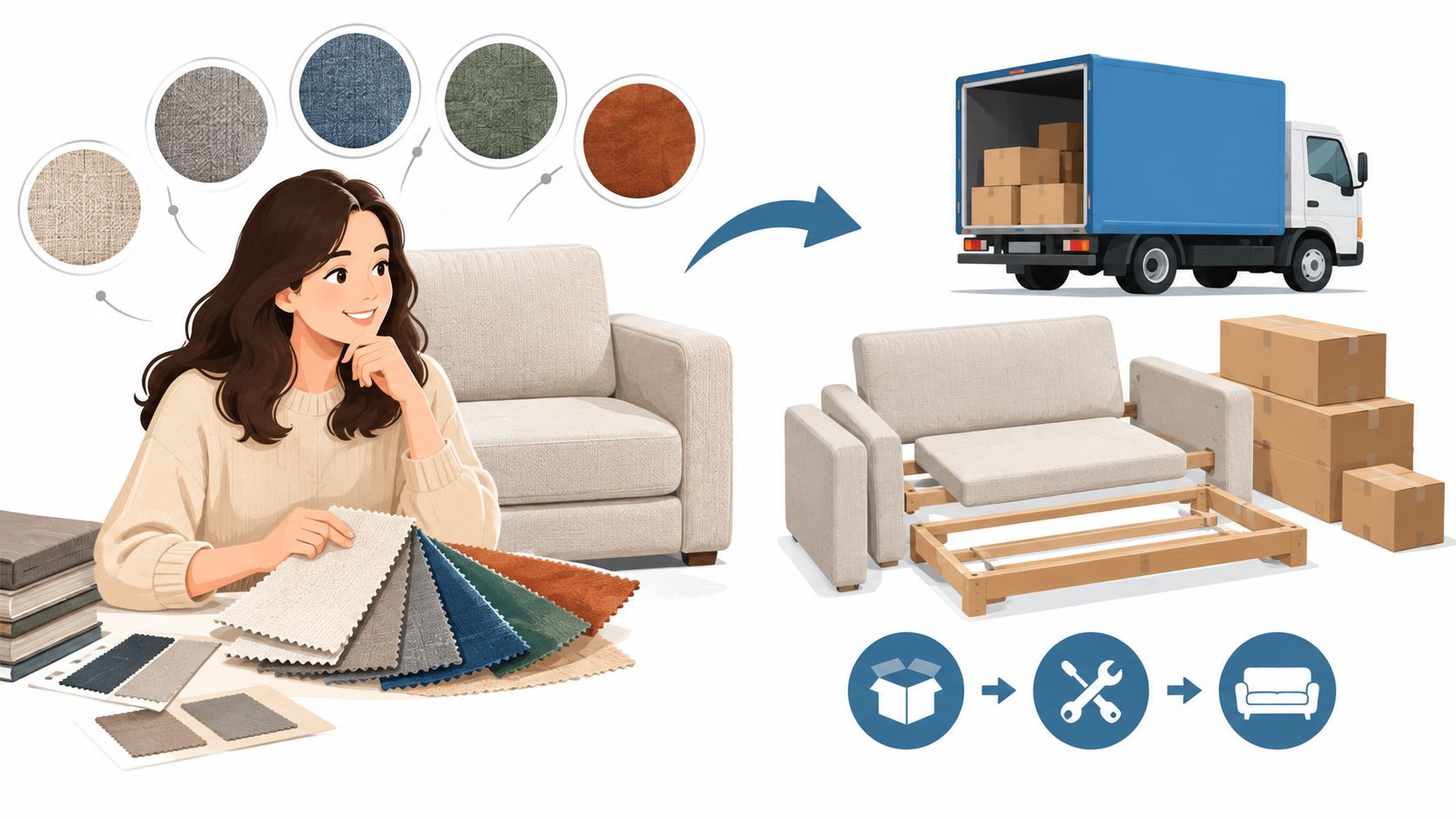
Upholstery affects the sofa's appearance, hand feel, cleaning routine, and long-term practicality. Fabric can offer a softer, more casual look, while leather creates a smoother surface that many households appreciate for everyday seating. Families should ask how each material responds to children, pets, sunlight, spills, and the amount of daily use the sofa will receive.
BILTRITE focuses on affordable, better-quality furniture, including USA-made, Amish-made, and solid-wood pieces. Those categories don't eliminate the need to inspect construction, but they give shoppers a useful starting point when comparing frames, upholstery, finishes, and custom choices. A guide to upholstery materials can help narrow the conversation before a showroom visit.
Delivery is part of the purchase
A beautiful sofa isn't useful if it can't get through the front door. Apartments, condos, older homes, narrow staircases, and tight turns can make a large reclining frame difficult to deliver. Shoppers should measure the full route, not just the doorway. The path includes the porch, entry door, hallway, corners, stairs, landings, and the room where the sofa will be assembled.
A come-apart sofa separates into manageable sections for delivery and reassembly. That can help households with tight doorways or challenging Metro Milwaukee floor plans without forcing them to give up a larger shared seating arrangement. The construction still needs evaluation, including how the sections connect, whether the hardware feels secure, and whether the reassembled frame sits level.
A wall-hugger example documents approximately 3 inches of wall clearance and lists operating depths of 53 inches in its first recline position and about 62 to 62.5 inches when fully extended, according to this wall-hugger product example. Those figures belong to that specific design, not every wall-hugger sofa. They demonstrate why shoppers should request both rear clearance and open-depth measurements for the exact model.
Match the material to the household
Ask these questions before choosing upholstery:
- Daily wear: Will the sofa serve as the main family seat, or occasional guest seating?
- Maintenance: Does the household prefer a material that can be wiped easily, or is regular fabric care acceptable?
- Touch and temperature: Does the material feel comfortable in both warm and cool conditions?
- Visual scale: Will a large sofa in a dark covering make a small room feel heavier?
- Delivery access: Can the chosen frame arrive in pieces, and does the delivery plan include reassembly?
The strongest choice balances style, comfort, maintenance, and logistics. A come-apart design can solve the doorway problem, but the sofa still needs to fit the room once assembled and fully reclined.
Experience the Comfort in Our Greenfield Showroom
A double reclining sofa is difficult to judge from a photograph. Pictures can't show whether the lumbar support lands in the right place, whether the footrest supports the heel, whether a control feels natural, or whether one seat moves too much when the other reclines. Those questions deserve a hands-on answer.
BILTRITE serves Greenfield and the wider Metro Milwaukee community with a broad selection for different homes and households. Small-scale furniture can help apartments, condos, smaller homes, and senior living spaces, while heavy-duty furniture can suit families seeking additional durability. The showroom also includes a large mattress department with over 60 models, along with living room, dining, bedroom, home office, entertainment, and home décor options.
Bring the household's real questions
Older adults and caregivers should pay particular attention to seat height, armrest position, standing clearance, and the return-to-upright movement. A 2025 recliner-design study found that many current designs fail to match older adults' physical dimensions, making in-person testing important for comfortable transfers, as discussed in this research on recliner design and older adults.
A practical showroom visit can include:
- Both users: Each person should sit in both seats, even if one seat appears identical to the other.
- Normal footwear: Shoes can change heel support and standing comfort.
- The actual controls: Each user should operate the manual lever or power controls without assistance.
- The room measurements: Bring the wall length, doorway width, open-depth limit, and walking-path dimensions.
- The delivery route: Discuss narrow turns, stairs, elevators, and whether a come-apart design may help.
BILTRITE's sales associates have over 400 years of combined experience and are available to answer questions without high-pressure sales tactics. The store is proud to be local, family-owned, and community-focused, and it doesn't sell online because the in-store experience gives shoppers the chance to sit, move, compare, and ask practical questions.
A comfortable decision takes time
The showroom is located at 5430 West Layton Avenue in Greenfield, Wisconsin. BILTRITE is closed on Sundays and Mondays to spend time with family, a choice that reflects the same family-first values many customers bring into their homes.
Visitors can compare manual and power mechanisms, explore fabric and leather choices, discuss USA-made and Amish-made furniture, and ask about solid-wood construction where it applies. In Wisconsin, power lift recliners are exempt from sales tax, which can make mobility-focused seating more affordable for eligible purchases. The team can also help shoppers consider whether a double reclining sofa supports both users or whether separate lift seating would better address transfer needs.
For location details, including showroom information, visit the BILTRITE locations page. A relaxed visit gives each household room to test comfort in a real way, measure carefully, and choose furniture that works beyond the first sit.
BILTRITE Furniture-Leather-Mattresses offers double reclining sofas, power and manual reclining seating, USA-made and Amish-made furniture, solid-wood pieces, small-scale options, heavy-duty furnishings, and a mattress department with over 60 models. Visit BILTRITE Furniture-Leather-Mattresses in Greenfield for a no-pressure, hands-on opportunity to test both seats, discuss delivery access, and find comfortable seating for the whole household.