Leather Furniture Upholstery: A Friendly Guide

A leather sofa can become the unofficial family calendar. It holds the Saturday-morning coffee, the after-school snack, the movie-night nap, and the quiet conversation that happens after everyone else has gone to bed. Then one afternoon, someone notices a faded arm, a split seam, or a cushion that no longer springs back.
That moment usually brings a phone search and a larger question: does the furniture need better care, a professional repair, new upholstery, or a complete replacement? The answer depends on the leather, the household using it, and the condition of the frame beneath it. Leather furniture upholstery can be a long-term investment, but only when the material and maintenance plan fit real family life.
Table of Contents
- When Your Favorite Leather Piece Starts Telling Its Age
- Getting to Know the Leather Quality Ladder
- Matching Leather Types to Real Family Life
- A Simple Care Routine That Actually Works
- Repair, Reupholster, or Replace
- Choosing a Local Upholsterer You Can Trust
- Bringing It All Together for Your Home
When Your Favorite Leather Piece Starts Telling Its Age
The first signs of wear rarely arrive all at once. A recliner may look lighter where afternoon sun reaches it. A sofa cushion may feel flatter on one side because the same person always sits there. Dining chairs may show darkened areas where hands and clothing touch the leather every day.
Those changes don't automatically mean the piece has failed. Leather behaves a little like a favorite pair of boots. A good pair can be cleaned, conditioned, repaired, or resoled when the rest of the boot still has life. Furniture works much the same way. A surface problem may be manageable, while a weak frame or failed support system can change the calculation.
A useful first question: Is the damage mostly on the surface, or does the furniture feel structurally tired?
Homeowners often see peeling and assume every leather problem has the same cause. It doesn't. Peeling may involve a synthetic coating separating from its backing, while cracking represents physical damage to the leather itself. The distinction matters because the repair method, expected result, and cost decision can differ. A plain-language guide to why leather couches peel can help identify what the eye is seeing before a repair estimate is requested.
Four decisions make the process clearer
First, identify the leather type and finish. Aniline, semi-aniline, pigmented, corrected, and bonded materials don't respond identically to sunlight, spills, cleaners, or daily friction.
Second, look at the use pattern. A quiet reading chair has a different job from a sectional in a home with children, pets, and constant snacks. The right choice isn't the one that looks most impressive under showroom lighting. It's the one that suits the household's ordinary Tuesday.
Third, match the care routine to the finish. Some leather needs careful prevention because its open surface absorbs liquids easily. Other leather has more protection and can handle practical wiping, though it still needs sensible treatment.
Finally, decide whether to repair, reupholster, or replace. That decision should consider the frame, cushions, springs, design, sentimental value, and total project cost, not just the appearance of one damaged panel.
Leather has been part of furniture history for a long time. Upholstered seating using animal skins and dressed leather dates back to ancient Egypt, and chromium salt tanning was patented in 1884, a development that helped make leather softer, more colorful, and more suitable for broader upholstery production, as described in this history of the leather furniture market. The material has lasted because it can combine comfort, character, and useful service life, but the specific hide and finish still matter.
Getting to Know the Leather Quality Ladder
Leather grades make more sense when shoppers picture a ladder rather than a collection of confusing sales terms. At the upper rung, the hide keeps more of its natural surface. Lower rungs involve more splitting, correction, coating, or combining with other materials.
The ladder is useful, but it isn't a promise of quality by itself. Construction, tanning, finish, stitching, cushion support, and care all influence how leather furniture upholstery performs. Price also varies by design and construction, so the ranges below are best treated as broad positioning rather than a quote.
The upper rungs keep more of the hide's character
Full-grain leather uses the outer surface of the hide with the grain largely intact. Natural markings and color variation may remain visible. It usually offers a rich hand feel and can develop patina with use, but it also asks more from the household because a less-covered surface is more exposed to stains, light, and changing appearance.
Top-grain leather comes from the upper portion of the hide, though the surface may receive light correction or finishing. It generally balances a natural feel with more consistent appearance. Many households choose it when they want genuine leather character without as much visible variation.
Split-grain leather comes from layers beneath the top grain. It may be finished or coated to create a consistent appearance, but the underlying structure has less of the original grain's natural strength and character. Its position and performance depend heavily on the finish and construction.
The lower rungs emphasize appearance or affordability
Corrected-grain leather has a surface that has been mechanically corrected and then finished for a more uniform look. That can make color and texture predictable, but it also means the material's natural surface has been altered. It often sits below full-grain and top-grain pricing.
Bonded leather combines leather fibers with a backing and surface coating. It can offer a leather-like appearance at a lower price, but it isn't leather in the traditional sense of a continuous hide. Buyers should ask direct questions rather than assume that every product using the word leather has the same material makeup.
| Grade | Hide Source | Durability | Best Fit |
|---|---|---|---|
| Full-grain | Natural outer hide surface | Strong potential with attentive care | Quiet rooms, heirloom-minded buyers, patina lovers |
| Top-grain | Upper hide, often lightly corrected or finished | Balanced everyday performance | Households wanting comfort and a more even appearance |
| Split-grain | Lower hide layer | Depends strongly on coating and construction | Value-focused rooms with moderate use |
| Corrected-grain | Corrected surface over upper hide | Practical, finish-dependent performance | Busy rooms seeking consistent color and texture |
| Bonded | Leather fibers combined with backing and coating | More limited long-term expectations | Short-term or tightly budgeted furnishing |
The difference between top-grain and full-grain leather comes down to more than a label. A shopper should feel the surface, ask how it was finished, and learn what care the seller recommends. A lower rung isn't automatically wrong. It may be the honest fit for a smaller budget or a room with a shorter furnishing timeline.
Matching Leather Types to Real Family Life
Leather should be selected like tires for a daily route. A smooth performance tire may be a fine choice on clean pavement, while a different tread makes more sense on rough roads. Furniture faces its own roads: juice spills, dog claws, direct sun, sticky hands, work-from-home lunches, and years of quiet reading.
Busy rooms need forgiveness
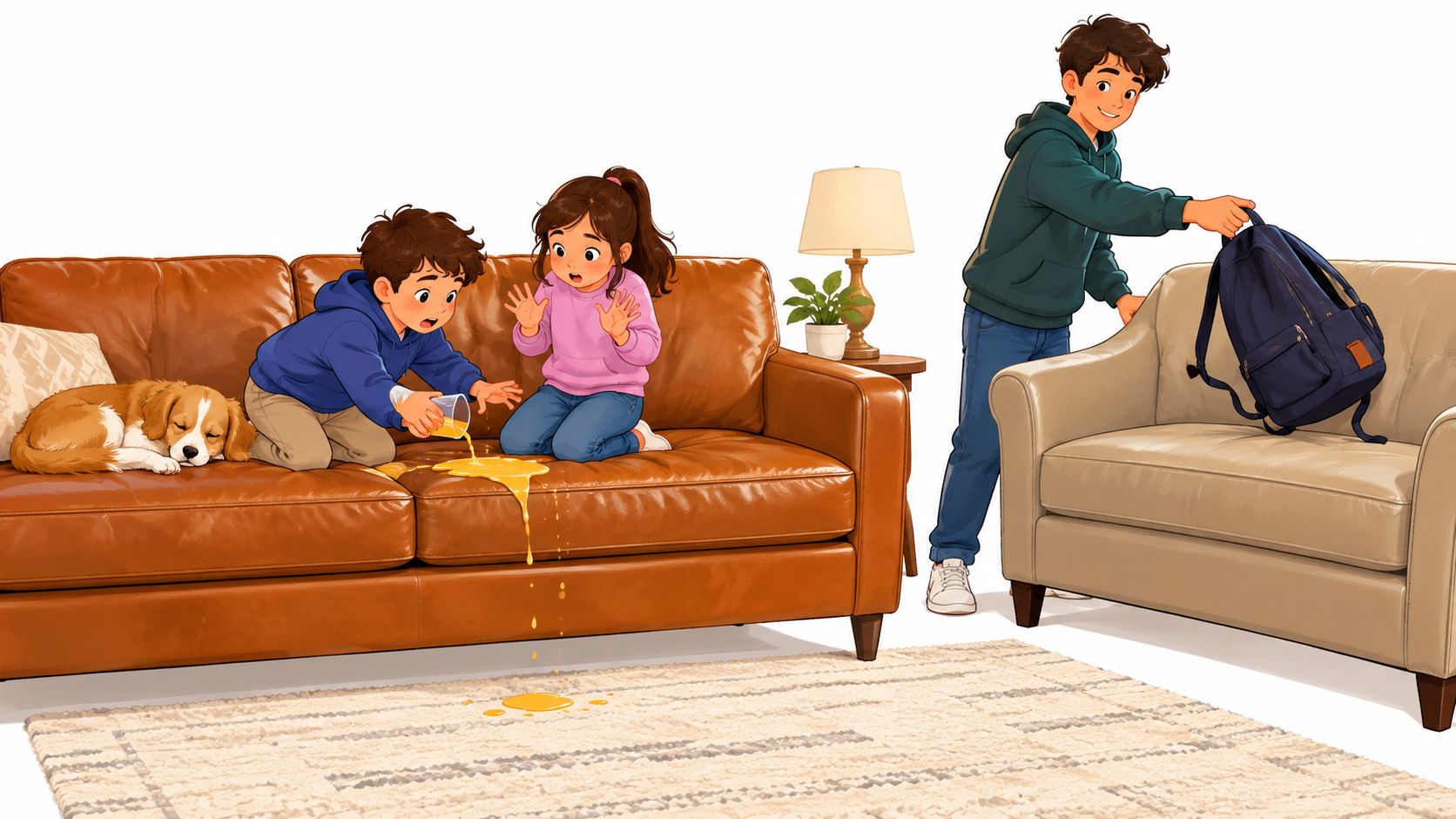
A household with children, pets, and frequent snacks usually benefits from a more protected finish. Pigmented leather has a stronger surface coating, which can make everyday wiping more practical. Protected top-grain or corrected-grain options may suit a family room where people aren't expected to sit perfectly still or carry every drink to the kitchen.
Semi-aniline leather adds a thin protective coating while preserving more of the soft, breathable character associated with less-covered leather. That places it between highly natural aniline and more heavily protected pigmented finishes. The trade-off is straightforward: more protection generally improves cleanability and resistance to fading, while less protection preserves a more natural feel but leaves the surface more vulnerable.
Aniline leather has no surface protection. Its pores remain open, so it feels soft and breathable, but it has greater risk from stains and light exposure. Guidance on leather types, characteristics, and maintenance notes that aniline leather can show slight color variation and should be kept away from direct sunlight because exposure can cause fading and other surface changes.
Quiet rooms can celebrate natural change
A reading nook, study, or formal sitting room may be a comfortable home for full-grain aniline leather. In that setting, the owner may welcome gradual patina, natural markings, and small changes in color. The room's lower traffic gives the material a better chance to age gracefully, provided sunlight and spills remain under control.
A rental, first apartment, or temporary living arrangement may call for a different compromise. Bonded leather can be considered as a short-term budget choice, as long as the buyer understands its construction and doesn't expect it to behave like a full hide over a long family timeline.
The honest match: Choose the leather that fits the household behind the showroom photo, not the household imagined for the brochure.
Color matters, too. Darker protected finishes may make daily marks less noticeable, while pale or highly natural leather can make variation part of the design. A local showroom lets shoppers compare these differences by hand, which is far more useful than judging a finish from a small screen image.
A Simple Care Routine That Actually Works
Leather care doesn't need to become a weekend project. The most useful routine removes grit, addresses spills quickly, limits damaging exposure, and follows the care instructions for the specific finish.
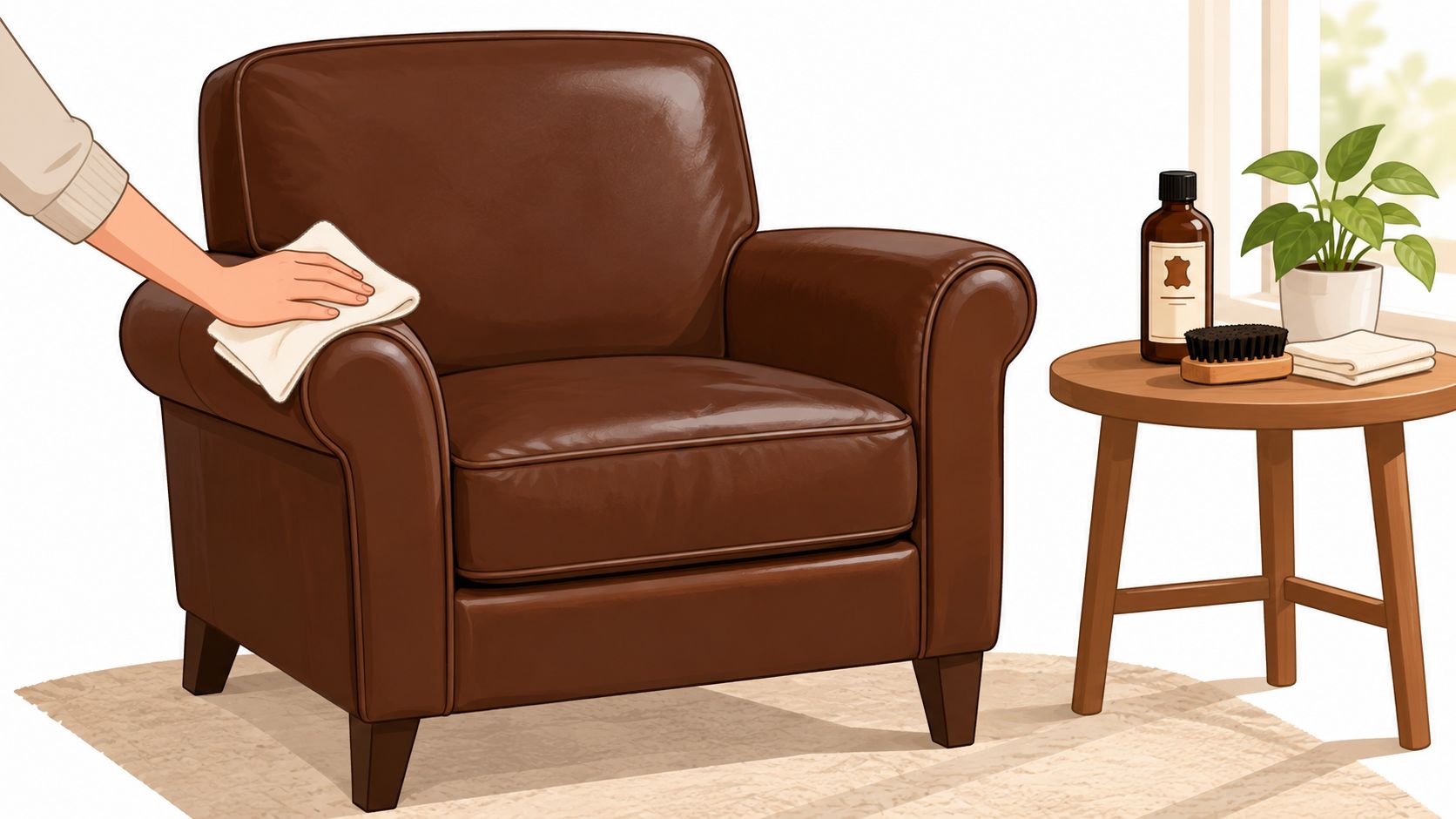
Start with the household's most common contact points. Arms, seat fronts, headrests, and cushion seams collect body oils and dust faster than untouched back panels. Leather service guidance recommends vacuuming weekly with a soft brush nozzle and avoiding saddle soaps, solvents, polish, oils, detergents, and abrasives, as explained in this leather furniture care guide.
A practical rhythm for busy homes
Each week, vacuum seams and cushions with a soft brush attachment. Follow with a gentle dry-cloth dusting where appropriate. If a spill happens, blot it promptly rather than rubbing it deeper into the surface. A damp cloth or mild soap-and-water method may be suitable for some finishes, but open leather needs extra caution.
During regular monthly upkeep, inspect high-contact areas for dullness, stickiness, darkened oils, or small scuffs. Use only a cleaner recommended for the furniture's leather type, and test an inconspicuous area first. A small amount of product is safer than soaking the surface.
With seasonal checks, look at fading near windows, dryness near heating vents, loose stitching, and cushion shape. Keep leather away from direct sun and strong heat. One leather-service recommendation advises keeping leather at least 2 feet from heat sources and conditioning 3 to 4 times per year, while another maintenance sheet advises keeping leather 30 cm away from heat. Because guidance varies by finish and product, the furniture's care instructions should take priority.
Mistakes that create bigger problems
Household sprays, baby wipes, solvents, abrasive products, and heavy water application can leave residue, strip finish, or push moisture into seams. Saddle soap, polish, oils, and ordinary detergents can also be unsuitable for upholstery leather.
Professional or periodic cleaning may be the safest choice for some pieces. A major retailer's upholstery care brochure states that periodic professional upholstery cleaning is its only recommended cleaning method for upholstery and warns that sunlight and heat can fade leather or reduce its soft feel. The core habit is simple: identify the finish before choosing the cleaner.
Repair, Reupholster, or Replace
A damaged leather chair can make every option sound urgent. It helps to separate the visible material from the furniture's bones. A surface scuff, split seam, or flattened cushion may be a focused repair. Worn leather over a sound frame may justify reupholstery. Sagging support or failed springs may point toward replacement.
Repair keeps a fundamentally sound piece in service
Repair is usually the sensible path when the damage is limited. Examples include small scuffs, seam splits, cushion refilling, and color touch-ups. These jobs often sit in the lower hundreds and may have a turnaround under two weeks, but the exact quote depends on the material, access, color matching, and shop workload.
The strongest repair candidates still feel solid when someone sits down. The frame shouldn't wobble, the mechanism should work as intended, and the cushions should be capable of restoration. A sentimental chair may also justify a careful repair even when a strictly financial calculation would point elsewhere.
Reupholstery changes the skin while preserving the body
Reupholstery makes sense when the frame and support remain sound but the leather is worn, faded, stained, or visually dated. The work can involve removing old upholstery, choosing new hides, cutting panels, sewing, rebuilding cushions, and fitting the material around arms, backs, and moving parts.
Costs commonly land in the four-figure range, with timelines often running 3 to 6 weeks, depending on shop workload and project complexity. The furniture's design can make a major difference. A simple chair may be more straightforward than a large sectional with fixed cushions and mechanical components.
A discussion of leather furniture restoration can help owners understand the difference between cleaning, recoloring, repair, conditioning, and a full upholstery project before requesting estimates.
Replacement starts with structure and math
Replacement deserves consideration when the frame is sagging, springs have failed, mechanisms are unreliable, or a repair quote climbs beyond half the cost of new furniture. Sentimental value can change the answer, but the owner should understand that new leather over a compromised frame won't solve the underlying problem.
| Option | Best When | Typical Cost | Typical Timeline |
|---|---|---|---|
| Repair | Damage is limited and the frame remains sound | Lower hundreds | Often under two weeks |
| Reupholstery | Frame is solid but leather is broadly worn | Four-figure range | Commonly 3 to 6 weeks |
| Replacement | Structure or support has failed, or repair exceeds half the cost of new | Depends on selected furniture | Depends on availability and delivery |
These figures are decision signals, not promises. A local professional should inspect the piece, explain the line items, and distinguish cosmetic improvement from structural restoration.
Choosing a Local Upholsterer You Can Trust
Leather upholstery is skilled hands-on work. The right shop should be comfortable discussing hides, finishes, seams, cushion interiors, frame condition, and the limits of the proposed repair. A general fabric shop may do excellent work, but leather requires specific cutting, handling, sewing, and color knowledge.
Questions worth asking before the work begins
A useful conversation should cover practical details, not just a total price.
- Leather sourcing: Does the shop source hides directly, and can it explain the finish and expected variation?
- Sewing responsibility: Who cuts and sews the leather, and is that work completed in-house?
- Warranty terms: What workmanship or material warranty is included, and what does it exclude?
- Past projects: Can the shop show work-in-progress photos or finished examples involving similar furniture?
- Written scope: Does the estimate list removal, materials, cushion work, frame work, delivery, and other charges separately?
- Timeline: What could change the completion date, and when will the shop communicate delays?
Red flags deserve attention
A vague quote can create confusion later. If the estimate doesn't identify what the customer is paying for, comparison becomes difficult. No written timeline is another concern, especially when the shop has not explained how workload, material availability, or design complexity affects completion.
Reluctance to show examples doesn't prove poor workmanship, but it gives a shopper less evidence to evaluate. A trustworthy craftsperson should be willing to explain what the finished result can and can't achieve. Leather with severe sun damage, deep cracking, or failed backing may not return to a factory-new appearance through a simple treatment.
The showroom visit still matters
Swatches reveal differences that photographs hide. One leather may feel soft and natural, another may feel more sealed and uniform, and a third may show markings that become part of its character. Sitting in the furniture also exposes cushion support, seat depth, arm height, and frame movement.
BILTRITE Furniture-Leather-Mattresses offers custom leather upholstery choices in its Greenfield showroom, giving shoppers a place to compare leather selections and discuss how a piece will be used. The same common sense applies when choosing any craftsperson working on furniture inside a home: the shop should answer clearly, document the plan, and treat the furniture with care.
Bringing It All Together for Your Home
The clearest decision path starts with the piece already in front of the household. A faded arm on a sound chair leads to a different answer than a sofa with sagging support. A protected leather in a busy den calls for a different routine than open aniline leather in a quiet reading nook.
A household-first decision path
Identify the material. Check the purchase documents, care label, or service records. If the leather type is unknown, ask a qualified furniture professional before applying cleaner or conditioner.
Study the room. Note direct sun, heating vents, fireplaces, food and drink habits, pets, children, and the areas everyone touches. The room's conditions often explain why one panel aged differently from another.
Match protection to behavior. Busy family rooms generally need a finish that tolerates practical cleaning. Quieter spaces may support a more natural leather if the household accepts visible variation and gradual patina.
Inspect the structure. Sit in every seat, check cushion recovery, test reclining or moving parts, and look for frame movement. Cosmetic wear is easier to justify than structural failure.
Choose the intervention. Limited damage may call for repair. Broad surface wear on a strong frame may justify reupholstery. Failed support or an uneconomical quote may make replacement more sensible.
Select the craftsman carefully. Ask about materials, sewing, warranty, examples, written scope, and timing. A clear conversation protects both the furniture and the household budget.
Furniture sustainability also needs this whole-system view. Industry discussions now consider repairability, recycling, and end-of-life handling rather than relying only on broad environmental labels. One supplier describes its leather as 100% post-consumer recyclable, another states that genuine leather is biodegradable within 50 years, and a furniture-industry white paper explains that recycling upholstered furniture components can be labor-intensive and costly, as summarized in this leather sustainability FAQ. Those claims don't answer every question because the complete upholstery system includes leather, backing, foam, adhesives, stitching, and frame construction.
A standards-based question can improve the buying conversation. EN 13336:2022 covers furniture upholstery leather including aniline, semi-aniline, nubuck or suede, and coated or pigmented leathers, while excluding furs, hair-on, and wool-on leathers. It also provides guidance on test methods, recommended performance values, sampling, and conditioning procedures for furniture upholstery leather, according to this furniture leather upholstery standard overview.
For abrasion, the Martindale method under ISO 17076-2:2011 uses a ball-plate setup and inspections at 100-rub intervals. Its endpoint is finish breakdown, with leather fibers visible, and the reported result counts the rubs needed to reach four or more breakdown points, as detailed in this ISO leather abrasion method. Higher resistance generally indicates better performance in high-contact areas such as cushions and armrests, giving buyers a more useful benchmark than an unsupported “heavy duty” label.
The final answer should feel comfortable and honest, not merely impressive in a showroom. The right leather furniture upholstery choice depends on the leather in front of the shopper, the household behind it, and the timeline and budget available.
BILTRITE Furniture-Leather-Mattresses has served Greenfield and Metro Milwaukee as a fourth-generation family-owned store since 1928, with leather selections, custom upholstery options, USA-made and Amish-made furniture, and a team with over 400 years of combined experience. Visit BILTRITE Furniture-Leather-Mattresses in Greenfield to feel the leather swatches, sit in the furniture, and talk through care, restoration, or replacement with a helpful local team.