USA Made Wood Furniture: A Buyer’s Guide to Real Value


A Saturday morning furniture search can turn into a surprisingly big decision. A Milwaukee family may be comparing a fast-shipped online import with a heavier American-made dining table that costs more upfront. Both may look attractive in a photograph, but the questions are less flashy: What is the table made from? Who built it? How were the joints assembled? Can the seller explain where the materials came from?
That's the practical value of learning how to evaluate USA-made wood furniture. The goal isn't to choose based on a flag or a slogan. It's to understand origin, construction, materials, safety documentation, repairability, and the total cost of owning the piece. Those details help a family choose furniture that fits the home today and continues serving it years from now.
Table of Contents
- Why USA Made Wood Furniture Matters Right Now
- What “Made in USA” Actually Means
- Common Woods and Finishes You Will See
- How to Spot Quality Craftsmanship
- Solid Wood vs Engineered Wood
- Pricing and Long Term Value
- Caring for Solid Wood Furniture
- Shopping the BILTRITE Showroom
Why USA Made Wood Furniture Matters Right Now
The family in that Milwaukee living room has a genuine tradeoff. The imported table may arrive quickly and carry a lower sticker price. The domestic table may have a more traceable supply chain, sturdier construction, and a local seller who can answer questions face to face.
That transparency matters because “made in the USA” involves more than patriotic feeling. A shorter, clearer supply chain can make it easier to ask where the lumber was milled, which parts are solid wood, who assembled the piece, and what happens if a drawer loosens or a finish needs attention. Domestic manufacturing also places the seller closer to the people responsible for design, construction, and quality checks.
The U.S. furniture industry has changed significantly. USDA Forest Service research found that the U.S. trade imbalance in wood household furniture widened by nearly 400% during the 1990s, moving from -$1.9 billion in 1990 to -$7.3 billion in 2000. Imports rose from $2.38 billion in 1989 to $8.31 billion in 2000, reaching 53% of domestic production by 2000. The same research found that real domestic production fell 51% between 2000 and 2009, while U.S. wood household furniture shipments were 48% below 2000 levels by 2019. These figures come from the USDA Forest Service analysis of the wood furniture industry.
Origin creates useful questions
A domestic piece doesn't automatically guarantee excellent craftsmanship. A shopper still needs to inspect the furniture. Origin gives the buyer a stronger starting point for questions about labor, materials, compliance, repairs, and accountability.
Domestic workshops may also purchase hardwood from regional sawmills, connecting furniture production with local forestry and manufacturing work. That relationship won't look identical for every maker, so shoppers should ask rather than assume.
Practical rule: Treat the country-of-origin claim as an invitation to verify the supply chain, not as a substitute for inspecting the furniture.
This guide gives shoppers a practical path. The key checkpoints are label language, wood species, finish, joinery, engineered components, care requirements, and long-term value. BILTRITE also shares more detail in its guide to the advantages of buying furniture made in the USA, especially for shoppers who want to compare local service with the uncertainty of a distant transaction.
What “Made in USA” Actually Means
The Federal Trade Commission sets a demanding standard for an unqualified “Made in USA” claim. The product must be made in the United States with “all or virtually all” of its content originating domestically, including significant components and processing. The FTC explains the standard in its guidance on complying with the Made in USA standard.
A simple way to think about the rule is to picture the finished furniture as a cost-and-labor pie. The wood, hardware, finish, upholstery, assembly, and major processing each represent slices. For an unqualified claim to be appropriate, virtually all of the meaningful slices should come from U.S. sources or work.
That doesn't mean every screw or small accessory must be domestic. It does mean a major imported component shouldn't be hidden behind a broad, unqualified claim. A piece assembled in the United States from substantial foreign components needs more precise wording.
Read the words, then ask a follow-up
A qualified statement such as “Made in USA of domestic and imported parts” tells shoppers that some content comes from outside the country. Phrases such as “designed in America,” “American style,” or “built for American homes” describe design or intended use, not manufacturing origin.
The Federal Trade Commission's household-furniture guidance also says that foreign origin must be disclosed clearly and conspicuously when it applies. Its household furniture origin guidance gives businesses a framework for avoiding misleading origin claims.
| Label Claim | What It Actually Means | Buyer Confidence |
|---|---|---|
| Made in USA | The product must be all or virtually all made in the United States | Strong, if the seller can explain the claim |
| Made in USA of domestic and imported parts | U.S. manufacturing is disclosed, along with imported content | Useful, but ask which parts are imported |
| U.S. assembled | Final assembly occurred in the United States | Limited, because components may come from elsewhere |
| Designed in America | The design connection is domestic | No manufacturing guarantee |
| American style | A style description only | No origin guarantee |
A retailer should be able to explain what the label covers. Shoppers can ask whether the frame, drawers, panels, hardware, finish, and upholstery were made domestically. BILTRITE's guide to furniture made in the USA offers another helpful starting point for understanding how shoppers can evaluate these claims.
Common Woods and Finishes You Will See
Wood species shape the furniture's appearance, feel, weight, and expected service. Finish affects how that wood handles daily use. A useful showroom conversation connects both choices to the room, the household, and the budget.
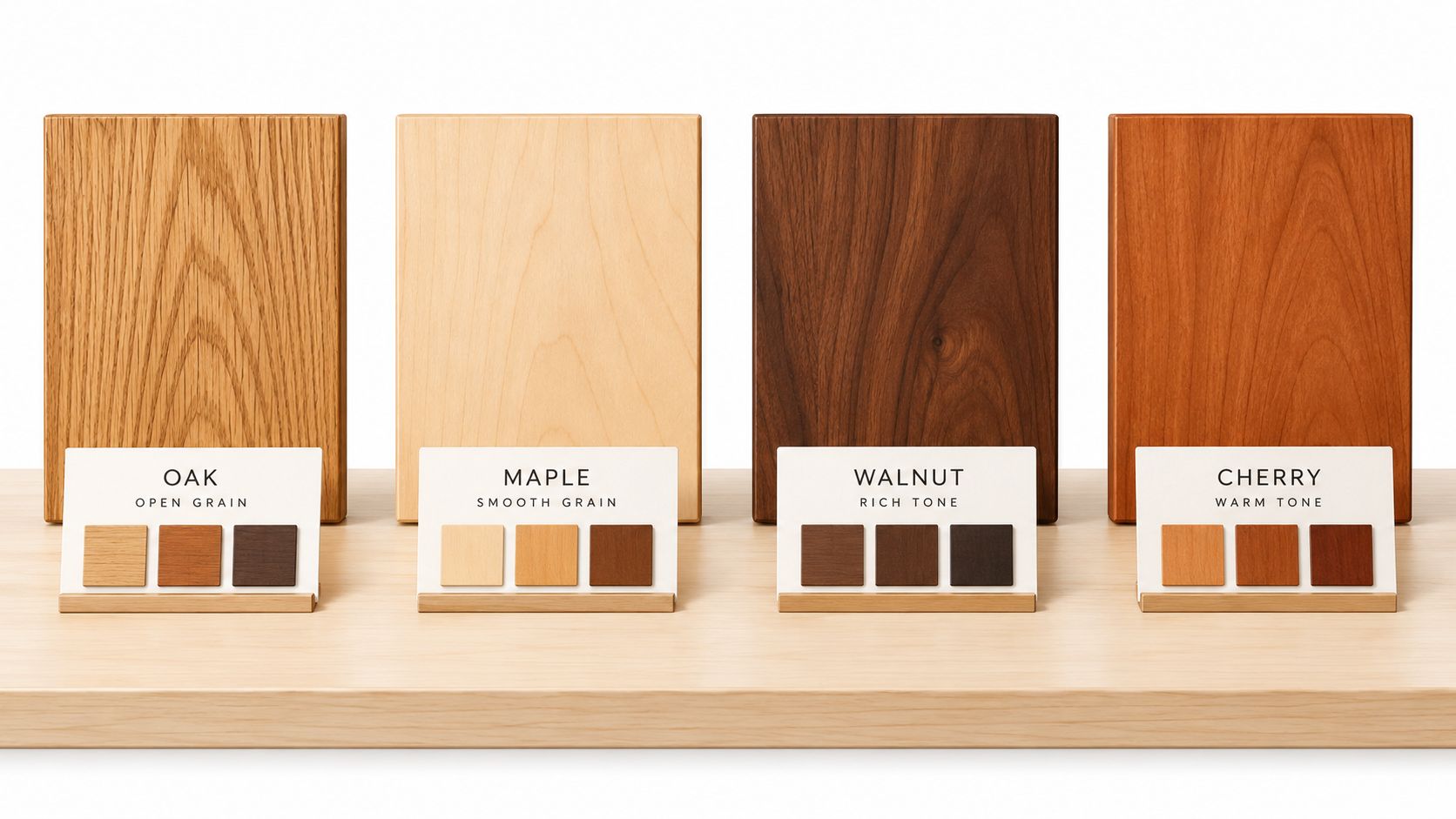
Hardwood character at a glance
Oak has an open grain and a reputation for handling active households. Its visible grain works well in traditional, rustic, and transitional rooms, and it often provides a practical balance between durability and price.
Maple and beech have tighter, smoother grain patterns. Their cleaner surfaces suit modern designs and painted furniture, especially when a homeowner wants a less visibly textured appearance.
Walnut brings deep brown and chocolate tones. It's often chosen for statement tables and heirloom-style pieces where the natural color does much of the decorating.
Cherry starts with a lighter warm tone and develops a richer reddish patina as it receives light. That gradual change is part of its appeal, though shoppers should expect the finish to evolve.
Ash offers a lighter appearance with noticeable grain. It can provide some of the visual flexibility associated with oak while creating a brighter overall look.
Rustic pine and parawood can be sensible choices for budget-conscious rooms or pieces where a softer surface is acceptable. Softer woods may show dents and wear sooner, which isn't necessarily a defect. It's a matter of matching the material to the way the furniture will be used.
Finishes change the maintenance conversation
Oil and wax leave a natural-looking surface and can make small repairs approachable. Conversion varnish and lacquer create a more sealed, durable finish. Painted milk-paint and enamel support farmhouse and cottage styles, while catalyzed finishes are designed for especially demanding use.
The right choice depends on the household. A formal sideboard may prioritize a rich finish and easy dusting. A busy dining table may need a more protective surface. BILTRITE's guide to choosing the right hardwood for longevity and style can help shoppers connect wood selection with design and everyday care.
A showroom sample is useful, but it isn't the whole answer. Buyers should ask whether the finish is intended to show natural variation, how it reacts to spills, and whether the maker recommends a specific cleaning routine. A beautiful species with a finish that doesn't suit the household can become a frustrating choice.
How to Spot Quality Craftsmanship
Quality becomes easier to judge once shoppers stop looking only at color and silhouette. A well-built piece usually reveals itself through weight, stability, joinery, fit, hardware, and finish consistency.
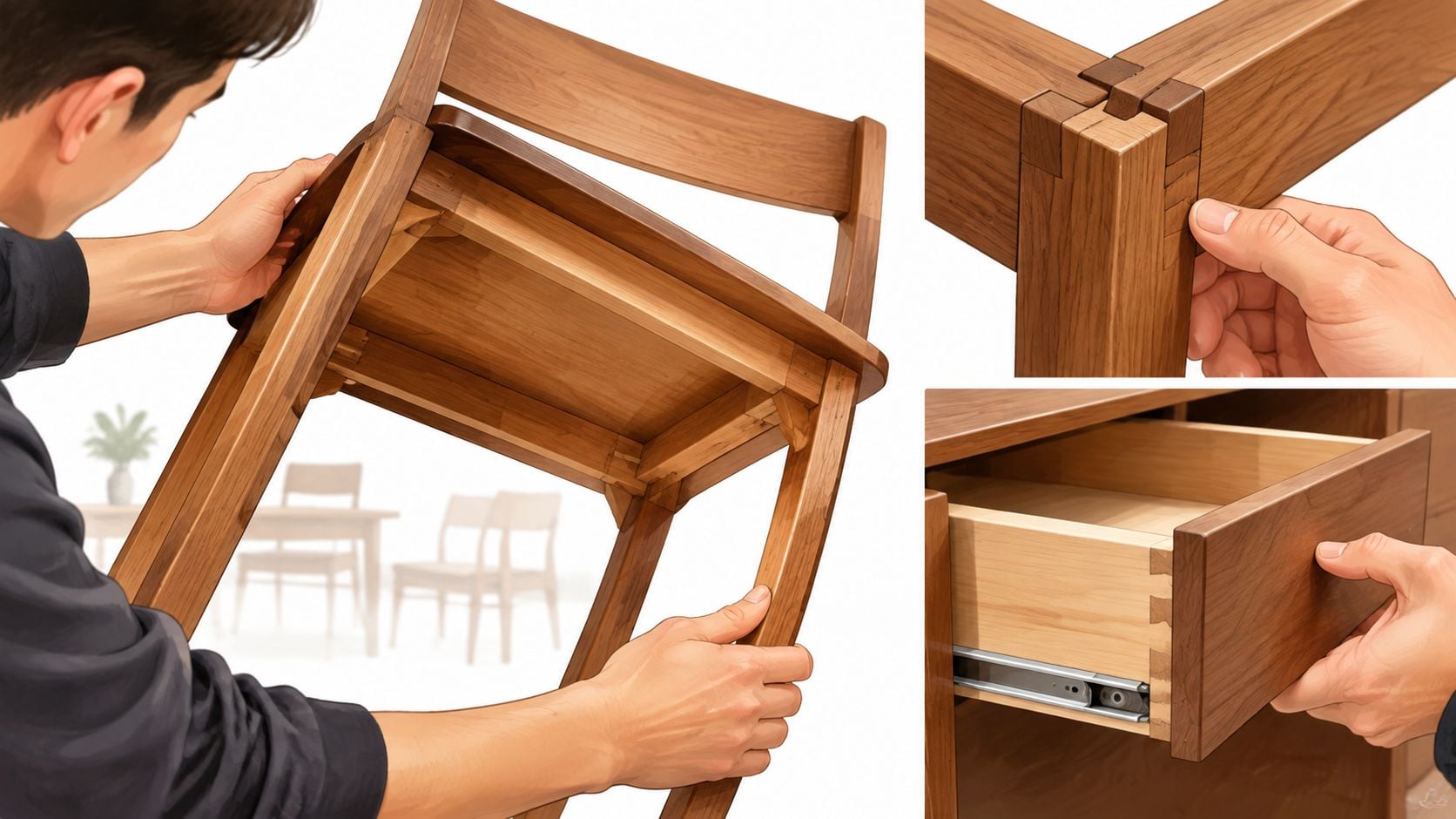
Start with the frame. A shopper can gently tip a chair or sofa, when the staff says it's safe to do so, and check whether the structure feels solid or hollow. A dining table should sit firmly on the floor, with no rocking caused by loose connections or uneven construction.
Inspect the joints first
Woodworking guidance emphasizes joint design and execution as major indicators of build quality. Industrial wood-engineering guidance commonly recommends increasing glued joint surface area to about 10 times the member cross-sectional area, because wood is roughly 10 times stronger in tension than in shear. The technical explanation and practical joinery examples appear in this Fine Woodworking joinery guide.
In plain language, a joint needs enough long-grain contact and mechanical strength to handle repeated movement. Mortise-and-tenon, dovetail, doweled, and bridle joints generally provide more meaningful connection than a simple butt joint held by a few fasteners.
Look closely at drawers. Dovetails should fit tightly, with clean pins and tails rather than rough gaps. Frame corners should show thoughtful construction, not merely screws driven into end grain. BILTRITE's page on dovetail joint furniture gives shoppers a focused look at why drawer joinery deserves attention.
Use hands, eyes, and a little movement
Run a hand along panel seams. Even gaps, flush edges, and consistent grain direction suggest careful fitting. Open drawers fully and test the glides. Full-extension and soft-close hardware can signal attention to the rest of the piece, though hardware should still feel smooth and secure rather than being judged by one feature alone.
Check the underside and back. Sanded surfaces, finished edges, and clean panel installation show that the maker considered areas customers may not notice immediately. If the piece contains MDF, particleboard, or other composite components, look for evidence of TSCA Title VI compliance. Under TSCA Title VI, regulated composite wood used in finished furniture sold or manufactured in the United States must meet formaldehyde emission standards, and products made or imported after March 22, 2019, must be certified and labeled by a recognized third-party certification body. The solid wood furniture guide covering TSCA Title VI compliance explains why panels, drawer bottoms, and back components deserve attention.
Finally, sit, lean, and move naturally. Furniture intended for family use should feel stable under ordinary pressure. A showroom test can't predict every future repair, but it can expose wobble, squeaks, loose hardware, and uncomfortable proportions before delivery.
Solid Wood vs Engineered Wood
A label that says “wood furniture” doesn't necessarily mean every part is solid wood. Buyers should ask which components use solid boards, plywood, MDF, particleboard, or veneer because each material behaves differently.
Solid wood comes from a board cut from a tree. It can often be sanded, repaired, and refinished, although movement from changes in moisture still needs to be respected. Plywood consists of thin wood veneers bonded in alternating directions, which gives it useful stability and strength for cases, shelves, and structural parts.
MDF, or medium-density fiberboard, is made from fine wood fibers bonded into a dense panel. It machines cleanly and accepts paint well, but moisture can cause swelling, and it generally can't be refinished like a solid board. Particleboard uses compressed wood chips, making it light and affordable, though exposed edges can chip and fastener holding can be less forgiving.
Veneer is a thin slice of real wood attached to a substrate. It can provide an attractive, consistent surface at a lower cost, but its refinishing options are more limited than those of solid wood.
| Material | Strength | Can Be Refinished | Moisture Resistance | Typical Price |
|---|---|---|---|---|
| Solid wood | High when properly designed and joined | Usually yes | Can respond to moisture changes | Higher |
| Plywood | Strong and dimensionally stable | Sometimes, depending on the surface | Better stability than many fiber panels | Mid-range |
| MDF | Smooth and stable when kept dry | Generally no | Vulnerable to swelling when wet | Lower to mid-range |
| Particleboard | Light, with more vulnerable edges | No | Poor when exposed to moisture | Lower |
| Veneer over substrate | Depends on the substrate | Limited | Depends on the substrate and finish | Mid-range |
The practical question isn't whether engineered wood is automatically bad. Plywood can be an excellent material in the right location. The better question is whether the material matches the load, moisture exposure, and expected lifespan.
Pricing and Long Term Value
A furniture price tag tells only part of the story. A lower-cost piece may make sense for a temporary room, a short-term need, or a space where heavy wear isn't expected. A solid wood table, dresser, or bed may deserve a different calculation because it can potentially be repaired, refinished, and kept in service rather than replaced.
Consider a simple example. A $1,200 dining table used for 25 years averages about $48 per year, while a $400 import replaced three times across the same span also averages about $48 per year. The arithmetic is based only on purchase prices and time. It doesn't include moving, reassembly, delivery, disposal, repairs, or the frustration of finding a replacement when a family needs the room every day.
Durability changes the ownership equation
Solid wood can often accept a new finish after years of use. A loose joint may be re-glued. A dent can sometimes be patched or blended. Those options give a homeowner more choices than discarding the piece.
Engineered panels have their place, but extensive swelling, crumbling edges, or stripped fastener holes can be difficult to restore. A lower initial price may still be reasonable when the use is light. For a dining table that anchors family meals, a bed used nightly, or a dresser opened constantly, repairability carries real value.
A durable piece doesn't need to be the most expensive item in a room. It needs to make sense for the work the household expects it to do.
Domestic manufacturing also keeps more of the production relationship within the U.S. supply chain and may make communication about repairs, replacement parts, and documentation easier. That doesn't make every domestic piece superior, and it doesn't make every imported piece unsuitable. It gives shoppers another factor to weigh alongside construction and price.
Tariffs add another layer to the conversation. Recent federal actions described new duties beginning at 10% for softwood lumber and 25% for certain upholstered furniture, cabinets, and vanities, with some increases scheduled later. The rates and product categories should be checked against the White House fact sheet on timber and derivative-product imports. Shoppers should ask whether pricing or lead times reflect imported components instead of assuming that country of assembly tells the whole story.
Caring for Solid Wood Furniture
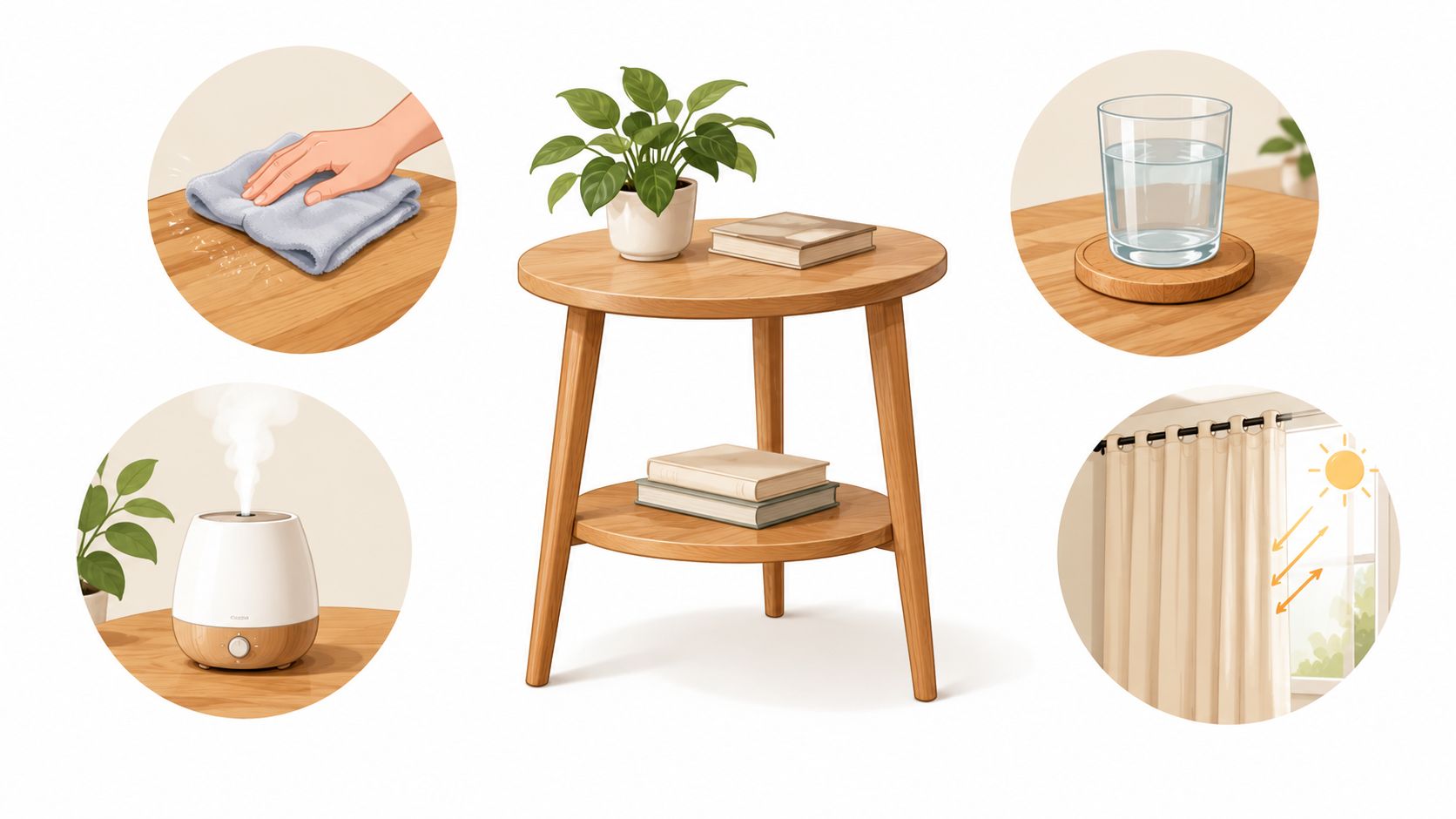
Solid wood responds to its environment. The three concerns that deserve the most attention are dryness, changing moisture levels, and direct heat or sunlight. A few simple habits can protect the finish and reduce stress on joints and panels.
Keep the routine simple
For weekly care, remove dust with a soft, dry cloth. If the surface needs more cleaning, use mild soap mixed with water on a lightly damp cloth, then dry the area promptly. Ammonia and silicone polishes can create problems for some finishes, so they shouldn't become automatic choices.
Use coasters under drinks, felt pads under décor, and placemats or a tablecloth during messy projects and meals. Felt pads should be checked occasionally because trapped grit can scratch a finish while an object moves.
Indoor humidity between 35% and 55% helps limit excessive drying and moisture swings. A household hygrometer can show whether the room is staying in that range. Furniture shouldn't sit directly beside a heat register, radiator, or strong window exposure, and window coverings can help reduce uneven fading.
BILTRITE's wood furniture maintenance guide offers additional care guidance for owners who want to protect a long-term investment.
Handle small damage carefully
A light surface scratch may respond to a compatible wax stick or touch-up product. A shallow dent or small gouge may be filled with wood putty, then carefully blended, but the color and sheen should be tested in an inconspicuous area first.
Water rings need patience. A homeowner should identify the finish before trying a repair, since heat, rubbing, or aggressive cleaners can make the mark worse. A professional furniture repair shop is the safer choice for deep gouges, broken structural joints, finish lifting, veneer damage, or anything that requires color matching across a large area.
Loose joints shouldn't be ignored. Continued movement can enlarge the joint and make a straightforward repair more complicated. If a chair rocks or a table connection shifts, the owner should stop stressing it and ask a qualified repair professional for advice.
Shopping the BILTRITE Showroom
A showroom visit lets a shopper evaluate the things a product photograph can't communicate. In Greenfield, a family can walk around a dining setting, compare table proportions with surrounding chairs, open drawers, view finish samples, and notice how a piece feels under normal use.
BILTRITE is a fourth-generation, family-owned business serving the Metro Milwaukee community since 1928. The store focuses on affordable, better-quality furniture and mattresses, including USA-made, Amish-made, and solid-wood options. Amish furniture is commonly associated with solid wood, handcrafted construction, premium hardwoods, and careful attention to detail, as described in this overview of Amish furniture craftsmanship.

A practical walk-through
Furniture arranged in room settings helps shoppers judge scale instead of relying on isolated measurements. Someone furnishing an apartment can look for small-scale pieces, while a larger household may need heavy-duty construction. Come-apart sofas and sectionals can also help families dealing with narrow hallways or difficult doorways.
A quick showroom checklist can keep the visit focused:
- Open a drawer: Feel for dovetail construction and smooth hardware.
- Lift a tabletop carefully: Notice whether the material feels substantial and stable.
- Inspect the underside: Look for consistent finishing, clean edges, and panel information.
- Ask about the lumber: Find out where it was milled and which parts are solid.
- Clarify the maker: Ask about the craft community, construction process, and origin of components.
- Bring measurements: Room dimensions, doorway widths, and fabric swatches make guidance more useful.
BILTRITE's sales associates have over 400 years of combined experience, and their role is to help shoppers compare options without pressure. The store doesn't sell online, so the in-person experience matters. The showroom at 5430 West Layton Avenue in Greenfield, Wisconsin, serves Milwaukee and surrounding communities, including New Berlin, Franklin, Oak Creek, Waukesha, Wauwatosa, Brookfield, Shorewood, West Bend, Mequon, Racine, and nearby areas. BILTRITE is closed on Sundays and Mondays to support family time.
The store also has a substantial mattress department with over 60 models, along with living room, dining, bedroom, home office, entertainment, and home décor selections. That makes it possible for a household to compare wood furniture choices while also discussing comfort, room size, and practical delivery needs in one visit.
BILTRITE Furniture-Leather-Mattresses offers USA-made, Amish-made, and real solid wood furniture, along with small-scale and heavy-duty options for different homes and households. Visit BILTRITE Furniture-Leather-Mattresses in Greenfield with room measurements or fabric samples, and let the local team help evaluate construction, origin, finish, and long-term value in person.