3 DAY MATTRESS SALE! THURSDAY - FRIDAY - SATURDAY!
98TH ANNIVERSARY SALE-A-BRATION ENDS SATURDAY, NOVEMBER 7TH AT 5PM!
NO CREDIT CARD FEES!
1000's of Items IN-STOCK + 500 Mattresses!
Largest selection of USA Made Furniture & Mattresses + Amish Made!
FREE In-Store Design Services!
BUY LOCAL & LOVE YOUR HOME!
Tuesday-Thursday 10am to 6pm | Friday 10am to 7pm | Saturday 10am to 5pm | Sunday Closed To Be With Family & Friends | Monday Showroom Closed
5430 West Layton Ave, Greenfield - Metro Milwaukee
A bedroom feels unfinished when the bed is new, the dresser is borrowed, and one nightstand is doing the work of two. Shopping online doesn't help much, because photos can't tell shoppers whether drawers glide smoothly, rails feel secure, or a chest will block the path to the bathroom at night. Amish made bedroom furniture sets deserve a slower, hands-on approach. The smart way to judge them is simple. Inspect the wood. Measure the room. Ask what can be repaired. Then decide what fits home and budget.
Say a shopper stands in a bedroom showroom, tape measure in hand, reading tags and wondering what they mean. The tags might be true, but they answer different questions. Sorting them out first prevents a pretty finish from doing all the talking.
Amish made: Amish craftspeople build the piece, often in small workshops where skills pass from one generation to the next.
USA made: Workers produce the piece in the United States, wherever the shop happens to be.
Solid wood: The main parts use real boards, not only a wood-look surface over another material.
A set can meet one, two, or all three descriptions, so each label deserves its own question. A bedroom set usually means a bed plus two or more matching pieces, such as a dresser, a chest, two nightstands, and a mirror. Think of a set like a family, and the craft like a shared recipe. Each piece has its own job, but they're built to belong together.
A Craft Rooted in Living Communities
Amish woodworking isn't tied to one town or one workshop. The Young Center for Anabaptist and Pietist Studies at Elizabethtown College estimated that approximately 410,955 Amish people lived in North America in June 2025, an increase of about 10,045 people from 2024, across 32 U.S. states and three Canadian provinces. Nearly 61% of that population lived in Ohio, Pennsylvania, and Indiana, where many established woodworking communities developed.
Those Center estimates come from settlement directories, regional publications, community correspondents, and local informants, not a conventional national census. They still tell shoppers something useful. This is a living, growing craft community, not a fading historical theme, and background on where Amish furniture is made helps explain why builder and origin should be stated clearly rather than assumed from a collection name.
Ask about Amish made, USA made, and solid wood separately. One label never proves the other two.
We at BILTRITE are a fourth-generation, family-owned business serving Metro Milwaukee since 1928, and we specialize in American-made, solid wood furniture. Bring those three labels to our Greenfield showroom and check them piece by piece on the floor. That's not being picky. That's shopping with eyes open, and we welcome it.
What Comes in a Typical Amish Bedroom Set
Start with the bed, because every other piece arranges itself around it. A typical set pairs the bed with a dresser, a chest or second dresser, two nightstands, and a mirror. Some sets add a bench, a blanket chest, or an armoire for homes short on closet space.
Shoppers don't need every piece on day one. What matters is knowing what each piece does, what to check, and whether the bedroom has room for it. A matching finish looks nice, but daily use decides whether a set earns its keep.
The Bed Anchors the Room
The bed frame includes the headboard, footboard, side rails, and the slat or support system under the mattress. Check how the rails join the posts. They should seat firmly, with hardware that can be tightened later, and the supports shouldn't flex or squeak under pressure.
Sit on the edge and shift position. That quick test says more about rail design than any product photo. Shoppers should also confirm what the bed requires underneath, since some frames need a foundation and others are built for slat support. Getting that answer early avoids a surprise on delivery day.
Storage Pieces Do the Daily Work
The dresser is usually the largest storage piece, so open every drawer, not just the top one. Glides should pull smoothly without tipping the drawer forward, and drawer bottoms should feel firm when pressed. A thin, springy bottom will sag under folded sweaters and jeans.
Chest: A chest stacks storage upward, so it fits smaller footprints. Compare width and depth against the actual wall, including baseboards.
Nightstands: These hold lamps, books, chargers, water, and medicine. Check that the top is big enough and nothing essential sits at ankle level.
Mirror: A mirror needs solid mounting hardware, whether it attaches to the dresser or hangs on the wall. Confirm which one applies.
A second dresser makes sense for couples who keep separate storage. A taller chest makes more sense when wall space is short but drawer space is still needed. There's no rule that says both are required.
Good shopping habit: Count needed drawers at home before falling for a finish at the store.
How the Pieces Work Together
Matching finish and hardware tie the room together, but proportions matter just as much. A dresser that's too deep can crowd the walkway between bed and wall. A footboard that's too tall can make a smaller room feel closed in, while a low footboard keeps sight lines open.
Three quick steps keep the decision grounded. First, list required pieces and optional pieces on separate lines. Second, ask whether rails, slats, supports, and the mirror are included in the price. Third, bring that list to our showroom and compare sets piece by piece, opening drawers and testing beds rather than judging from a distance.
Optional pieces can often wait. A bench at the foot of the bed is handy for putting on shoes, but only if the walkway stays clear. An armoire solves a real closet shortage, yet it takes serious wall space and delivery clearance. Buy for the room and the routine, not for the showroom arrangement.
Solid Wood, Moisture and Materials You Should Verify
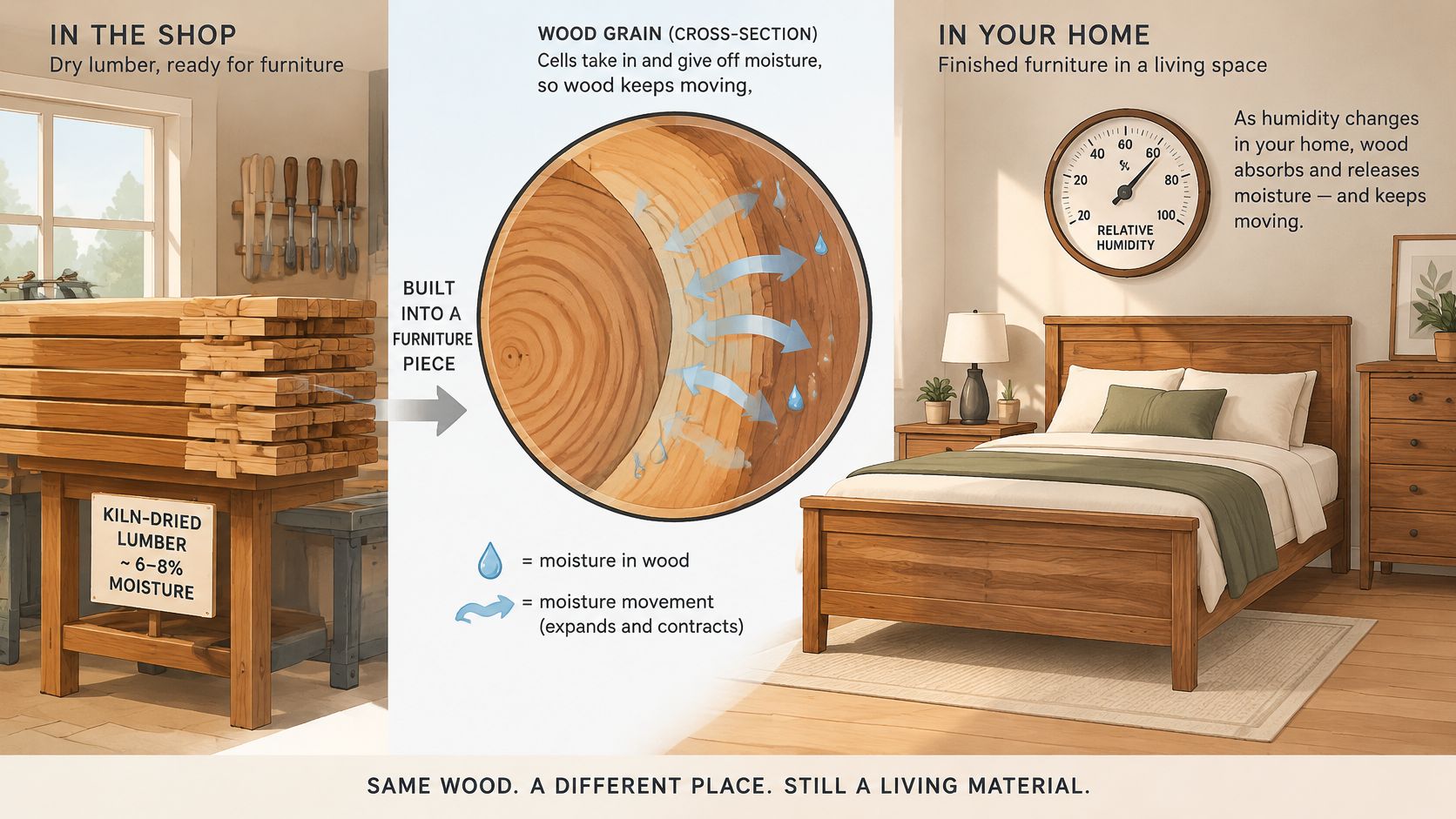
Solid wood behaves a bit like a sponge, though slowly and with much better manners. It trades moisture with the air around it, which means it keeps adjusting after it leaves the workshop. That single fact explains many furniture problems that shoppers blame on age or bad luck.
The USDA Forest Products Laboratory Wood Handbook reports that furniture and cabinet lumber is commonly dried to approximately 7 to 9% moisture content, compared with roughly 10 to 12% for many appearance-grade softwood applications. That lower target helps furniture settle into heated, conditioned homes with less cupping, twisting, open joints, and sticky drawers. In Metro Milwaukee, dry winter heat and humid summers make this more than a textbook detail.
Movement Is Normal, Restraint Is the Problem
Wood expands and contracts mainly across the grain, and builders can't stop that seasonal movement. Good builders design around it. Floating panels and elongated fastener holes give wide parts room to shift slightly without splitting or cracking the finish.
That matters most on wide headboards, bed rails, dresser tops, and solid drawer fronts. A top that's screwed down rigidly on every side has nowhere to go when the air turns humid. Something eventually gives, and it usually isn't the screw.
Common hardwoods like oak, maple, cherry, and walnut each bring different hardness, grain, and color behavior. Cherry deepens in color over time, while maple takes lighter stains evenly and oak shows bold grain. Species choice affects daily wear, so it deserves more than a quick glance at a stain chip.
Where Composite Panels Fit In
Not every panel in a well-built set needs to be solid. Plywood drawer bottoms and case backs can be stable, sensible choices when they're disclosed and well made.
The EPA guidance on formaldehyde standards for composite wood products covers hardwood plywood, MDF, and particleboard, with emission limits of 0.05 ppm for hardwood plywood, 0.11 ppm for MDF, 0.13 ppm for thin MDF, and 0.09 ppm for particleboard, and covered finished goods must be labeled TSCA Title VI compliant after March 22, 2019. Composites aren't automatically bad, and veneer over plywood is common. The problem is guessing, so material disclosure matters, which is why our guide to Amish furniture quality encourages component-level questions.
Component
Usually Solid Wood
Often Engineered or Veneered
Question to Ask
Bed rails and posts
Yes, in quality sets
Rarely
Which hardwood species is used?
Dresser top and sides
Often
Plywood in some case parts
Is the top solid wood or veneer?
Drawer fronts
Frequently
Sometimes veneered over a core
Are fronts solid or veneer over a core?
Drawer bottoms
Sometimes
Plywood is common
What material and thickness are used?
Panels and case backs
Sometimes, on framed panels
Plywood or MDF
Are regulated panels labeled TSCA Title VI compliant?
Three questions cut through most confusion. Is the lumber kiln-dried and allowed to acclimate before final machining? Which specific parts are solid, veneered, or engineered? Can the material list be confirmed in writing before ordering?
Choosing Between In-Stock and Custom Sets
Both paths can lead to a good bedroom. The right choice depends on timing, flexibility, and how particular the room is about size or finish. Neither option is automatically the smarter buy.
When In-Stock Makes Life Easier
An in-stock set is what's on the floor. Shoppers can see the actual color, open the actual drawers, and arrange delivery without waiting for a workshop to build anything. That's a real advantage before a move, a house closing, or overnight guests arriving soon.
The trade-off is fixed choices. The finish is the finish, and the piece mix is what it is, though individual pieces can sometimes be swapped within a collection. For many households, that's plenty. Seeing the exact set also removes guesswork about stain color under home lighting versus showroom lighting.
Easiest timing: No build wait stands between purchase and delivery.
Known outcome: The piece in the store is the piece going home.
Fixed options: Finish, hardware, and sizes are already decided.
When Custom Earns the Wait
A custom set lets shoppers choose wood species, finish, hardware, and often sizes that suit an unusual wall or a smaller room. That flexibility helps when a dresser needs to fit between two windows or match a treasured family piece. At BILTRITE, we offer these custom options alongside a large in-stock selection, and details on Amish furniture made to order explain how the choices come together.
Lead time depends on the wood, finish, and workshop schedule, so timing should be confirmed at ordering rather than assumed from a neighbor's experience last year. Households planning around a move, a new baby, or a bedroom deadline should say so early. That conversation protects everyone from a mattress on the floor and clothes in boxes.
A custom order should never start with a guessed delivery date. Get the current timing confirmed before committing.
A Mixed Approach Can Work
Shoppers who already own a bed they love might order matching nightstands and a dresser, or buy in-stock pieces now and add later. That works when the team confirms the wood and finish can be matched closely, since stains shift with age and light. Honest matching conversations beat hopeful ones every time.
Before ordering, ask five plain questions. What is the current lead time, and what does delivery include? What does the warranty cover on hardware and finish? How are replacement parts handled, and which pieces can match what's already owned?
Seeing finish samples in person makes the decision much easier. Bring paint swatches, flooring samples, or photos of the room and compare them under real light. Small samples on a big decision are fine, as long as eyes, not screens, make the final call.
Measuring Your Room and Delivery Path
A bedroom needs room to move, not just room for furniture. Sets that look balanced in a big showroom can overwhelm a real bedroom with doors, closets, and heating vents. Measuring first turns a guessing game into a simple yes or no.
Numbers Worth Writing Down
A guide to bedroom size, code, and livability notes that aging-in-place guidance commonly recommends a 5-by-5-foot clear maneuvering area in bedrooms, hallways at least 36 inches wide, and doors with at least 32 inches of clear width. Those numbers translate directly into shopping choices about walkers, bed transfers, drawer reach, and delivery access.
Measurement
Common Guideline
Why It Matters
Clear maneuvering area in the bedroom
5 by 5 feet
Room to turn, use a walker or pull a chair out
Hallway width
At least 36 inches
Carrying a dresser or chest through without scraping walls
Doorway clear width
At least 32 inches
Getting the largest piece through the opening
Bed height for transfers
Comfortable for getting in and out
Easier sitting down and standing up each night
Nightstand height
Level with or slightly above the mattress top
Easy reach from bed without stretching
Measure clear width, not frame width. Open the door, allow for the door slab and trim, then record the actual space a dresser has to pass through. That distinction has saved many shoppers from a delivery-day headache.
A 10 by 11 Foot Room, Walked Through
Say a bedroom measures 10 by 11 feet. Place the bed against the longest wall, put the dresser across from it, and check the gap at the foot of the bed. That gap is the main road through the room, and it needs to stay open for half-asleep trips at 2 a.m.
A bench at the foot might fit on paper but still catch shins in the dark. A chest tucked beside the closet door can block the door swing. Tape outlines on the floor with painter's tape and live with them for a day. Walking the outline beats studying a sketch.
Floor tape test: If walking around taped outlines feels cramped now, real furniture won't feel better later.
Smaller Isn't Always More Accessible
Shallow pieces help circulation, but undersized drawers force overstuffing, and low seating can be hard to rise from. Bed height deserves attention too, because a mattress top that's too high or too low makes transfers harder. Function needs measuring right alongside size.
A tall dresser or chest saves floor space and stores plenty, though top drawers can be a stretch. A wide, low chest offers easier reach and a useful surface, but it claims more wall. The better choice depends on the person's height, reach, and daily routine. Anti-tip anchoring matters for tall pieces, especially in homes with children or anyone who might steady themselves on a drawer front.
Finish with the delivery path. Measure the front door, hallways, stair turns, and bedroom doorway, then ask how pieces will be delivered and placed. Removable rails, mirrors, and feet can make a tight turn possible, so ask about them before the truck arrives.
What Amish Bedroom Sets Typically Cost
Real numbers help ground expectations. A snapshot of 2026 listings from several Amish furniture sellers shows starting prices ranging from roughly $5,500 to $12,500. That's a wide spread, and it comes mostly from piece count, wood, and finish.
Set Type
Price Seen in 2026 Listings
Three-piece set, starting price
$6,839
Five-piece set, starting price
$8,629
Five-piece set, current price
$6,048
Five-piece set, starting price at the top of the range
$12,550
Solid-wood set, starting price
$5,503
Set on sale, sale price
$5,631 (was $8,404.48)
A starting price is exactly that. It may reflect the smallest bed size, the least expensive wood, or fewer pieces than the photo shows, so shoppers should ask what's included before comparing one listing against another. A sale price can also look dramatic while describing a smaller configuration than the one a household needs.
Piece count explains much of the gap. Adding a chest and a second nightstand changes the total, and richer woods or custom finishes change it again. Our overview of Amish furniture prices walks through those drivers in more detail.
Price alone tells shoppers very little. A lower-priced set with sound joints, firm drawer bottoms, and honest materials can be good value. A higher price guarantees nothing if rails wobble and glides grind. The numbers set the budget. The inspection decides the value.
What Drives the Price and Long-Term Value
Here's the uncomfortable part. Solid wood alone does not guarantee good construction. Poorly designed solid lumber can still move, split, or fail when joinery, hardware, humidity control, and support design are weak. The material is one ingredient, not the whole recipe.
Think in Cost per Year
A simple worked example helps. Say a set costs $3,000 and serves a household for 15 years. That works out to about $200 per year, while a cheaper set replaced after five years can easily cost more across the same stretch. Nobody can promise a lifespan, but the math reframes the decision from sticker price to years of use.
Durability is what shoppers say they want. An article on durable design and transparent supply chains reported that a 2025 European consumer survey found 95.5% of respondents considered durability important or very important when buying furniture, while only about 19% were willing to pay more for sustainability. A 2025 study also found dressers and cupboards among the product types where repaired items outnumbered unrepaired ones.
Cost Driver
How It Changes Price
Value Question
Wood species
Harder or rarer woods raise the cost
Does the wood suit daily use in your home?
Piece count
Each added piece raises the total
Which pieces do you truly need now?
Finish and hardware
Custom choices add cost and personal style
Will you still like this finish in ten years?
Construction detail
Solid rails and visible joinery usually cost more to build
Can you see the joints and drawer construction?
Warranty and replacement parts
Adds protection for the purchase
What is covered, and for how long?
Repairability Is Real Value
A set that can be tightened, touched up, refinished, or fitted with a replacement glide stays useful longer. That's where wood species, rail construction, center supports, fasteners, and drawer-bottom material stop being trivia and start being money. Ask which components can be refinished or replaced, and how replacement hardware is sourced years from now.
We aim for affordable, better-quality furniture at BILTRITE. We're not the cheapest option, and we won't pretend otherwise, but we work hard to keep quality strong for the price. That honest middle ground has served Metro Milwaukee families well since 1928.
Judge value with hands and eyes. Open the drawers, sight along the rails, and ask about parts before asking about discounts.
A short showroom checklist makes the judgment concrete. Check rail joinery, press drawer bottoms, run glides through their full travel, and look for finish that's smooth inside drawer edges. Confirm warranty terms in writing. Sets that pass those checks tend to be the ones still doing quiet, reliable work a decade later.
Caring for Your Set Over the Years
Solid wood isn't fussy, but it does appreciate steady conditions. Most care is really room care. Keep the indoor climate reasonably consistent, avoid parking pieces against radiators or damp exterior walls, and small seasonal movement stays small.
A Simple Routine That Works
Dust weekly: Use a soft, dry cloth so grit doesn't scratch the finish during wiping.
Check humidity monthly: A quick look before seasons change helps catch a room that's drifting too dry or too damp.
Tighten hardware every few months: Bed bolts and drawer pulls loosen with use, and early tightening stops rattles.
Inspect glides and drawer bottoms yearly: Drawers that stay smooth and square put less stress on joints.
Touch up worn finish as needed: Small repairs protect exposed wood before moisture gets in.
None of this takes long. Dusting and a seasonal hardware check handle most of it, and our wood furniture maintenance guide covers cleaning products and finish care in more depth. Skip heavy sprays and soaking cloths. Wood likes gentle and dry far better than wet and scented.
Everyday Habits That Prevent Damage
Lift furniture instead of dragging it, since dragging racks joints and can snap a leg. Felt pads under feet protect floors and make small adjustments easier. Coasters on dresser tops sound old-fashioned, but water rings are forever, and a cold glass doesn't care how nice the finish is.
Don't overload drawers. A drawer stuffed past its glide capacity will sag, stick, and eventually pull its own front loose. Rotate what's stored seasonally if drawers are running full, and keep the heaviest items in lower drawers where the case is strongest.
Household rule: If a drawer needs a hip-check to close, it's asking for relief, not more force.
Keep Repair Information Handy
Dressers are among the pieces owners commonly repair rather than replace, so a little paperwork pays off. Record the finish name, wood species, and hardware sizes when the set arrives. A decade later, that note turns a replacement pull or touch-up pen into a five-minute task instead of a guessing game.
Ask about replacement parts at the time of purchase, while the answer is easy to get. Find out whether glides, bolts, and pulls are standard sizes or builder-specific. Standard hardware is simpler to replace locally, and knowing that upfront shapes long-term expectations.
Keep receipts and warranty paperwork in one folder, ideally with the finish record. Repairs start faster when the right information is already in hand. A well-kept set doesn't need pampering. It needs steady air, sensible loads, and an owner who notices small things early.
Visit Our Greenfield Showroom to Compare Sets in Person
We don't sell online, and for bedroom furniture, we think that's a strength. Wood grain, drawer feel, and bed height don't come through a screen. Judging Amish made bedroom furniture sets properly takes hands, eyes, and a tape measure.
A Short Visit Plan
Bring measurements: Room dimensions, plus doorway and hallway sizes along the delivery route.
Bring photos and samples: Bedroom pictures, paint swatches, and fabric samples make matching honest.
Open every drawer: Glides should travel smoothly without grinding or dipping.
Sit on the bed: Check the height for getting in and out, shoes off if that's the nightly routine.
Touch the joints: Run a hand along rails and frames, then compare finishes in natural light.
Bring the material questions and warranty questions from earlier shopping notes too. A written list keeps the visit focused, and nobody here minds detailed questions. We'd rather answer them in the store than have a shopper wonder at home.
Our sales associates bring over 400 years of combined experience, and they're here to help shoppers compare, not to pressure them. Between small-scale options for apartments and condos, heavy-duty pieces for busy families, and a mattress department with over 60 models, there's plenty to explore at a comfortable pace. We're closed on Sundays so our team can spend time with family, which feels right for a family business.
While visiting, households helping a parent or planning ahead can also ask about lift recliners. In Wisconsin, power lift recliners are exempt from sales tax, which makes mobility help a little more affordable. It's one of those local details our team is glad to explain in person.
Come on down to our showroom and see for yourself! We'd love to see you in our store, so come say hi and let us help find the right pieces for home. No pressure, no rush, just good furniture and friendly folks ready to help.
BILTRITE has helped Metro Milwaukee households choose USA-made and Amish-made solid wood bedroom furniture since 1928, with in-stock sets to touch today and custom wood, finish, and hardware choices for rooms that need something specific. Bring measurements, photos, and toughest questions, open the drawers, sit on the beds, and compare finishes in real light with a team that helps without pressure. Start planning a visit at BILTRITE Furniture-Leather-Mattresses and then stop by the Greenfield showroom to see the difference in person.