Best Recliners for Small Spaces: A BILTRITE Guide


A small living room can make recliner shopping feel harder than it should. You want somewhere comfortable to read, watch the game, or put your feet up after work. You just don’t want a chair that takes over the whole room or gets stuck in the doorway on delivery day.
We hear that all the time from Milwaukee-area homeowners, condo owners, apartment renters, and adult children shopping for a parent. Older bungalows, narrower stairwells, cozy dens, and condo layouts all create the same question. Which are the best recliners for small spaces that still feel good to sit in every day?
We’ve been helping local families sort that out since 1928. As a fourth-generation family business, we’ve learned that the right small-space recliner isn’t just about finding a shorter chair. It’s about fit, function, construction, and getting it into the home without a headache.
Your Cozy Corner Solution for Small Spaces
A tight living room often has one open corner that needs to do a lot of work. It might be the spot where you read before bed, watch the Brewers game, or sit with your feet up after a long day. In many Milwaukee homes, that corner is all you get, so the recliner has to earn its place.
We see that every week in our showroom. Shoppers come in expecting a small-space recliner to feel skimpy or look temporary. In practice, the better ones are thoughtfully scaled, easier to live with, and built for daily use instead of a short-term fix.

What people usually get wrong
In our experience, many shoppers still picture the old oversized recliner with thick arms, a heavy back, and a footprint that takes over the room. That picture leaves out how much better modern compact recliners have become, especially in USA-made and Amish-built lines that focus on durability instead of disposable trends.
A smaller recliner should still support your back, open comfortably, and hold up to regular use. It also needs to suit the person using it. That matters for seniors who need a seat height that is easier to get in and out of, and for families who want one chair that will still be working years from now.
What works in real rooms
The best recliners for small spaces usually have a few things in common:
- A cleaner footprint: Slimmer arms and a tighter profile keep the room from feeling crowded.
- Efficient reclining motion: Wall-hugger and other compact designs use less space behind the chair.
- Practical proportions: A chair can look compact and still feel comfortable if the seat depth, back height, and arm height are balanced well.
- Sturdier construction: Better frames, better mechanisms, and better cushioning matter more in a chair you use every day.
- Delivery sense: In older Milwaukee homes, the right recliner often comes down to what can make it through the front door, up the stairs, and around the turn.
One hard lesson from years on the sales floor is simple. A chair can fit the room and still be wrong for the home if it blocks traffic, looks too bulky, or is a struggle for an older parent to use safely.
That is why we steer shoppers toward well-built pieces designed for smaller homes from the start, including our small space furniture solutions. Big-box stores tend to chase what looks good in a photo. We pay more attention to long-term comfort, reliable construction, and whether the chair will still make sense after the novelty wears off.
First Things First Measuring for Success
A small-space recliner usually goes wrong before it ever reaches the house. A customer finds a chair that looks compact on the showroom floor, then delivery day comes and it catches on a stair turn, blocks a radiator, or cannot fully recline once it is in place. That is why measurements come first.
A recliner has to work in three ways. It has to fit the room, fit the delivery path, and fit when fully open. In older Milwaukee homes, that second part can be the one that decides everything.
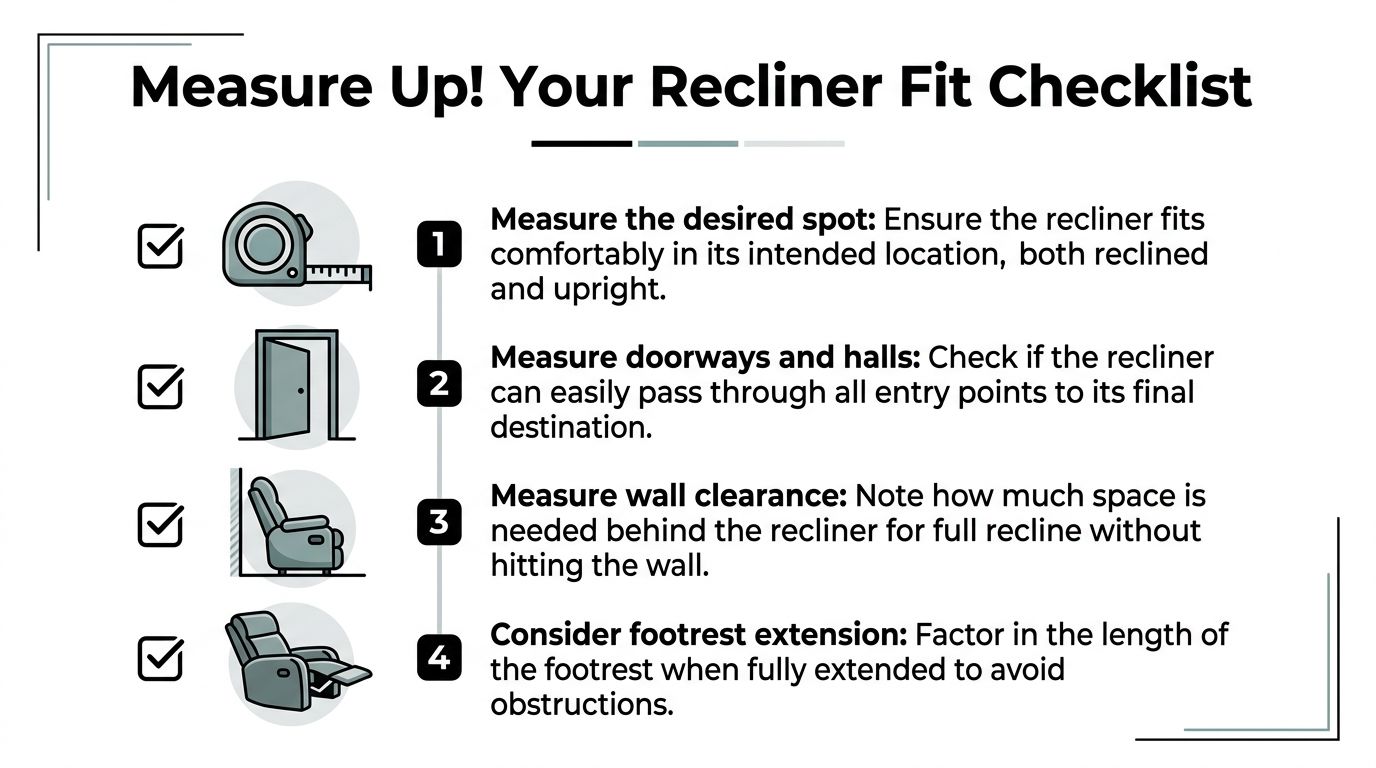
Measure the destination first
Start with the exact spot where the recliner will live. Use a tape measure, not a guess from across the room.
Write down:
- Width of the open floor area
- Depth from the wall to the nearest obstacle
- Walkway space beside the chair
- Distance to end tables, radiators, vents, or other furniture
Pay special attention to what happens after the chair reclines. Some models need more room behind them. Others move forward as they open and save space at the wall, but still need clear space in front. The only measurement that matters is how the chair behaves in your room, with your traffic pattern and your other furniture around it.
Measure the path, not just the room
This is the step families skip most often, and it causes plenty of avoidable headaches.
Measure every tight point between the front door and the final spot. That includes entry doors, storm doors, hallways, stairwells, ceiling drops, corners, banisters, and the last turn into the room. In a bungalow, duplex, or older Milwaukee brick home, one sharp angle can matter more than the room itself.
Use a checklist like this:
- Front entry: Measure width and height.
- Interior doors: Include the narrowest one on the route.
- Hall turns: Check turning space, not only the straight opening.
- Stairs: Note width and any low overhead spots.
- Final room opening: Door trim and tight angles can cut down usable space.
Come-apart recliners and some USA-made motion chairs solve delivery problems better than one-piece imports. That is a real advantage in small homes and upstairs rooms, especially if you are buying for an older parent who needs a sturdier chair with easier access.
Don’t forget the reclined depth
This is the number that gets overlooked.
A chair can fit nicely against the wall and still take over the room once the footrest is up. Check the full reclined depth and the space needed in front of the chair. Then look at the coffee table, ottoman, hearth, or TV stand nearby. If the room feels cramped every time the chair opens, it is not the right fit no matter how good it looked in the store.
Bring those numbers with you. A good salesperson can do a lot more with actual measurements than with “it’s a pretty small room.”
If you want help getting organized before you visit, our guide to measuring furniture for your home walks through the dimensions worth checking.
Decoding Recliner Types for Tight Spots
Not all small recliners solve the same problem. Some save wall space. Some fit shorter users better. Some are better for reading corners, and some are built around mobility support.
That’s why comparing types is more useful than chasing one trendy style.
Space-Saving Recliner Cheat Sheet
| Recliner Type | Best For | Space Requirement |
|---|---|---|
| Wall-hugger | Rooms where the chair must sit close to the wall | Minimal rear clearance |
| Petite-scale recliner | Shorter users and rooms that feel crowded by full-size seating | Smaller overall footprint |
| Swivel glider recliner | Reading corners, nurseries, and multipurpose spaces | Needs room for gentle motion around base |
| Power lift recliner | Seniors and users who need standing assistance | Needs careful planning for placement and access |
| Come-apart recliner | Older homes, condos, and stairwells with tight delivery paths | Chosen as much for access as room fit |
Wall-huggers make sense near walls
A wall-hugger is often the first place to look. The mechanism moves the chair forward as it recline, so you don’t lose a lot of room behind it.
That makes it a strong choice for condos, apartments, TV rooms, and family rooms where the recliner has to live against a wall. If you’ve got a narrow living room, this style usually works better than a traditional deep-body recliner.
The trade-off is simple. Some shoppers expect the oversized, sink-in feel of an old-school recliner and don’t get that same look or profile in a smaller wall-hugger.
Petite-scale chairs fit people better, not just rooms
A petite recliner isn’t just a smaller version of a standard chair. It’s proportioned for a different body type.
Petite-scale recliners are engineered with 19 to 21 inch seat depths and slim arms for users under 5'3" and for rooms under 120 square feet, according to this petite recliner overview. That matters because a chair can fit the room and still feel wrong if the seat is too deep.
When the seat is too deep, shorter users often end up sitting on the edge or stuffing pillows behind their back. That’s not comfort. That’s compensation.
Swivel gliders are useful in flexible rooms
Some small-space shoppers don’t need a recliner for movie night only. They want one chair that can face the TV, angle toward a conversation area, or work beside a window for reading.
A swivel glider does that nicely. It brings motion and flexibility without the heavy presence of a big overstuffed chair. In the right room, it can feel lighter than a classic recliner.
The catch is placement. You have to account for the moving base and nearby furniture, especially side tables.
Lift recliners need a practical eye
For seniors, a lift recliner can be a major help. It supports sitting, standing, and position changes without asking the user to struggle with a manual lever.
Zero-gravity lift positioning can lower spinal disc load by 40 to 50% in the source above. That’s one reason many caregivers focus on lift chairs when comfort and ease of use both matter.
If the recliner is for a parent or grandparent, don’t shop by silhouette alone. Sit in it, test the control, and pay attention to seat height, arm support, and how easy it is to exit.
You can also compare features across styles by looking at different types of power reclining seating.
Why USA and Amish Made Quality Matters
A small-space recliner usually has no quiet corner role. It becomes the chair people use after work, during ballgames, while reading to the grandkids, or when an older parent needs a steady place to sit and stand. In many Milwaukee homes, especially bungalows, condos, and flats, that one chair has to do real work every day.
What’s inside the chair counts
A compact recliner can look sharp on the sales floor and still wear out early if the frame, seat support, and mechanism were built to hit a price point instead of last. That is the trade-off many shoppers do not see until a few years later, when the seat starts sagging, the motion gets rough, or the arms loosen up.
That lines up with what we’ve seen in the showroom over decades. Better-built USA-made and Amish-crafted chairs usually feel steadier, sit more comfortably over time, and give families fewer headaches down the road.
Smaller homes ask more from every piece
In a larger home, an occasional chair can get by on looks alone. In a smaller home, every seat has to earn its footprint. A recliner that saves a few inches but wears out fast is rarely a bargain.
This is particularly important in smaller homes.
Older adults feel it first. If someone uses the arm for support while standing, weak joinery and lighter mechanisms become more than a durability issue. They become a daily annoyance, and sometimes a safety concern. That is one reason we often steer shoppers toward chairs with solid frames, dependable reclining systems, and seat heights that make getting in and out easier.
What to check before you buy
Good construction leaves clues. Look closely at details like these:
- Solid wood framing: Better long-term support than lower-grade panel materials.
- Smooth reclining action: The mechanism should operate cleanly, without wobble or hesitation.
- Supportive arms: They should feel firm enough to help with sitting down and standing up.
- Consistent tailoring: Straight seams and properly fitted upholstery usually reflect better workmanship overall.
- Serviceable value: A chair should make sense for the long haul, not just for this season’s trend.
Durable can still fit the room
Some compact USA-made and Amish-made recliners have cleaner lines and a lighter visual profile than shoppers expect. You do not have to choose between lasting construction and a chair that works in a smaller living room, den, or bedroom.
One option local shoppers can evaluate in person is BILTRITE Furniture-Leather-Mattresses, where small-scale recliners, USA-made pieces, Amish-made options, and heavy-duty seating are part of the assortment rather than an afterthought.
A recliner for a small room should hold up to daily use, fit the home, and still feel dependable years from now.
If you want to learn more about why many shoppers start with domestic construction, our page on the advantages of buying furniture made in the USA is a useful place to start.
The Delivery Day Dance Made Easy
Even after you choose the right style and size, one big question remains. How does the recliner get inside?
That’s not a small detail around Milwaukee. Older houses, upper flats, condo elevators, side entries, and narrow stairwells all create delivery challenges that a lot of online buying guides barely mention.
Tight entries change the whole decision
Google searches for “small space lift chair recliner Milwaukee” have significantly increased, yet few guides address delivery. “Come Apart” models are especially important for navigating narrow doorways under 30 inches and can reduce move-in injury risks by 40%, according to this reference on slim recliners and delivery concerns.
That’s a useful reminder that “small space” doesn’t just mean the room itself. It also means the route to the room.
A come-apart recliner can be a smart choice if you’re dealing with:
- Older homes: Narrow hallways and tighter interior doors
- Upper-level apartments: Stairs with awkward turns
- Senior communities: Limited maneuvering room and safety concerns
- Basement family rooms: Low ceilings and enclosed staircases
How to prepare before delivery
A few simple steps make delivery day smoother:
- Clear the path completely. Move rugs, lamps, baskets, and accent tables.
- Open the full route. Prop doors open if possible.
- Protect pets and kids. Delivery teams need room to move safely.
- Know the final placement. Decide ahead of time which wall or corner makes the most sense.
- Measure one last time. It’s worth confirming the tightest opening.
If the recliner is a power model, think about outlet placement too. A good spot on the floor isn’t always a good spot for cords and controls.
White-glove service matters more than people think
This is one of those areas where experience shows. A recliner can be technically deliverable and still be difficult to place well without a careful team.
For seniors and caregivers, that matters even more. Heavy-duty and lift models are helpful, but only if they arrive safely and get set up correctly. White-glove delivery takes a lot of stress off the household because the crew handles placement, setup, and the awkward part of getting a substantial piece through a tricky layout.
You can read more about what that includes in our white-glove delivery service overview.
Come Say Hi and Find Your Favorite Seat
Reading about recliners is useful. Sitting in them is what makes the decision clear.
That’s especially true for the best recliners for small spaces. Two chairs can have similar measurements and feel completely different once you’re seated. One may support your back well. Another may hit your knees wrong. One may look compact from the front but feel bulky in the room.
What to test in person
When you visit a showroom, don’t just sit down and stand up once. Use the chair the way you would at home.
Try this:
- Sit all the way back: See whether your lower back feels supported.
- Rest your arms naturally: Arms that are too high or too wide get annoying fast.
- Recline fully: Make sure the motion feels easy and steady.
- Get out of the chair: This matters just as much as getting into it.
- Check the scale visually: Step back and look at how the chair carries its size.
Why local shopping still helps
Furniture is personal. So is floor planning. A local showroom gives you the chance to ask practical questions that matter in real homes, especially when you’re deciding between small-scale, lift, heavy-duty, or come-apart options.
Our team works with Milwaukee-area families every day, and that hands-on experience shows up in the little things. Which arm shape feels less bulky in a condo. Which motion base suits a reading corner. Which recliner style is more forgiving in an older house with narrow access.
Some chairs win on paper. The right chair wins when you sit in it, recline it, and know it will work in your home.
We’d love to see you in Greenfield at 5430 West Layton Avenue. Bring your measurements, bring photos of the room if you have them, and take your time. We’re a family business, and we believe furniture shopping should feel helpful, not rushed.
We’re proud to serve Metro Milwaukee the old-fashioned way: In person, with honest guidance, and with a strong focus on quality that lasts. We’re also closed on Sundays and Mondays so our own team can spend time with family. That’s part of who we are.
If you’re ready to compare small-space recliners, lift chairs, USA-made options, Amish-crafted furniture, or even shop for a new mattress while you’re here, visit BILTRITE Furniture-Leather-Mattresses in Greenfield. We’d be glad to help you find a comfortable seat that fits your room, your routine, and your home.