Black Leather Loveseat Recliners: A Buyer’s Guide


Saturday night in a Milwaukee family room usually has a familiar rhythm. One person wants the footrest up for the movie, another wants to sit upright and keep an eye on the kids, and somebody is trying to save enough space for a trip to the kitchen. A black leather loveseat recliner can handle that shared routine beautifully, but only when its two seats, upholstery, room footprint, and support are chosen as a unit.
This isn't a sofa with two footrests attached. The right piece should let two people settle in without fighting over the mechanism, support different body shapes, fit the room when open, and stand up to years of flexing and daily contact. The practical starting point is BILTRITE's reclining sofa and loveseat selection, followed by a proper hands-on test.
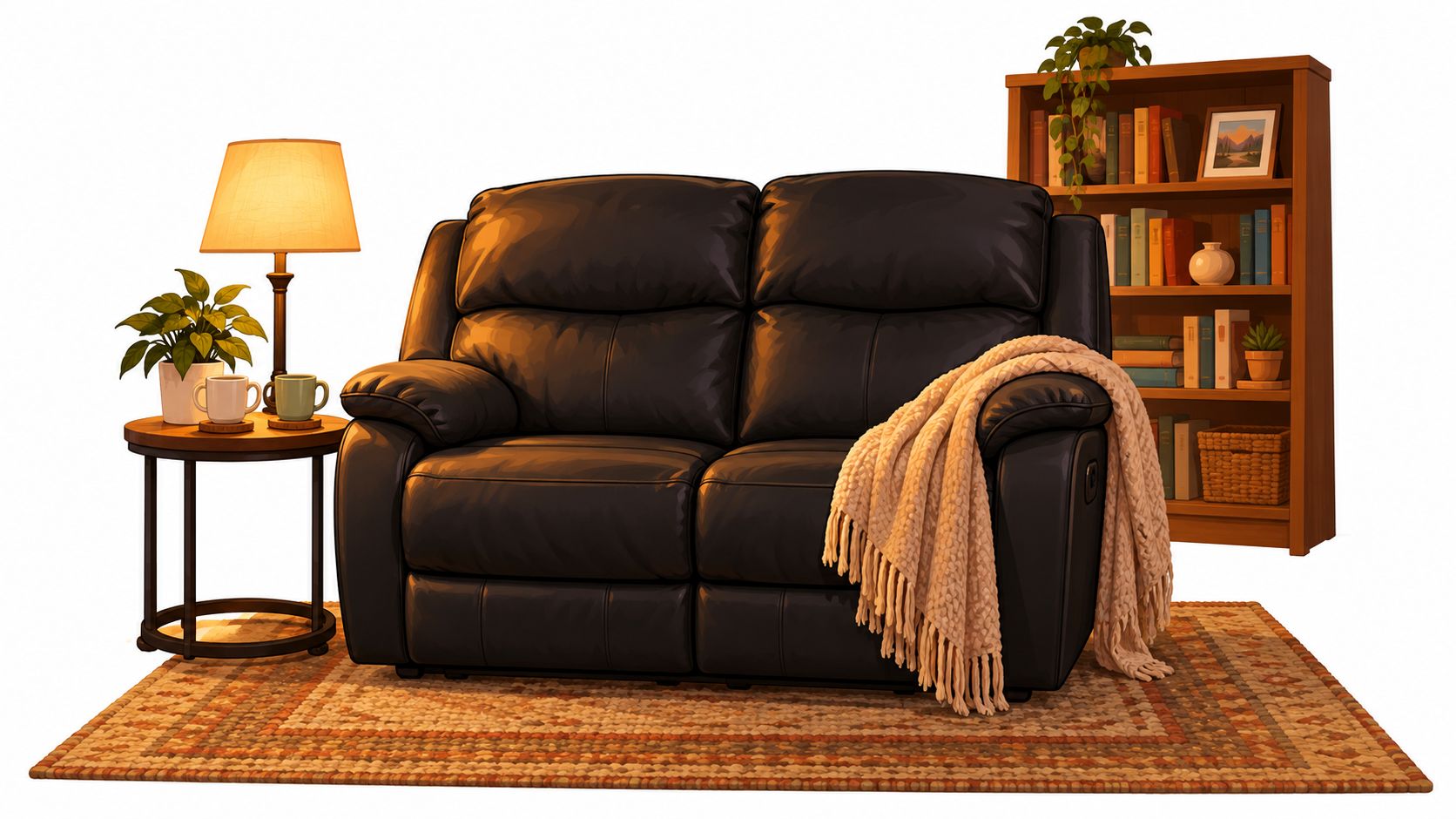
A good choice comes down to more than black leather and a comfortable first sit. Leather quality, independent mechanisms, transfer safety, measuring, maintenance, and local showroom testing all matter. The goal is a long-term piece of two-person furniture, not a quick purchase that looks good in a closed-room photograph.
Table of Contents
- A Loveseat Recliner Is a Different Kind of Furniture
- Understanding Leather Grades Before You Sit Down
- Manual, Power, and Wall-Hugger Mechanisms Compared
- Measuring the Room So It Actually Fits
- Comfort, Ergonomics, and the Two-Person Test
- Keeping Black Leather Looking Like New
- Why Seeing It in Person at Our Greenfield Showroom Matters
A Loveseat Recliner Is a Different Kind of Furniture
The first question isn't, "Does the loveseat recline?" It's, "How do two people use it together?"
A couple may want separate positions during a football game. One person may stretch out while the other reads upright. A caregiver may need firm arms and a stable seat edge for easier standing, while another household member wants softer cushioning and a deeper recline. Those needs can coexist, but the loveseat has to be built around independent comfort rather than a shared motion that moves both occupants at once.
Shared seating needs separate answers
Independent reclining seats are usually the strongest choice for households with different routines. Before choosing a model, shoppers should confirm whether each seat reclines independently, whether the footrests open together, and whether both occupants receive comparable head and lumbar support. A loveseat that feels comfortable for one person can still feel cramped or poorly aligned when two people sit side by side.
Black leather adds a polished, flexible look. It works with warm wood, lighter walls, and family-room furniture, while the loveseat format uses less visual and floor space than two separate recliners. The tradeoff is that leather surface quality and mechanism alignment become more noticeable because both seats receive frequent contact and movement.
The showroom test: Both users should sit down together, recline together, return upright, and repeat the transition. A loveseat that only feels good with one occupant hasn't passed the real test.
BILTRITE has served the Metro Milwaukee community as a fourth-generation, family-owned business since 1928. That history matters here because a local furniture decision benefits from practical advice about room size, delivery paths, leather care, and the difference between a standard recliner and a mobility-focused chair. A black leather loveseat recliner deserves the same careful attention as any substantial home investment.
Understanding Leather Grades Before You Sit Down
Leather grades describe how the hide has been selected and finished, but the label alone doesn't tell the whole story. A full-grain hide preserves more of the natural surface, while corrected-grain leather receives more surface treatment to create a consistent appearance. Split leather comes from a lower layer of the hide, and leather-match furniture combines leather with a matching synthetic material in selected areas.
A useful comparison is food. Full-grain leather is like a well-marbled cut, with natural variation that remains part of the character. More heavily corrected or split materials are closer to a lean blend, shaped and finished for consistency. Neither analogy replaces a sample, but it helps shoppers understand why two black surfaces can feel and age differently.
What the labels can and can't tell you
A reclining loveseat flexes repeatedly at the seat, back, and footrest. Arms collect skin oils and hand pressure. Pets may scratch or puncture the surface, and sunlight can affect a dark finish. Thickness by itself doesn't predict how well the upholstery will handle those demands.
FIRA identifies tear strength, flexing endurance, finish adhesion, wet and dry rub colorfastness, and lightfastness as relevant furniture-leather tests. An example European procurement specification under EN 13336 sets a minimum average tear load above 20 N. Buyers should ask whether the retailer or manufacturer can provide test results or warranty language addressing cracking, peeling, and color transfer. More practical guidance on evaluating construction appears in BILTRITE's guide to leather furniture quality.
| Leather Grade | Surface Character | Best Fit for a Reclining Loveseat |
|---|---|---|
| Full-grain | Natural markings and surface character remain visible | Buyers who value natural variation and documented performance |
| Top-grain | The upper hide surface is refined for a more consistent look | Daily-use seating where appearance and comfort both matter |
| Corrected-grain | Surface treatment creates a more uniform finish | Homes wanting an even black appearance with appropriate testing |
| Split leather | Made from a lower layer and commonly finished for upholstery use | Lower-contact areas or lines where the finish and warranty are clearly documented |
| Leather-match | Leather is paired with a matching synthetic material | Buyers who understand which panels use leather and which do not |
Why black makes differences easier to spot
Black doesn't hide every problem. It can disguise some ordinary dust, but scratches, scuffs, oily transfer, pet marks, and fading may stand out sharply against a dark finish. The more often a household reclines, leans on the arms, or allows pets on the furniture, the more important finish adhesion and flex endurance become.
Amish-made and USA-made frames can be paired with different leather grades depending on the furniture line. Craftsmanship origin is valuable, but it doesn't replace a direct question about the upholstery specification. The smartest conversation covers the frame, the leather category, the tested performance, and the warranty together.
Manual, Power, and Wall-Hugger Mechanisms Compared
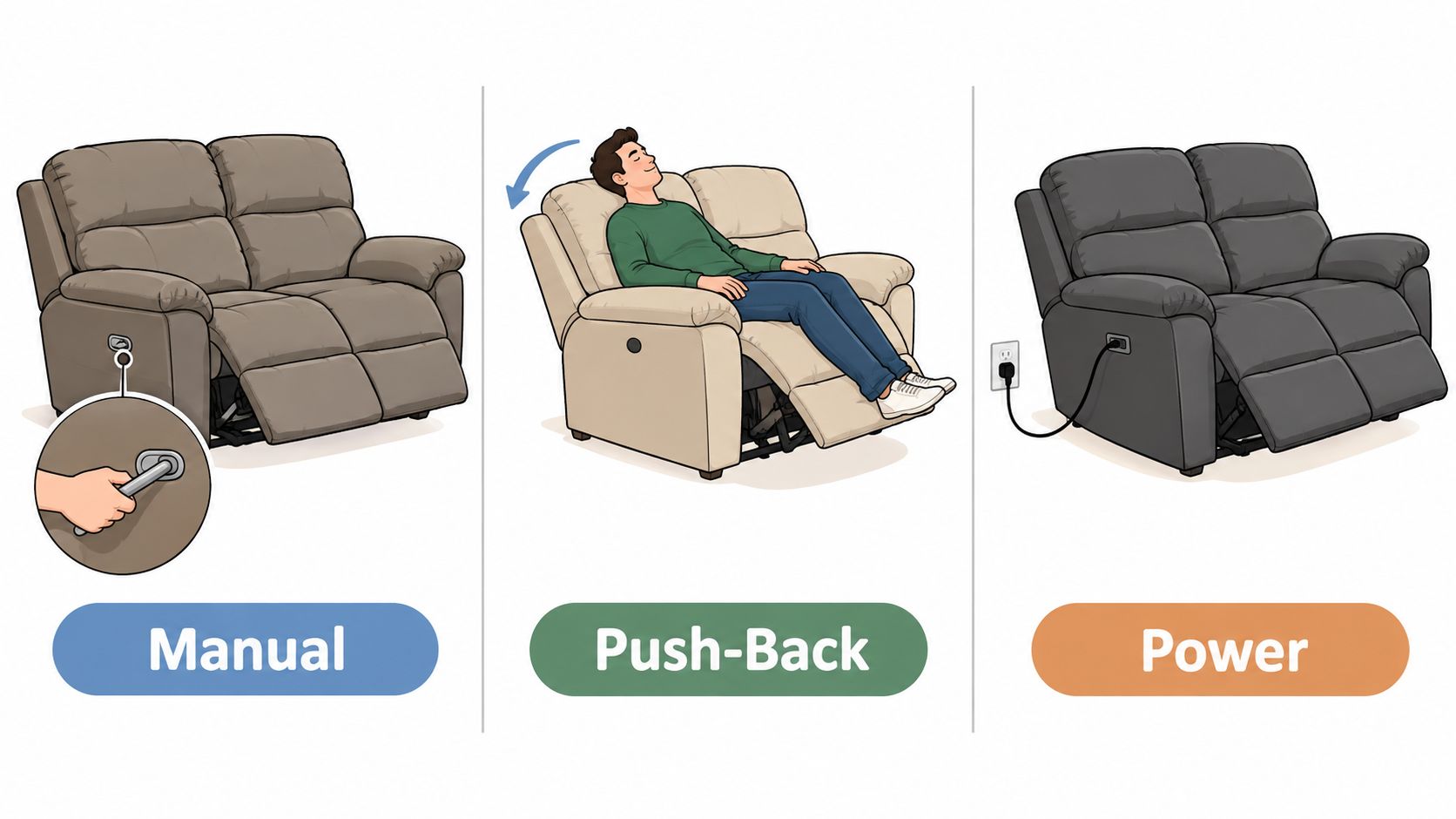
A mechanism should match the household, not just the room photograph. Manual reclining keeps operation simple and doesn't require a nearby outlet, while power reclining offers controlled movement and can be easier for people who don't want to push against a footrest. Wall-hugger construction solves a different problem by reducing the distance needed behind the loveseat.
Manual operation
A manual loveseat may use a side lever or a push-back action. It suits shoppers who prefer straightforward controls and want fewer cords near children, pets, or a busy walkway. A push-back seat can also preserve a cleaner appearance, although the user needs enough leg and body strength to activate the movement comfortably.
The main question is whether the manual action feels smooth for both occupants. One person may manage a lever easily while another finds the footrest difficult to close. Each seat should be tested by the person who will use it most.
Power operation
Power models use an electric motor and need access to an outlet. They can offer controlled reclining, and some designs may include separate adjustments for the headrest or lumbar area. Cord placement matters in a shared living room, especially where pets cross between the sofa, dining area, and kitchen.
A power loveseat also needs independent controls if two people have different preferences. A single shared motion turns separate seats into one experience, which defeats much of the reason to choose a two-person recliner.
Wall-hugger placement
Wall-hugger models can recline with approximately 4 to 7 inches of rear clearance, according to this reclining-loveseat guidance. That helps in compact Milwaukee living rooms, but it doesn't remove the need for front clearance. The extended footrest still occupies space, and the back must remain clear of nearby surfaces.
Mechanism rule: Confirm independent reclining, manual or powered operation, full-open depth, and minimum wall distance before ordering.
More options are outlined in BILTRITE's power reclining seating information. The right mechanism is the one that both users can operate safely and comfortably every day.
Measuring the Room So It Actually Fits
A black leather loveseat recliner can fit neatly against a wall when closed and still crowd the room once both footrests open. Measure the changing footprint, walking routes, and delivery path before choosing a two-person model.
Start with the closed footprint
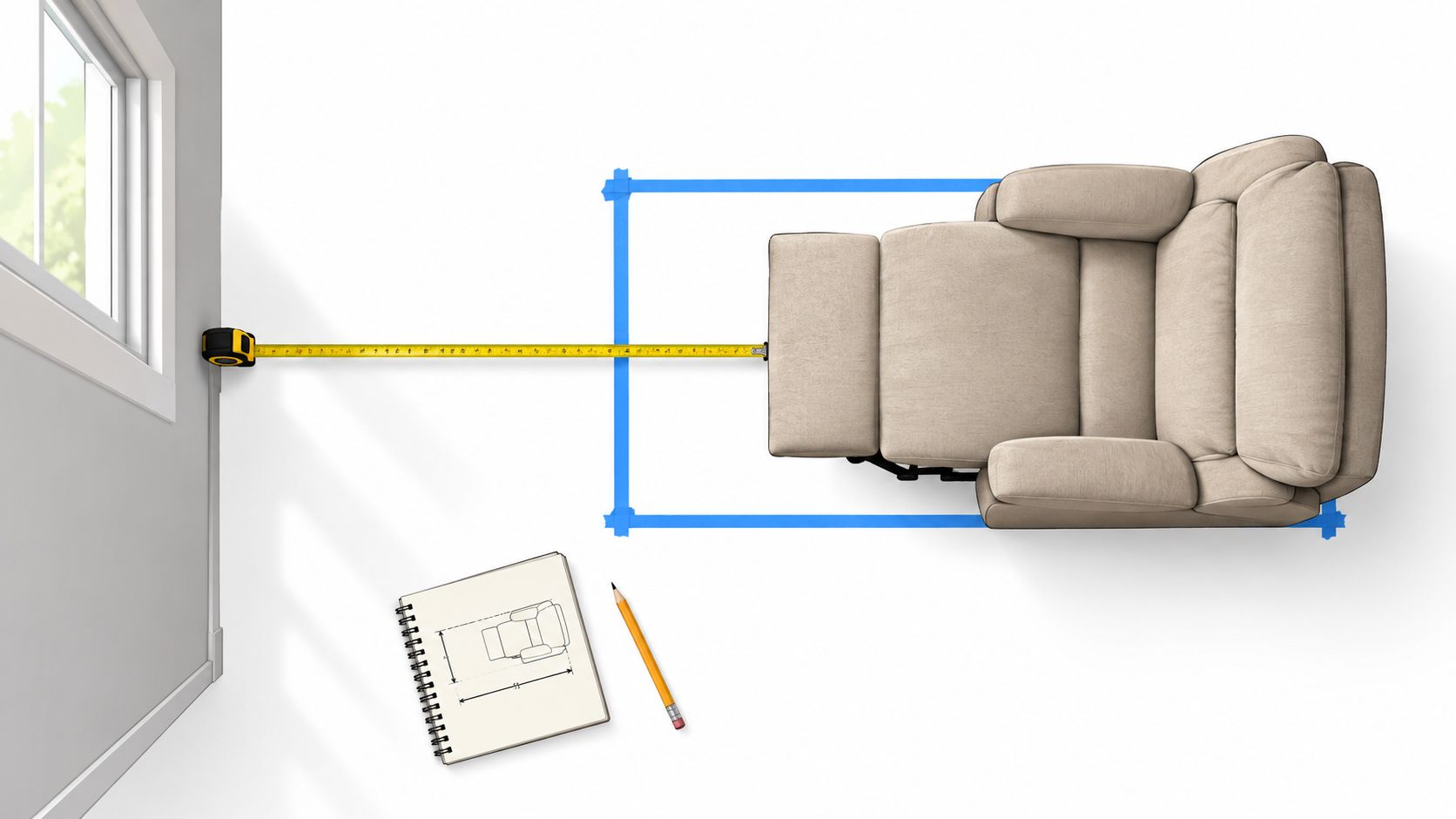
Loveseats commonly measure roughly 48 to 72 inches wide and about 36 inches deep, but the product specifications decide whether the piece fits. Mark its width and depth on the floor with painter's tape. Add nearby tables, lamps, doors, and the route toward the kitchen or hallway.
Then mark the fully reclined footprint. Get the manufacturer's full-open depth instead of estimating from the closed dimensions. A wall-hugger can reduce the space behind the loveseat, but the footrests still need clear space in front.
Keep circulation open
For a small room, plan on roughly 3 feet of clear circulation around the furniture. This useful planning target keeps walkways usable when the footrests are open. The loveseat should not block a doorway, cut through the main walking route, strike a coffee table, or leave another chair trapped in a corner.
Use this home test:
- Tape the closed shape: Mark the outside edges and check the room's usual walking paths.
- Tape the open shape: Extend the front edge to match the manufacturer's full-open measurement.
- Test both positions: Sit where each person would sit while someone walks past.
- Measure delivery: Check the driveway, entrance, hallways, doorways, turns, and stairways.
- Ask about come-apart construction: Some frames separate, which can help with narrow delivery routes.
Older Milwaukee bungalows, condos, and compact living rooms often have tight turns even when the destination room looks spacious. Review BILTRITE's furniture measuring guidance before delivery, and confirm every doorway and turn with a tape measure. A loveseat that fits the room but cannot reach it is not a workable purchase.
Comfort, Ergonomics, and the Two-Person Test
A loveseat can look plush and still leave one occupant with unsupported shoulders or pressure behind the knees. Comfort has to be tested in the fully supported position, with both people sitting naturally rather than perched at the front edge.
Use the whole body, not just the seat cushion
Cornell ergonomics guidance associates supported backrest recline between approximately 110 and 130 degrees with lower lumbar-disc pressure and reduced back-muscle activity than more upright postures. A recent functional-recliner study identified a 125-degree backrest angle and a 60-degree footrest angle as optimal for the young adults tested, though body size and cushion geometry affect individual comfort. The research is a useful reference, not a substitute for sitting in the actual loveseat. The angle findings are detailed in this functional-recliner study.
Both users should check four contact points:
- Feet: They should rest on the footrest without dangling or forcing the knees upward.
- Head: The headrest should support the head while the eyes face forward.
- Lumbar area: The lower back should feel filled and supported, not pushed into an exaggerated arch.
- Knees: The seat shouldn't press sharply behind the knees when the user sits fully back.
Seat depth often separates a comfortable loveseat from one that looks comfortable. A smaller adult may need a shorter seat, while a taller adult may need more length to avoid feeling folded up. One shared cushion shape rarely serves every body equally, so both occupants should test the same seat and then switch.
Add the standing and transfer test
Older adults and people recovering from surgery need more than a comfortable recline. They need to sit down, adjust position, and stand without feeling trapped in a low, soft seat. Independent senior-furniture research found that 76 percent of people aged 60 and older said armrests make sitting down and standing up easier, and nearly 80 percent preferred a backrest extending above the head. Those findings support a simple showroom routine: sit down slowly, stand using the arms, and check whether the feet stay stable on the floor.
A standard power recliner changes position. A power lift recliner also helps raise the user toward standing. Those are different functions, and a lift mechanism shouldn't be confused with a swivel lift design. Wisconsin shoppers should also remember that power lift recliners are exempt from sales tax, which can make mobility-focused seating more affordable for caregivers and seniors.
Keeping Black Leather Looking Like New
Black leather needs regular care, not wishful thinking. The dark color may conceal some dust, but it can make scratches, scuffs, pet punctures, fading, and oily transfer stand out. Frequent reclining adds repeated flexing around the seat, arms, and moving panels.
A simple maintenance rhythm
Routine care should stay gentle. Independent leather-cleaning guidance recommends vacuuming crevices, wiping with a dry cloth, conditioning approximately every 6 to 12 months, and avoiding soaked sponges, household solvents, furniture polish, and abrasive soaps.
A practical schedule looks like this:
- Regularly: Use a soft brush or vacuum attachment in seams and mechanism areas, then wipe the surface with a dry cloth.
- Every 6 to 12 months: Apply only an approved conditioner after confirming that the leather finish allows it.
- After spills: Blot promptly rather than soaking the panel or scrubbing aggressively.
- Before using any cleaner: Test it in an inconspicuous area and follow the manufacturer's instructions.
Place the loveseat thoughtfully
Direct sunlight can contribute to deterioration, so the loveseat shouldn't sit in strong window exposure. Keep it away from heat registers and radiators, and route power cords where children, pets, and feet won't catch them. Pet owners should also consider a soft throw over the preferred lounging area, while recognizing that a cover won't prevent claw marks on exposed arms.
Care requirements vary by leather type and finish, not only by color. The retailer or manufacturer should provide approved products and instructions. For additional care guidance, BILTRITE's leather conditioning guide offers a useful starting point.
Why Seeing It in Person at Our Greenfield Showroom Matters
Online descriptions can't tell a shopper how smoothly a footrest closes, whether the headrest lands in the right place, or whether two people can sit without crowding each other. Leather feel, cushion response, recline angle, arm height, and motor noise all become clearer when the actual loveseat is in front of the household.
That hands-on visit matters even more for buyers comparing regular seating with senior living or mobility-focused furniture. A person who will use the chair should sit, recline, return upright, and stand. A caregiver should watch the transfer, check the walking path, and confirm that the controls are easy to understand.
What a local visit makes easier
BILTRITE is a fourth-generation, family-owned furniture, leather, and mattress showroom serving Metro Milwaukee since 1928. The store carries a broad in-stock selection, including small-scale furniture for apartments and senior living spaces, heavier-duty choices for active families, and furniture identified as USA-made, Amish-made, and solid wood. Those categories help shoppers compare construction and scale in person instead of relying on a single product photo.
The sales associates bring over 400 years of combined experience to the showroom floor. Their role is to help households compare comfort, room fit, leather, and mechanisms without pressure. The store doesn't sell online, which makes the showroom conversation central to the experience.
BILTRITE also has more than black leather loveseats. The showroom includes living-room furniture, dining and bedroom pieces, home office and entertainment furniture, home décor, lift chairs, and a mattress department with over 60 models. A family furnishing several rooms can ask questions in one place, while shoppers focused on a loveseat can stay focused on the two-person test.
A local advantage: Bring room measurements, doorway dimensions, and the names of both users. The right questions are easier to answer when the furniture and the people using it are in the same room.
Wisconsin's power lift recliner sales-tax exemption is another practical point for caregivers and seniors. Power lift recliners are exempt from Wisconsin sales tax, making mobility-focused seating more affordable. The showroom is closed on Sundays and Mondays so the family can spend that time together, a choice that reflects BILTRITE's family-first, buy-local values.
A black leather loveseat recliner should be judged with the same care as any long-lasting household purchase. Sit in both seats, test every position, inspect the leather, check the transfer, and measure the delivery route. Come on down to the Greenfield showroom, kick back, and decide based on how the furniture works for the household.
BILTRITE Furniture-Leather-Mattresses offers leather seating, reclining loveseats, power lift recliners, USA-made and Amish-made furniture, and supportive options for Metro Milwaukee homes. Visit the Greenfield showroom for a no-pressure, hands-on test of black leather loveseat recliners, comfort, mechanisms, and fit, and let the experienced team help answer the questions that matter.