Sectional with Bed and Recliner: A Friendly Guide


A family settles in for movie night, but one person is balancing a drink on the armrest, another is stretched across the sofa, and a visiting parent is wondering where to sleep. A regular couch can handle one of those jobs comfortably. It starts to struggle when the living room also needs everyday seating, a place to put feet up, and a guest bed.
A sectional with bed and recliner brings those functions into one furniture arrangement. The sleeper section creates an overnight option, while a reclining seat gives someone a dedicated place to relax. That sounds simple, but the details matter. The right choice must fit the room when the bed is open, allow the recliner to extend safely, and make it through the doorway without turning delivery day into a household project.
For a helpful introduction to sectional layouts, shoppers can review this guide to sectional basics before buying. Then the practical questions become easier to answer: How will the mechanisms work together? Is the sleeper suitable for frequent use? Would a come-apart design be more useful than a smaller one-piece sectional?
Table of Contents
- When One Couch Just Is Not Enough
- How a Sleeper and Recliner End Up in One Sectional
- Measure the Room Around the Fully Deployed Footprint
- Choosing the Right Sleeper Mattress Inside the Sectional
- Recliner Comfort, Clearance, and Senior-Friendly Features
- Come Apart Sectionals for Tight Doorways and Tricky Deliveries
- Is the Sleeper Built for Nightly Use or Just the Occasional Guest
- Bringing It All Together and Visiting the Showroom
When One Couch Just Is Not Enough
The need usually appears during an ordinary evening. A family watches a film, a child claims the chaise, and a parent wants a seat with a footrest. Then a relative announces a weekend visit, and the household starts measuring the floor for an air mattress.
A sleeper-recliner sectional handles these competing needs through separate sections. The stationary seats support conversation and daily use, the sleeper opens for overnight guests, and the recliner lets one person lean back without converting the entire room into a lounge. Nobody has to move a separate chair into the traffic path just to get comfortable.
That flexibility has a practical history. Sectional seating grew from modular concepts that can be traced to the early 1800s, while the modern form became prominent in the United States during the 1930s and 1940s. In 1936, designer Gilbert Rohde introduced a “grouping principle” using interchangeable armless and corner chairs that could be rearranged into L-shaped and other configurations, as described in this history of the sectional sofa.
The useful question is not whether it does more
Multifunctional furniture earns its floor space only when the functions cooperate. A sleeper that blocks the hallway, or a recliner that prevents the bed from opening, creates more frustration than comfort.
A thoughtful shopper asks:
- Daily seating: Does the upright arrangement suit the household before guests arrive?
- Relaxation: Can the primary user recline with feet supported and controls within reach?
- Overnight use: Will the sleeper serve occasional guests, regular visitors, or someone sleeping there often?
- Room access: Can every module reach its final location through the home?
The category isn't a gimmick. It's a modular way to combine seating, lounging, and sleeping where a room has to work hard. The trade-off is that the furniture demands more planning than a standard sofa.
How a Sleeper and Recliner End Up in One Sectional
A sleeper-recliner sectional isn't one complicated mechanism trying to perform every task. It's a group of modules, with each module assigned a job.
The sleeper portion generally hides a folded mattress beneath the seat cushions. Depending on the design, the mattress may pull forward on a frame or unfold from within the sofa section. The frame can use metal or wood components, and the exact mattress size, support structure, and opening direction vary by model.
The reclining portion works separately. A manual seat may use a side lever or a push-back action. A power seat uses a motor and controls to move the back and footrest. Because the sleeper and recliner occupy different modules, a reclining seat can sit beside the bed section without requiring every seat to recline or every seat to convert.
Why sectionals suit mixed functions
Modular construction gives manufacturers room to combine sofas, corners, chaises, armless seats, storage pieces, and sleeper sections. It also allows layouts to adapt to different room shapes, which is one reason the sectional became useful in homes, offices, and retail settings during the late 1930s.
That same logic supports today's mixed arrangements. A corner module can turn the layout, a sleeper module can provide the bed, and a reclining module can create a personal comfort zone. Shoppers comparing layouts can browse reclining sectional sleeper options with this division of functions in mind.
Test the order of operations
A showroom demonstration should follow the same sequence used at home:
- Sit upright in every seat.
- Extend the recliner fully.
- Return the recliner to its closed position.
- Open the sleeper.
- Confirm that the mattress clears the recliner, tables, walls, and walking lanes.
- Close the sleeper without moving a heavy component out of the way.
Practical rule: The two functions should work side by side, not take turns competing for the same floor space.
This simple test reveals issues that a quick glance cannot. A sectional can look tidy in its closed position while becoming difficult to operate once both mechanisms are in use.
Measure the Room Around the Fully Deployed Footprint
The most important measurement is the one many shoppers skip. The sectional must fit not only when it sits neatly against the wall, but also when the sleeper mattress is fully open and the recliner is extended.
A full or double sleeper mattress may measure approximately 48 to 54 inches wide by 72 to 80 inches long, while a queen sleeper may measure about 60 inches wide by 75 to 80 inches long. The sectional's open depth can reach roughly 80 to 90 inches, according to this commercial sofa-bed measurement guide. These are planning ranges, not substitutes for the exact specifications of the model under consideration.
Mark the floor before shopping
Use painter's tape to outline the sectional's closed footprint. Then add the farthest edge of the opened mattress and the path of the recliner's footrest. This makes the cause and effect visible. A coffee table that looks comfortably placed in the upright arrangement may sit directly in front of the sleeper, while a walkway may disappear when the bed opens.
Measure these areas:
- Back wall to mattress edge: Start at the wall behind the sectional and measure to the farthest point of the open bed.
- Recliner clearance: Check the space behind the back and in front of the footrest, following the model's exact requirements.
- Walking lane: Preserve a clear route between the living room, kitchen, bathroom, and exterior doors.
- Door swing: Confirm that nearby doors can open without hitting the mattress or extended footrest.
- Delivery route: Measure entry doors, halls, stair turns, and diagonal paths, not just the final room.
A wall may accommodate the closed sectional while the opened sleeper blocks a doorway. That's why the fully deployed plan should come first.
Quick room planning numbers
| Measurement | Typical range | What to check |
|---|---|---|
| Full sleeper mattress | 48 to 54 inches wide by 72 to 80 inches long | Mattress edge, walking path, and nearby doors |
| Queen sleeper mattress | 60 inches wide by 75 to 80 inches long | Bed opening direction and clearance from furniture |
| Open sectional depth | Roughly 80 to 90 inches | Coffee table, circulation, and room boundaries |
Exact dimensions matter more than a label such as “full” or “queen.” Shoppers can also use this sectional measuring guide when sketching the room.
For Metro Milwaukee homes with narrow doorways, the delivery path deserves equal attention. A come-apart design may be easier to carry through a tight turn because separate modules can enter the home individually and be reassembled in the room.
Choosing the Right Sleeper Mattress Inside the Sectional
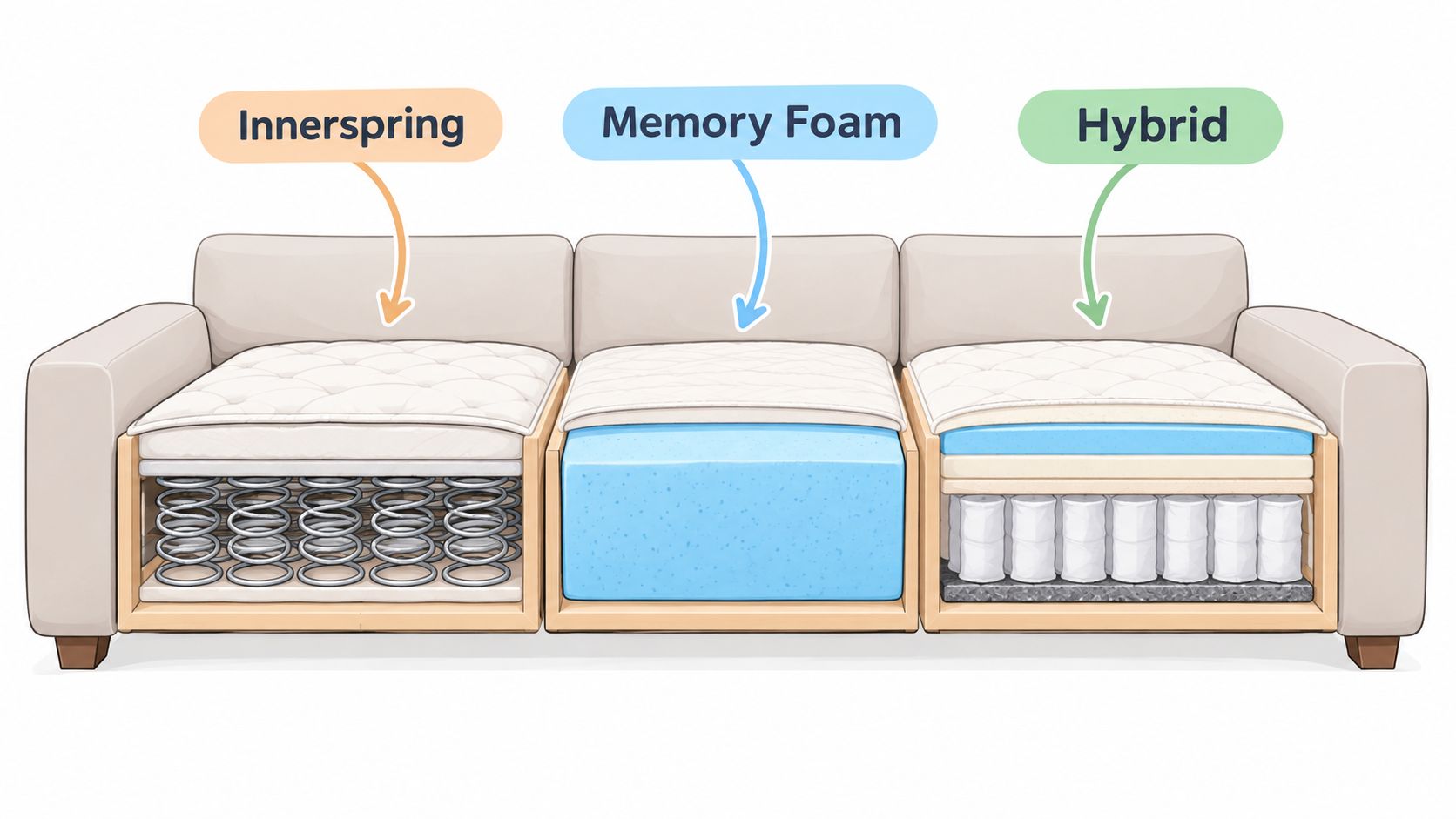
A sleeper mattress can feel familiar, contouring, or balanced between the two, depending on its construction. The right option depends less on the label and more on who will sleep on it, how often, and how easily the household needs to open it.
Three common constructions
| Mattress type | General feel | Practical advantage | Possible trade-off |
|---|---|---|---|
| Innerspring | Familiar and responsive | Often lighter and easier to convert | Support can feel less cushioned |
| Memory foam | Contouring and motion-absorbing | Can reduce the feeling of movement between sleepers | May retain heat and add weight |
| Hybrid | A blend of spring support and foam comfort | Tries to balance response and cushioning | May cost more and require a sturdier mechanism |
Thickness changes the experience. A thinner mattress can fold into the sleeper section more easily, but some sleepers may notice the support bar beneath it. A thicker mattress can feel closer to a conventional bed, yet it needs a mechanism designed to close around it without excessive strain.
Match the mattress to the sleeping schedule
For a guest who stays a few weekends each year, easy conversion and comfortable seating may carry more weight than the thickest mattress. A household hosting a weekly sleepover should pay closer attention to pressure points, support, ventilation, and whether sheets stay in place when the mattress folds.
A sleeper used frequently also deserves a practical conversion test. The person opening it shouldn't need to move a heavy recliner, clear a large coffee table, or perform awkward lifting. The mattress should open smoothly, and the support structure should remain stable across repeated use.
Before choosing a model, shoppers can review guidance on sleeper sofa mattress replacement considerations. The central lesson is simple: “full” and “queen” names can vary among manufacturers. The actual mattress dimensions matter more than the name on the tag.
Recliner Comfort, Clearance, and Senior-Friendly Features
The recliner needs to fit the person as carefully as the sleeper fits the room. A seat that looks inviting can still leave a shorter user's feet unsupported or give a taller user too little head and back support.
Ergonomic seating should accommodate a broad range, approximately from the 5th-percentile female through the 95th-percentile male, as discussed in this ergonomic seating guide. That range reinforces why showroom testing matters. Seat height, depth, width, arm position, and back support should be judged by the primary users, not by appearance alone.
Test more than the first sitting position
A proper test includes the upright, partially reclined, and fully reclined positions. The user should sit with hips fully back, keep feet supported, and check whether the controls are reachable without twisting.
A deep seat may feel luxurious to a tall person but leave a shorter user unable to maintain stable foot contact. A high seat can create pressure behind the knees. An extended footrest needs room so it doesn't become a trip hazard or block the sleeper's opening path.
The recliner's back also needs clearance from the wall. The exact space depends on the mechanism, so the model specification should guide the layout rather than a general assumption.
Consider transfer support
For older adults and caregivers, stable arms can provide useful support while sitting down or standing up. Firm cushions, a manageable seat-to-floor height, and a lift-assist option may matter more than extra softness.
A power lift recliner is a different category from an integrated reclining seat. The built-in recliner offers comfort and positioning, but it doesn't automatically provide therapeutic or medical support. Anyone dealing with serious mobility, circulation, or back concerns should seek appropriate medical advice or test a properly fitted lift chair.
Before purchase, confirm three points:
- Reachable controls: The user can operate the recliner without leaning or twisting.
- Clear deployment path: The footrest and back don't interfere with the sleeper.
- Stable transfers: Arms and cushion firmness provide support during sitting and standing.
The recliner buying guide can help shoppers organize those questions before visiting a showroom.
Come Apart Sectionals for Tight Doorways and Tricky Deliveries
A sectional can fit the living room and still fail the doorway test. Older Metro Milwaukee homes, narrow staircases, tight hallway turns, and senior-living apartments often create more delivery difficulty than the final room dimensions suggest.
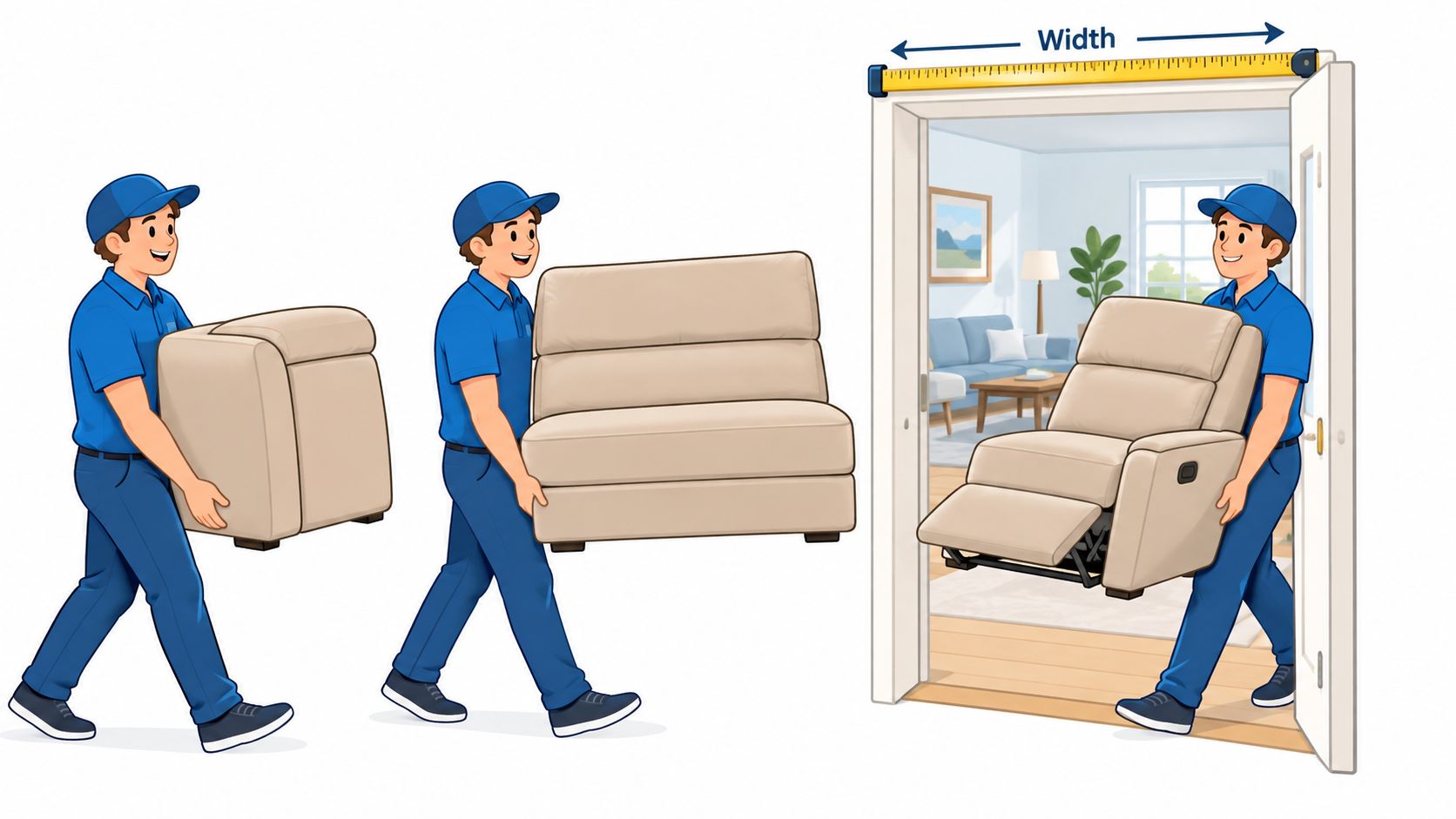
A one-piece sectional arrives as one large object. A sectional made from two or three connected pieces offers some flexibility, but those pieces may still be bulky. A true come-apart sectional allows modules to separate for carrying, enter the room individually, and connect again indoors.
Smaller isn't always easier
Reducing the overall seat dimensions can help, but it isn't the only answer. A slightly larger sectional with removable backs and movable modules may create fewer delivery problems than a smaller piece that cannot separate.
Come-apart construction can also help after a move. A layout that works in one home may need to change in another, and independent sections provide more options than a fixed one-piece shape.
Some shoppers worry that separation means weakness. It doesn't have to. A well-built modular frame can be solid once the pieces are connected. The important questions concern the frame, the joining hardware, the stability of the connection, and the instructions for moving or reassembling the modules.
Measure the route, not only the room
The delivery team needs a workable path from the exterior door to the final location. Measure the clear width of doors with them fully open, the narrowest hallway point, stair turns, ceiling height at tight corners, and the diagonal space available when a module must rotate.
The easiest sectional to live with may be the one that can be separated, not the one with the smallest seat dimensions.
This is especially relevant for apartments, condos, senior-living spaces, and older homes where a sharp turn can stop a large piece before it reaches the living room.
Is the Sleeper Built for Nightly Use or Just the Occasional Guest
A sleeper sectional can serve as a guest bed, a temporary bedroom, or a nightly sleeping space. Those roles place different demands on the folding frame, hinges, latches, and opening routine. Buy for the job the bed will do. A nightly sleeper justifies a thicker mattress and a sturdier mechanism than a twice-a-year guest bed.
Mechanism durability deserves a hands-on check. Open and close the sleeper several times in the showroom, using the same steady movement you would use at home. Watch for catching, scraping, excessive flex, or a frame that needs force to lock into place. Ask how the mechanism is supported and whether the moving parts remain stable after repeated cycles. One easy opening proves convenience, not long-term reliability.
Check the bed with sheets in place. Some designs hold a fitted sheet neatly when folded, while others bunch the fabric or make the sleeper difficult to close. Ask whether bedding can stay on the mattress between uses, and where pillows and blankets will go when the sectional returns to sofa mode. A storage ottoman or nearby closet may matter more than an extra decorative feature.
“Transitional use” describes a bed that fills a changing need rather than serving as a permanent primary bed. A college student might use it during school breaks. A caregiver or visiting relative might sleep there for several weeks while the household adjusts. In those cases, conversion should be manageable by the person using it, and the open bed should not block the home's basic paths.
Daily logistics can decide whether the sleeper gets used at all. If opening it requires moving a heavy recliner, clearing a coffee table, or lifting cushions into another room, the routine may become tiresome. Test the full conversion in the showroom, then confirm that the household can repeat it comfortably.
Bringing It All Together and Visiting the Showroom
Choose the sectional for the room with the bed open and the recliner extended. The closed position is the easy part. Doorway width, hallway turns, and the fully deployed footprint decide whether the arrangement works in a Milwaukee-area home.
Bring three questions to the showroom. Will the sleeper mattress suit occasional, regular, or nightly use? Can the people using the recliner manage its foot support, arms, controls, and transfers comfortably? Will a one-piece frame make delivery difficult, while a come-apart design can pass through the route in separate sections?
BILTRITE Furniture-Leather-Mattresses began in Milwaukee in 1928, when Irwin Kerns operated an upholstery shop that built and sold custom eight-way hand-tied sofas. The company later moved to Greenfield. Its showroom covers 45,000 square feet and includes thousands of furniture items and approximately 500 mattresses, according to this history of BILTRITE's Greenfield showroom. Members of the third and fourth generations of the founding family continue to operate the business.
At the showroom, look for the come-apart icon, sit in the recliner, test its controls, and open the sleeper fully. BILTRITE offers USA-made, Amish-made, solid-wood, small-scale, heavy-duty, senior-living, and mattress options. Ask the team about current Wisconsin tax treatment of power lift recliners rather than assuming how a purchase will be handled.
A hands-on visit replaces guesswork from photographs. Ask staff to confirm the open-bed clearance, recliner travel, delivery path, and whether the full arrangement suits your room.
Visit BILTRITE Furniture-Leather-Mattresses at 5430 West Layton Avenue in Greenfield for a no-pressure visit, test the sleeper and recliner together, and review the fit with the team.