Twin Panel Bed Guide: Styles, Sizing & Custom Options

A twin panel bed is built around a 38-by-75-inch mattress, but the finished bed needs additional floor space for its frame, headboard, footboard, and room circulation. The mattress footprint is compact, yet the bedroom still has to accommodate the complete furniture piece and the people using it.
That surprise often arrives during a furniture delivery. A bed looked manageable on paper, then the headboard reaches farther than expected, the footboard narrows the walking path, and a nearby dresser makes changing sheets awkward. Whether the room belongs to a growing child, a guest, or an older adult, the right twin panel bed starts with more than mattress dimensions.
Table of Contents
- Understanding What Makes a Twin Panel Bed Special
- Panel Bed Construction and Quality Indicators
- Twin Versus Twin XL Understanding Size Differences
- Comparing Panel Beds to Sleigh Beds and Bedframes
- Styling Twin Panel Beds for Kids and Guest Rooms
- Custom Ordering and Local Showroom Experience
- Common Twin Bed Misconceptions Worth Addressing
- Your Next Steps Finding the Right Twin Panel Bed
Understanding What Makes a Twin Panel Bed Special
A family may begin shopping for a twin bed because a child has outgrown a smaller sleep setup. Another household may need a guest bed in an apartment, while a caregiver may be arranging a comfortable room for an older relative. In each case, a twin panel bed offers a single-person sleeping surface with a more finished presence than an exposed metal frame.
The word “panel” describes the furniture around the mattress. A substantial headboard and footboard connect through side rails, creating an enclosed, architectural look. Depending on the design, the bed may use solid wood, engineered panels, slats, center supports, or built-in drawers. The construction changes the bed's outside footprint, but it doesn't change the mattress category.
Why the format remains useful
The twin format became associated with matching single beds, which helped explain the name “twin.” Historical accounts connect the wider use of twin-bed arrangements with changing ideas about hygiene, privacy, and flexible household layouts in the late nineteenth and early twentieth centuries. By the early 1900s, identical beds appeared in hotels, dormitories, boarding schools, and institutional rooms, and the arrangement later became fashionable in some middle-class homes. This history of the twin bed helps explain why the word refers both to a mattress size and, traditionally, one bed in a matching pair.
A panel bed brings warmth and visual height to that practical format. It can make a child's room feel more settled, give a guest room a welcoming focal point, or add a sense of permanence to a senior-living space. Readers looking at different silhouettes can also review BILTRITE's guide to types of beds before narrowing down a style.
Practical rule: Measure the finished furniture, not just the mattress. The headboard, footboard, rails, and storage determine how the room will actually function.
Panel Bed Construction and Quality Indicators
A quality panel bed should be judged by how its parts work together, not by a marketing phrase printed on a tag. The first inspection starts with the rails. They should connect securely to the headboard and footboard, because those joints carry movement every time someone sits down, turns over, or gets out of bed.
Solid wood offers a natural grain and a substantial feel, while engineered panels can provide a stable surface when properly designed and finished. Neither label tells the entire story by itself. A shopper should ask what material forms the rails, how the panels attach, and whether the support system matches the mattress and foundation requirements.
A practical construction check
The following questions help reveal the difference between appearance and structure:
What supports the mattress? Slats, a platform, or a foundation should support the mattress without leaving unsupported perimeter gaps. The spacing and center support matter more than decorative panel thickness.
How do the rails connect? Strong hardware and carefully made joinery help limit rocking and creaking. Readers curious about traditional furniture construction can learn more about the mortise-and-tenon joint, a joint associated with durable woodworking.
What does “solid wood” describe? The phrase should be clarified for the individual bed. It may describe the major frame parts while other components use engineered material or metal hardware.
Does the finish suit daily use? A family bed needs a finish that can handle routine cleaning and ordinary bumps without making care difficult.
Amish-made and USA-made furniture can bring careful workmanship and a strong focus on materials, but “USA made” requires particular attention. The Federal Trade Commission says an unqualified claim generally requires a product to be “all or virtually all” made in the United States, including domestic final assembly, significant processing, and components that are entirely or almost entirely domestic. The FTC's Made in USA guidance explains why shoppers should ask what the claim covers, including hardware, finishes, adhesives, and supports.
BILTRITE has specialized in USA-made, Amish-made, and solid-wood furniture in the Metro Milwaukee community since 1928. The store's associates can help shoppers examine rail connections, support systems, and finish details rather than relying on a label alone.
Twin Versus Twin XL Understanding Size Differences
The standard twin and Twin XL share the same approximate width, but they don't share the same length. A U.S. twin mattress generally measures 38 inches wide by 75 inches long, while a Twin XL measures approximately 38 by 80 inches, adding 5 inches of length without adding side-to-side width. These mattress size details make the choice especially important for teenagers, taller adults, and rooms where every inch affects circulation.
A standard twin panel bed is engineered for the standard twin opening. A Twin XL mattress normally won't fit correctly because the frame lacks the additional sleeping length. The reverse creates its own problem, since a standard twin in a Twin XL opening may leave unsupported space or shift during use. The Twin XL size guide can help shoppers keep the two specifications separate before ordering.
Measure the inside, then measure the room
The outside panel dimensions don't confirm mattress compatibility. Before purchasing, a shopper should verify:
- Mattress specification: Measure the actual mattress and confirm whether it's standard twin or Twin XL.
- Interior opening: Ask for the manufacturer's rail-to-rail dimensions, not only the outside measurements.
- Support system: Confirm that the slats, platform, or foundation support the selected mattress without gaps.
- Room footprint: Mark the complete bed outline on the floor, including the headboard and footboard.
- Access route: Measure hallway turns, stair corners, and door openings before delivery.
For a child's room, the standard twin may preserve more usable space. For a taller sleeper, the extra length of a Twin XL may improve comfort, but only if the room and panel bed are designed around it. Bedding and replacement parts must match the frame's stated size, not merely the shared width.
Comparing Panel Beds to Sleigh Beds and Bedframes
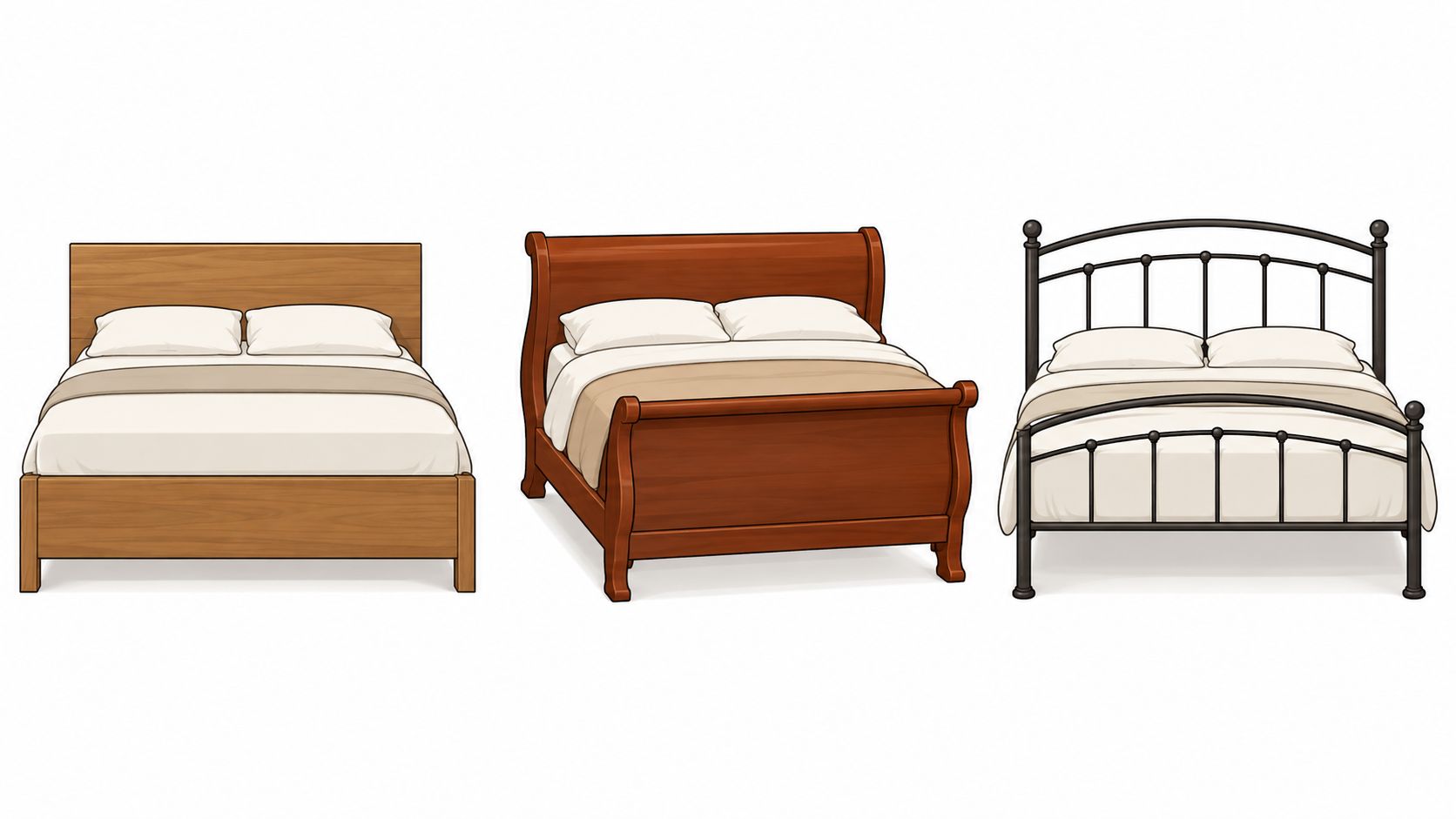
A panel bed, sleigh bed, and traditional bedframe can all hold a mattress, but they create very different rooms. The panel bed uses broad headboard and footboard surfaces joined by side rails. A sleigh bed typically has curved headboard and footboard profiles that bring more visual drama. A simple bedframe keeps the structure lighter and more visible, often emphasizing exposed slats or metal supports.
Choosing by room character
A panel bed suits a room that needs visual weight and an enclosed, coordinated appearance. It can work well with a bedroom suite, especially when the household wants the bed to feel like lasting furniture rather than a temporary frame. A sleigh bed makes a stronger decorative statement, and its curves may require extra attention to wall placement and surrounding furniture.
A traditional frame may appeal to someone who values a minimalist silhouette, easy access around the mattress, or a lighter look in a small room. It can also make sheet changes simpler because fewer panels surround the mattress. The trade-off is that it may provide less visual warmth and fewer opportunities for integrated storage.
| Style | Main character | Planning question |
|---|---|---|
| Panel bed | Enclosed, substantial, and furniture-like | Will the panels leave enough circulation space? |
| Sleigh bed | Curved and decorative | Do the curves fit the room's scale and style? |
| Traditional bedframe | Open and streamlined | Does the exposed structure provide the desired support and appearance? |
Storage changes the decision again. Drawers or shelving can reduce the need for separate furniture, but they may increase the bed's footprint or restrict access from one side. Shoppers comparing curved profiles can read about what a sleigh bed is before deciding whether a panel design better suits the home.
Styling Twin Panel Beds for Kids and Guest Rooms
A twin panel bed can anchor a room without making the space feel childish. In a child's bedroom, simple bedding and a washable accent can leave room for the child's interests to change. A warm wood finish, a small lamp, and a few carefully chosen textiles can make the same basic furniture feel settled rather than temporary.
A guest room benefits from the opposite approach. Neutral bedding, layered lighting, and a clear surface beside the bed create a welcoming place for visitors. The panel becomes the room's steady element, while colors and accessories can change with the season or the family's taste.
Style and safety need to work together
A beautiful room still has to be easy to use. Dressers, bookcases, televisions, cords, and climbable storage near a bed can create hazards, particularly for children and older adults. The U.S. Consumer Product Safety Commission estimates 17,800 emergency-department-treated injuries annually from furniture, television, and appliance tip-overs, based on 2020–2022 data; children younger than 18 represented 44% of those injuries, and children ages 1–3 represented 22% of all cases. The CPSC's tip-over safety guidance supports a room plan that includes anchoring and clear movement paths.
For older adults, the same release reports that furniture-only tip-over injuries among adults aged 60 and older increased from an estimated 1,800 in 2013 to 4,300 in 2022. A practical arrangement should keep the transfer side open, place heavier items low, secure dressers and bookcases to wall studs, and leave room for a mobility aid. The headboard or footboard shouldn't obstruct the route to the bathroom or doorway.
Elevated and bunk configurations require extra care. When the underside of the foundation is more than 30 inches above the floor, CPSC requirements call for guardrails on both sides, with the wall-side guardrail running continuously. Guardrails must rise at least 5 inches above the top of the thickest recommended mattress, and children younger than six shouldn't use the upper bunk. The CPSC bunk-bed test manual explains why mattress thickness and rail geometry must be treated as one safety system.
Custom Ordering and Local Showroom Experience
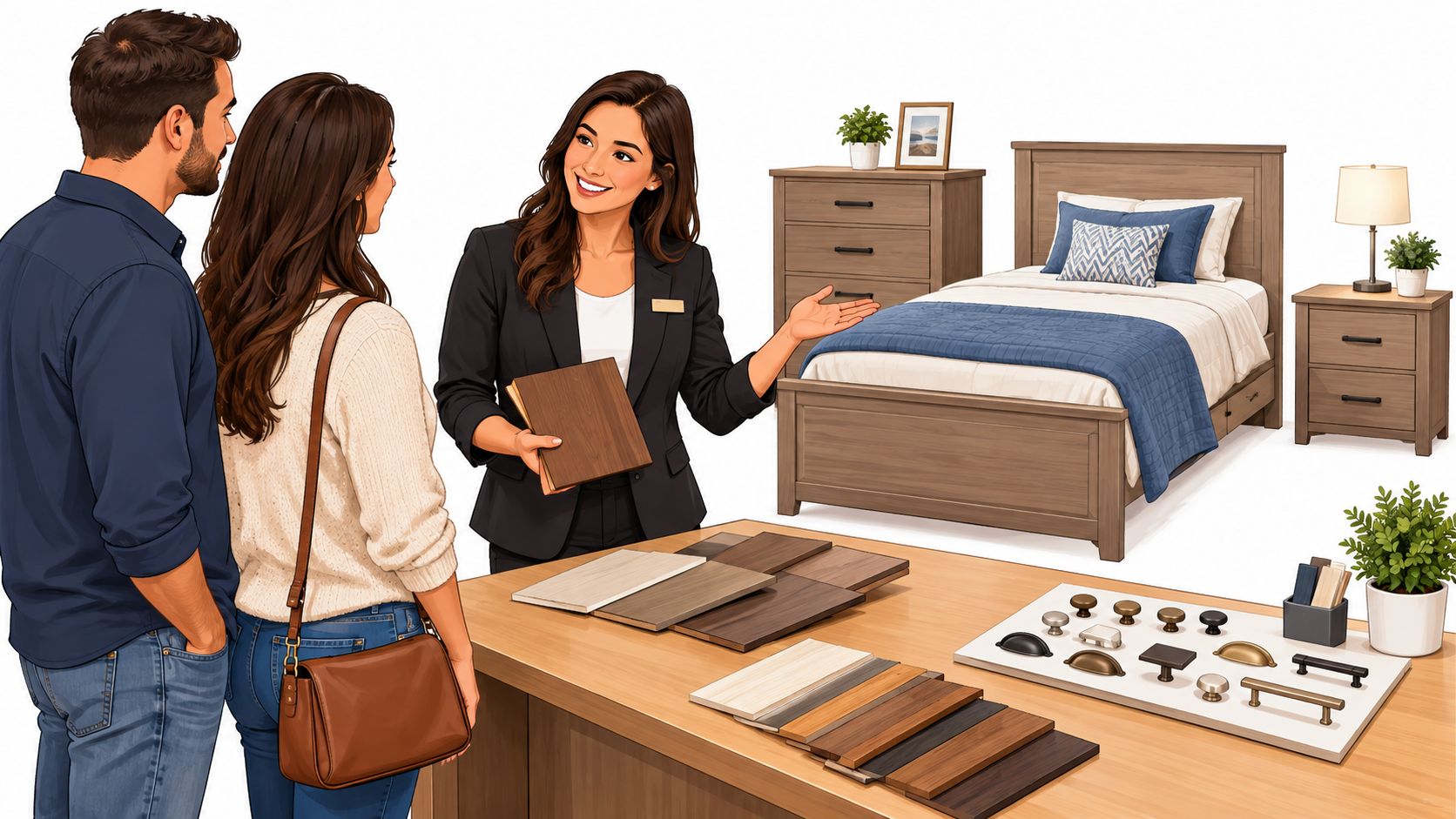
Custom ordering starts with measurements, not paint chips. A shopper should bring the room dimensions, mattress specification, preferred transfer side, and delivery route to the showroom. That information lets a furniture associate discuss wood, finish, hardware, panel design, storage, and the practical limits of the room.
A useful showroom conversation
A thoughtful ordering process often follows this path:
- Describe the sleeper and room. A child, guest, or older adult may need different clearance, support, and access choices.
- Confirm the mattress size. Standard twin and Twin XL should be treated as separate specifications.
- Review materials and finish. Solid wood, engineered panels, and mixed-material construction each have a place, but the buyer should know what forms the structural parts.
- Check delivery access. Hallway turns, stairways, door swings, and tight entry points can affect which design is practical.
- Write down the final details. The order should identify the size, finish, hardware, support system, and any storage features.
A local showroom makes the conversation hands-on. Shoppers can see the panel proportions, touch wood samples, compare finishes in person, and judge whether a footboard feels too imposing for the room. BILTRITE's guide to getting started with a custom order offers a useful starting point for families who want a more personalized piece.
BILTRITE is a fourth-generation, family-owned business serving Metro Milwaukee since 1928. The showroom offers affordable, better-quality furniture, USA-made and Amish-made options, custom choices, small-scale pieces for apartments and senior living, and heavy-duty furniture for demanding households. Its sales associates have more than 400 years of combined experience, so shoppers can ask detailed questions without feeling rushed.
Common Twin Bed Misconceptions Worth Addressing
The first misconception is that twin beds belong only in children's rooms. The compact sleeping surface works in guest rooms, apartments, dormitory-style spaces, and senior-living settings. A panel design can make the bed feel more like permanent furniture, which suits adults who need a smaller footprint without wanting a temporary-looking frame.
The second misconception is that “twin” tells a shopper how much room the finished bed needs. It doesn't. The mattress measures approximately 38 by 75 inches, but the headboard, footboard, rails, storage, and required circulation add to the furniture footprint. One planning guide recommends at least a 7-by-9-foot room for a twin, while another lists 7 by 10 feet as a recommended minimum and 8 by 10 feet as a more practical room size with additional furniture. This room planning guide makes clear that those figures are benchmarks, not universal building-code requirements.
Smaller doesn't mean simpler
A compact room can demand more planning because every obstruction matters. Before ordering, a shopper should mark the outside bed dimensions with painter's tape, test the door swing, check closet access, and reserve room for a nightstand or lift-assist device. The bed may fit while the room still fails as a usable bedroom.
A third misconception is that all panel beds provide the same support. Panel thickness alone doesn't prove durability. Rail connections, slat design, center support, material quality, and the match between the interior opening and mattress determine how the bed performs.
Finally, custom ordering isn't automatically complicated. Clear measurements and a short list of priorities can simplify the process. A local associate can help separate the must-haves from the nice-to-haves, whether the goal is a warm solid-wood finish, compact scale, storage, or easier access for an older sleeper.
Your Next Steps Finding the Right Twin Panel Bed
A shopper standing in a bedroom with a tape measure can make the next decision much easier. The first task is to record the mattress size, then measure the wall, door swings, closet openings, walking path, and delivery route. Painter's tape can outline the bed's outside footprint before anyone places an order.
The next task is to prepare questions. A useful list includes:
- Interior fit: Is the bed designed for a standard twin or Twin XL?
- Support: What slat, platform, or foundation system does it require?
- Construction: Which parts are solid wood, engineered material, or metal?
- Safety: Are there special limits for mattress thickness or raised use?
- Delivery: Can the finished piece reach the bedroom through the home's tightest turn?
Families in Metro Milwaukee can compare small-scale, solid-wood, Amish-made, USA-made, and heavy-duty furniture in person at BILTRITE. The showroom also has a large mattress department with over 60 models, giving shoppers a place to consider the mattress and frame as one coordinated setup. In Wisconsin, power lift recliners are exempt from sales tax, which can make mobility assistance more affordable for households furnishing an older adult's room.
A twin panel bed should feel comfortable in the room before it ever arrives. The right local team can help a family balance style, construction, safety, access, and budget without turning the decision into a sales contest.
BILTRITE Furniture-Leather-Mattresses offers USA-made, Amish-made, solid-wood, small-scale, and custom furniture for homes across Metro Milwaukee, along with a large mattress selection and experienced in-store guidance. Visit BILTRITE Furniture-Leather-Mattresses in Greenfield for a no-pressure, hands-on chance to test comfort, compare finishes, and ask questions about the right twin panel bed.