Should I Flip My Mattress? a Friendly Guide to Mattress Care


Most modern mattresses should not be flipped unless they're specifically designed as two-sided, and rotating a one-sided bed head-to-foot is the safer maintenance move. New mattresses are often rotated every 2–3 months during the first year, while established mattresses are commonly rotated every 6 months. Mattress maintenance guidance can vary by construction and age, so the mattress label and warranty instructions should have the final say.
Someone is standing at the foot of the bed, tugging at the fitted sheet and remembering a parent who flipped a mattress every few months. That old habit made sense for the beds of that era. Today, the same move could put the wrong support layer under the sleeper and create more trouble than it solves.
Table of Contents
- The Quick Answer on Flipping Your Mattress
- Why Mattress Flipping Advice Changed Over the Years
- Two-Sided Versus One-Sided Mattress Construction
- How to Tell If Your Mattress Is Flippable
- Rotation and Flipping Schedules by Mattress Type
- Warranty Risks and Durability Tradeoffs
- Visit BILTRITE for Personalized Mattress Guidance
The Quick Answer on Flipping Your Mattress
The short answer to “should I flip my mattress” is usually no. Most current mattresses have a designated top and bottom, with comfort materials above a support base. Turning that structure upside down can leave the firmer underside facing the sleeper, changing the feel and reducing the support the manufacturer intended.
Rotating is different from flipping. Rotation turns the mattress head-to-foot while keeping the same sleeping surface on top. That shift redistributes pressure across the surface, which can help limit localized wear without disturbing the internal layer order. A one-sided memory foam, hybrid, or pillow-top mattress generally belongs in this rotate-only group, as outlined in BILTRITE's mattress care guidance.
The decision in plain language
- Two-sided construction: Flip it only if the manufacturer identifies both faces as sleeping surfaces.
- One-sided construction: Rotate it head-to-foot instead of turning it upside down.
- Unclear construction: Check the tag, product paperwork, and warranty before moving it. If the answer remains uncertain, rotation is the safer choice.
Practical rule: A mattress benefits from flipping only when both sides were built to support a sleeper.
The confusion is understandable because older family advice wasn't careless. Traditional mattresses were often made differently. The important question isn't what worked for a relative's bed, but what the current mattress has inside.
Why Mattress Flipping Advice Changed Over the Years
If a relative tells you to flip your mattress every season, that advice may come from the way beds were built in their home. For much of the twentieth century, mattresses were commonly true two-sided innerspring units, with springs and cotton arranged on both faces. Historical summaries describe that design as common from the first innerspring mattresses through about the 1970s. This mattress history explains why older family guidance still sounds reasonable.
Both sides could handle a sleeper's weight. Flipping moved the used surface away from the sleeper, gave it time to recover, and put the alternate comfort surface on top. The care advice matched the construction, so it could help distribute wear and support longer service life.
The construction shift
Manufacturers began moving toward one-sided designs after a major manufacturer introduced such a design in 2000. By 2007, many had adopted one-sided construction, and care instructions commonly changed from “flip” to “rotate only.” That change affects more than comfort. Flipping a one-sided mattress can place its support base against the sleeper, create uneven pressure, and potentially conflict with the product's warranty requirements. The historical timeline is summarized in This mattress history.
A regulatory change also shaped production. The U.S. mattress flammability standard 16 CFR Part 1633 took effect in 2007. Industry accounts say the requirements applied to the sleep surface, while building one usable surface simplified production compared with preparing two. Background on the flammability standard and construction change provides context for that shift.
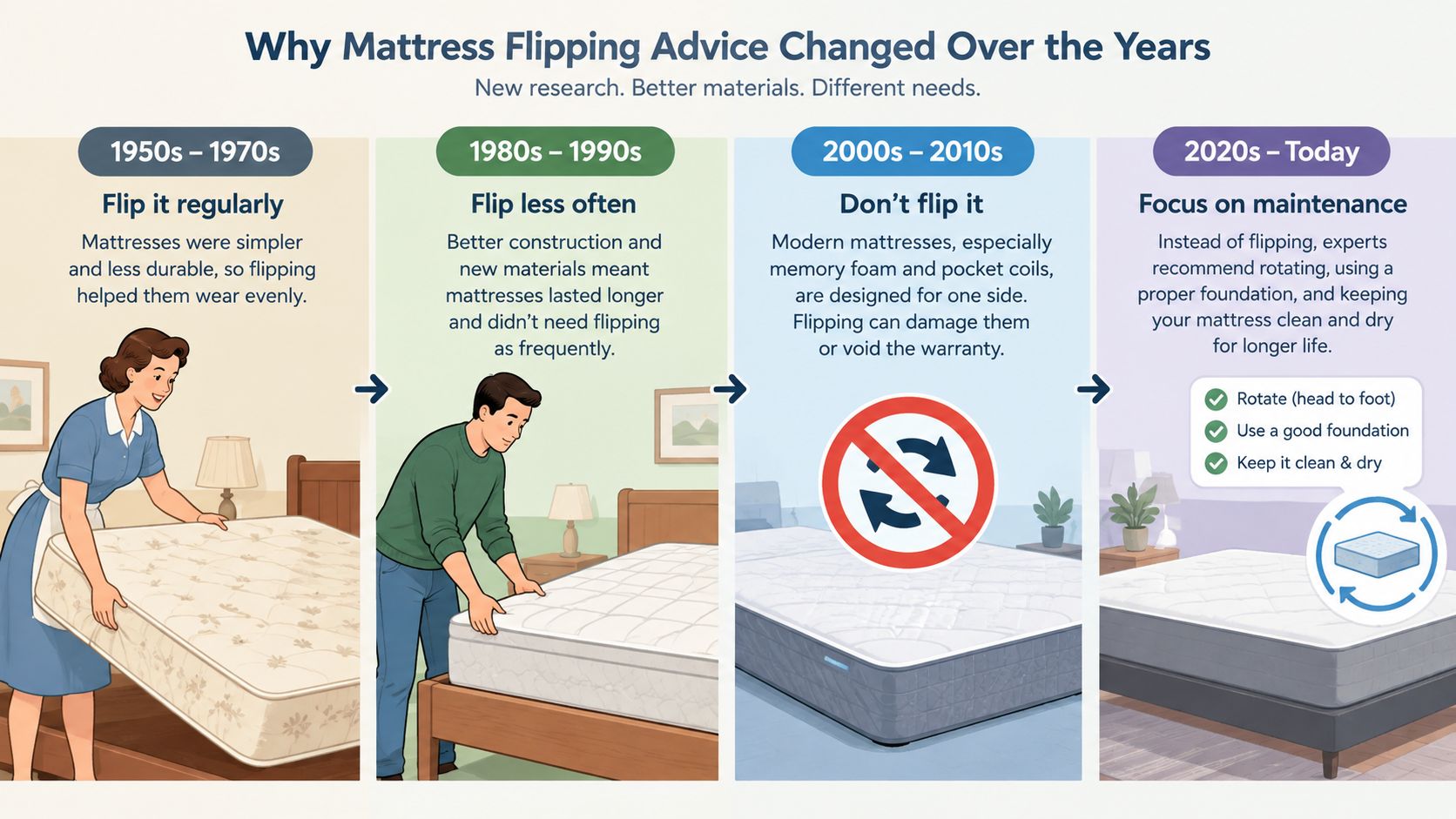
Older advice was not careless. It belonged to a different design. At our local showroom, we start with the mattress construction and warranty, then decide whether flipping will extend its usable life or cause avoidable wear.
Two-Sided Versus One-Sided Mattress Construction
A two-sided mattress is built like a reversible jacket. Both faces contain materials arranged for sleeping, so the comfort layers, support structure, and quilting can work in either direction. Flipping gives each surface time to carry the sleeper's weight, which can distribute wear and help the mattress stay comfortable longer.
A one-sided mattress follows a fixed recipe, more like a layered cake. The top holds cushioning and pressure-relieving materials, while the underside contains a support layer meant to rest on the foundation. Turn it over, and the base is suddenly taking direct body contact. That can change the feel, reduce support, and wear materials that were never designed as a sleep surface.
What the common categories usually mean
Older innerspring mattresses are more likely to be two-sided, although age alone does not confirm that construction. Newer innerspring models may have a designated top and bottom. Memory foam, hybrid, and pillow-top mattresses also commonly use fixed layers, so rotation is usually the appropriate care method. Sleep Foundation's guidance on flipping and rotating explains the difference between these care approaches.
| Mattress Type | Typical Construction | Flip or Rotate |
|---|---|---|
| Older innerspring | May have usable comfort and support materials on both faces | Flip only when identified as two-sided |
| Newer innerspring | Often has a designated top and bottom | Rotate |
| Memory foam | Comfort foam above a structured support base | Rotate |
| Hybrid | Springs combined with fixed comfort layers | Rotate |
| Pillow-top | Extra cushioning attached to one sleeping surface | Rotate |
The practical issue is pressure calibration. A one-sided mattress's underside may expose a hard or unsuitable layer when flipped. The result can be less cushioning, altered spinal support, and faster wear. In a local showroom, we treat flipping as a durability choice, not a routine chore. For a confirmed two-sided mattress, sharing wear between both faces may extend its useful life. For a one-sided model, flipping can create avoidable damage and may conflict with warranty care requirements.
For a closer comparison of construction types, see BILTRITE's guide to two-sided and one-sided mattresses.
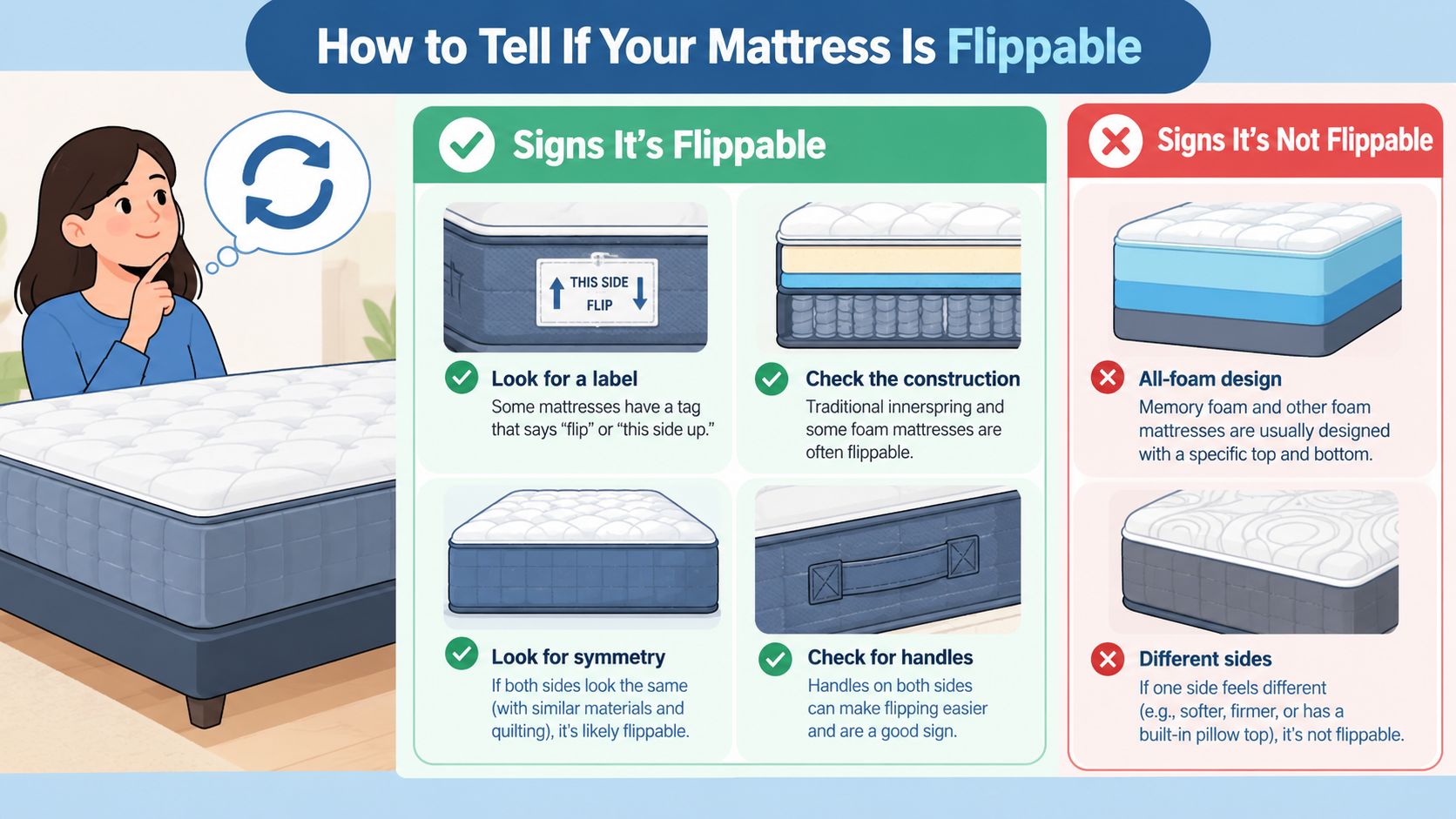
How to Tell If Your Mattress Is Flippable
The mattress itself usually provides clues, but the manufacturer's instructions are more reliable than appearance alone. A bed can look substantial and old-fashioned while still having one intended sleep surface. It can also have handles that help with moving, not flipping.
Start with the label
Look along the mattress edge for a law label, model tag, care label, or sewn-in product information. Terms such as “two-sided,” “double-sided,” or “flippable” support flipping, while language identifying a top side or rotate-only care points the other way. The original receipt, product sheet, and warranty terms can settle the question when the tag is hard to read.
Next, inspect both faces. A two-sided design often has comparable quilting, padding, and finished fabric on each side. An unfinished underside, non-skid material, visibly different stitching, or a thin base cover suggests a one-sided build. Handles on both sides can be useful, but handles alone aren't proof that both surfaces are intended for sleeping.
Use touch as a supporting clue
Press both surfaces with an open hand. A two-sided mattress may feel similarly cushioned on each face, while a one-sided model often has a noticeably padded top and a firmer, more basic underside. This test can guide an inspection, but it shouldn't replace written care directions.
Secondhand and inherited mattresses require extra caution because the original documentation may be missing. If the construction can't be confirmed, rotating head-to-foot avoids reversing the layer stack. Readers comparing surface styles can also consult BILTRITE's explanation of tight-top mattresses.
Rotation and Flipping Schedules by Mattress Type
A mattress that looks fine today can still develop a dip if its weight stays in one area. A simple calendar reminder helps you care for it before wear becomes obvious. The schedule depends on the materials, the mattress's age, and whether both faces are designed for sleeping.
For a new bed, rotate it every 2–3 months during the first year, then every 6 months once it has settled. Schedule guidance by mattress age also separates care for newer and older innerspring designs. For step-by-step instructions, see BILTRITE's guide on how to rotate a mattress.
A practical schedule
- Memory foam: Rotate 1–2 times per year, following the care instructions. This range reflects general maintenance recommendations.
- Latex: Rotate 1–2 times per year, unless the product guide gives different directions.
- Newer innerspring: Rotate 1–2 times per year, checking the manufacturer's instructions.
- Older innerspring: Rotate 2–5 times per year, depending on its construction and visible wear pattern.
- True two-sided mattress: Flip and rotate every 6 months when the manufacturer permits both actions. The written care guidance should take priority.
A two-sided mattress benefits from changing both the face and the head-to-foot position, spreading use through more of its structure. A one-sided mattress should be rotated head-to-foot only. Sleep Foundation's maintenance recommendations also distinguish rotation from flipping and place care instructions ahead of a universal schedule.
Before moving a heavy mattress, clear the path and ask another person to help. At our local showroom, we often suggest marking the next rotation on a household calendar. It is a small habit that can protect comfort, durability, and the warranty's intended use.
Warranty Risks and Durability Tradeoffs
Flipping the wrong mattress can turn a well-intended care routine into a construction problem. The bottom support layer may not be calibrated for direct pressure, so placing it on top can change the bed's feel and compromise the way it supports the body. Guidance on flipping versus rotating also highlights the warranty concern, since using a mattress contrary to its design may affect coverage.
Why the risk matters
A one-sided mattress depends on an ordered layer stack. The comfort surface cushions the sleeper, transition materials manage pressure, and the support base stabilizes the structure against the foundation. Reversing that arrangement can create uncomfortable firmness, uneven loading, and faster breakdown in layers that weren't made for nightly contact.
Warranty language deserves a careful reading before any flip. If the manufacturer specifies rotation only, flipping may be treated as misuse rather than routine maintenance. That doesn't mean every problem will automatically void coverage, but it does mean the owner shouldn't assume that an upside-down mattress remains within the product's intended use.
True two-sided mattresses offer the opposite tradeoff. Alternating faces distributes body-load stress and can slow permanent impressions in the comfort layers. In that specific construction, flipping can support durability because the bed is designed to share the workload between both surfaces. The action extends useful comfort only when the mattress was engineered for it in the first place.
Visit BILTRITE for Personalized Mattress Guidance
The safest routine is straightforward: identify the construction, follow the care instructions, and rotate instead of flipping whenever the mattress is one-sided or uncertain. A true two-sided mattress can benefit from alternating faces, while a modern layered mattress needs its top and bottom kept in the correct order. Anyone testing a replacement bed can use BILTRITE's mattress testing guide to think through comfort and support in person.
BILTRITE is a fourth-generation, family-owned furniture store serving Greenfield and Metro Milwaukee since 1928. Its mattress department includes over 60 models, and the store carries flip-able and two-sided options for shoppers who specifically want that construction. The team's sales associates bring over 400 years of combined experience and can explain the care requirements without pressure.
BILTRITE Furniture-Leather-Mattresses offers a broad mattress selection, including one-sided beds and flip-able, two-sided designs that relate directly to long-term care. Visit BILTRITE Furniture-Leather-Mattresses in Greenfield, test the options in the showroom, and let the local team help match the mattress construction to the household's comfort and maintenance needs.