Furniture Made in USA: What It Really Means and Why It


The Martinez family has reached the third furniture store of the afternoon. Two children are arguing in the back seat, while their parents are comparing three nearly identical sofas, each with a different origin story on the tag. One says Made in USA, another says assembled domestically, and the third offers no clear answer at all.
That confusion is common. In 2026, furniture made in USA can mean a fully domestic hardwood build, a frame assembled here from imported components, or a piece distributed by an American company without being built domestically. The label matters, but the construction behind it matters more.
For families in Metro Milwaukee, the showroom floor is where those differences become clear. A shopper can sit on the sofa, inspect the frame, open a drawer, ask about the warranty, and learn whether a piece is built for everyday life or styled only to look good on delivery day.
Why Where Your Furniture Is Built Actually Matters
Furniture origin affects more than a patriotic feeling. It can shape the materials selected, the people responsible for assembly, the availability of replacement parts, and the kind of support a household receives years after the sale.
A domestic hardwood table, for example, may offer a different repair path than a table built from engineered panels and shipped through several supply-chain stages. A locally supported upholstered sofa may also provide clearer answers about frame construction, cushion options, fabric selection, and service. Those details become important after children climb across the cushions, pets claim the best seat, or a move puts stress on a tabletop.
The label also deserves context because American furniture production has a substantial history. A USDA and Forest Service review describes long-standing concentrations in the Midwest, South, and Southwest, with the leading producing states accounting for about two-thirds of U.S. furniture and kitchen-cabinet output. The same review records a loss of 108,000 furniture-industry jobs, or 21% of the workforce, between 1997 and the early 2000s, a reminder that domestic manufacturing has faced serious restructuring even while regional production clusters remained important. The historical furniture manufacturing record shows why a country-of-origin label shouldn't be treated as a simple story of steady growth.
Practical rule: A country label starts the conversation. Joinery, materials, upholstery construction, warranty coverage, and service finish it.
What shoppers should examine
Before a credit card comes out, the Martinez family should ask:
- What is the frame made from? Solid hardwood, plywood, engineered wood, or a mixture?
- Where does assembly happen? A domestic facility may still use globally sourced components.
- Can the piece be repaired? Ask about replacement cushions, hardware, finish touch-ups, and structural service.
- What does the warranty cover? A long warranty means less if the seller can't explain how claims are handled.
- Will it fit the room and the home? A well-built sofa that can't pass through the doorway isn't a useful purchase.
The best furniture made in USA decisions combine origin with evidence. A shopper shouldn't pay extra for a flag icon alone. The right piece should also feel stable, fit the household, and offer a sensible path for care and repair.
What Made in USA Really Means in 2026
The phrase Made in USA has both a legal meaning and a practical meaning. Under the Federal Trade Commission's substantial transformation standard, a company may use a USA-origin claim when the product's last substantial transformation occurs in the United States. That doesn't automatically mean every screw, cushion component, mechanism, or fabric originated here.
This distinction is why showroom questions matter. A product may be built in an American facility while using some imported parts. Another product may be assembled domestically from a more globally sourced system. A third may be sold by an American retailer but manufactured elsewhere. Those are different supply-chain positions, even if the marketing language feels similar.
The domestic industry remains large enough to matter. In 2026, the United States has 3,736 household furniture manufacturing businesses, projected industry revenue of $28.4 billion, and an estimated 269,177 workers across furniture and fixtures manufacturing. The sector is regionally concentrated, with the South accounting for 33% of furniture manufacturers and the Midwest accounting for 28%. Bureau of Labor Statistics furniture manufacturing data supports a straightforward conclusion: furniture made in USA is a major manufacturing segment, not a tiny specialty category.

A useful origin spectrum
Shoppers can place furniture into three practical groups:
- Built domestically. Most major construction and assembly occur in American facilities.
- Assembled domestically. The final build happens here, but some important components may come from other countries.
- American-distributed. An American business sells or distributes the product, but the manufacturing occurs elsewhere.
The tag, hangtag, manufacturer's mark, and salesperson should help clarify which group applies. BILTRITE's guide to American-made furniture companies can also help shoppers understand the broader category before visiting a store.
The practical takeaway is simple. A USA label can be meaningful without promising that every material is domestic. Responsible shoppers ask what was built here, what was sourced elsewhere, and how those decisions affect durability, repairability, delivery, and support.
The Real Benefits of Buying Furniture Made in USA
Buying domestic furniture can support more than the person ringing up the sale. It can keep demand connected to woodworkers, finishers, upholsterers, repair professionals, freight providers, and other workers involved in the product's path from material to living room.
That doesn't make every American-made piece automatically well built. It does create a clearer opportunity to ask who made it, how it was made, and what support exists after delivery. A local retailer can often explain those details more directly than a product page with a few polished photographs.
Craftsmanship that earns its place
The strongest quality benefit comes from construction choices. A solid hardwood frame, carefully fitted joints, properly supported upholstery, and a finish designed for service can give a piece a better chance in a busy household. The result isn't just attractive furniture. It's a sofa that remains comfortable, a dining table that can be refreshed, or a drawer that can be adjusted instead of discarded.
Materials matter, too. Industry data reports that only 15% of U.S. furniture companies report importing raw materials, while 23% report international distribution. Those figures suggest that many manufacturers remain domestically anchored in labor and assembly even when some components move through global channels. U.S. furniture manufacturing sourcing data gives shoppers a useful reason to ask detailed questions rather than treating origin as all or nothing.
Sustainability and household comfort
A repairable piece can reduce the need for replacement. A refinished hardwood tabletop or a recoverable chair keeps useful material in the home longer than a disposable product that can't accept replacement parts.
Health considerations also belong in the conversation. Shoppers can ask about finish chemistry, upholstery materials, wood sourcing, and ventilation during production. Those questions are especially relevant for bedrooms, nurseries, and homes where people spend a lot of time close to the furniture.
A domestic purchase can also make service more practical. If a cushion, drawer slide, finish, or structural component needs attention, a local showroom may be able to coordinate the next step with a person who knows the original order.
How to Spot Authentic USA-Made and Amish-Made Pieces
A good showroom visit should feel like a conversation, not a scavenger hunt. Still, shoppers need a repeatable way to evaluate the icons and claims attached to furniture made in USA.
Start with the salesperson. The most useful questions are specific:
- Where was the wood harvested? Ask whether the piece uses domestic hardwood, imported wood, veneer, or a combination.
- Where does joinery happen? Final assembly location doesn't always tell the whole story.
- What parts are imported? Mechanisms, hardware, springs, foam, and fabrics may have different origins.
- Are cushions sewn domestically? Upholstered furniture deserves its own sourcing explanation.
- What does the warranty cover? Ask about the frame, finish, fabric, mechanisms, and available repairs.
Read the piece, not just the tag
Hangtags and manufacturer's marks can identify the maker and country-of-origin disclosure. The Federal Trade Commission's rules make origin claims important, but the tag still needs to be read alongside the construction details.
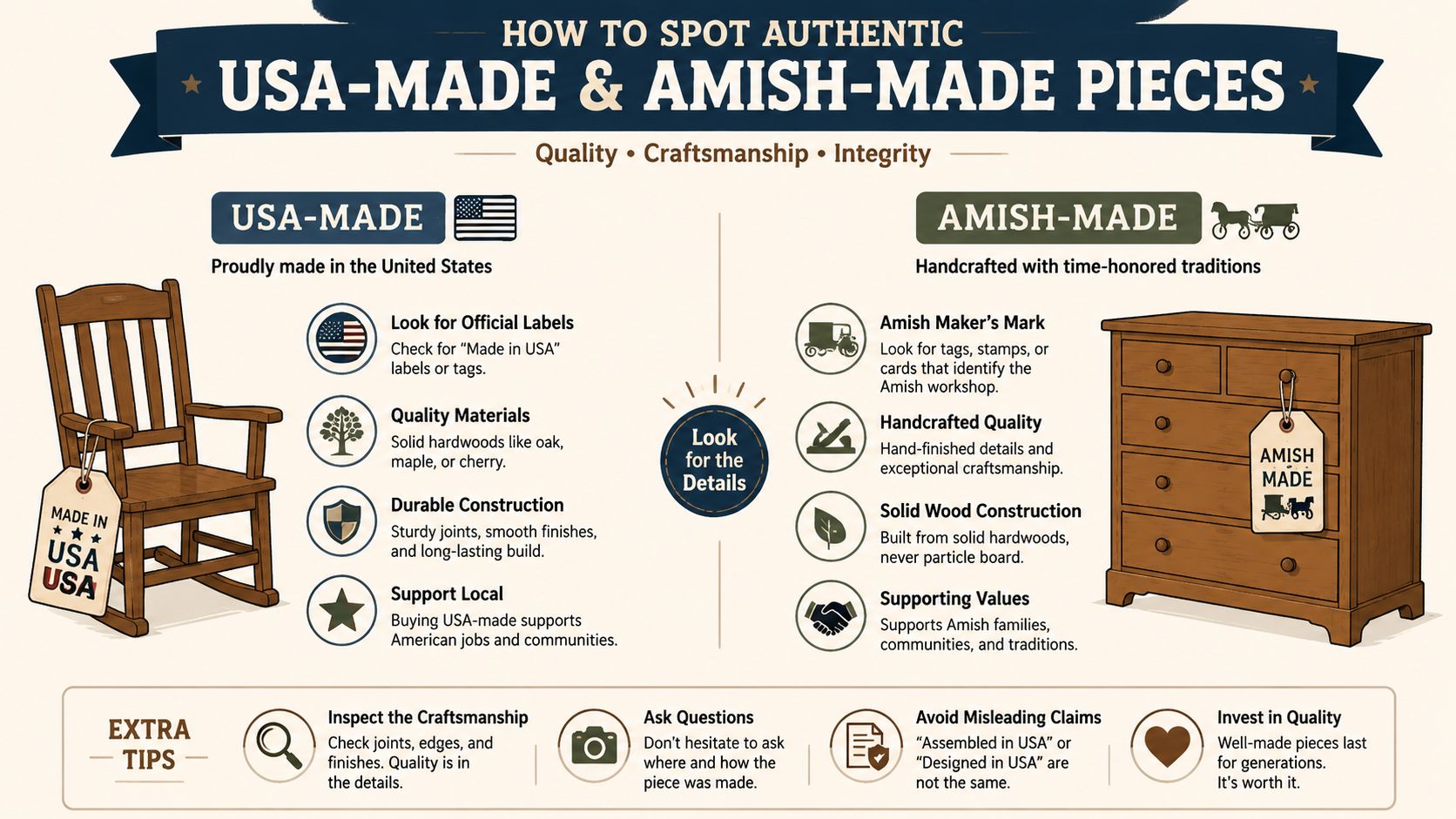
At BILTRITE, the USA-made flag icon identifies products built in American facilities. The Amish-made icon identifies handcrafted solid hardwood pieces produced through partner workshops. Those icons help narrow the search, but shoppers should still inspect the furniture itself.
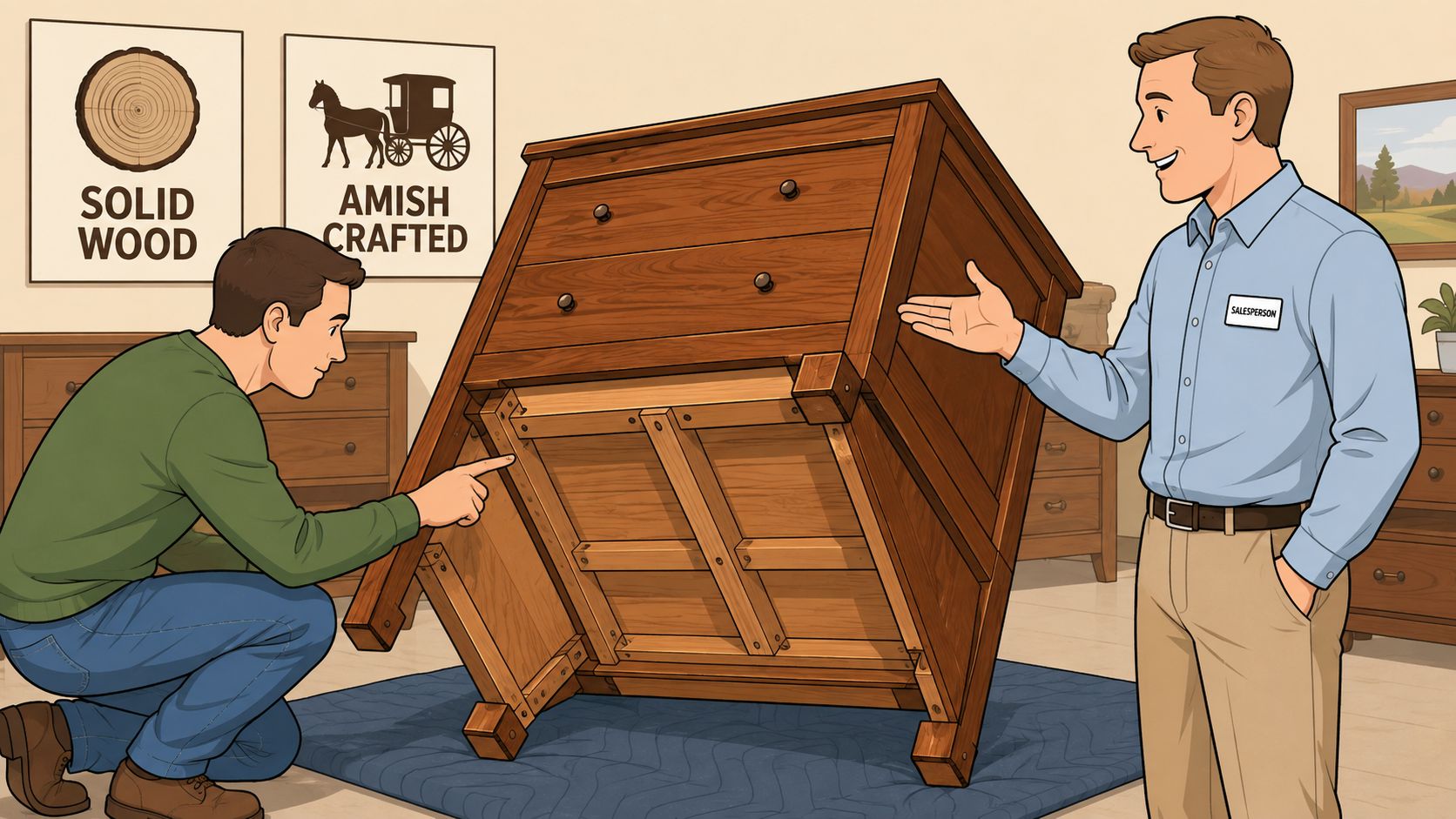
Open drawers and examine the joinery. Look beneath tables and chairs. Check whether edges feel like solid wood or reveal a particleboard core. Flip cushions when the design allows, press along the frame, and test whether doors and drawers move smoothly.
For shoppers who want to understand one traditional construction method more closely, BILTRITE's explanation of mortise-and-tenon joints provides useful background.
What the icons should help clarify
A USA-made marker should lead to a conversation about domestic construction and the manufacturer's production location. An Amish-made marker should point toward solid hardwood, traditional woodworking, and a traceable workshop relationship.
The icon isn't a substitute for questions. It's a useful doorway into them.
What Makes Amish Furniture Different from the Rest
Amish furniture stands apart through visible construction choices, not through a decorative style. It's commonly associated with solid hardwood boards such as oak, cherry, maple, and walnut, with limited plywood use in areas such as drawer boxes or backs when added strength makes sense. This explanation of Amish solid-wood construction helps separate the material tradition from vague claims about being “handcrafted.”
Traditional joinery also changes how a piece behaves over time. Mortise-and-tenon joints and dovetail drawers can create strong connections that are serviceable when a piece eventually needs attention. A particleboard cabinet with damaged edges often offers fewer repair options, while a solid hardwood table may be refinished, adjusted, or restored.
Construction differences at a glance
| Feature | Amish-Made | Mass-Produced Import |
|---|---|---|
| Materials | Commonly solid hardwood, with limited plywood in selected areas | May use engineered panels, veneers, or mixed materials |
| Production | Smaller workshop production and hands-on craftsmanship | Larger-scale manufacturing and standardized production |
| Joinery | Traditional methods such as mortise and tenon or dovetails | May rely on fasteners, cam hardware, adhesives, or mixed methods |
| Customization | Wood species, stain, hardware, dimensions, and other options may be available | Options are often tied to a fixed catalog |
| Repairability | Solid components can support refinishing and selected repairs | Damaged engineered panels can be difficult to restore |
| Design character | Wood grain and hand-finished details remain central | Repeated designs prioritize consistency and efficient production |
The slower workshop approach can also help explain why Amish-made furniture feels different in the hand. A solid top has visual depth. A properly fitted drawer has a distinct movement. A chair or cabinet often carries small details that reveal careful attention instead of a rushed assembly line.
BILTRITE's guide to the advantages of Amish furniture offers additional context for shoppers comparing solid hardwood construction with lower-complexity alternatives.
Repairability is part of quality. Furniture doesn't have to remain untouched forever to be valuable. It needs a sensible way to stay useful.
Why Shopping a Local Showroom Beats the Algorithm
An algorithm can show a sofa from several angles. It can't tell whether the seat feels supportive after ten minutes, whether the arm height works for a shorter family member, or whether the tabletop wobbles when someone leans against it.
A showroom answers those questions quickly. Shoppers can sit, recline, lean back, open drawers, touch finishes, compare seat depths, and check table clearance. Those physical tests reveal information that photographs routinely hide.
Comfort needs a real test
A family with young children may need a different sofa than a household that hosts occasional guests. A senior may need a lift chair or a supportive seat with easier access. Someone furnishing an apartment may need small-scale furniture, a come-apart sectional, or a piece that can fit through a narrow doorway.
Those needs aren't solved by a search filter alone. A knowledgeable associate can ask about room dimensions, daily use, pets, children, mobility, and delivery access, then guide the shopper toward practical options.
BILTRITE's team brings over 400 years of combined furniture experience, which gives shoppers access to plain-language comparisons across frames, reclining mechanisms, upholstery, mattresses, and wood construction. The point isn't pressure. It's translation. A staff member can explain what a feature does and whether it solves an actual household problem.
Origin claims are easier to verify in person
A local showroom lets shoppers see the USA-made and Amish-made icons beside the furniture rather than relying on an isolated listing. The team can explain customization, expected lead times, warranty terms, and care requirements before the order is placed.
Delivery deserves the same attention. White-glove delivery typically includes in-home placement, assembly or installation, and removal of packaging debris, rather than leaving a large item at the curb. This overview of white-glove final-mile service explains why that upgrade can matter for heavy furniture, tight entryways, seniors, and households that don't want to manage assembly.
A useful preparation step is reviewing how to use online furniture photos more intelligently, then using the showroom to confirm what the images can't prove.
Is USA-Made Furniture Really Worth the Price
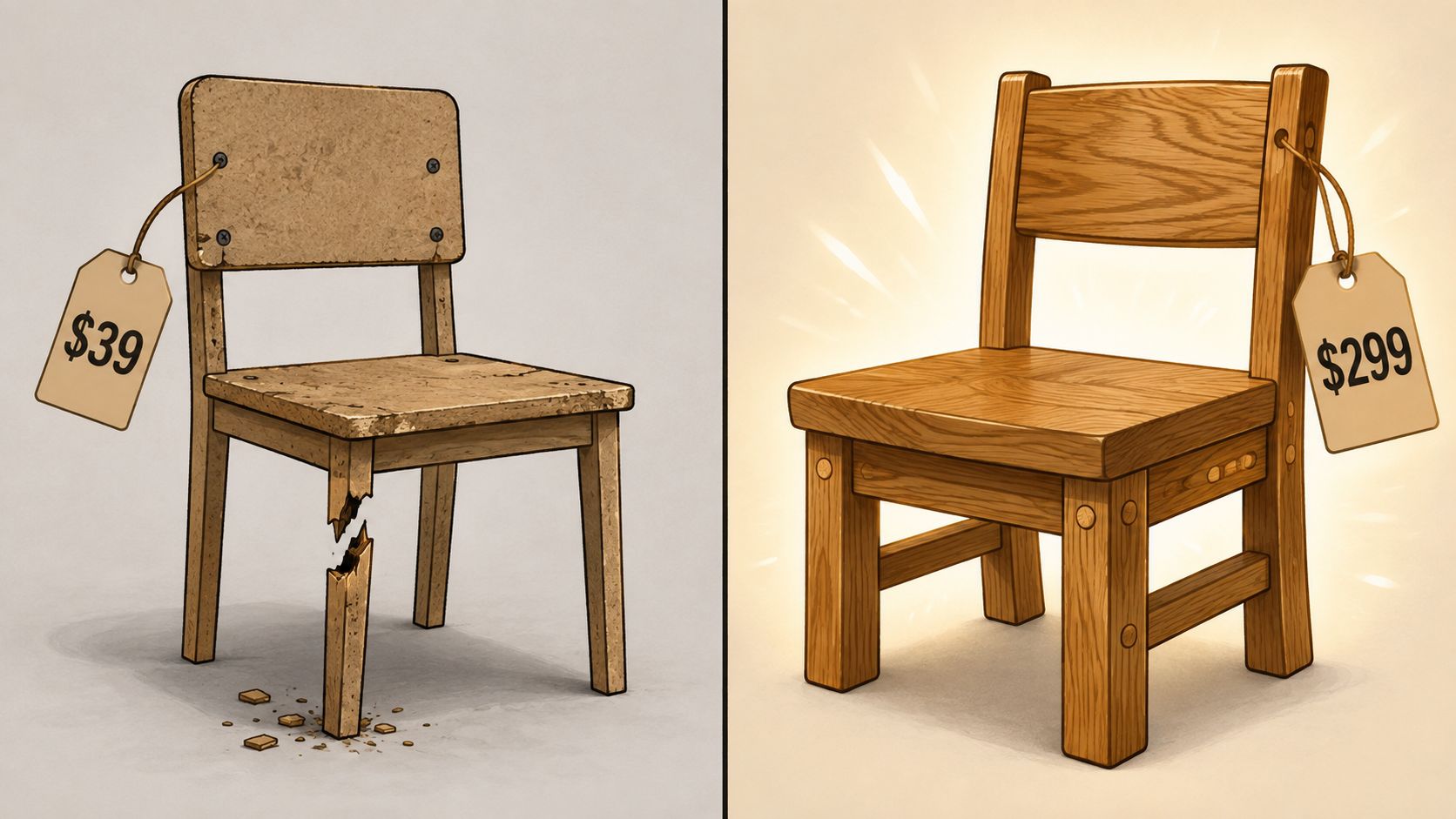
The honest answer is often yes, but only when the construction matches the household's needs. A higher price may reflect solid hardwood, stronger joinery, skilled labor, smaller production runs, repairable components, customization, and service. Those features can matter more than the country label by itself.
A useful comparison looks beyond the initial receipt. Consider a sofa priced at $1,200 and used for five years versus a sofa priced at $2,000 and maintained for fifteen years. The first costs $240 per year, while the second costs about $133.33 per year, before considering repairs, delivery, comfort, or resale. Those figures come directly from the example, not from an industry study, so the result depends entirely on the actual service life of each piece.
Price should follow construction
Shoppers should compare:
- Frame details: Ask what materials support the sofa or chair and how the joints are secured.
- Upholstery structure: Learn about cushions, springs, stitching, fabric, and replacement options.
- Customization: Consider whether dimensions, fabric, wood, stain, or hardware solve a genuine room problem.
- Warranty and service: Find out who handles repairs and what the coverage excludes.
- Delivery: Confirm whether the item arrives assembled, placed in the room, and cleared of packaging.
Domestic construction isn't automatically a bargain. A poorly designed piece can still disappoint, while a well-chosen imported item may suit temporary housing or a strict budget. The right question is whether the furniture's useful life, comfort, service, and repair options justify the purchase.
Household fit matters more than bragging rights
A smaller home may benefit from a compact sofa that comes apart for delivery. A growing family may need heavy-duty seating. A senior may prioritize supportive height, easier access, and a mattress that can be rotated or flipped. A custom option can be worthwhile when it prevents a room from feeling cramped or forces fewer compromises.
A huge mattress department can also change the value conversation. BILTRITE offers over 60 mattress models, giving shoppers a chance to compare support and comfort in person rather than choosing by label alone.
Come See Our USA-Made Selection for Yourself
A country-of-origin label can narrow the search, but furniture still needs to be judged with the senses. At BILTRITE's Greenfield showroom, shoppers can compare solid-wood and upholstered options, inspect drawer joints and hardware, feel finishes, and test seat depth, cushion support, and table clearance.
The USA-made icon identifies pieces built in the United States. The Amish-made icon points toward furniture rooted in traditional craftsmanship and solid hardwood construction. Those markers make the floor easier to understand, while the showroom team explains the details behind each option, including customization, care, lead time, warranty, and delivery.
Bring useful information to the visit
A productive furniture appointment doesn't require a design degree. Shoppers should bring:
- Room measurements: Include wall length, ceiling height, and the space around doors.
- Doorway dimensions: Measure entry doors, stairways, elevators, and tight turns.
- Fabric or paint samples: Colors can look different under showroom lighting.
- A working budget: Clear numbers help the team recommend value without wasting time.
- Daily-use details: Mention children, pets, mobility needs, entertaining, or frequent moving.
The team's 400-plus combined years of furniture experience can turn a vague goal into a practical shortlist. That might mean a small-scale sofa for an apartment, a heavy-duty chair for a busy family room, a solid hardwood dining set, or a two-sided mattress designed for households that value long-term use.
BILTRITE has served the Metro Milwaukee community since 1928 as a fourth-generation, family-owned business. The store doesn't sell online, so the showroom experience remains central. Its USA-made furniture selection gives local shoppers a place to examine origin icons and construction details before committing.
The store is closed on Sundays and Mondays by choice, because family time matters too. That community-first approach fits the larger point of buying local: the transaction is connected to real people, practical guidance, and an ongoing relationship.
BILTRITE Furniture-Leather-Mattresses offers USA-made, Amish-made, solid-wood, small-scale, heavy-duty, and custom furniture, along with a mattress department featuring over 60 models and in-store guidance. Visit BILTRITE Furniture-Leather-Mattresses in Greenfield, bring room measurements and questions, and let the team help match the right construction to everyday life.