Bed Frames with Hooks for Headboard and Footboard: Guide


A lot of people run into the same bedroom headache. The headboard looks great. The footboard is solid. The frame seems close enough. Then assembly starts, and suddenly the hooks don't meet the slots, the bed sits crooked, or the whole setup feels less stable than it should.
That confusion is common with bed frames with hooks for headboard and footboard. The hardware looks simple, but the fit has to be right. A hook-on frame can be sturdy and long-lasting when the parts match well. When they don't, frustration shows up fast.
This is also one of those furniture topics that gets oversimplified online. “Universal” gets tossed around a little too freely, especially when someone is working with an older headboard, a heavier solid wood piece, or a footboard that doesn't follow today's common slot patterns. A little measurement and a little hardware knowledge can save a lot of time.
Table of Contents
- Welcome from Your Neighborhood Furniture Family
- Understanding Hook-On Frame Basics
- The Ultimate Fit and Measurement Checklist
- Heavy-Duty Frames for USA and Amish-Made Quality
- Installation and Troubleshooting Common Issues
- Let Our Family Help Yours Find The Right Fit
- Frequently Asked Questions About Hook-On Frames
Welcome from Your Neighborhood Furniture Family
A Milwaukee-area family brings home a handsome headboard from one room, a frame from another, and expects a simple afternoon project. Instead, the rails hang too low, the hooks don't seat correctly, and somebody ends up crouched on the floor saying the same thing heard in furniture stores every week: “This looked like it should fit.”
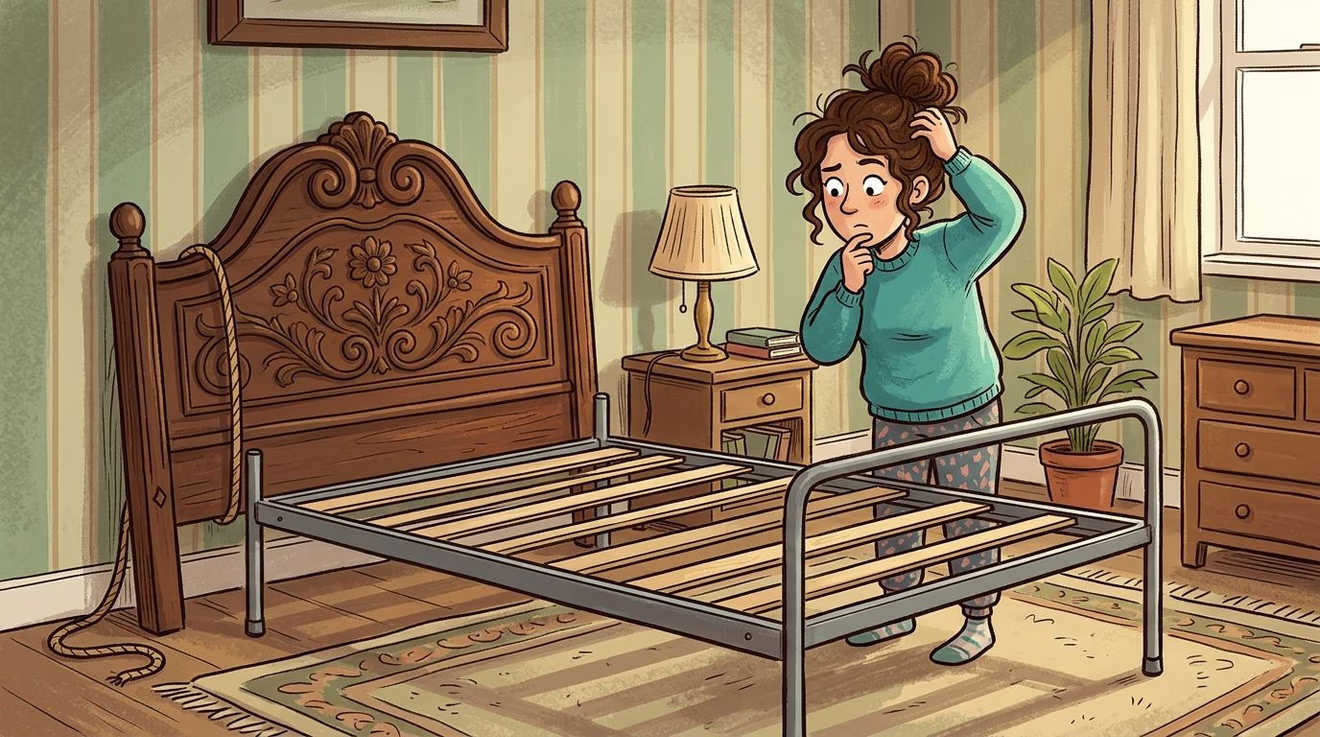
That moment is exactly why practical bed-frame advice matters. Hook-on systems aren't complicated once the parts are understood, but they can be maddening when a headboard, footboard, and frame were never designed for one another. Older furniture can be especially tricky. So can substantial solid wood pieces that need more than a basic metal rail.
BILTRITE Furniture was founded in 1928 by Irwin Kerns and his wife Frieda Kerns as an upholstery shop in Milwaukee, and it remains a fourth-generation, family-owned business serving Metro Milwaukee, as shared on BILTRITE's company history page. That local history matters because long-running furniture businesses tend to hear the same real-life problems again and again, and bed-rail compatibility is one of them.
Practical rule: A bed can look assembled and still be assembled wrong. If the hooks aren't seated cleanly and evenly, the setup isn't finished.
A good frame connection should feel calm, solid, and boring in the best possible way. No sway. No metal strain. No guessing whether the footboard will loosen after a few nights of use.
That's where a little know-how pays off. The basics come first.
Understanding Hook-On Frame Basics
What hook-on really means
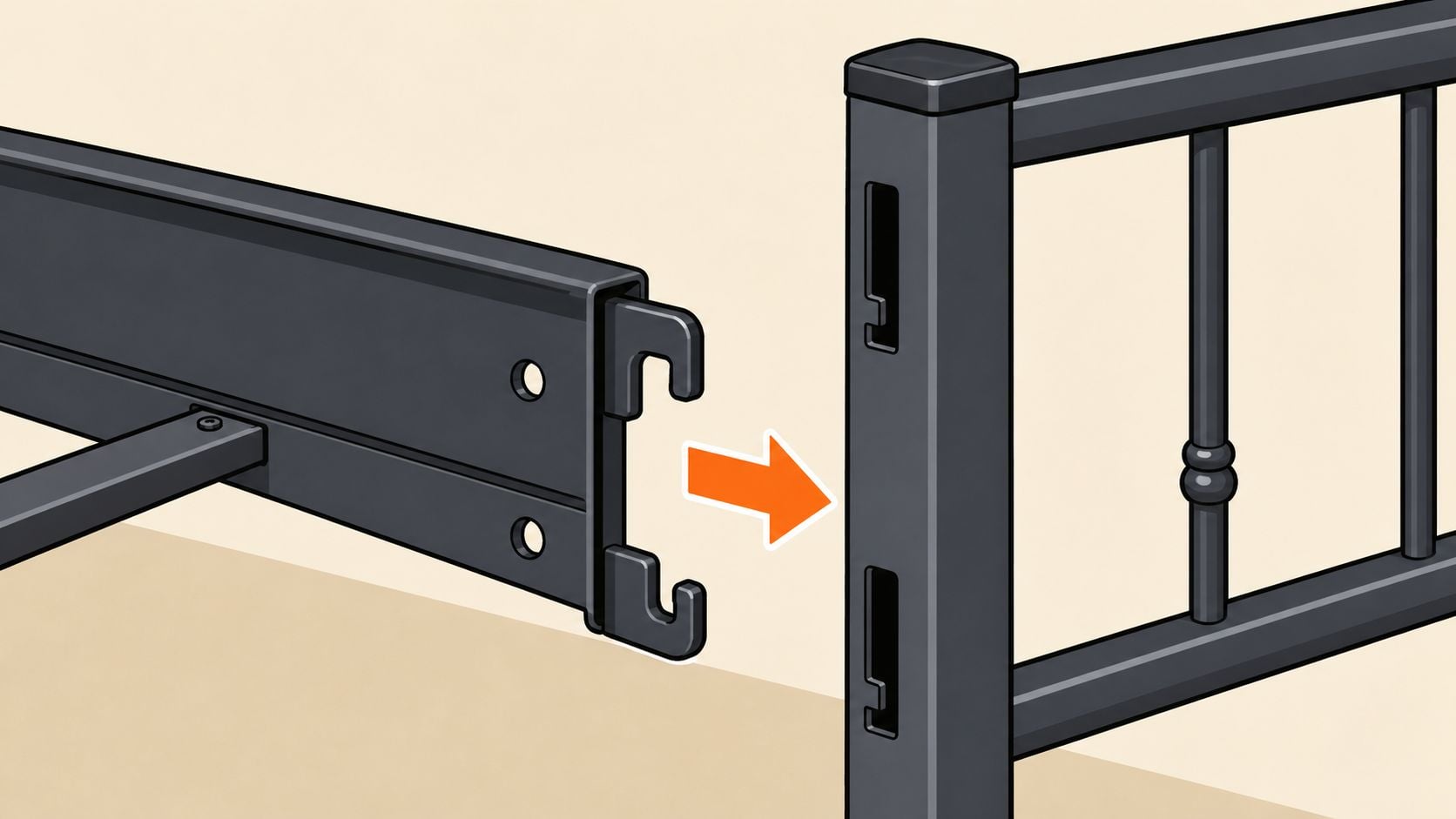
A hook-on frame uses metal hooks at the ends of the side rails. Those hooks slide into receiving slots or related hardware on the headboard and footboard. When the hardware matches, gravity helps lock the rail into place and creates a clean connection without a lot of extra parts.
The easiest way to think about it is like a puzzle. The pieces don't need to look identical. They do need to engage in the right position, at the right height, and at the right angle. If any one of those is off, the rail may not seat all the way.
Some hook-on models are built for flexibility. According to this product detail for a queen or king hook-on bed frame, specific models are engineered with a 10-year warranty and an extra-wide offset design that allows the frame to hook into virtually any headboard and footboard. That kind of design is helpful because real homes often involve mixed furniture pieces instead of one factory-matched set.
A shopper comparing styles can also get a helpful overview by looking at different types of bed constructions, since not every bed uses the same rail connection.
Why some frames feel sturdier than others
Two hook-on frames can look similar and perform very differently. Material, rail shape, center support, and the quality of the hook hardware all matter. A stronger rail does a better job of keeping the sleep surface level and reducing movement over time.
A few details are worth noticing right away:
- Hook shape: The hooks should engage fully, not barely catch the slot.
- Rail strength: Heavier steel usually gives a more confident feel than thin stamped metal.
- Support underneath: Wider beds need dependable center support to help control sag and shifting.
- Fit at both ends: The headboard side and footboard side should both sit evenly. One side shouldn't do all the work.
A hook-on connection should drop in with intention. If it needs twisting, forcing, or wishful thinking, something is off.
That's why “close enough” is risky with bed hardware. The frame might assemble. It still might not be the right frame.
The Ultimate Fit and Measurement Checklist
The best time to solve a bed-frame problem is before the frame comes home. A tape measure takes only a few minutes to use, and it can prevent the most common mismatch issues.
The measurements that matter most
Start with the headboard and footboard. Look closely at the legs or posts where the rails connect. The key question isn't only “Does it have slots?” The better question is “Where are those slots, how wide are they, and how far apart are they?”
Then move to the frame rails. Check the location of the hooks, the spacing between them, and how those hooks sit relative to the floor. If the hook height and slot height don't match, the rails won't lock in properly.
For anyone getting ready to shop, this furniture measuring guide is a good reminder that dimensions matter well before delivery day.
Bring written measurements, not guesses. Most bed-fit problems start with “It looked about right.”
Headboard & Frame Compatibility Checklist
| Measurement | What to Check on Headboard/Footboard | What to Check on Frame Rails |
|---|---|---|
| Overall bed size | Confirm whether the piece is meant for twin, full, queen, or king | Confirm the rail set matches the same size |
| Slot type | Note whether there are open slots, hook receivers, or a pin-style connection | Check whether the rail hardware is designed for that same connection style |
| Slot height from floor | Measure from floor to the bottom and top of the receiving area | Measure from floor to the top and bottom of the hook position when the frame is standing level |
| Distance between connection points | Measure spacing if there are multiple slots or mounting positions | Measure spacing between hooks or bracket contact points |
| Width of opening | Measure the slot width carefully | Check hook width and thickness so the hardware can seat fully |
| Depth around the post | Look for trim, curves, or thick wood that could block the rail | Check whether the hook plate sits flat or gets blocked before locking in |
| Footboard match | Confirm the footboard uses the same style and height as the headboard side | Make sure both rail ends are compatible, not just the headboard end |
| Floor contact | Look at how the bed will sit on carpet, wood, or uneven flooring | Check whether glides or supports sit level and stable once assembled |
A few practical mistakes show up again and again:
- A shopper measures only width and forgets hook height.
- The headboard fits, but the footboard connection is different.
- Decorative trim blocks the rail plate from sitting flush.
- An older bed uses a less common slot shape, and a modern frame only partly engages it.
When those details get checked ahead of time, assembly gets much easier. When they don't, the “simple setup” can turn into a return, an adapter search, or a wobble that never quite goes away.
Heavy-Duty Frames for USA and Amish-Made Quality
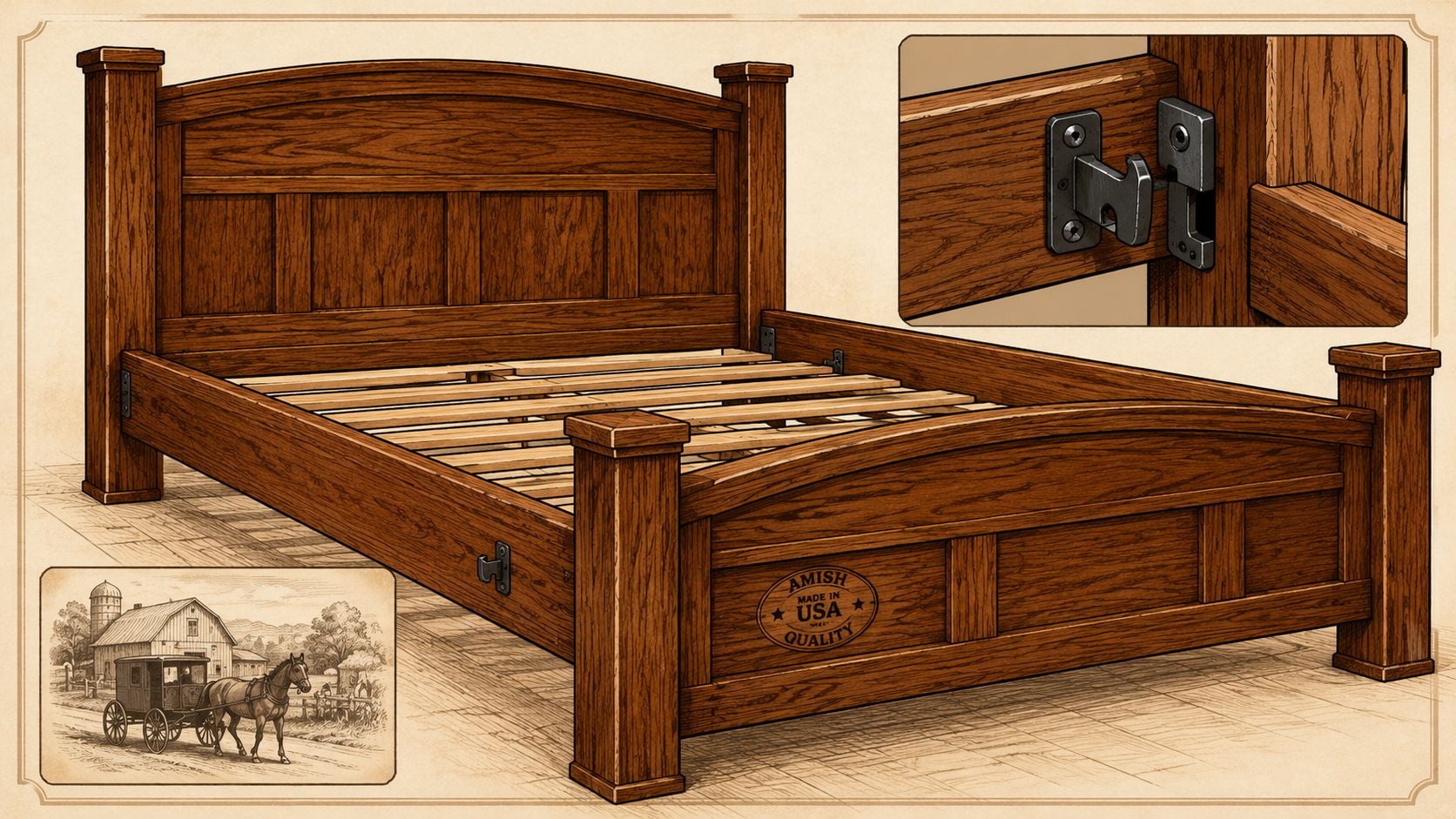
A neighbor walks into our Milwaukee showroom with a beautiful solid wood headboard from a family maker in Indiana or Ohio. The hooks look close. The size sounds right. Then we set the frame beside the bed, and the critical question shows up. Will this connection support a heavy, tall piece of furniture for years, or will it only sort of work for a while?
That practical fit question gets skipped online all the time, especially with better furniture. USA-made and Amish-made beds are often built from thicker hardwood, with taller posts, deeper rails, and more weight carried at each corner. A hook-on frame can still be the right choice, but only if the steel, hook plate, and center support are built for that kind of load.
A bed frame works like the foundation under a porch. If the top is substantial, the support underneath has to be substantial too.
Why heavier wood furniture changes the frame choice
Solid wood headboards put different stress on a frame than lighter pieces made with thinner materials. The issue is not just total weight. Height matters too. A tall headboard gives everyday movement more room to create sway at the connection point when someone sits up to read, leans back with pillows, or bumps the bed while changing sheets.
That is why heavier beds often do better with thicker steel, stronger corner construction, and a center support system that carries weight instead of barely touching the floor.
Hook-on rails are still common for a reason. They are convenient, familiar, and often a very good match when they were designed for the bed in the first place. But with premium wood furniture, "the hooks fit" is only the starting line. The better question is whether the frame is strong enough to keep that furniture steady and quiet over time.
What to look for in a heavy-duty frame
For substantial wood beds, I tell folks to focus on the parts that do the essential work:
- Thicker-gauge steel rails: Heavier steel resists flexing better under side-to-side movement.
- Secure hook plates: The connection should sit firmly and fully engage the bed hardware.
- Strong center support: Queen, king, and many full-size setups benefit from center legs and a support beam that bears weight properly.
- Stable cross support: Extra structure across the width helps reduce twist and sag.
- Adjustable glides or legs: These help the frame sit properly on older hardwood floors, carpet, or slightly uneven surfaces.
Here in Wisconsin, we see this a lot with handcrafted beds that are meant to last for decades, not just until the next move. If you are considering one of those pieces, the advantages of Amish furniture explain why the materials and joinery feel so different from mass-market options. Furniture built that well deserves support built with the same mindset.
When bolt-on support may be the better answer
Some heavy headboards are better candidates for bolt-on rails or reinforced adapter hardware. That is often true for heirloom-style beds with large posts, extra-tall panels, or designs meant to stay put for the long haul. A bolted connection usually creates a more rigid hold, which can help reduce shifting over years of daily use.
This does not mean hook-on frames are poor quality. It means matching the connection style to the furniture matters.
If a bed will be used every night, if children are likely to climb or lean on it, or if the headboard has serious mass to it, a heavier-duty solution is often the honest recommendation. That kind of advice may not be flashy, but it saves people from squeaks, wobble, and premature wear on good wood furniture.
Heavy, high-quality furniture needs hardware that matches its weight, height, and long-term use.
That is the part big box listings rarely help with. In a local store, someone can look at the wood, the hardware, the rail profile, and the support underneath all at once. With better beds, that hands-on matching process makes all the difference.
Installation and Troubleshooting Common Issues
Even when the right frame comes home, assembly can still hit a snag. Most problems fall into two camps. The bed wobbles after setup, or the hooks don't line up cleanly with the headboard and footboard hardware.
What causes wobble
A wobble usually means one of three things. The hooks aren't fully seated. The frame is not level on the floor. Or the support under the middle of the bed isn't doing enough.
Try this quick check:
- Push each rail downward: A properly seated hook should feel locked, not perched.
- Check both sides at once: One rail can be fully in while the other is only partly engaged.
- Look at the floor contact points: Carpet, old hardwood, and uneven surfaces can throw a frame off.
- Inspect the center support: If it's adjustable, make sure it's bearing weight.
A stable bed should feel quiet when pressure shifts from side to side. If the connection creaks or lifts, the hardware needs another look.
What to do when hooks don't line up
Misalignment is one of the biggest sources of frustration, especially with older furniture or pieces that use less common connection geometry. Sometimes the hook style is technically similar, but the rail meets the slot in the wrong place.
That's where an adapter can help. As shown in this explanation of the Tech Team #911 adapter hook bracket, adapter hook brackets are engineered to resolve alignment failures when a frame's mounting point doesn't line up with a headboard's vertical slot and pin configuration. The bracket changes the connection geometry so the parts can lock together more securely.
A few practical clues suggest an adapter may be the answer:
- The hooks are close, but they sit too high or too low to engage.
- The headboard uses a vertical slot and pin arrangement that the frame doesn't naturally match.
- The frame can attach on one end, but not both.
- The rail only catches the hardware partially.
Readers sorting through bed components may also find it helpful to review the basic parts of a bed, since terminology alone causes plenty of mix-ups.
If a connection almost works, forcing it usually makes things worse. Misalignment is a hardware problem, not a strength problem.
Forcing the hooks, bending the brackets, or stuffing spacers into the gap often creates a bed that feels assembled but isn't secure. A proper adapter or a better-matched frame is the safer fix.
Let Our Family Help Yours Find The Right Fit
Why seeing the hardware in person helps
Bed hardware is one of those categories that makes more sense face to face than in a product photo. A slot that looks standard in a picture may be shaped differently in person. A frame that sounds “universal” on paper may still not be the right partner for a substantial solid wood bed.
That's one reason local showroom help still matters. BILTRITE specializes in American-made furniture, including Amish-made and USA-made solid wood pieces, and uses a visible USA Made icon in-store to identify locally crafted furniture, as noted in this feature on BILTRITE's family tradition and quality focus. For shoppers dealing with heavier headboards, unusual slot placement, or a room that needs a smaller-scale solution, in-person guidance can save a lot of second-guessing.
There's also practical value in talking through frame options before carrying anything upstairs. Some households need heavier-duty support. Others need a lower-profile look, easier delivery into a tighter room, or a frame that pairs well with one of the many mattress choices available. For anyone comparing support options, this bed-frame guide is a helpful starting point.
Good furniture service shouldn't feel pushy. It should feel useful. A family trying to protect a high-quality headboard deserves honest advice about whether a hook-on frame is the right answer, whether an adapter will solve the problem, or whether a stronger connection makes more sense.
Frequently Asked Questions About Hook-On Frames
Quick answers to common showroom questions
Can a bolt-on headboard work with a hook-on frame?
Sometimes, but not automatically. The connection style has to match. If it doesn't, an adapter or a different rail system may be needed.
Are hook-on frames always tool-free?
Not always. The basic connection can be simple, but setup may still involve center support parts, glides, or adjustments to get the bed level and secure.
Do hook-on rails work well with antique headboards?
Sometimes they do, and sometimes they don't. Older furniture often uses less common slot shapes or spacing, which is why measuring first matters so much.
Is a hook-on frame good for a heavy solid wood bed?
It can be, if the frame is designed for that weight and the hardware engages properly. With very substantial headboards, a stronger rail system may be the better long-term choice.
What's the most overlooked measurement?
Hook and slot height. Many people check bed size and stop there. Height alignment is often the detail that decides whether the hardware seats correctly.
What if the frame fits the headboard but not the footboard?
That's more common than people think. Both ends need to be checked before buying, since some sets have different hardware placement front and back.
Can a shaky bed usually be fixed?
Often, yes. The fix might be as simple as reseating the hooks, leveling the supports, or correcting the hardware match. If the connection style itself is wrong, the fix is usually a better-fitting rail or adapter.
BILTRITE Furniture-Leather-Mattresses has helped Milwaukee-area families furnish their homes since 1928, with a fourth-generation, family-owned approach that still values honest guidance, American craftsmanship, and long-lasting comfort. The Greenfield showroom offers affordable, better-quality furniture, Amish-made and USA-made solid wood options, and a mattress department with over 60 models and 500+ mattresses in stock. Shoppers can also ask about white-glove delivery on qualifying purchases, old mattress removal for donation, and select mattress-set extras. For anyone sorting out bed frames with hooks for headboard and footboard, visit BILTRITE Furniture-Leather-Mattresses and have a real conversation with a team that's there to help.