Fabric Durability Ratings a Fun and Friendly Guide

A lot of furniture shopping starts the same way. A family spots a sofa that looks great in the showroom, then somebody asks the question. Will this thing still look good after movie nights, naps, grandkids, pets, and everyday living?
That question matters because fabric doesn't live in a catalog. It lives in busy family rooms, quiet formal spaces, senior apartments, condos with tight layouts, and homes where one favorite chair gets used all day long. The upholstery has a job to do, and shoppers deserve to know whether it's ready for that job.
That's where fabric durability ratings come in. They sound technical at first, but they're one of the most helpful tools for choosing furniture with confidence. A little background can make those odd-looking numbers feel a lot less mysterious and a lot more useful.
For families thinking about long-term value, it also helps to understand how long furniture should last before falling in love with a fabric that isn't suited for daily life.
Table of Contents
- Welcome to the World of Furniture That Lasts
- What Are Fabric Durability Ratings Anyway
- Decoding the Numbers What Double Rubs Mean for You
- Choosing the Right Durability for Your Home
- More Than Just Rubs Other Fabric Performance Factors
- Find Your Long Lasting Furniture at BILTRITE
Welcome to the World of Furniture That Lasts
A new sofa can look amazing on day one. Its test starts later, when kids bounce into it after school, guests gather for holidays, or a dog claims the same corner cushion every evening.
That's why furniture shoppers often feel torn between style and practicality. A soft woven fabric might catch the eye right away, while a tighter, tougher upholstery may be the one that handles daily life better. Both can be good choices. The difference is whether the fabric matches the way the piece will be used.
In homes across Metro Milwaukee, that question shows up in all kinds of ways. A condo owner may need a smaller-scale loveseat that still holds up well. A growing family may want a sectional that can take real wear. A caregiver may be looking at a lift chair and thinking less about trend and more about dependable performance.
Practical rule: The best fabric isn't the fanciest one. It's the one that fits the room, the routine, and the people using it every day.
Fabric durability ratings help answer that fit question. They give shoppers a way to compare fabrics beyond color and texture. Instead of guessing, they can look at a rating and get a clearer sense of whether a fabric belongs on an accent chair that sees occasional use or on a hardworking sofa that anchors the family room.
That kind of clarity is useful because furniture becomes part of everyday life. It's where people read, recover, gather, snack, stretch out, and make memories. A rating won't tell the whole story, but it gives shoppers a strong starting point for choosing furniture that lasts.
What Are Fabric Durability Ratings Anyway
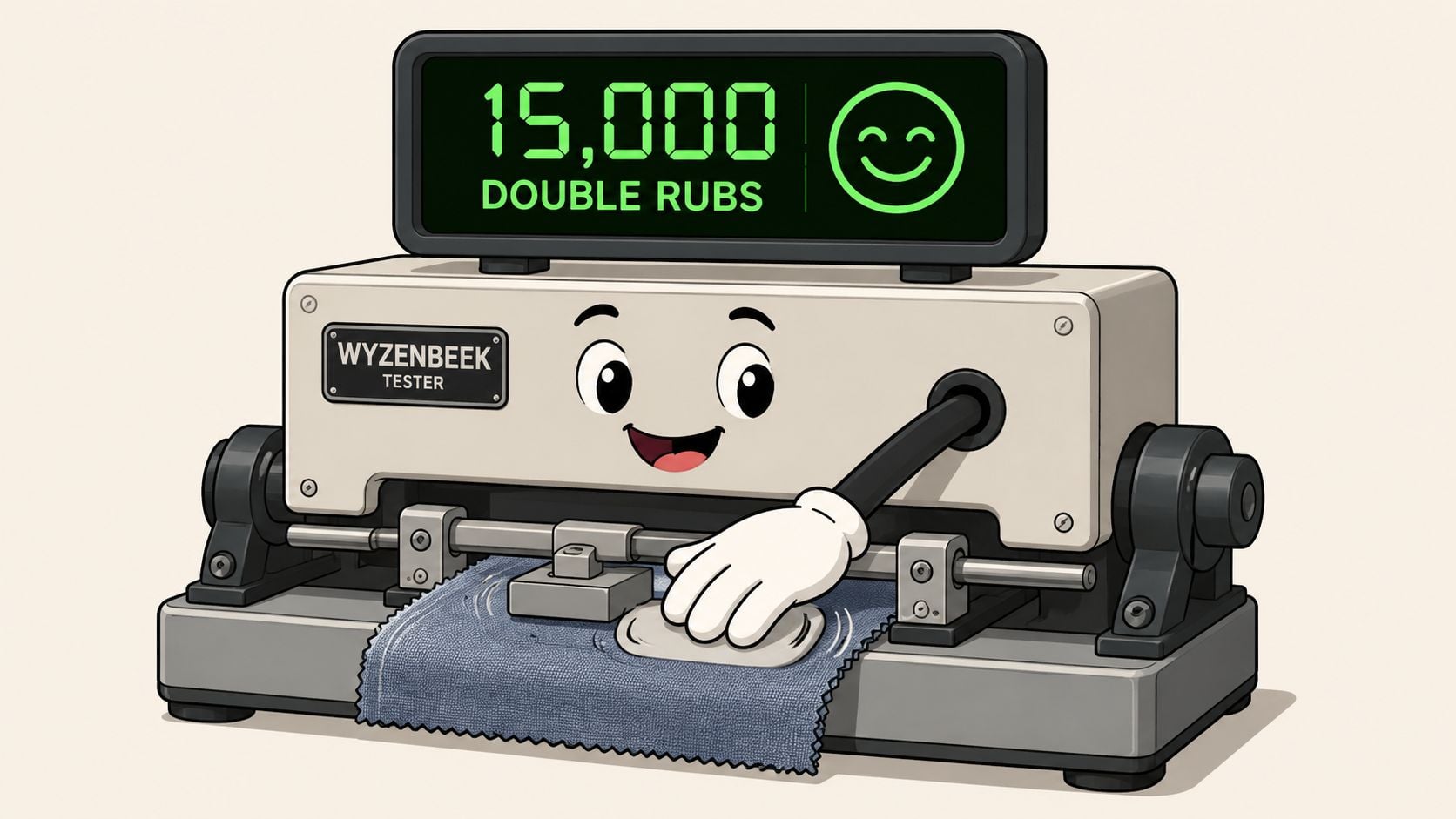
The phrase fabric durability ratings sounds more complicated than it is. At its core, it's a wear test. A fabric goes into a lab, a machine rubs it repeatedly, and the result helps predict how well that material may stand up to use over time.
A lot of shoppers first notice this on a tag or spec sheet as a number followed by “double rubs.” That's not a typo. It's a standard way of talking about abrasion resistance in upholstery.
The simple idea behind the test
Consider it an odometer for fabric. The higher the reading, the more rubbing the fabric handled before showing wear in the test.
In the United States, the common test is the Wyzenbeek test. In Europe and many global spec sheets, the common test is Martindale. Both are useful, and both measure abrasion, but they don't do it the same way.
According to Swavelle's explanation of upholstery durability testing, Wyzenbeek and Martindale are the two dominant abrasion standards for upholstery, and they are not numerically interchangeable. Wyzenbeek reports double rubs in the U.S., while Martindale reports cycles or rubs in Europe. Both simulate repeated wear, but the test motions differ, so it's key to verify the test method first before interpreting the rating.
That last point is where many shoppers get tripped up. A fabric with one number on a tag might not be weaker or stronger than another fabric with a different number unless the same test method was used.
Why the test name matters
If a shopper sees 15,000 on one fabric and 20,000 on another, the higher number might seem like the obvious winner. But that only works if both ratings came from the same test. If one is Wyzenbeek and the other is Martindale, a direct side-by-side comparison doesn't tell the whole story.
That's why furniture professionals look for the method first, then the number.
A few simple habits can help when comparing upholstery:
- Check the label language: Look for “double rubs” for Wyzenbeek or “cycles” for Martindale.
- Match the rating to the room: A fabric for a guest-room chair doesn't need the same toughness as the main family sofa.
- Ask about the full fabric story: Abrasion matters, but so do texture, cleanability, and how the piece will be used.
Shoppers who want a broader look at upholstery choices can also explore upholstery materials and how they behave in real homes.
Decoding the Numbers What Double Rubs Mean for You
Once the test method is clear, the number starts to become useful. The simplest way to read it is this. A higher rub count usually means better resistance to wear from regular contact.
That doesn't mean every room needs the highest rating available. A formal sitting room and a busy den ask very different things from a fabric. The smart move is to match the durability to the furniture's job.
A quick way to read the rating
For lighter domestic use, the recommended minimum is 15,000 double rubs or 20,000 Martindale cycles, while heavy-duty furniture in high-traffic family areas should be at 30,000 double rubs or 40,000 Martindale cycles, based on Famcor's guide to upholstery fabric performance ratings.
That gives shoppers a practical way to sort fabrics into everyday categories.
A decorative chair in a low-use room can live happily with less abrasion resistance than the sofa where the whole household lands every night.
Fabric Durability Ratings at a Glance
| Double Rub Count (Wyzenbeek) | Durability Level | Best For |
|---|---|---|
| Under 15,000 | Light duty | Accent pieces, formal rooms, furniture that doesn't get daily use |
| 15,000 to 30,000 | Medium duty | Everyday residential seating, guest spaces, quieter households |
| 30,000+ | Heavy duty | Primary sofas, family-room sectionals, recliners, high-use seating |
This table works best as a quick filter, not a final verdict. Two fabrics with similar ratings may still feel very different in the hand. One may be smoother, another more textured. One may resist visible wear better, while another may hide everyday use more gracefully because of its weave or color.
That's one reason many shoppers take a close look at performance fabrics and why they're popular for active homes. The rating is a strong clue, but it works best alongside the rest of the fabric's performance profile.
A good rule of thumb is simple. If the piece is going to be sat on every day, leaned on every evening, and used by multiple people, it deserves a tougher fabric than a chair that's mostly there for looks.
Choosing the Right Durability for Your Home
The most helpful way to use fabric durability ratings is to think about life at home, not life in a lab. The right number depends on who uses the furniture, how often they use it, and whether the seat is a main destination or an occasional landing spot.
A rating can look impressive on paper and still be the wrong fit for the room. A fabric that works nicely in a formal living room may get worn-looking much faster on a sectional that serves as the household headquarters.
For active family rooms
Family rooms usually call for the tougher end of the scale. These are the sofas and sectionals that handle homework, streaming marathons, after-school snacks, and a lot of repeated sitting in the same spots.
A useful benchmark comes from Trivantage's discussion of Wyzenbeek and Martindale ratings. It notes that a fabric rated at 15,000 double rubs can correspond to about a decade of use at four sittings per day, which helps show the relationship between abrasion resistance and visible wear over time. That same guidance points shoppers toward higher ratings for family-room sofas, recliners, or senior-living seating.
For busy homes, a few patterns usually make sense:
- Main sofa or sectional: Lean toward heavy-duty ratings because the same cushions will get used over and over.
- Recliners in daily rotation: Choose tougher upholstery, especially if the chair is used for reading, napping, or recovery every day.
- Homes with kids or pets: Look for a durable rating plus easy-care fabric features, not just one or the other.
Families who are balancing real life with easier cleanup may also appreciate kid-friendly and pet-friendly furniture ideas.
For quieter spaces and formal rooms
Not every room needs battle-ready upholstery. Some spaces stay tidy, calm, and lightly used. In those rooms, a medium-duty fabric can make a lot of sense.
That can include a formal living room, a guest bedroom chair, or a loveseat in a condo where seating gets gentler use. In those settings, shoppers often have more freedom to prioritize feel, pattern, or visual texture without needing the toughest rating on the floor.
A lower-demand room may be a good place for a fabric chosen more for appearance than for maximum abrasion resistance. The key is honesty about how the piece will be used six months from now, not just how it's used this week.
For seniors and caregivers
This is one area where durability gets very practical, very quickly. Lift chairs, supportive recliners, and senior-living seating often receive concentrated, repeated use. The same arms, seat edge, and back areas are touched constantly.
That kind of daily use makes stronger upholstery a wise choice. Caregivers also tend to benefit from fabrics that are easier to maintain and easier to live with over time.
Furniture for seniors should feel welcoming, supportive, and dependable. Durability isn't just about looks. It affects comfort and day-to-day ease.
In smaller homes, apartments, and senior communities, scale matters too. A chair may need to fit the room well and still stand up to heavy use. That's why durability should always be considered alongside comfort, seat height, cleanability, and the layout of the space.
More Than Just Rubs Other Fabric Performance Factors
A high abrasion rating is helpful, but it doesn't tell the whole story. Some shoppers see a very large rub count and assume they're done comparing. That's where mistakes happen.
Performance in real life depends on more than one test. A fabric can score high for abrasion and still disappoint if it pills, fades, or proves difficult to clean.

Why abrasion isn't the whole story
As noted in Roger and Chris's overview of durability measurement, a recent trend is performance fabrics advertised above 100,000 rubs, but buyers still need method-specific interpretation. That same source also notes that a high rub count doesn't guarantee protection against pilling or poor colorfastness.
That's an important reality check. Fabric durability ratings measure one kind of toughness. They don't automatically answer every question a homeowner should ask.
Worth remembering: The best upholstery choice balances wear resistance, appearance, cleanability, and how the fabric feels in everyday use.
Three other things worth checking
Some of the most useful follow-up questions have nothing to do with the rub count itself.
- Pilling: Those little fuzz balls can show up when fibers work loose on the surface. Some textures and fiber blends are more prone to it than others, especially on seats that get a lot of friction from blankets, denim, or frequent shifting.
- Colorfastness: A fabric may be durable and still lose visual appeal if it doesn't hold color well in bright rooms. This matters in sunny spaces, near windows, or in rooms with a lot of natural light.
- Cleaning code: Upholstery tags often include care codes that tell owners what kind of cleaning approach is appropriate. That can matter just as much as abrasion resistance in a home with children, pets, or frequent entertaining.
For shoppers thinking ahead about care, natural fabric sofa cleaning tips can help make maintenance feel less intimidating.
Looking at the full picture often leads to better decisions. A family might choose a slightly different fabric once they realize one option is easier to care for. A senior household may favor a fabric that combines durability with simpler upkeep. A style-focused shopper may decide that a textured weave is worth it in a low-use room but not on the main sofa.
Find Your Long Lasting Furniture at BILTRITE
Good furniture decisions get easier when shoppers know how to read the signs. Fabric durability ratings aren't there to confuse people. They're there to help match a fabric to real daily use.
That matters because furniture isn't a short-term purchase for most households. People want a sofa, recliner, loveseat, or chair that still feels good to live with after years of use. They want materials that suit their routines, their families, and the way their home functions.
What smart shoppers remember
The most useful takeaways are straightforward.
- Check the test method first: Wyzenbeek and Martindale are both valid, but the numbers don't translate directly without context.
- Match the rating to the room: A main seating piece usually needs more durability than a decorative one.
- Look beyond abrasion: Pilling, color retention, and cleaning requirements matter too.
- Be realistic about use: The favorite seat in the house will always need more from its fabric.
Those four habits help shoppers cut through a lot of marketing noise and focus on what is important in the home.
Why seeing it in person still matters
Specifications are helpful, but furniture is still a hands-on choice. People can learn a lot by touching a fabric, sitting on the cushion, noticing the weave, and asking how a piece is likely to behave in everyday life.
That matters even more for Milwaukee-area families, seniors, condo owners, and anyone furnishing an unusual space. A fabric may look durable on paper, yet feel too rough for the room. Another may feel welcoming and still offer the level of performance the household needs.

For a fourth-generation family business that has served Metro Milwaukee since 1928, that in-person guidance still matters. BILTRITE has built its reputation around affordable, better-quality furniture, with a strong focus on USA-made, Amish-made, and solid wood pieces built to last. The showroom also serves a wide range of households, from shoppers looking for small-scale furniture to families who need heavy-duty options and seniors who need supportive seating that works hard every day.
Because BILTRITE doesn't sell online, the showroom experience stays at the center of the process. Shoppers can see fabrics up close, compare options side by side, and talk with an experienced team that helps people sort through the practical details without pressure. That's especially useful when choosing upholstery, where feel and function matter just as much as appearance.
A durability rating can point a shopper in the right direction. A real conversation, a fabric swatch in hand, and a seat test in person can help confirm the right choice for the home.
BILTRITE Furniture-Leather-Mattresses has been helping Metro Milwaukee families find better-quality furniture since 1928. For anyone ready to compare fabrics, test comfort, and see durable USA-made and Amish-made options in person, visit BILTRITE Furniture-Leather-Mattresses in Greenfield. The showroom team would love to help families find furniture that fits their space, their lifestyle, and the years ahead.