Sofa Bed or Futon: Which Is Right for Your Milwaukee Home?


The holidays are coming. A college kid is heading home for break, grandparents are staying the weekend, or friends just texted that they'd love to crash after the game. Suddenly that office, den, or basement has to work a lot harder than it did yesterday.
That's when a lot of Milwaukee families end up asking the same question. Should the extra sleep space be a sofa bed or futon? It sounds simple until real life gets involved. Will it sit comfortably for movie night? Will guests sleep well? Will it fit through an older bungalow doorway? Will it still feel like a smart purchase a few years from now?
BILTRITE has been helping local families sort through decisions like this since 1928. As a fourth-generation, family-owned business in Greenfield, the focus has always been practical comfort, better quality, and furniture that works for the way people live. That means looking beyond the showroom floor “look” and discussing use, durability, upkeep, and who will be sleeping on it.
Table of Contents
- Welcome to the Family! Solving Your Guest Room Puzzle
- The Great Debate What Really Separates a Sofa Bed and a Futon
- The Comfort Showdown A Look at Mattresses and Sleep Quality
- Built to Last A Guide to Frames Durability and Maintenance
- Finding the Right Fit for Your Space and Style
- Who Wins for Your Family Use Cases and Recommendations
- Your BILTRITE Buying Checklist What to Look For in Our Showroom
Welcome to the Family! Solving Your Guest Room Puzzle
A lot of homes don't have a dedicated guest room sitting empty year-round. That room is usually doing double duty. It might be a home office during the week, a craft room on Saturday, and a sleep space when family visits. That's why the sofa bed or futon decision comes up so often.
Families usually start with the same wish list. They want something comfortable, something that doesn't eat the whole room, and something they won't regret after the first overnight visit. They also want furniture that feels welcoming instead of temporary. That matters more than people think.
For some households, the challenge isn't the room itself. It's the whole chain of use. A piece needs to look good every day, open without a wrestling match, and stay manageable when kids, pets, and busy schedules are part of the picture.
A guest piece earns its keep when it works well on an ordinary Tuesday, not just on the two weekends a year someone sleeps on it.
That's also why a little planning helps. Before picking fabric or finish, it helps to think about who's coming, how often they'll stay, and whether the room needs to feel more like a living area or more like a bedroom. Families working through a broader guest-room refresh can get more ideas from BILTRITE's guest bedroom update guide.
Everyday life usually decides
A futon often appeals to households that need flexibility and a smaller footprint. A sofa bed often appeals to households that want the piece to live in a main seating area without looking casual.
Both can work. The smarter choice usually comes down to how the room is used between visits, not just during them.
The Great Debate What Really Separates a Sofa Bed and a Futon
The easiest way to explain it is this. A sofa bed is a sofa with a hidden bed inside. A futon is a frame with a mattress that changes position and becomes both the seat and the bed.
That sounds like a small difference, but it changes almost everything. It changes the look, the feel, the weight, the cleaning routine, and how the piece fits into daily life.
Sofa bed and futon basics
Here's the quick side-by-side view most shoppers want first.
| Feature | Sofa Bed (Sleeper Sofa) | Futon |
|---|---|---|
| Basic design | Sofa with a hidden pull-out mattress | Foldable frame with mattress serving as seat and bed |
| Everyday look | More like a conventional sofa | More casual and straightforward |
| Sleep setup | Separate sleep surface from seat cushions | Same mattress handles sitting and sleeping |
| Weight and mechanism | Heavier, with more hardware | Simpler frame with fewer moving parts |
| Best room fit | Main living rooms, dens, recurring guest use | Apartments, offices, dorm-style spaces, guest rooms |
| Typical ownership trade-off | Better sofa appearance and more guest-oriented sleep setup | Easier to move, simpler to use, usually more space-efficient |
A lot of shoppers also assume a futon is just a cheaper sleeper sofa. That's not really accurate. They come from different design ideas and solve different problems. Families comparing the two can also look at BILTRITE's sleeper sofa overview for a closer look at how sleeper seating fits into everyday homes.
Why the history still matters
The word futon started somewhere very different from the modern Western futon sofa bed. The traditional Japanese futon developed as a portable bedding system for compact living, with roots traced to 17th-century Japan, and a complete set traditionally includes three parts: the shikibuton mattress, kakebuton duvet, and makura pillow, laid directly on the floor, often on tatami mats. Historical accounts also note that padded futons were originally limited to rich noblemen because they were expensive to produce before manufacturing made them more accessible, as described in this overview of traditional Japanese futon history.
That original setup wasn't a couch at all. It was a space-saving sleep system.
The Western futon sofa bed came much later and became broadly popular in the United States in the 1970s, especially as young buyers looked for affordable, multifunctional furniture for small spaces such as studios, dorm rooms, and guest rooms. That same background helps explain why modern guidance often says futons usually aren't the first choice for nightly use. They're typically thinner and less supportive than a standard bed, according to this explanation of how the Western futon evolved.
Practical rule: If the room's main job is “look like a real living room,” a sofa bed usually starts ahead. If the room's main job is “change roles easily,” a futon often makes more sense.
The Comfort Showdown A Look at Mattresses and Sleep Quality
Comfort is where many sofa bed or futon decisions become much clearer. A piece can look sharp in the store, fit the room, and still disappoint once someone sleeps on it.
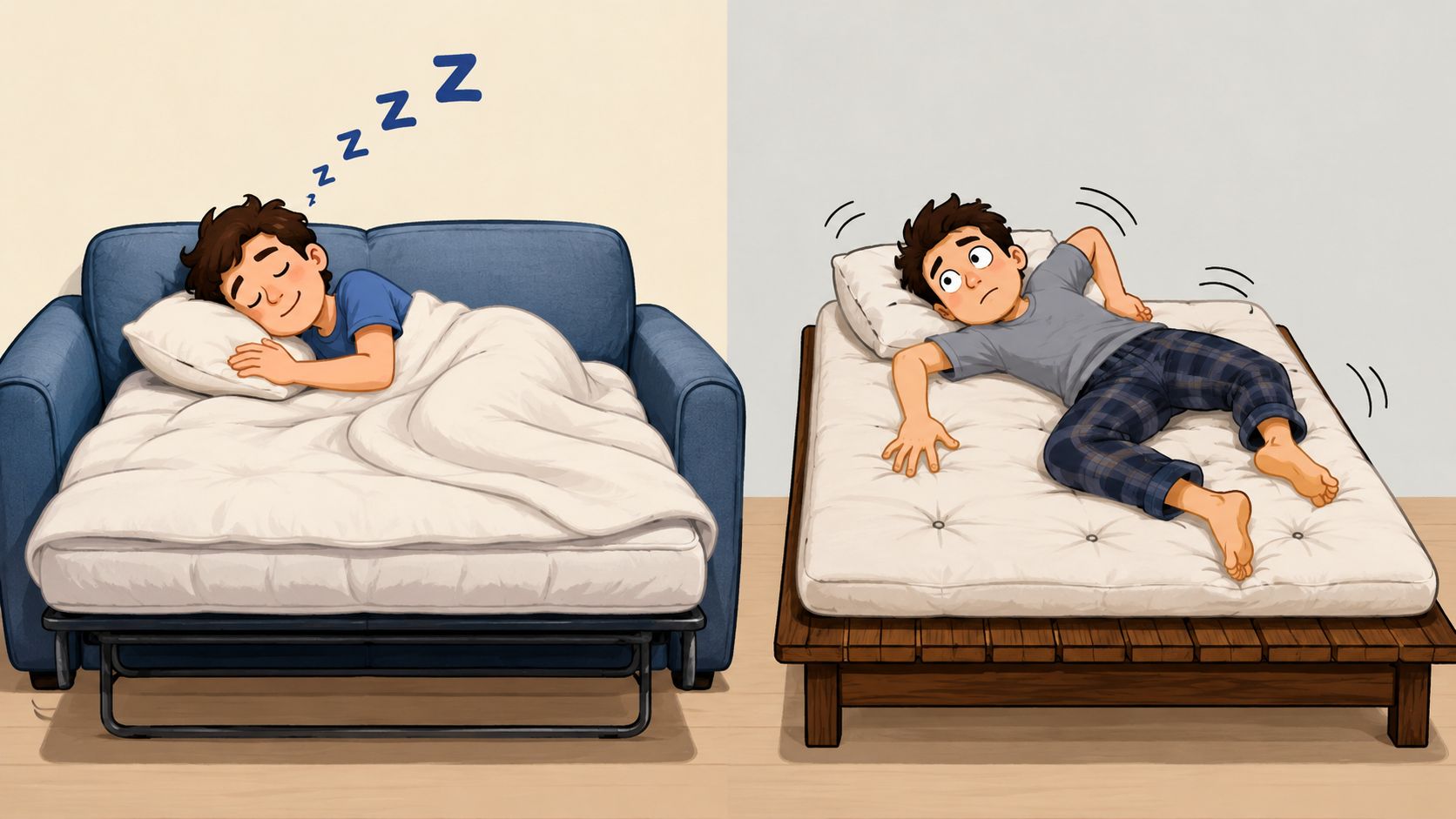
The main reason is simple. A sofa bed and a futon distribute comfort differently. With a sofa bed, the seating cushions and the bed mattress are separate parts. With a futon, the same mattress handles both jobs.
What guests actually feel at night
One useful comparison notes that futon mattresses are usually about 6 to 8 inches thick, while sofa beds more often use 4 to 6 inch mattresses, but the sofa bed's dedicated mattress is often engineered with memory foam or innerspring support for better multi-night sleep. That distinction is explained in this mattress thickness and comfort comparison.
At first glance, thicker sounds better. It isn't always that simple.
A futon may have more visible thickness, but that mattress is also being folded and used as a seat. Over time, sitting pressure and sleeping pressure affect the same surface. A sofa bed's mattress may be slightly thinner, yet it's designed specifically to open into a sleeping surface and support a guest differently than the sofa seat does.
That usually leads to a familiar real-world outcome:
- For occasional overnight use: A futon can feel totally fine, especially in a secondary room.
- For multi-night visits: A sofa bed often gives guests a more bed-like experience.
- For people with back sensitivity: Dedicated sleep design usually matters more than visual thickness.
- For mixed-age households: The easier sitting height and more familiar feel of a sofa bed often gets a better reaction.
Shoppers thinking about future mattress changes or upgrades can also review replacement sleeper sofa mattress considerations, because not every comfort issue starts and ends with the outer frame.
When comfort changes the decision
A college student staying two nights may happily use almost anything that lies flat. A grandparent visiting for four nights usually won't judge it the same way.
That's where honesty helps. If the piece will host recurring guests, especially adults, it makes sense to favor sleep quality over initial simplicity. If the room is mostly for daytime use and guest sleep is occasional, a futon may still be the right answer.
The wrong choice usually isn't “bad furniture.” It's furniture matched to the wrong sleep pattern.
The best test is still the in-person one. Sit on it like a sofa. Then picture the actual sleeper. Not the easiest sleeper in the family, but the pickiest one.
Built to Last A Guide to Frames Durability and Maintenance
A lot of regret shows up a year after the purchase, not on delivery day.
The test starts after repeated openings, spilled drinks, dog nails, grandkids jumping on the seat, and overnight guests who are not as gentle as showroom shoppers. Long-term ownership depends on three things: frame strength, how well the moving parts hold up, and how much work it takes to keep the piece clean and usable.

What holds up over time
A futon usually wins on simplicity. Fewer moving parts often means fewer things to adjust, tighten, or repair later. A sofa bed asks more from its frame and hardware every time it opens and closes, so build quality matters more.
That is why I tell families to look past the fabric first. Start underneath. Check whether the frame feels solid, whether the deck or platform flexes too much, and whether the opening action feels controlled instead of jerky. For households that expect years of regular use, our guide to heavy-duty living room furniture and stronger everyday construction is a helpful next read.
Material choice matters, too. Solid wood and well-made metal components usually age better than lighter construction that saves cost upfront. That is especially true in busy homes, and it matters even more for older adults who need stable seating height and a bed mechanism that does not fight back.
One local option in this category is BILTRITE Furniture-Leather-Mattresses, which carries sleeper and living room furniture with an emphasis on USA-made, Amish-made, solid-wood, small-scale, and heavy-duty options.
The ownership side people forget
Maintenance often decides whether a piece still feels like a smart purchase five years later. Futons are usually easier to flip, rotate, air out, and cover. Sofa beds can be more involved because crumbs, dust, and pet hair can collect around the mechanism and under the cushions.
Repairability is another real-world difference. A simpler futon frame can be easier to service if something loosens over time. A sofa bed can last well, but cheaper mechanisms tend to show wear faster, and repairs are not always simple or inexpensive.
A practical checklist helps:
- Check the joints: Wood connections should feel tight, and metal parts should not wobble.
- Open and close it more than once: One smooth demo is not enough.
- Ask how the fabric cleans up: Families usually appreciate removable covers or forgiving performance fabrics.
- Look at seat height and reach: Seniors often do better with a seat that is easier to get in and out of.
- Ask about replacement parts: Long-term ownership gets easier when hardware or mattresses can be replaced instead of the whole piece.
Good furniture should fit daily life, not require careful handling every weekend.
For low-drama ownership, many families prefer a futon for its straightforward design. Others do better with a higher-quality sofa bed built for repeated use. The better choice depends on how hard the piece will be used, who will sleep on it, and whether you want the simplest upkeep or the more furniture-like feel of a sleeper.
Finding the Right Fit for Your Space and Style
A sofa bed or futon can look good on paper and still be wrong for the room. Fit isn't just floor dimensions. It's traffic flow, visual weight, delivery path, and whether the piece matches the feeling the room is supposed to have.
For style alone, sofa beds usually blend in more easily with a traditional living room or den. They read like normal upholstered seating. Futons often feel more casual, more relaxed, and more useful in rooms that need flexibility over formality.
Where each one works best
Futons often follow standard mattress widths such as twin 38" x 75", full 54" x 75", queen 60" x 80", and king 76" x 80", and they generally have simpler, lighter frames that make them more space-efficient and easier to move. Sofa beds are heavier and more complex, but they usually offer a more conventional sofa appearance, as outlined in this guide to futon and sleeper sofa dimensions and construction.
That usually makes the room-by-room choice easier:
- Main living room: Sofa bed usually looks more natural.
- Home office: Futon often wins for flexibility.
- Teen room or basement hangout: Futon can be practical and easygoing.
- Den with regular overnight guests: Sofa bed often fits the role better.
- Apartment or condo: Either can work, but scale becomes everything.
A lot of Milwaukee-area homes also have rooms that don't want bulky furniture. Smaller bungalows, condos, senior living spaces, and upstairs bonus rooms often need a lighter visual footprint. That's where small-scale furniture can make a big difference.
Delivery day matters too
This is the part many shoppers skip until it's too late. A big, heavy sofa bed can be a challenge in tight stairwells, narrow turns, or older door openings. A futon is often easier to maneuver because the structure is simpler and lighter.
Sofa beds can still work beautifully in compact homes, but buyers should think through the full path from the front door to the final room. Families who want to map dimensions before they shop can use this sofa bed sizing guide as a starting point.
A furniture piece doesn't fit your home if it only fits after the delivery crew leaves.
That's also why come-apart seating can be such a practical category in local showrooms. It solves a very real Milwaukee problem that online photos never warn anyone about.
Who Wins for Your Family Use Cases and Recommendations
There isn't one universal winner. The right answer depends on who's using it, how often they're sleeping on it, and what job the room has the other days of the year.
Still, a few patterns show up again and again when families talk through the decision.
The quick match guide
Choose a sofa bed if the piece will sit in a main living area, host adults regularly, or needs to feel like a standard sofa first and a bed second. This is often the better fit for households that want guests to have a more familiar sleep setup.
Choose a futon if the room needs to stay flexible, the footprint needs to stay lighter, or the piece will mainly handle occasional overnight visitors. It's often a smart option for home offices, casual spaces, and smaller secondary rooms.
Lean toward quality construction if kids will jump on it, pets will climb on it, or the furniture will be used often in both modes. A bargain that becomes annoying to open or uncomfortable to sit on isn't much of a value.
Stay realistic about guest expectations. A nephew home from college and a parent in retirement won't judge the same sleep surface the same way.
A closer look at senior-friendly use
Senior-friendly furniture decisions usually come down to three things. Ease of opening, stable sitting support, and ease of getting in and out.
A sofa bed often feels more familiar to older guests because the seated position is closer to what they expect from a standard sofa. It may also create a more natural guest-room feeling when opened. On the other hand, some sleeper mechanisms can be heavier or more awkward for one person to manage.
A futon may be easier in terms of simpler conversion, but lower seating height and a more casual sleep surface can be less comfortable for some older adults. If grandparents or aging parents visit often, it's worth prioritizing ease of transfer, support, and mattress feel over compactness alone.
A simple way to decide is to match the piece to the most demanding regular guest, not the easiest one.
Your BILTRITE Buying Checklist What to Look For in Our Showroom
Furniture like this should be tried in person. That's especially true for a sofa bed or futon, because the decision isn't only about looks. It's about motion, support, fabric feel, seat height, and whether the piece feels easy or annoying to use.
That hands-on process is one reason BILTRITE doesn't sell online. A family can learn more in a few minutes of sitting, opening, closing, and asking questions than they can from a long string of product photos.

What to test before making a decision
Bring this checklist into the showroom:
- Sit like you normally sit: Don't perch on the edge for five seconds. Lean back, shift around, and notice whether the seat feels supportive.
- Open and close it: If it feels clumsy in the store, it won't feel easier at home.
- Lie down fully: Check shoulder room, back support, and whether the surface feels even.
- Notice the height: This matters for older guests and anyone with knee or hip concerns.
- Study the upholstery: Daily-use fabric needs to make sense for kids, pets, and real life.
Questions worth asking in the store
A strong showroom conversation usually sounds simple, not technical.
- What is the frame made of?
- How does this piece handle frequent use?
- Can the mattress or sleep surface be maintained easily?
- Will this fit smaller rooms or tighter delivery paths?
- Is there a small-scale or heavier-duty version of this style?
BILTRITE's team brings more than 400 years of combined experience to those questions, and that matters. Experienced associates can usually spot the difference between something that only looks good for now and something that will still feel right after years of use.
The store also gives families the chance to compare styles side by side, including sleeper seating, small-scale options, and pieces suited for senior living or tougher daily wear. There's no rush, and there's no need to guess from a screen.
Come down to Greenfield, say hello, and test the furniture the way you'd use it at home. BILTRITE has been part of Metro Milwaukee since 1928, and that family-first mindset still shows up in how the store operates. That includes being closed on Sundays and Mondays for family time.
If a Milwaukee-area home is trying to solve the sofa bed or futon question, BILTRITE Furniture-Leather-Mattresses is a great place to start in person. Visit the Greenfield showroom, try the pieces for real, and talk with a team that knows how to match comfort, durability, space, and everyday family life.