Optimal Foundation for Tempurpedic Mattress Support


You finally picked out a Tempur-Pedic mattress. Maybe it’s already on the way. Maybe it’s sitting in your bedroom right now, still wrapped, while you stare at your old bed frame and wonder, “Can I just put it on that?”
That question comes up all the time, and it’s a smart one.
A Tempur-Pedic doesn’t behave like an old innerspring mattress. It needs the right base underneath it, or you won’t get the feel, support, and long-term performance you expected. The good news is that choosing the right foundation for tempurpedic mattress support is much simpler than it sounds once you know the basic rules.
So You Got a Tempur-Pedic Mattress Now What
Bringing home a new mattress is exciting. Then the practical questions start. Do you need a foundation? Can you keep your current frame? Is a platform bed enough?
The short answer is yes, the support underneath matters. A lot.
Tempur-Pedic’s story helps explain why. The technology behind these mattresses came from NASA’s development of viscoelastic foam in the 1960s, created to absorb pressure for astronauts. The product reached the U.S. market in 1992 through Bobby Trussell, and NASA publicly recognized Tempur-Pedic in 1998 for commercializing the technology, as noted in this Tempur-Pedic history overview.
That space-age foam is designed to respond to your body. It isn’t designed to compensate for a weak, uneven, or bouncy base.
Why people get tripped up
A lot of shoppers hear the word “foundation” and think “box spring.” That’s where confusion starts.
With a Tempur-Pedic, the base should support the mattress evenly. If the mattress is resting on something that flexes, dips, or has big gaps, the comfort layer can’t do its job the way it was designed to.
Simple way to think about it: the mattress handles pressure relief. The foundation handles stability.
A common real-life scenario
You buy the mattress first because that’s the exciting part. Then you look at what you already have:
- An older metal frame that used to hold a box spring
- A wooden bed with slats that look “close enough”
- A platform bed you hope will work
- An adjustable base you’re curious about
Each one might work. Each one also might not.
If you’re considering extra comfort features, an adjustable base can change how your bed feels and functions, especially for reading, relaxing, or finding a more comfortable sleep position.
The key is matching the mattress to support that stays flat, firm, and consistent.
The Four Main Choices for Supporting Your Tempur-Pedic
When shoppers ask about a foundation for tempurpedic mattress use, there are four main setups worth knowing. They all solve the same problem in different ways.
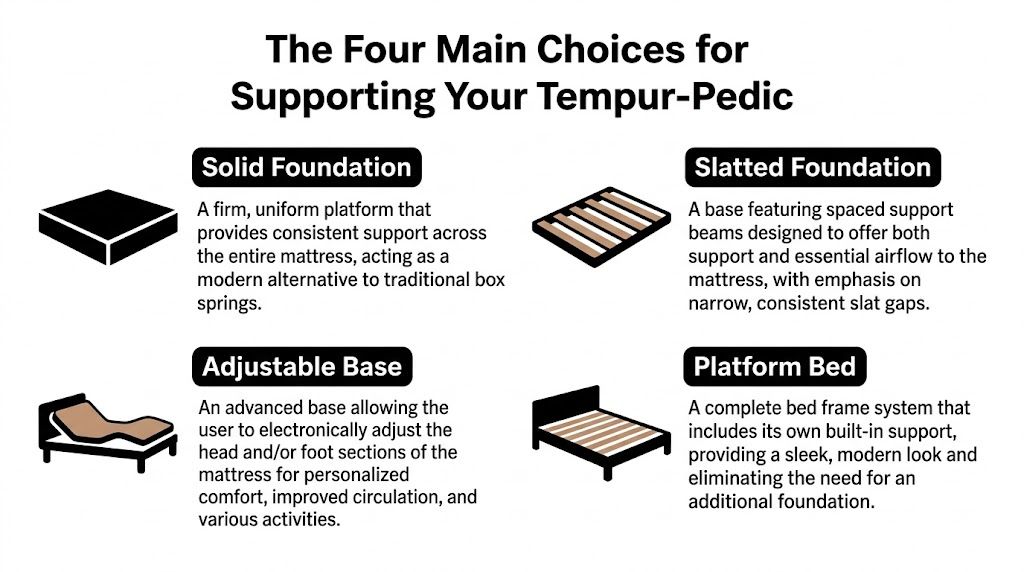
Solid foundation
This is what many people mean when they say “foundation.” It often looks like a box spring from the outside, but it doesn’t have springs inside.
It gives the mattress a flat, rigid surface from edge to edge.
The official Tempur-Pedic TEMPUR-Flat® Foundation is built this way and comes in 9-inch, 5-inch, and 2-inch profiles, with a Queen supporting up to 800 lbs, according to the TEMPUR-Flat Foundation product details.
That profile choice matters more than some people expect. A taller foundation gives a more traditional bed height. A lower one creates a more modern look and can make getting in and out of bed easier.
Platform bed
A platform bed includes support as part of the bed itself. Some have a solid deck. Others use slats.
That can be a clean, all-in-one option because you don’t need a separate foundation sitting on a frame. If you want a refresher on the broader types of bed, that guide helps sort out platform beds, panel beds, and other common styles.
A platform bed works well when:
- You want fewer pieces and a simple setup
- You like lower bed height
- You’re buying a full bed and support system together
Slatted base
A slatted base can work, but people need to be mindful.
Some slatted frames are strong and properly spaced. Others look fine at first glance but leave too much open space between boards. That can create trouble over time.
A slatted base is usually a good candidate only when the slats are rigid and closely spaced. More on that in the next section.
Adjustable base
This is the comfort-focused option. It lets you raise the head, feet, or both, depending on the model.
People often choose adjustable bases because they want more than just mattress support. They want a bed that works for reading, TV, relaxing, or sleeping in a position that feels better on their body.
Not every shopper needs an adjustable base. But the people who love them usually know why very quickly.
Quick comparison
| Support type | Best fit for | Main thing to check |
|---|---|---|
| Solid foundation | Straightforward, strong support | Correct height for your room |
| Platform bed | Clean style and built-in support | Whether surface is solid or slats meet requirements |
| Slatted base | Existing frame you want to keep | Slat width, spacing, and rigidity |
| Adjustable base | Position changes and added comfort | Mattress compatibility and room setup |
No single choice fits every bedroom. The right one depends on your frame, your room, your preferred bed height, and whether you want flexibility or simplicity.
Getting Technical With Slats Gaps and Support
This is the part people often skip. It’s also the part that saves mattresses.
If your Tempur-Pedic is going on a slatted frame, you need to look past the style and check the structure.
The slat rule that matters
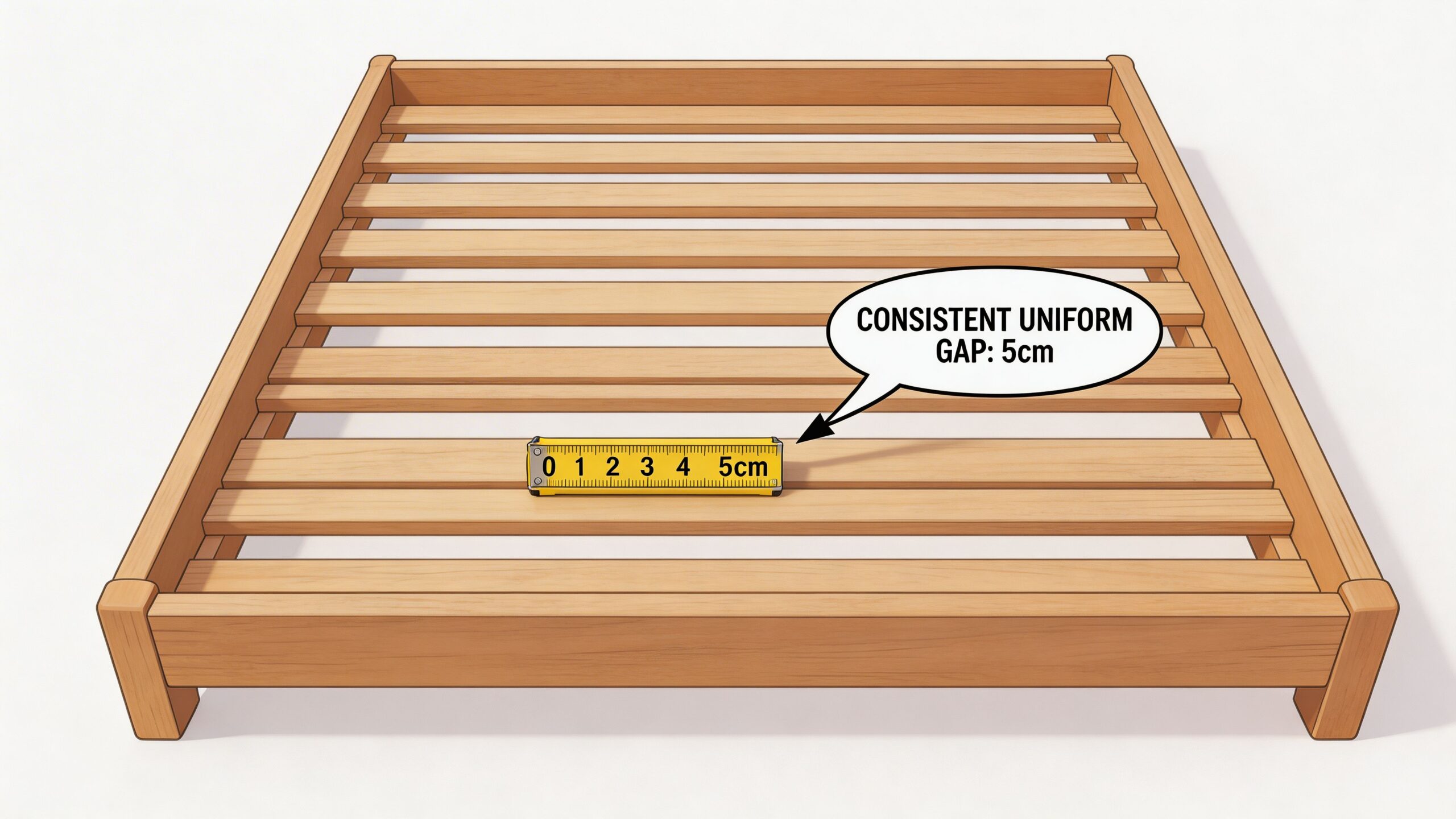
Tempur-Pedic’s engineering standards call for either a solid platform or a slatted base with slats that are at least 3 inches wide and spaced no more than 3 to 4 inches apart. The same source notes that a non-compliant base can reduce foam conformance by 20 to 30 percent over 5 years, according to Tempur-Pedic foundation guidance.
That sounds technical, but the practical meaning is simple.
If the gaps are too wide, parts of the mattress don’t get enough support. Over time, the foam can settle unevenly.
What to check on your current frame
Take out a tape measure. Then check these points:
- Slat width: Each slat should be at least 3 inches wide.
- Gap size: The spaces between slats should stay within the recommended range.
- Rigidity: The slats shouldn’t bow or flex easily.
- Center support: Larger sizes need stable support through the middle.
- Overall flatness: The surface should feel even, not crowned or saggy.
If you’ve got a slatted bed frame, this is exactly the kind of inspection worth doing before the mattress goes on top.
Why this matters in plain language
Think about laying a sheet of plywood across two sawhorses versus laying it across six evenly spaced supports. The second setup spreads weight better.
Foam mattresses need that same even support. Wide gaps create concentrated pressure points. That can change how the mattress feels under your shoulders, hips, and lower back.
Practical rule: If you can see obvious space between slats and wonder whether it’s too much, measure it. Guessing isn’t good enough here.
What about an old box spring
If it has actual springs or noticeable give, it’s the wrong tool for the job.
Traditional box springs were built to work with older innerspring mattresses. Tempur-Pedic foam wants a base that stays steady and level, not one that adds bounce.
That’s why people often hear “box spring” and “foundation” used as if they mean the same thing, even though they don’t.
How Your Foundation Choice Affects Your Warranty
This part doesn’t need to feel scary. It just needs to be clear.
Mattress warranties are built around one basic idea. The mattress has to be used on the kind of support it was designed for. For Tempur-Pedic, that means a rigid, solid, non-spring base that keeps the mattress properly supported.
If the base underneath is weak, flexible, or uneven, the mattress may not perform the way it should. If sagging develops because the support system was wrong, that can create warranty problems.
That’s why foundation choice isn’t just about bed height or style. It’s part of protecting what you bought.
The simplest way to stay on safe ground
Ask these questions before setup:
- Is the surface flat and supportive?
- Does the base avoid springs and bounce?
- If it uses slats, do they meet the required spacing?
- Does the frame support the center well on larger sizes?
If you’re still fuzzy on the difference, this guide on whether you need a boxspring for your mattress helps clear up the terms.
A lot of warranty headaches start with one bad assumption. “It fit” is not the same as “it was the right support.”
The nice thing is that this is easy to solve before the mattress ever gets slept on.
Finding Your Foundation The BILTRITE Way
Most online advice stops at “buy a solid base.” That’s not wrong. It’s just incomplete.
In real homes, people care about strength, appearance, delivery, budget, and whether the piece will hold up over time. That’s where well-built USA-made and Amish-crafted options stand out.
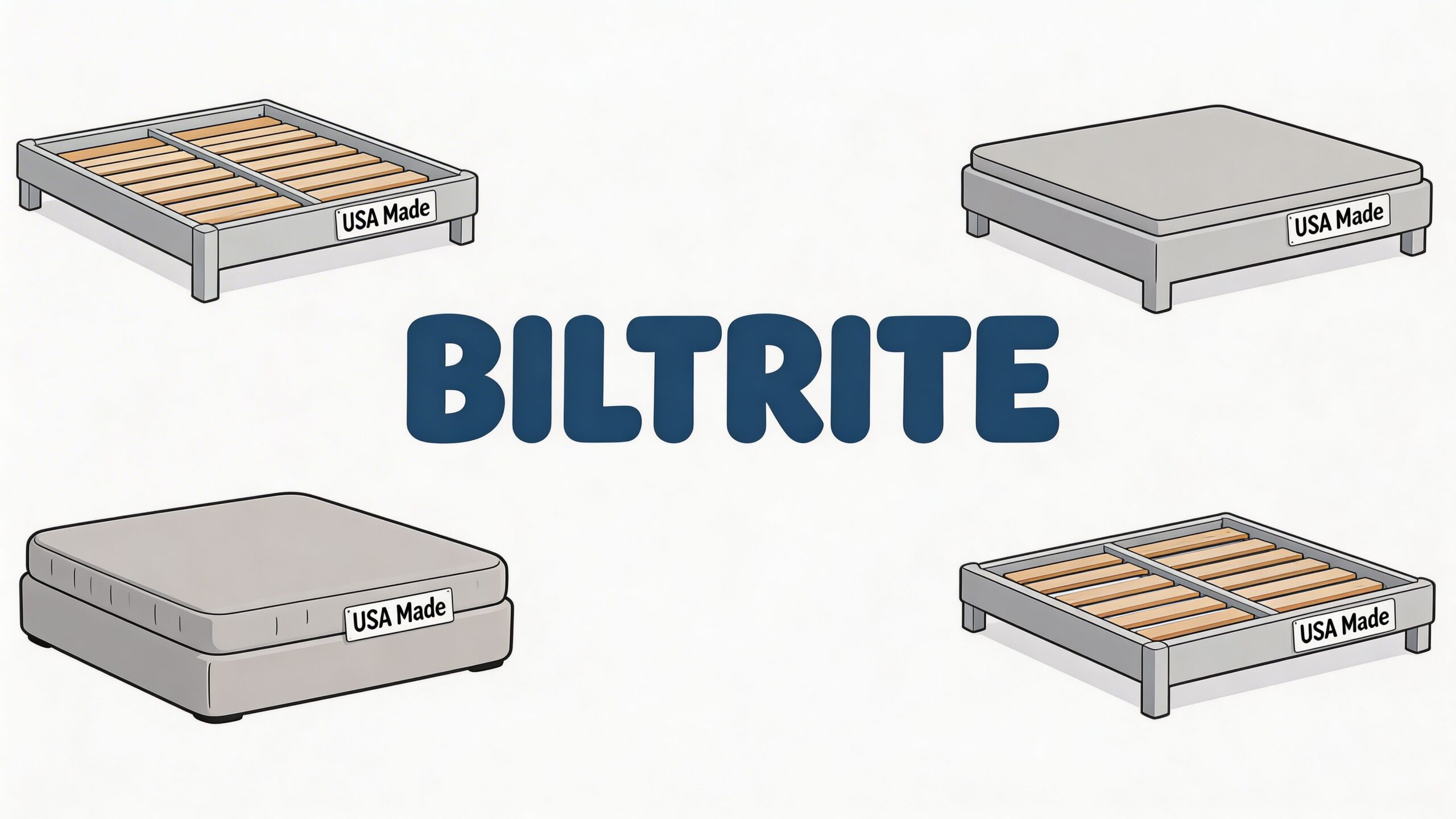
A projected 2025 consumer report says 40% of Midwest mattress buyers prefer USA or Amish durability over imports, and it also notes that many guides don’t do much to validate third-party solid wood foundations, while stores like BILTRITE can confirm compatibility in person, according to this regional foundation guide.
Why local craftsmanship fits this mattress category so well
A Tempur-Pedic asks for support that is flat, strong, and consistent. That lines up nicely with:
- Solid wood platform beds built with sturdy surface support
- Heavy-duty foundations made for long-term use
- Amish-crafted bedroom furniture that focuses on strength as much as style
- Low-profile or taller setups depending on room design and mobility needs
That matters for families, couples, and older adults alike. Some people want a lower modern bed. Others want a bed that sits higher and feels easier to enter and exit.
A better question than “Do I need the official one”
A lot of shoppers ask if they must buy the branded base.
A better question is this: does the base give the mattress the support it requires?
If the answer is yes, and the construction is rigid and appropriate, you can open up many more choices in wood type, design, height, and price range.
Good support doesn’t have to look generic. A strong foundation can also be handsome furniture.
Where hands-on shopping helps
This is one of those categories where seeing the build quality matters.
Online photos rarely show you:
- whether the center support feels stout
- how thick the slats really are
- how the bed height changes with a low or tall foundation
- whether a frame feels steady when you sit on the edge
That’s why many people feel more confident after seeing options in person, especially when they want a foundation for tempurpedic mattress support that also looks at home in the room.
How to Choose and Measure for Your Space
Support matters. Fit matters too.
A foundation can be technically correct and still feel wrong if the bed ends up too high, too low, or awkward in the room.
Start with bed height
Tempur-Pedic’s official flat foundation comes in 9-inch, 5-inch, and 2-inch profiles, which gives you a useful way to think about bed height options even if you choose another compatible support style.
A taller setup often feels more traditional. A lower one can look cleaner and work better in rooms where you want a less bulky visual line.
Measure these three things
Don’t stop at mattress size. Check the whole path and the whole room.
Bedroom footprint
Measure the wall where the bed will go. Then leave enough space to walk, open drawers, and move around comfortably.Overall bed height
Add up the height of the frame, foundation, and mattress. That gives you the sitting height you’ll live with every day.Delivery path
Measure doorways, stair turns, hallway pinch points, and tight corners.
If you want a better breakdown of the parts of a bed, that can help you sort out what contributes to total size and height.
A few practical examples
- For a smaller bedroom: a lower-profile foundation may help the room feel less crowded.
- For a taller sleeper or a traditional look: a standard-height foundation can make the bed feel more substantial.
- For tricky access: split foundations can make delivery much easier than one bulky piece.
- For aging in place: bed height becomes a comfort and mobility issue, not just a style choice.
A quick shopping checklist
Bring these measurements with you:
- Mattress size
- Current frame dimensions
- Desired finished bed height
- Bedroom door width
- Stair or hallway measurements
- Any obstacles like low ceilings or tight turns
Measure the room. Then measure the path to the room. That second step is the one people forget.
It’s also smart to think about who’s using the bed. Kids, couples, seniors, and guest rooms all have different needs. A sleek low platform may look great in one home and be annoying in another.
Come Say Hi and Find Your Foundation in Greenfield
Reading about support systems helps. Touching them helps more.
If you’re trying to choose the right foundation for tempurpedic mattress support, seeing a platform bed, a solid foundation, and an adjustable base side by side makes the decision much easier. You can check height, stability, and style in a few minutes instead of guessing from photos.
There’s also peace of mind in talking it through with people who do this every day. That’s especially helpful if you’re trying to reuse a frame, fit a bed into a smaller room, or decide between low-profile and standard-height support.
BILTRITE has been serving Metro Milwaukee since 1928 and remains a fourth-generation family-owned business in Greenfield. The showroom is at 5430 West Layton Avenue in Greenfield, and being closed on Sundays and Mondays reflects the family-first values that still guide the store.
If you’re nearby, stopping in often clears up questions fast.
Your Tempur-Pedic Foundation Questions Answered
Can I use my old box spring with a new Tempur-Pedic mattress
Usually, no.
If the old box spring has springs, flex, or bounce, it isn’t the right support for a Tempur-Pedic. These mattresses do best on a rigid, even surface.
Do I have to buy the official Tempur-Pedic brand foundation
No. The key is using a base that gives the mattress the kind of flat, stable support it requires.
That could be a compatible solid foundation, platform bed, or properly built slatted system.
What’s the benefit of a split king foundation
Two smaller pieces are often easier to move through tight spaces than one large king foundation. Split setups are also helpful when paired with split king adjustable bases, since each sleeper can have their own position.
If you’d like hands-on help sorting through your options, visit BILTRITE Furniture-Leather-Mattresses in Greenfield. We’d love to help you compare support styles, check bed height, and find a strong, comfortable setup that fits your home and your mattress.