Sofa too big to fit through door?


You finally found the sofa you love. It shows up, everybody grabs a corner, you get it to the front door, and then everything stops.
The angle looks close. The doorway looks close. Your patience is not close.
If your sofa too big to fit through door situation is happening right now, take a breath. Don’t force it. A stuck sofa usually turns into scraped walls, torn fabric, sore backs, and a much bigger headache when people switch from measuring to shoving.
We’ve helped Milwaukee-area families with furniture since 1928, and this is one of those problems that feels personal when you’re in it. The good news is that there’s usually a smart next move. Sometimes it’s a better angle. Sometimes it’s hardware removal. Sometimes it’s simple disassembly. And sometimes the right answer is to stop before you damage a good piece of furniture.
That Heart-Sinking Moment Your New Sofa Gets Stuck
A lot of people think they’re the only ones this happens to. They’re not.
One minute you’re excited about your new living room. The next minute you’re holding one end of a sofa in a front hall, your helper is saying “tilt it more,” and the door frame is already losing the argument.

We’ve seen this in old Milwaukee bungalows, upper flats, condos, and newer homes with awkward entry turns. The sofa isn’t always “too big” in the obvious way. Sometimes it’s the depth. Sometimes it’s the hallway corner. Sometimes it’s a back cushion shape that changes the angle just enough to stop the whole move.
This problem is so real that math got involved
There’s a famous mathematical puzzle about this exact kind of challenge. The moving sofa problem was introduced by Leo Moser in 1966, and mathematicians have spent nearly 60 years working on the largest shape that can get through an L-shaped corner. A leading solution was proposed by Joseph L. Gerver, and a potential final proof was posted in November 2024, as explained in this moving sofa problem overview.
That tells you something useful right away. Tight-space furniture moving is not simple. If it feels weirdly complicated, that’s because it is.
Start calm, not aggressive
Your first instinct might be to push harder. Bad idea.
Practical rule: If the sofa stops moving and the walls start flexing, the move has changed from “tight fit” to “damage in progress.”
If you’re already shopping with narrow access in mind, it helps to look at options built for this challenge, including furniture for narrow doorways.
The main thing right now is simple. Stop wrestling it. Measure first. Then choose the least risky path.
Your Pre-Move Measurement Checklist
A tape measure saves more sofas than muscle does.
Before you lift again, get real numbers. Not guesses. Not “it looks like it should fit.” Real measurements. This step matters because a failed fit can get expensive fast. Many retailers charge restocking fees of 15-25%, and return shipping can add $100-$300, according to this doorway measurement and delivery guide. The same guide notes that standard doorways are 30-36 inches and that sofa depth is often the measurement that causes the problem.
Measure the sofa first
You need the sofa’s full outside dimensions, not just the seating area.
Write down:
- Length. Arm to arm.
- Height. Floor to the highest point of the back.
- Depth. Front edge to the back.
- Removable parts. Cushions, legs, backs, or arms that come off.
If you want a cleaner way to track all of this, use a guide like how to measure furniture.
Measure every opening on the path
Don’t stop at the front door. That’s where people get in trouble.
Measure:
- Door width at the narrowest point
- Door height
- Interior doors
- Hallways
- Corners and turns
- Stair landings
- Anything that sticks out, like trim or uneven frames
Older homes are where this really matters. One narrow turn can ruin an otherwise easy move.
Use this checklist, not your eyeballs
| What to Measure | Why It Matters |
|---|---|
| Sofa length | Tells you how much turning space you need |
| Sofa height | Matters when you stand the sofa up |
| Sofa depth | Often the make-or-break dimension at the doorway |
| Cushions and removable parts | Reduces bulk before you try again |
| Front door opening | Confirms the first access point |
| Interior doors | Catches hidden pinch points deeper in the house |
| Hallway width | Helps you know whether you can rotate the sofa |
| Tight corners | Decides whether an angle move is possible |
What your numbers usually tell you
Once you compare the sofa to the openings, the result usually falls into one of three buckets:
- Good fit. It should pass with normal handling.
- Tight fit. You’ll likely need a controlled angle or pivot.
- Bad fit. You need disassembly, hardware removal, or a different plan.
If you haven’t measured the whole route, you haven’t measured the move.
That one habit prevents a lot of avoidable frustration.
Smart Ways to Maneuver Your Sofa
If the numbers say the fit is close, stop thinking force and start thinking geometry.
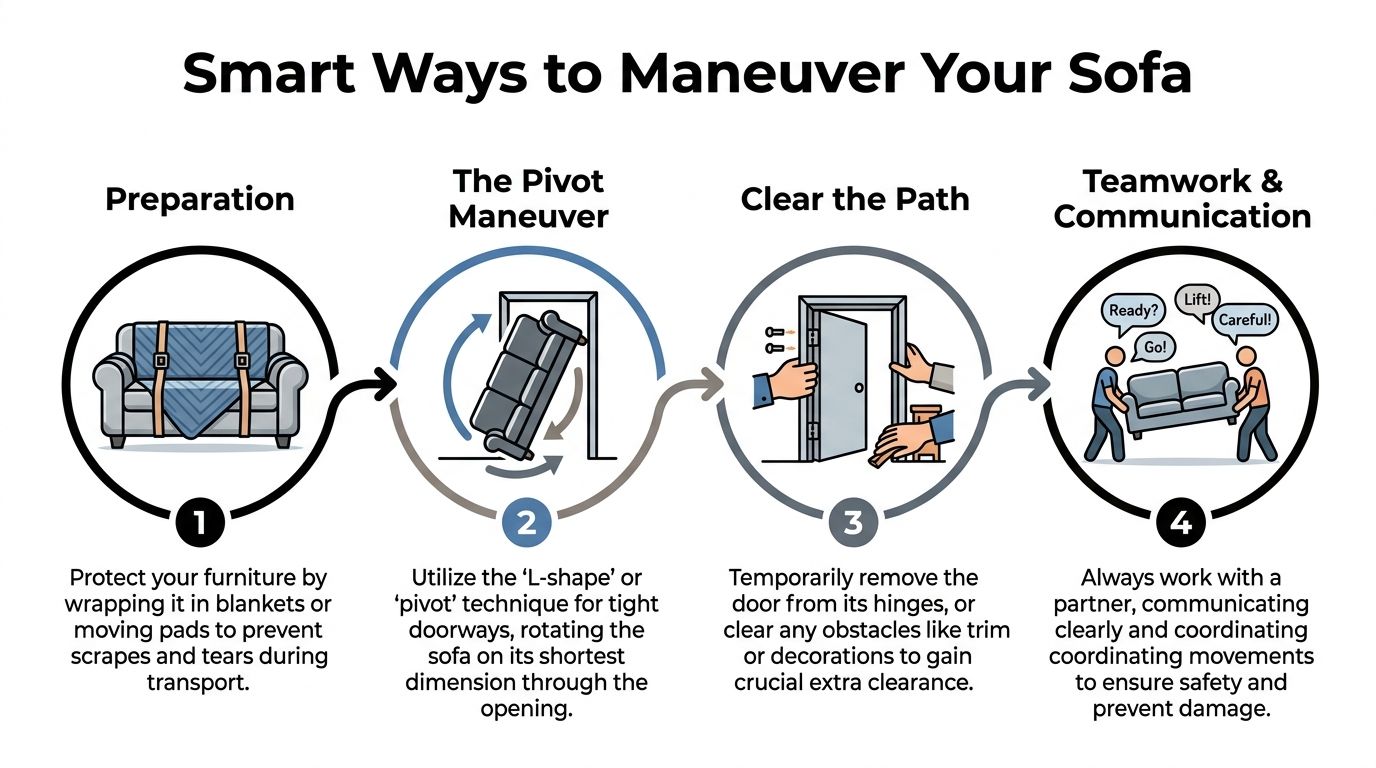
The goal is to make the sofa temporarily “smaller” by changing its orientation, not by crushing it through the frame. Use two people, clear the route, and protect the upholstery with moving blankets or heavy covers before you start.
Try the vertical pivot first
This move is often the first one to try before taking anything apart.
Stand the sofa on one end. Usually the back-leg end works well. Then guide the top portion through the doorway first while the person on the lower end pivots the base around the frame. This works because the sofa’s profile changes when it’s upright.
The key is slow movement and constant communication. One person leads. One person follows. Nobody jerks it.
Remove the easy obstacles
Sometimes the sofa is not the main issue. The doorway hardware is.
Professional movers know that removing door hinges can free up about ½ inch of width, and removing door stops can add another inch of width and ½ inch of height, for up to 1.5 inches of clearance, according to this guide on getting a couch through a door.
That’s a big deal when you’re stuck by a tiny margin.
What to remove first
- The door itself. Fastest way to gain room.
- Hinge hardware. Helpful when you only need a little more width.
- Door stops. Worth considering if the fit is extremely close.
Work the opening, not the whole house at once
Bring the sofa right up to the opening before you start rotating. Don’t try a wide dramatic spin in the hallway if the primary challenge is at the frame.
A controlled move usually looks like this:
- Bring the sofa square to the doorway.
- Stand it up on end.
- Feed the upper section in.
- Pivot the lower section through.
- Reset your grip once the center clears.
If the route also includes stairs or a split-level entry, a separate approach matters. For those scenarios, how to move heavy furniture upstairs is the more useful playbook.
Move slowly enough that you can stop instantly. That’s how you protect fabric, woodwork, and fingers.
If the sofa starts binding hard, don’t keep “testing” the frame. That’s where the damage starts.
A Guide to Simple Sofa Disassembly
If the pivot failed, your next move is selective disassembly. Not surgery. Not desperation. Just the parts that are designed to come off.
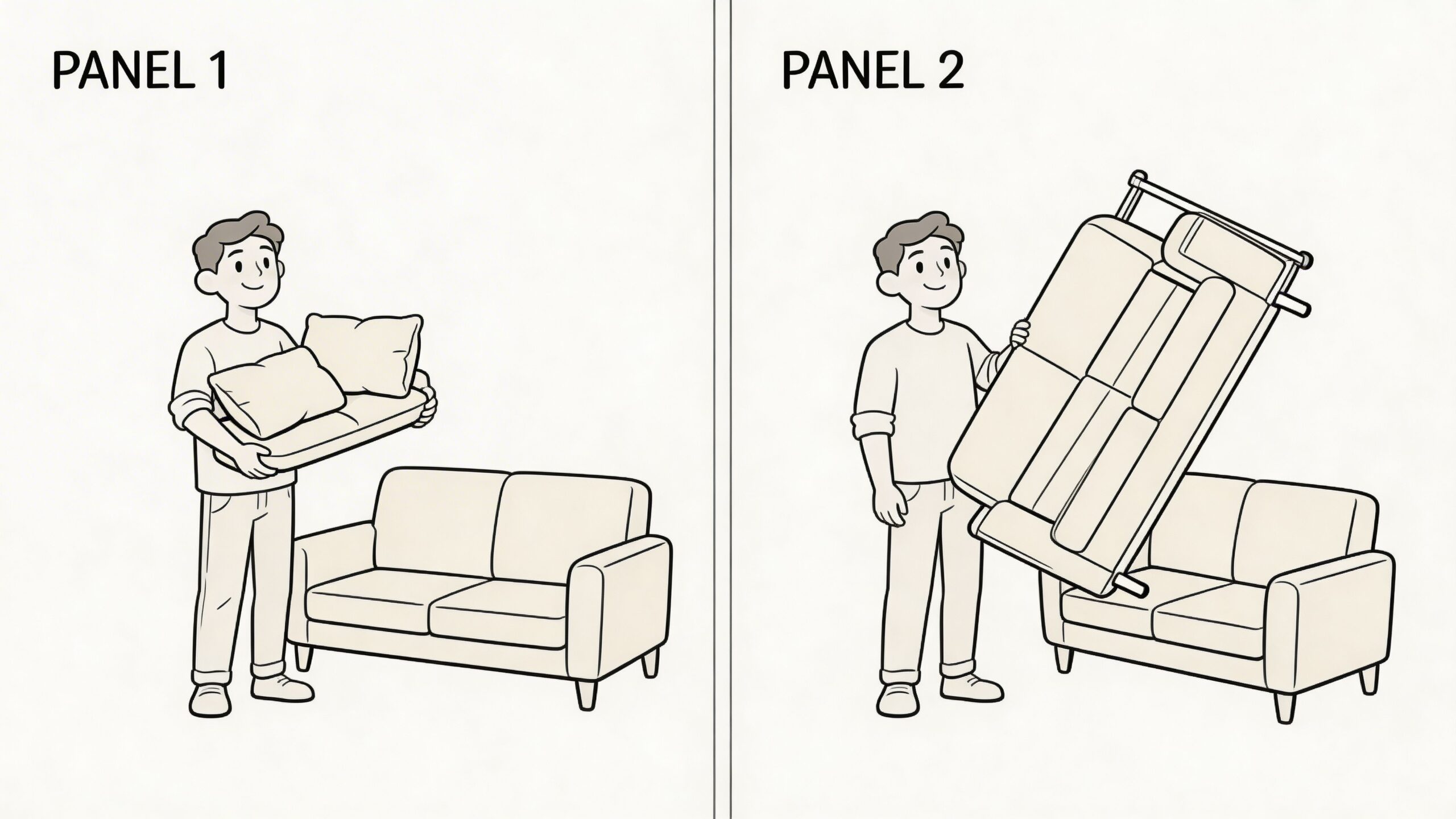
Start with the obvious pieces. Remove all loose cushions and pillows. Then flip the sofa carefully and check the legs. A lot of sofas have screw-off legs, and that one step can change the whole fit.
What’s usually safe to remove
These parts are commonly removable without turning the job into a mess:
- Seat and back cushions. Easy win. Less bulk.
- Legs. Often unscrew with basic tools.
- Removable arms or backs. Only if the design clearly allows it.
Some room layouts also call for slimmer pieces from the start, especially if you’re working with tighter footprints like sectional sofas for small spaces.
Where DIY goes wrong
People get impatient. They start forcing bolts, pulling fabric panels, or removing structural pieces they don’t understand. That’s where a stuck sofa turns into an expensive mistake.
A 2025 Furniture Today report found that 18% of U.S. delivery claims involve damage from maneuvering furniture, costing $250-800 per incident, and many USA/Amish furniture warranties are voided by customer disassembly, as noted in this article on fitting a sofa through a door.
That should change how you think about “just taking it apart.”
My opinion on disassembly
If the part is obviously removable, go ahead carefully.
If you need to guess, pry, force, or peel upholstery to get to it, stop. High-quality furniture deserves better than panic repairs. This is especially true with solid, rigid frames. They’re built to last, but they’re less forgiving when somebody tries to bend them into a shape they were never meant to be.
Good disassembly feels orderly. Bad disassembly feels like you’re hoping no one notices later.
That’s a reliable test.
Why Sometimes a Professional Mover is Your Best Friend
There’s a point where the smart move is calling somebody who does this all the time.
Not because you failed. Because risk changes fast once the sofa is wedged, the angle is wrong, and your house starts taking hits. A professional mover brings technique, equipment, and accountability. That matters when the piece is heavy, rigid, or expensive to repair.
Signs you should stop the DIY attempt
You should hand it off if any of this is happening:
- The sofa binds hard and won’t move without force
- You need to twist the frame to keep going
- The walls, trim, or flooring are getting marked
- You’re dealing with a narrow turn or stairs
- Nobody is fully in control of the weight
Professional help is also a good call if the sofa has substantial wood construction or upholstery you don’t want to risk.
Why paying for help can save money
A short service call can be cheaper than replacing damaged trim, repairing a torn arm, or finding out the warranty won’t help after a risky DIY attempt.
Here, delivery service also matters. One option people consider is BILTRITE Furniture-Leather-Mattresses, which offers white-glove delivery on qualifying purchases and handles in-home placement as part of the service structure. If you’re buying quality furniture, that kind of setup reduces a lot of stress before delivery day even starts.
The main point is simple. A professional mover costs money. Damage usually costs more.
Find Furniture That Always Fits at BILTRITE
The smartest way to solve a sofa that won’t fit is to stop buying against your doorway.
That’s not glamorous advice, but it’s the truth. The best long-term answer is choosing furniture with delivery in mind before it ever leaves the showroom. In Metro Milwaukee, that matters a lot. We’ve been helping local families since 1928, and we know how many homes have tight entries, older trim, awkward stair turns, and rooms that don’t forgive oversized furniture.
Choose furniture built for real homes
Some sofas are easier to deliver because they’re engineered for it.
The technical advantage of come-apart furniture is that it has intentional disconnect points for tight spaces, which eliminates the need for risky door modifications and reduces stress during delivery, as explained in this overview of come-apart sofa design.
That’s a very different situation from random DIY disassembly in your hallway.
What we tell neighbors in the showroom
If you live in an apartment, condo, bungalow, duplex, or older home, we tell you to shop with access in mind, not just style.
That usually means looking at:
- Come-apart sofas and sectionals for tight entries
- Small scale furniture for cozier rooms and narrower routes
- USA-made and Amish-made pieces with strong construction and better long-term value
- Real solid wood furniture when durability matters, while still respecting delivery limits
If you want to compare dimensions before you come in, sofa dimensions inches is a useful starting point.
The old-school advice still wins
Bring measurements with you. Bring photos of the doorway. Bring the hallway width and the tricky turn by the stairs.
We’ll take that seriously because this problem is preventable when people plan for it. Our team has a huge amount of combined experience, and we’d rather help you choose the right piece the first time than watch you fight with a doorway later.
We’re proud to be a fourth-generation family business in Greenfield. We don’t sell online. We want people to sit on the furniture, look at the build quality, ask real questions, and get honest guidance from people who know the difference between a tight fit and a bad idea.
If you’re dealing with a sofa too big to fit through door problem right now, or you want to avoid one on your next purchase, come visit BILTRITE Furniture-Leather-Mattresses in Greenfield. We’d love to help you find a better-quality sofa, sectional, recliner, or mattress that works for your home, your family, and your doorway.