What Is Coil Count in Mattresses? A BILTRITE Guide


You are here because you have looked at a few mattresses and hit that point where every tag starts to blur together. One says pocketed coils. Another says heavy-duty support. Then you spot a big number for coil count and wonder, “Am I supposed to know if that’s good?”
That confusion is normal. We’ve been helping Metro Milwaukee families sort through mattress choices since 1928, and even now, coil talk is one of the places shoppers get tripped up most often. Numbers sound simple, but they do not always tell the whole story.
The good news is that what is coil count in mattresses is not hard to understand once someone explains it in plain English. That’s what we’d do for you in our Greenfield showroom, neighbor to neighbor, without the marketing fog.
Your Guide Through the World of Mattresses
A lot of folks walk into a mattress department thinking they just need to lie down for five minutes and pick the one that feels nice. Then the questions start.
How many coils does it have? Are pocketed coils better? What in the world is gauge? Why do two mattresses with similar tags feel completely different?
That’s where a little guidance helps. As a fourth-generation family business, we’ve spent decades translating mattress jargon into practical meaning. We’re not interested in impressing you with buzzwords. We want to help you understand what supports your back, what holds up for a couple, and what makes sense for a guest room versus a primary bedroom.
Why shoppers get stuck
Most confusion comes from one simple issue. Mattress labels usually show specs, but shoppers want outcomes.
You do not care about coil count just because it’s a number. You care because you want to know:
- Will it support my body well
- Will I feel my partner moving
- Will it hold up over time
- Will it fit my budget without cutting corners
A mattress spec only matters if you know how it changes the way the bed feels and lasts.
If you want a broader starting point beyond coil count, our ultimate guide for choosing a mattress is a helpful companion.
The local, practical way to think about it
In Milwaukee-area homes, we see a wide mix of needs. Young families want something durable. Seniors often want easier support getting in and out of bed. Couples usually ask about motion transfer. Some shoppers want a sturdy two-sided mattress that can handle years of use.
Coil count fits into all of that. It’s not the whole mattress story, but it is one of the first clues about how the support system is built.
So What Is Coil Count in a Mattress
At its simplest, coil count is the total number of metal springs inside an innerspring or hybrid mattress.
That’s it. It’s a count of the coils doing the support work underneath the comfort layers.
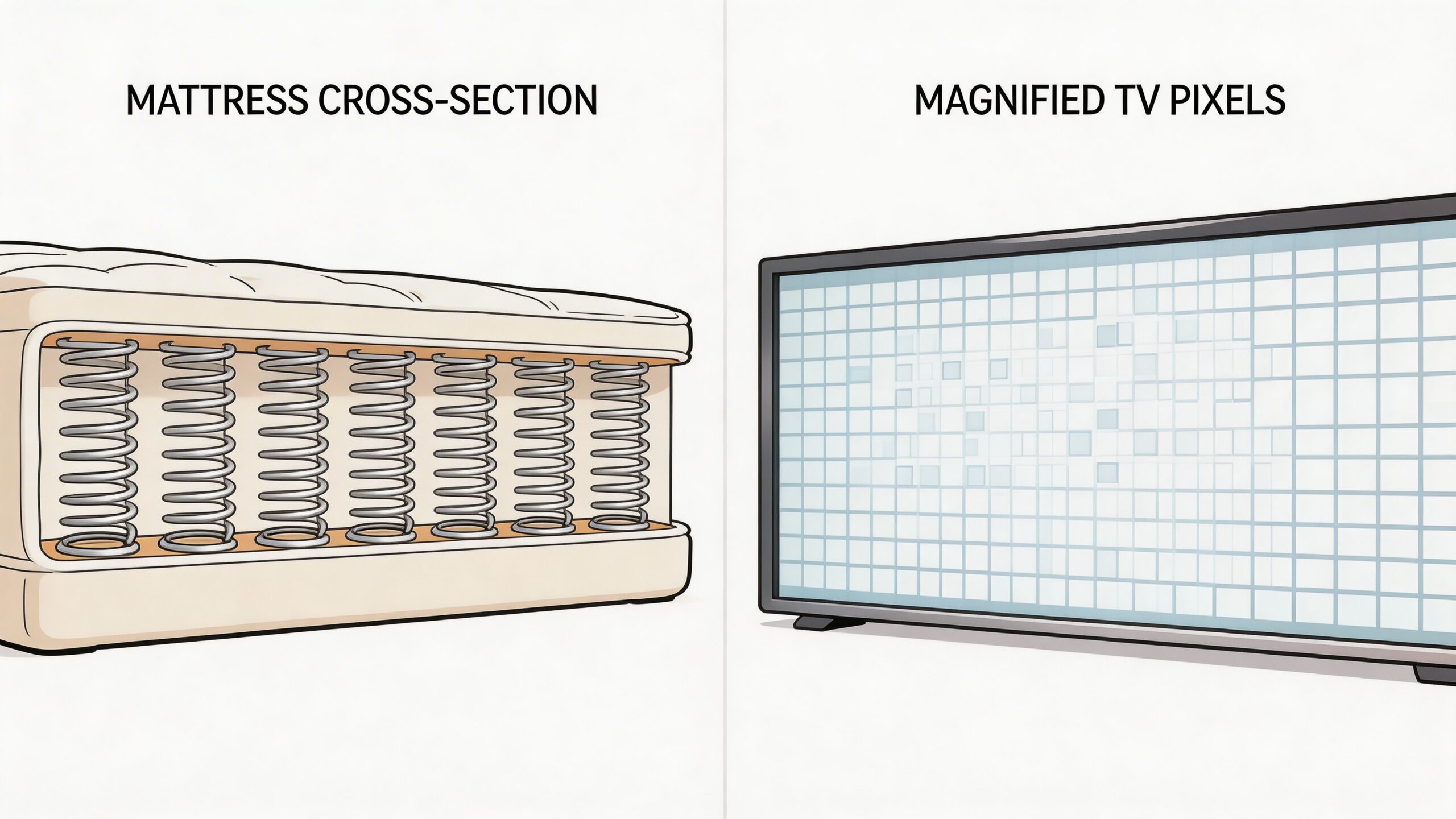
A simple way to picture it is to think about a TV screen. More pixels can create a more detailed image. In a mattress, more coils can create more points of support across your body. That can help the mattress respond more precisely to your shoulders, hips, and lower back.
What the number tells you
Coil count gives you a starting point for comparing mattresses of the same size.
A queen mattress naturally needs more coils than a full because it has a larger sleep surface. So the meaningful comparison is queen to queen, not queen to twin or king to full.
According to Saatva’s explanation of coils in a mattress, queen mattresses typically range from 400 to 1,200 coils, with an industry minimum of 400 for a queen and 480 for a king to provide baseline support. The same source notes that higher counts, often using pocketed coils, can reduce pressure points by 20 to 30 percent compared to lower-count systems.
What coil count affects in daily life
When shoppers ask what coil count changes, we usually bring it back to feel.
A higher-quality coil system can help with:
- Body support so you don’t feel like you’re dipping in the middle
- Weight distribution across the mattress surface
- Pressure relief around hips and shoulders
- Motion control, depending on the coil design
Where people get mixed up
The number isn’t a grade. It doesn’t mean “higher is always better,” and it doesn’t automatically tell you firmness.
A mattress with fewer well-built coils can outperform one with a flashy number on the tag. Coil count matters, but only when you pair it with the other parts of the support system.
Simple rule: Use coil count as a comparison tool, not as the final verdict.
Coil Count vs Coil Gauge: The Full Story on Support
Here’s the part many shoppers don’t hear soon enough. Coil count and coil gauge are not the same thing, and both matter.
If coil count tells you how many springs are in the mattress, coil gauge tells you how thick the wire is that makes those springs.
That thickness changes how the mattress supports weight, how it feels, and how well it stands up over time.
Gauge works backward
This is the counterintuitive part.
With coil gauge, lower numbers mean thicker wire. So a 13-gauge coil is thicker and firmer, while a 17-gauge coil is thinner and softer.
According to Sleep Doctor’s page on mattress coil types, coil gauge runs from 13, the thickest and firmest, to 17, the thinnest and softest. The same source says lower gauge coils can resist compression by 30 to 50 percent more than higher gauge wires under the same pressure.
Why that matters more than people think
Let’s say two queen mattresses both have a strong-looking coil count on the tag. One uses sturdier wire. The other uses thinner wire to fit in a bigger number.
They may sound similar on paper, but they won’t behave the same in a home.
The sturdier one is more likely to:
- Hold shape longer
- Support heavier sleepers better
- Feel steadier at the edge
- Handle regular use without softening as quickly
The thinner-wire version may feel fine at first, especially if you like a softer surface. But if the support core is too light for the job, the comfort layers on top can only hide that for so long.
Consider This Analogy
Coil count is how many workers are on the job. Gauge is how strong they are.
If you hire more workers but each one is weaker, the team doesn’t always perform better. Mattress support works the same way.
Here’s a quick comparison:
| Support detail | What it tells you | Why it matters |
|---|---|---|
| Coil count | Number of springs | More support points across the mattress |
| Coil gauge | Thickness of the steel wire | Strength, firmness, and long-term durability |
For shoppers comparing comfort levels, our mattress firmness guide can help connect these build details to how a bed feels.
A Friendly Guide to Mattress Coil Types
The shape and design of the coils matter just as much as the number of coils. Two mattresses can have similar counts and feel completely different because the springs are built differently.
That’s why showroom conversations usually get easier once you can put the main coil types into plain categories.
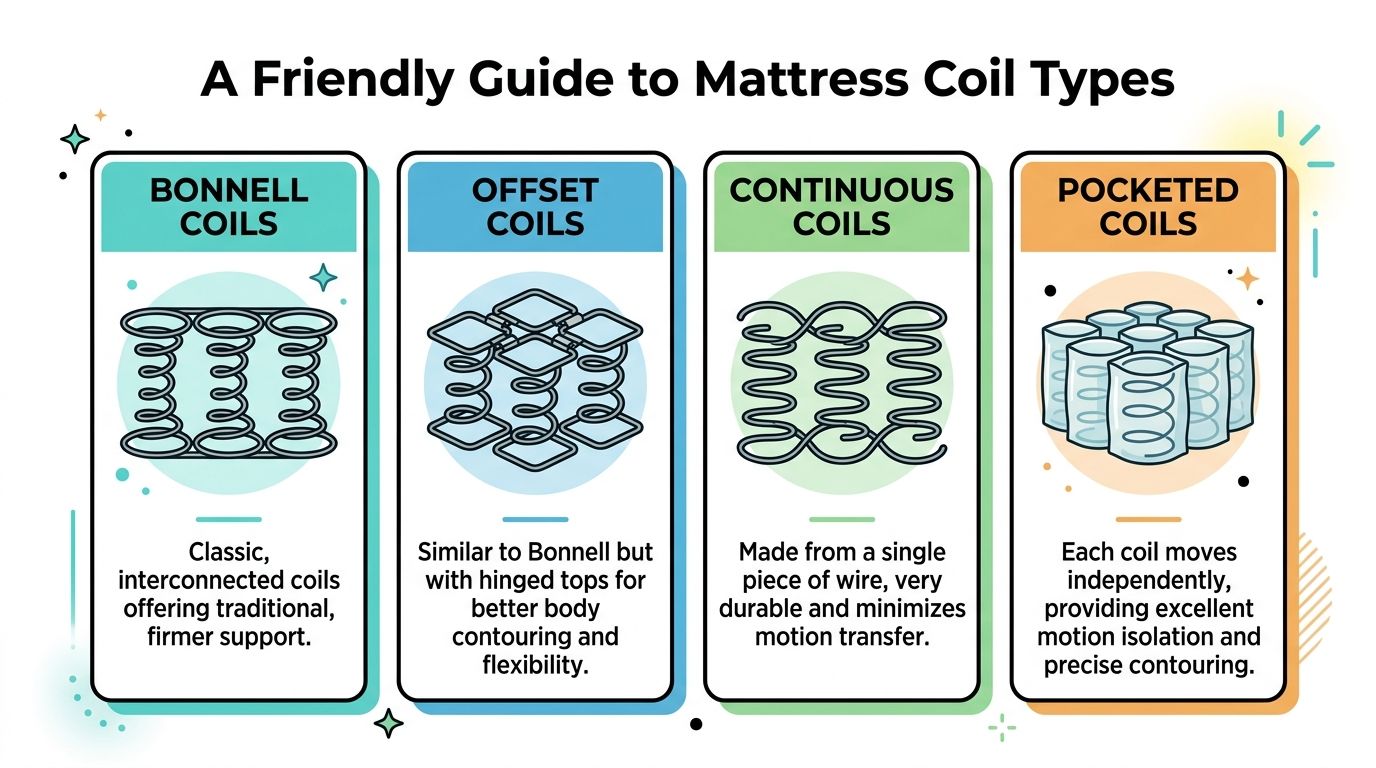
Bonnell coils
These are the classic hourglass-shaped springs many people remember from older innerspring beds.
They’re interconnected, which gives the mattress a traditional feel with a more uniform bounce. They can be a practical fit for budget-minded shoppers or secondary bedrooms, but because the coils are tied together, movement tends to travel across the bed more easily.
Offset coils
Offset coils are similar to Bonnell coils, but they’re shaped to allow a bit more flex.
That usually means better contouring and a more adaptive feel than old-school interconnected systems. They still share motion more than individually wrapped designs, but they can offer a nice middle ground between sturdy support and a little extra give.
Continuous coils
Continuous coil systems use a connected wire design across the mattress.
They often feel consistent and supportive from one side to the other. Some shoppers like that steady, uniform feel, especially if they don’t want a lot of sink or hug from the bed.
Pocketed coils
Pocketed coils are individually wrapped in fabric, so each spring can move more independently.
That’s a big reason couples often notice a difference right away. One person moves, and the whole bed doesn’t react the same way an interconnected unit does.
Comparing Common Mattress Coil Types
| Coil Type | How It Works | Best For |
|---|---|---|
| Bonnell | Hourglass-shaped coils connected together | Budget beds, guest rooms, traditional feel |
| Offset | Connected coils with a hinged shape for more flex | Shoppers who want contouring with sturdy support |
| Continuous | Coils formed from a connected wire system | People who like a consistent, stable feel |
| Pocketed | Individual coils wrapped in fabric pockets | Couples, combination sleepers, motion control |
Pocketed coils became a major shift in mattress design because they let the mattress respond in smaller, more precise areas instead of acting like one large spring unit.
If you’d like a deeper look at innerspring construction, this page on what is an innerspring mattress is a useful next read.
Why type changes the feel so much
A shopper may lie on two mattresses with similar comfort layers and wonder why one feels calmer and the other feels springier. Coil type is often the reason.
The support core affects:
- Motion transfer
- Contour
- Bounce
- Edge feel
- Overall stability
That’s why we never like to reduce mattress shopping to one number on a card. The style of coil changes the experience in ways you’ll notice every night.
Is More Coils Always Better Debunking the Myths
Short answer. No.
The idea that more coils always mean a better mattress has been around for a long time, but it’s one of the biggest oversimplifications in mattress shopping.
According to Sleep Foundation’s overview of mattress coil types, the “more coils equal better” myth dates back to the mid-20th century. That same source explains that modern mattress construction places more emphasis on coil type and coil gauge, and notes that pocketed coils introduced in the 2000s can reduce motion transfer by up to 50 percent for couples. It also points out that high-quality queen constructions often fall in the 800 to 1,200 coil range, which is a major change from the 200 to 300 coils found in early innerspring designs.
Why the myth stuck around
Big numbers are easy to market. They give shoppers something quick to compare.
But mattresses aren’t a contest to see who can print the biggest number on a tag. If a brand pushes count while avoiding details about steel quality, coil type, and build quality, that’s usually a sign to slow down and ask more questions.
What matters besides the number
A smarter way to judge support is to look at the mattress as a full system.
- Coil type affects motion and contouring
- Gauge affects strength and feel
- Comfort layers affect pressure relief
- Overall construction affects how the mattress ages
Honest advice: A balanced mattress with good materials often beats a flashy mattress with a giant coil number.
If you enjoy separating fact from sales talk, our article on mattress myths busted and what you really need to sleep better in warmer months, which tackles several common claims shoppers hear.
A practical perspective
For a Milwaukee family, “better” usually means something practical. It means the mattress supports two people well. It means it doesn’t feel worn out too soon. It means it fits the sleeper, not just the marketing.
That’s why we tell people to look past the bragging rights and focus on how the mattress is built.
Finding Your Ideal Support at BILTRITE
Once you understand coil count, gauge, and coil type, mattress shopping gets a lot less mysterious. The next step is matching those details to the person sleeping on the bed.
That’s where real-life use matters more than jargon.

A practical starting point for queen mattresses
If you’re shopping queen size, a solid baseline helps. According to Eco Terra’s guide to a good mattress coil count, a good quality queen should have at least 400 coils, while 600 to 800 coils are recommended for better support and durability. The same source says luxury or heavy-duty models often exceed 1,000 coils and may last 8 to 10 years on average.
That doesn’t mean every shopper needs the highest count available. It means you should think about the job the mattress has to do.
Matching the build to the sleeper
Here are a few examples we often talk through in the showroom:
- For a guest room you may not need an advanced coil system if the bed gets occasional use.
- For couples pocketed coils usually make more sense because movement stays more contained.
- For seniors a supportive surface and steadier edge can matter as much as softness.
- For families wanting durability stronger support components usually matter more than a flashy comfort top.
What we look at during a mattress fitting
At BILTRITE Furniture-Leather-Mattresses, shoppers can compare over 60 mattress models in person, which makes it easier to feel differences in support systems instead of guessing from a product card.
When we help someone narrow it down, we usually focus on a few practical questions:
| What we ask | Why it matters |
|---|---|
| Do you sleep alone or with a partner | Motion isolation becomes more important for shared beds |
| Do you like a steadier or softer feel | Coil gauge and comfort layers shape that experience |
| Is long-term durability a top priority | Heavy-duty and two-sided builds may make more sense |
| Do you sit on the edge often | Stronger support systems can feel more secure there |
For in-store shoppers, our guide on how to test a mattress can help you make better use of those few minutes lying down.
Some of the most satisfied mattress buyers aren’t the ones who picked the fanciest spec sheet. They’re the ones who matched the build to the way they sleep.
Why local guidance still matters
Our family has been doing this since 1928, and one thing hasn’t changed. People sleep better when they buy with confidence.
That confidence usually comes from asking honest questions, trying different feels side by side, and learning which specs matter for your body, your partner, and your home. That’s especially true with supportive, USA-made, Amish-made, heavy-duty, and flip-able mattress options where the construction details really count.
Your Top Mattress Questions Answered
Is coil count the same thing as firmness
No. Coil count tells you how many springs are inside the mattress. Firmness is shaped by the whole build, including coil gauge, coil type, and the comfort materials above the support core.
A mattress can have a healthy coil count and still feel softer if the top layers are plush.
Should couples care more about coil count
Couples should care about support and motion control, not just count by itself.
In many cases, pocketed coils are the bigger story because they move more independently. That can help one partner sleep through the other person’s tossing and turning.
Does a king always have more coils than a queen
Yes, larger mattresses tend to have more coils because there’s more surface area to support.
That’s why comparing different sizes by raw count alone doesn’t tell you much. Keep your comparisons within the same mattress size.
What’s the easiest way to shop smarter
Start with a few simple questions:
- What size do I need
- Am I sleeping alone or with a partner
- Do I want a softer feel or stronger support
- Is durability my top priority
- Can I try different constructions in person
Those questions will get you farther than chasing the biggest number on the tag.
Is coil count still worth paying attention to
Absolutely. It’s useful. It’s just not the whole story.
Think of coil count as one important clue. Then look at the gauge, the coil type, and how the mattress feels under your body when you lie on it.
If you’d like help sorting through coil count, support, and all the other mattress details without any pressure, come visit BILTRITE Furniture-Leather-Mattresses in Greenfield. We’d love to say hello, show you the differences in person, and help you find a mattress that fits your home, your budget, and the way you sleep.