Small Scale Sofa Bed Guide: Mechanisms, Sizes and Fit

Saturday afternoon, a studio's only sofa serves as its bed by night, then has to make room for breakfast the next morning. A small scale sofa bed can handle that routine without adding a separate mattress and frame, but its compact folded footprint is only part of the decision.
People furnishing a guest room that also serves as a home office face a different version of the same problem: the bed must be useful without taking over the room every day. A sofa bed replaces two pieces with one, though the open bed still needs space to use comfortably.
Judge the full setup by three factors: how it converts, whether it suits the people sitting and sleeping on it, and whether it fits the room and the route into it. A sofa that works on all three fronts is easier to live with than one chosen by folded width alone.
Table of Contents
- What a Small Scale Sofa Bed Does for Your Home
- How Pull-Out and Flip-Down Mechanisms Convert
- Seat Depth and Height That Fit Your Body
- Sleeper Sizes Compared to Standard Mattresses
- Nightly Sleep Versus Occasional Guests
- Mattress Durability and Compliance Documentation
- Room Clearance and the Delivery Route
- Choose Your Small Scale Sofa Bed and Visit Greenfield
What a Small Scale Sofa Bed Does for Your Home
A studio's sofa bed may sit against one wall by day, while the same room also needs space for a desk and clear access to the kitchen. The right choice has to work as a connected system: comfortable seating, a usable sleeping surface, room for the bed to open, and a delivery route that can accommodate the furniture.
For example, a sofa bed can fit the living area neatly yet leave too little room for a side table once guests are settled. Check how the piece serves the room in both modes, and consider the surrounding furniture and walkways as part of the fit. Small scale furniture for apartments can help you explore options suited to compact homes.
Evaluate the sofa bed by sitting on it and lying down on the opened bed, then measure the room and the route into it. A compact footprint matters, but so does whether the whole arrangement works for everyday life.
How Pull-Out and Flip-Down Mechanisms Convert
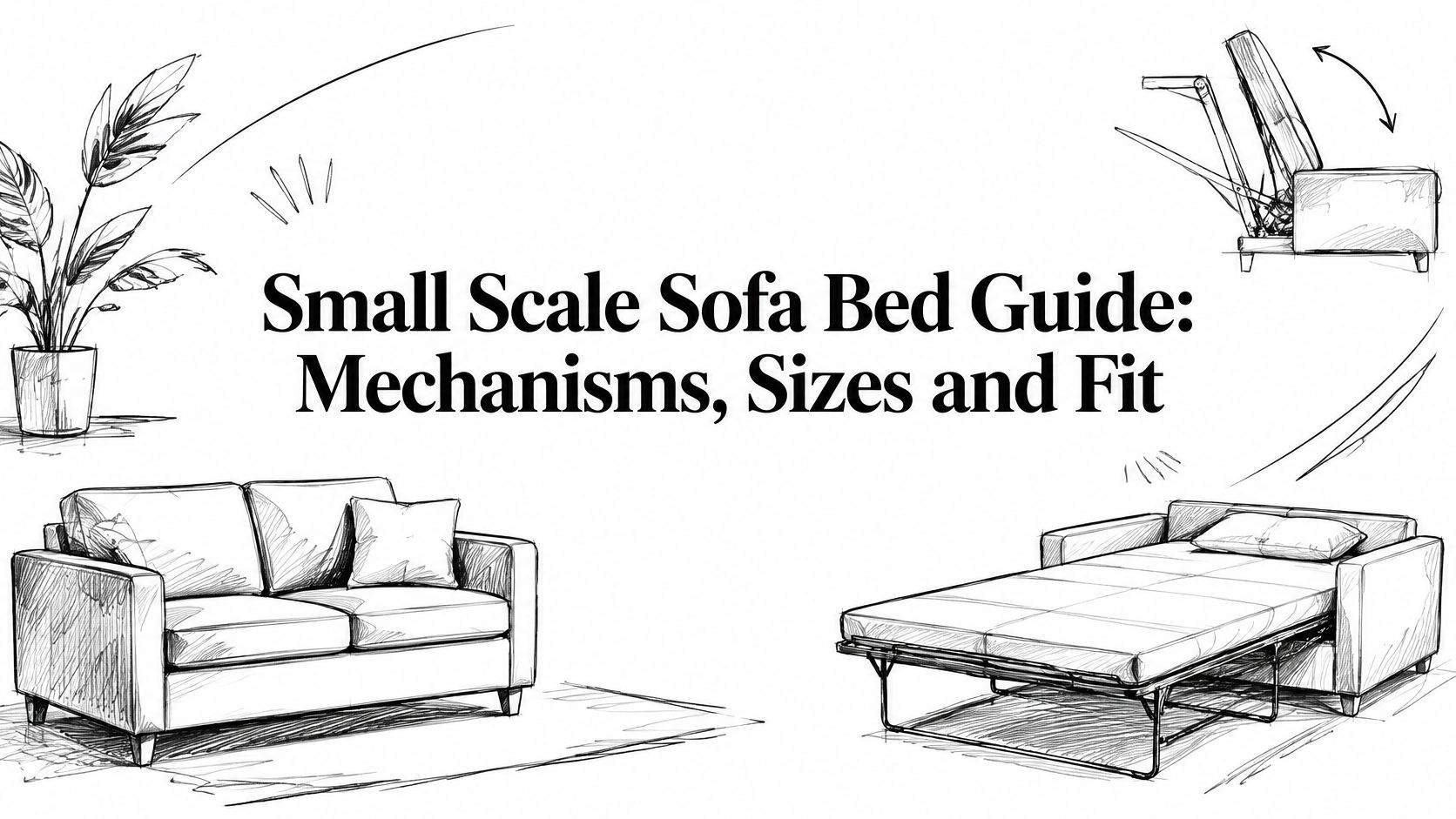
The opening motion determines how a compact sofa bed uses the room. A pull-out frame travels forward; a flip-down surface pivots from the back or seat. Check the space each needs, including room to operate the mechanism and move around the open bed.
| Mechanism | How It Converts | Open Depth | What to Check |
|---|---|---|---|
| Traditional pull-out | Seat cushions come off, and a folded mattress and frame extend forward | About 80 to 90 inches | Where the cushions go and how much floor stays clear in front |
| Flip-down or fold-flat | The back or seat pivots on a hinge | Closer to a conventional bed length | Hinge pinch points and whether the sleeping surface ends up level |
With a traditional pull-out, the frame and mattress extend toward the room, often reaching about 80 to 90 inches in open depth. With a flip-down or fold-flat design, the back or seat pivots on a hinge, and the opened depth may be closer to a conventional bed length.
A pull-out needs a clear path for the frame to travel. A flip-down needs space for the surface to swing, plus room to stand while operating the hinge. In either case, check whether the open bed blocks a doorway, walkway, coffee table or heating register.
What to check in the showroom
- Cushion storage: Ask where the seat cushions go while the bed is open. Cushions left on the floor can become a trip hazard in a small room.
- One-person operation: Open and close the mechanism yourself at a normal pace, without assistance.
- A level sleeping surface: Run a hand across the unfolded deck. A ridge or dip can make the bed uncomfortable for a guest.
- Pinch zones: Watch the hinges and locking points as the frame moves, and keep fingers clear of those areas.
Choose the mechanism whose open footprint matches the floor you can spare. Test its conversion, sleeping surface and room clearance together before deciding.
Seat Depth and Height That Fit Your Body
A 5-foot-2 sitter on a deep cushion slides forward and loses lumbar contact. A taller sitter on a shallow seat sits with thighs hanging past the front edge. Both problems show up while the piece is still a sofa, before anyone pulls a bed out.
Sitting needs its own measurements. Seat height and usable depth matter more than the frame's overall size. As a fitting method, look for seat height around 40 to 45 cm (15 to 17 in) and seat depth around 60 to 70 cm (23 to 28 in). Usable depth runs from the front edge to the actual back support. Frame depth includes the back cushion and overstates the sitting surface.
- Measure the seat height. Around 40 to 45 cm (15 to 17 in) lets adults about 5 feet 4 inches and taller plant their feet and push up without a hand from someone else.
- Measure usable depth, not frame depth. Start the tape at the front edge and stop where the back meets the cushion.
- Check the gap behind the knees. Compare usable depth with buttock-to-popliteal length, from the back of the seat to the back of the knee. Leave enough clearance that the front edge does not press into the knee.
- Sit on the compressed cushion. Soft foam changes knee angle and how easily you stand. Sit fully, then stand up. A hang tag will not show that.
Too much depth makes shorter sitters slide and lose support. Too little depth leaves taller sitters with the thigh unsupported.
In a compact apartment, a model near the lower end of that depth range can keep a walkway open, provided a thick back cushion does not eat the usable depth you just measured. Narrow sofas fail on that cushion more often than on closed width.
Seniors and caregivers should weigh the push to stand more heavily than a slim folded footprint. A seat that is hard to leave becomes a daily frustration, separate from whether the frame will clear a bedroom door. The guide to the most comfortable sofa for seniors covers standing and support in more detail.
I would treat seat fit as one part of the compromise: an evening of sitting, a clean stand-up, and enough floor left once the sleeper is open. A comfortable depth that blocks the only path around the coffee table is not a win.
Sleeper Sizes Compared to Standard Mattresses
A sofa bed has to fit both the room and the person sleeping on it. Mattress labels offer a useful starting point, but check the actual sleep surface: sofa-bed versions can differ from standard mattress dimensions.
| Sleeper Format | Standard Mattress Size | Sofa-Bed Length | Typical Sofa Width* |
|---|---|---|---|
| Twin | 38 x 75 in | May be shorter than 75 in | Often under about 70 in |
| Twin XL | 38 x 80 in | May be shorter than 80 in | Less common in compact frames |
| Full | 54 x 75 in | May be shorter than 75 in | Often under about 70 in, or 70 to 80 in |
| Queen | 60 x 80 in | Some versions measure 72 to 74 in | Often 70 to 80 in |
*Width ranges are typical examples, not standards or guarantees. The frame's outside width does not establish the sleeping surface size.
Why the label and the tape measure disagree
A 6-foot-2 guest is roughly 74 inches tall, so a 72-inch sleeping surface may leave little room at the head or foot. Compare the sleeper's height with the usable length, and check the exact dimensions rather than relying on “queen” or “full” alone.
The standard mattress dimensions in the table provide a reference for that comparison. For the full set of conventional sizes, see this guide to standard mattress sizes.
Before choosing a fabric or frame, ask for the sleep surface's exact length and width. That measurement, along with the room clearance and delivery route, determines whether the sleeper works as a whole.
Nightly Sleep Versus Occasional Guests
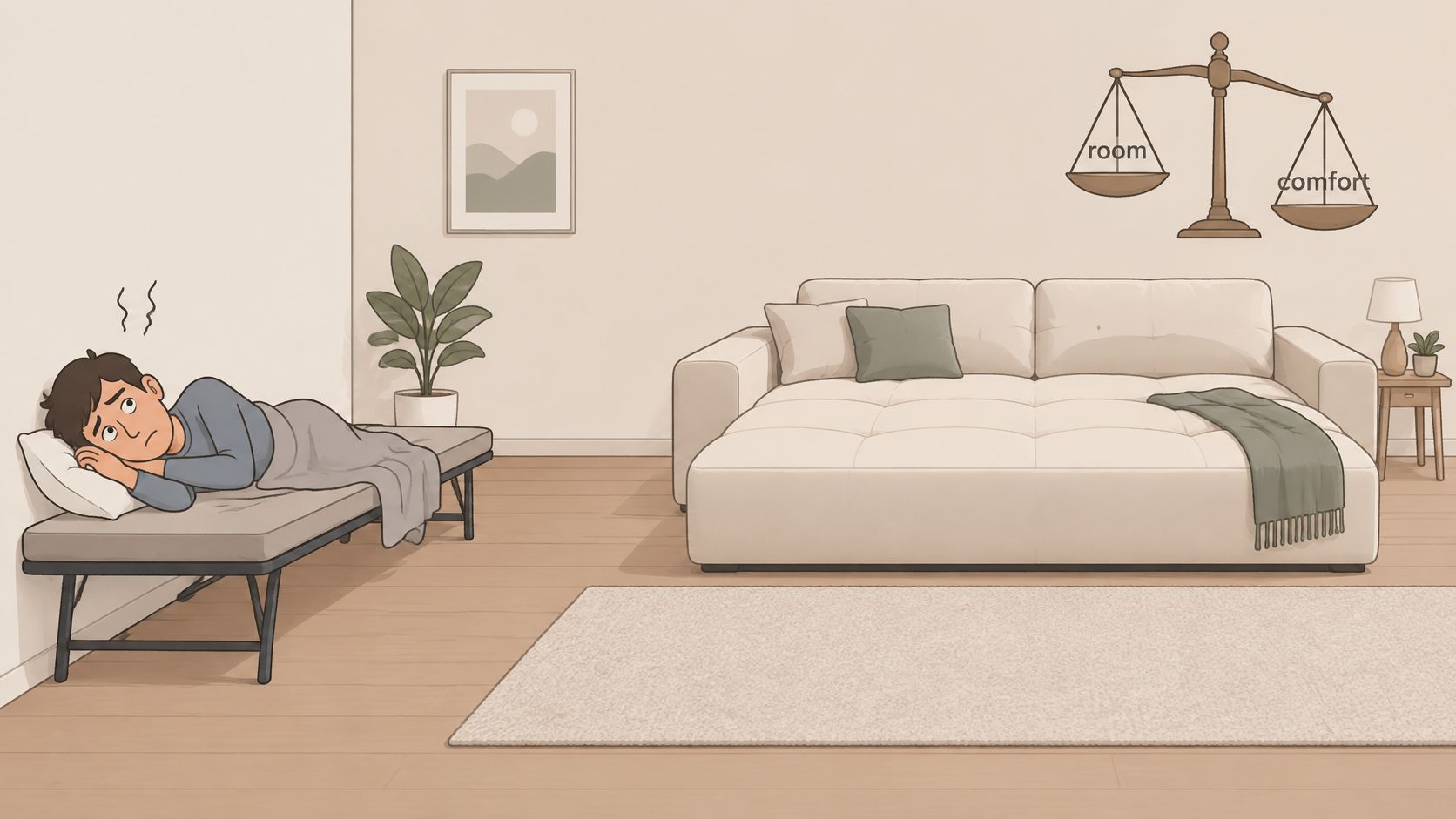
The narrowest sofa bed in the showroom isn't automatically the smartest space-saver. Shave a few inches off the sleeping surface and you haven't saved space at all. You've moved the cost onto your guest's back, or onto the replacement mattress you'll shop for in two years.
Comfort comes from support as much as padding. The Globe and Mail's sofa bed guide makes the point that the sleeping surface should help maintain reasonably natural spinal alignment while cushioning pressure points such as the shoulders and hips, and that the support beneath the mattress has to be even and stable, because gaps, bars or uneven sections push the spine out of a comfortable position. Practical specifications commonly identify 4 to 6 inches as a typical sofa-bed mattress thickness, while guidance for more frequent use points toward at least 6 to 8 inches and warns that a support bar across the middle can create discomfort.
Thickness alone doesn't guarantee comfort. A thick slab of foam over a sagging deck is worse than a thinner pad over a flat, rigid platform. And "memory foam" on a label is not a quality signal by itself; it describes a material, not a support structure.
A five-minute test that settles it
- Lie on your back for a full two minutes. You're checking whether your lower back is supported or arching into a gap.
- Roll onto your side. Hips and shoulders should feel cushioned, not bottomed out against a bar.
- Press the middle of the surface. A center bar or dip announces itself immediately under a flat hand.
- Move around. If the whole frame shifts or squeaks when you turn over, that's the sound of a hinge doing work it wasn't built for.
For occasional guests, a topper can soften a firm built-in mattress into something comfortable for a weekend. Two conditions apply: the topper can't be used to disguise an unstable or uneven frame, and it must not be so thick that the sofa won't fold closed with the bedding stored inside. For nightly sleeping, buy thickness and even support first, then worry about the fabric.
Mattress Durability and Compliance Documentation
A sofa bed that gets opened every weekend wears out at the frame first, not the cushions. The hinges, locking points and support deck take the stress, which is why the hardware deserves more of your attention than the upholstery.
Press gently on the open sleeping surface and along both side rails. A solid frame stays quiet and doesn't flex. Then look at the parts that fail: hinges and their pinch points, locking catches that should engage with a firm click, the support deck under the mattress, and the legs or base. Solid wood construction with careful joinery stands up to daily opening far better than a light frame stapled together. Much of what we stock is American-made solid wood, and some of it is Amish-made, which is a big reason customers choose those pieces for a decade of guest seasons rather than a season of guests.
The removable mattress question
Ask one thing early: is the sleeping mattress detachable? The answer changes the paperwork.
According to the Consumer Product Safety Commission, mattresses are regulated under federal flammability requirements in 16 C.F.R. Parts 1632 and 1633. When a sofa-bed mattress is detachable, that mattress is generally treated separately under those mattress standards, while the remaining upholstered product may fall under 16 C.F.R. Part 1640. When the mattress is permanently attached, the product may be regulated as a whole under Part 1640.
That means a sofa-bed label doesn't automatically cover every component. Ask for documentation showing which pathway applies to the piece you're buying, and get it before delivery day rather than after. Compliance evidence and mechanism safety are separate questions, and satisfying one doesn't prove the other. If a sleeper in an innerspring format interests you, our innerspring sleeper sofa page walks through how coil support behaves in a convertible frame.
Room Clearance and the Delivery Route
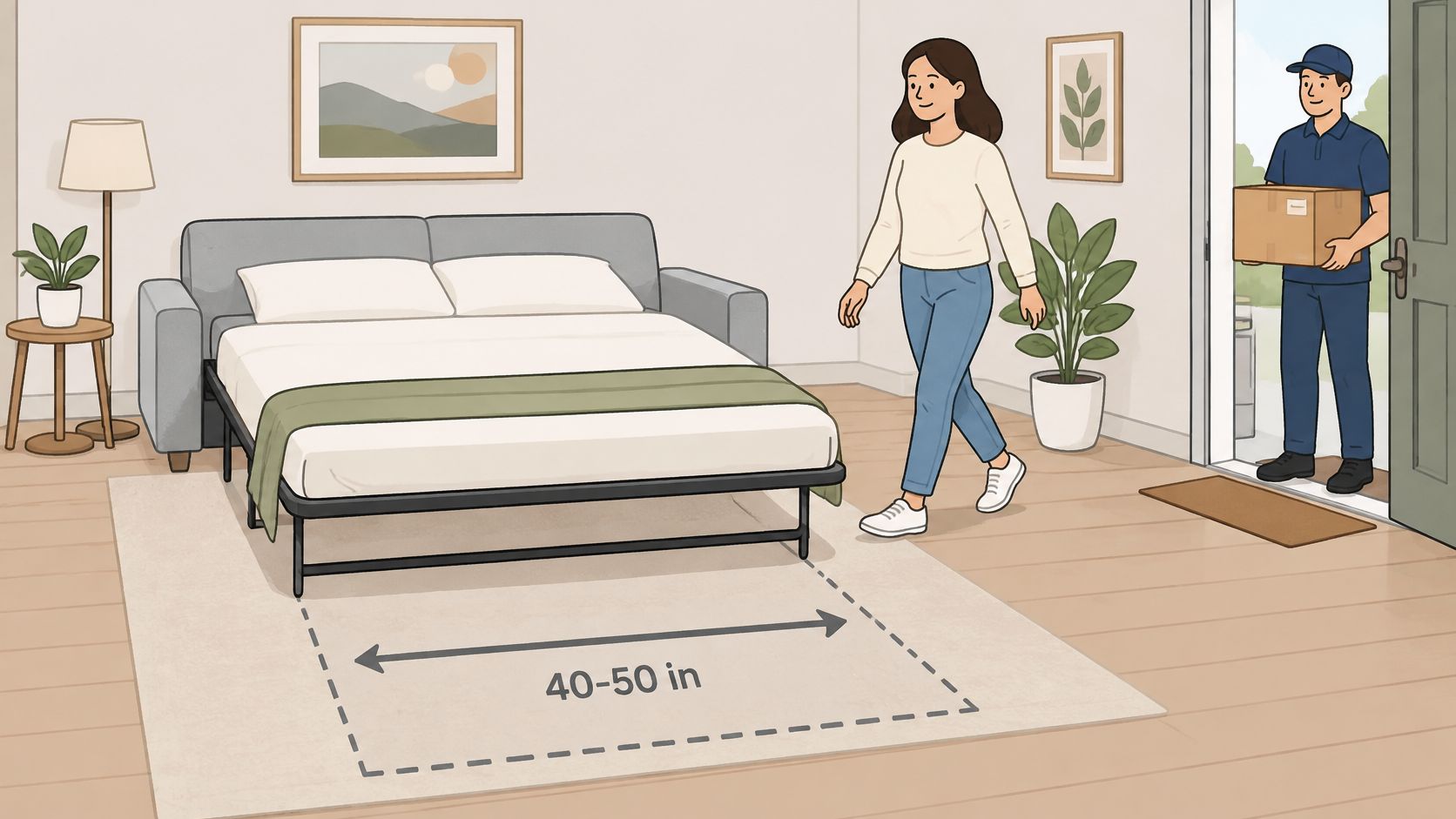
A sofa bed can fit neatly against a wall when closed and still block the room when opened. Check its full sleeping footprint alongside the paths people need to use around it.
Measure wall width, closed depth, fully opened depth and the remaining walking paths while you're in the store. Compare those measurements with your room, including the route from the sofa to a bathroom or other frequently used space.
A route checklist worth printing
- Every door on the path. Measure the clear opening, accounting for the frame, stops, handles and door leaf.
- The narrowest hallway and every turn. A sofa may clear the hallway but still catch at a doorway or corner.
- Stairs and landings. Note the ceiling height at each turn and which side has a railing.
- Elevator doors and cabin depth. Check the cabin's inside dimensions and diagonal against the packaged piece.
- The sofa's depth and diagonal depth. These measurements often decide whether it can turn through a tight passage.
- Carton size and frame construction. Ask whether the sofa ships in sections and can be separated for delivery.
A come-apart frame can pass through a narrow stairwell or an older Milwaukee hallway where a one-piece sofa bed may not. BILTRITE offers come-apart sofas and sectionals. Its furniture for narrow doorways can help you consider options for a tight delivery route.
For older adults and people using a walker, plan the route around the open bed, too. The room needs to allow both access to the sleeping surface and a clear path through the home at night.
Choose Your Small Scale Sofa Bed and Visit Greenfield
A sofa bed can fit its room and still be the wrong choice if it is uncomfortable to sit on, awkward to sleep on, or difficult to deliver. Judge the whole setup, not just the closed footprint.
Before deciding, ask for the mattress and frame specifications in writing. Confirm the sleeping surface's actual length and width, and request any mattress compliance documentation you need. Format names such as “full” and “queen” do not guarantee identical dimensions across sofa beds.
Then weigh those details against the sitting, sleeping, clearance and delivery checks covered earlier. BILTRITE Furniture-Leather-Mattresses is a fourth-generation, family-owned showroom serving Greenfield and Metro Milwaukee since 1928, with small scale furniture for apartments, condos, smaller homes and senior living residences.
Bring your room measurements and delivery route notes when you visit BILTRITE Furniture-Leather-Mattresses in Greenfield. Compare how the sofa feels for sitting with the sleeping surface and frame details, then decide whether the trade-offs work for your home.