3 DAY MATTRESS SALE! TUESDAY - WEDNESDAY - THURSDAY!
LABOR DAY SALE EXTENDED ENDS SATURDAY, OCTOBER 3RD AT 5PM!
NO CREDIT CARD FEES!
1000's of Items IN-STOCK + 500 Mattresses!
Largest selection of USA Made Furniture & Mattresses + Amish Made!
FREE In-Store Design Services!
BUY LOCAL & LOVE YOUR HOME!
3 DAY MATTRESS SALE! TUESDAY - WEDNESDAY - THURSDAY!
LABOR DAY SALE EXTENDED ENDS SATURDAY, OCTOBER 3RD AT 5PM!
NO CREDIT CARD FEES!
1000's of Items IN-STOCK + 500 Mattresses!
Largest selection of USA Made Furniture & Mattresses + Amish Made!
FREE In-Store Design Services!
BUY LOCAL & LOVE YOUR HOME!
OPEN LABOR DAY | Tuesday-Thursday 10am to 6pm | Friday 10am to 7pm | Saturday 10am to 5pm | Sunday Closed To Be With Family & Friends | Monday Showroom Closed
5430 West Layton Ave, Greenfield - Metro Milwaukee
You’re probably here because you’re standing in a bedroom, tape measure in hand, wondering whether a queen size bed vs full size bed decision is really a big deal.
It is.
We’ve helped Milwaukee-area families make this choice for generations, and the honest answer is simple. A full works well when space is tight and one person is sleeping there. A queen is the better choice for most couples and for single sleepers who want room to stretch out. That’s the short version. The longer version matters too, especially if you care about how the bed fits your room, how long it lasts, and whether you’ll still be happy with it years from now.
A lot of big box advice stops at mattress dimensions. That’s not enough. Bed size affects how you move around your room, what kind of frame works best, how your mattress wears over time, and whether your setup makes sense in a Milwaukee bungalow, condo, apartment, or guest room.
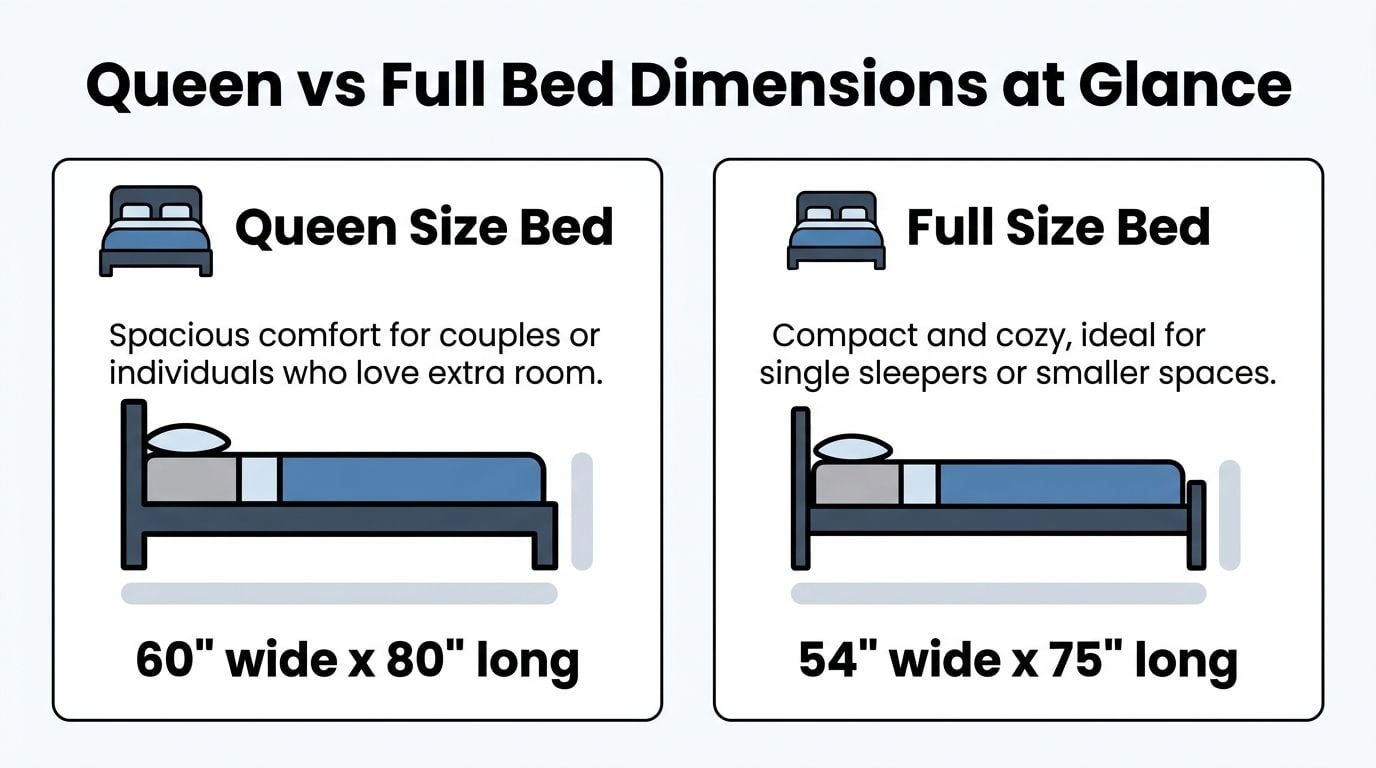
Queen vs Full Bed Dimensions at a Glance
The biggest difference between a queen and a full is easy to say and important to feel. A queen size bed measures 60 inches wide by 80 inches long, while a full size bed measures 54 inches wide by 75 inches long. That gives the queen 6 extra inches of width, 5 extra inches of length, and about 18.5% more surface area with 750 extra square inches according to Purple’s full vs queen mattress comparison.
That may not sound dramatic on paper. In real life, it’s the difference between “this feels comfortable” and “why are my feet at the edge and my elbow in someone’s ribs?”
Here’s the quick side-by-side view.
Feature
Queen Size Bed
Full Size Bed
Width
60 inches
54 inches
Length
80 inches
75 inches
Surface area
Approximately 4,800 square inches
4,050 square inches
Extra space compared to full
750 extra square inches
Smaller footprint
Best general use
Couples, taller sleepers, solo sleepers who like room
Single adults, teens, guest rooms, smaller bedrooms
What those inches actually mean
A lot of people shrug at a 6-inch width difference. Don’t. Beds don’t feel bigger by percentage. They feel bigger where your shoulders, hips, knees, and pillows land.
If you sleep alone, a full can still feel generous. If you sleep with a partner, those few extra inches on a queen matter fast. The same goes for anyone who sleeps diagonally, uses a body pillow, or just doesn’t like feeling boxed in.
Practical rule: If you’re debating because a full “might be enough,” it probably is for one person. If two people will use it regularly, lean queen.
Room footprint matters too
The mattress isn’t the whole story. The frame, headboard, nightstands, and walking space all count. That’s why bed size should never be chosen in isolation.
My opinion is straightforward. A full is a smart small-room bed. A queen is the better everyday bed if your room can handle it. Most regrets happen when people buy too small for how they sleep, or too large for how they live.
Who Sleeps Best in a Queen or Full Bed
We’ve seen the same patterns over and over.
A young professional moves into a smaller apartment and wants the bedroom to feel open. A full usually makes sense. A teen outgrows a twin and wants something that feels more grown up. A full is a great fit there too. A couple walks in and says, “We can probably make a full work.” That’s usually where I step in and say, “You can. You probably won’t enjoy it.”
When a full is the right call
A full bed shines in a few situations:
Solo sleepers who want more room than a twin: A full feels comfortable without dominating the room.
Teen bedrooms: It gives a growing kid a more substantial bed and still leaves floor space.
Guest rooms: It’s welcoming without swallowing the whole room.
Smaller apartments and condos: You keep better flow around the rest of the furniture.
A full can absolutely work for one adult. For many solo sleepers, it’s the sweet spot between comfort and footprint.
When a queen wins easily
For shared sleep, a queen is usually the smarter choice. A full-size bed gives each sleeper 27 inches of personal width, while a queen gives each sleeper 30 inches. That added space matters because 30 or more inches per person reduces involuntary contact and allows more independent sleep positioning, according to Mattress Firm’s full vs queen mattress guide.
That’s why couples tend to feel cramped on a full even if they think they don’t need a lot of room.
If you sleep with a partner, a kid who climbs in at 2 a.m., or a dog who thinks it pays the mortgage, a queen is usually the safer bet.
A queen also makes more sense for taller sleepers. The extra length helps you stay on the mattress instead of curling up to fit it.
My direct advice is this. Buy a full for one regular sleeper. Buy a queen for two. That solves most of the debate.
Finding the Right Fit for Your Milwaukee Home
Bed shopping gets real. Not showroom real. House real.
A queen may sound better in theory, but if it crowds the doorway, blocks a dresser, or leaves no room for nightstands, it can make the whole bedroom feel clumsy. A full often wins not because it’s more luxurious, but because it lets the room work.
Start with the room, not the mattress
A common rule of thumb is a 10×10 foot minimum room for a queen, while a full is easier to live with in tighter spaces. That matters even more in urban homes and compact bedrooms. Hamlin Kersey’s discussion of queen vs full mattresses notes that 40% of urban solo sleepers regret upsizing to queens due to frame incompatibility in rooms under 120 square feet, and that full beds pair better with smaller-scale setups in those spaces.
That tracks with what we’ve seen in older Milwaukee homes. Bedrooms aren’t always laid out for big furniture. Alcoves, radiator placement, narrow stairways, and shorter wall runs can all change what makes sense.
How to measure like a pro
Before you choose, do these three things:
Measure the room wall to wall. Don’t guess.
Mark the bed size on the floor with painter’s tape. Include the frame, not just the mattress.
Walk the room. Open drawers. Picture laundry baskets, pets, kids, and everyday traffic.
A queen that technically fits can still feel too tight. A full that leaves breathing room can make the whole room feel calmer and more usable.
Small-scale furniture can save the room
This is the part chain stores often skip. The bed has to work with the rest of the furniture. In a tighter room, smaller-scale nightstands, dressers, and simpler headboards make a full feel intentional, not like a compromise.
A well-planned full bed setup often looks better than a queen that overwhelms the room.
If you’re furnishing a tighter bedroom, these ideas for a bed for small spaces can help you think beyond the mattress size alone.
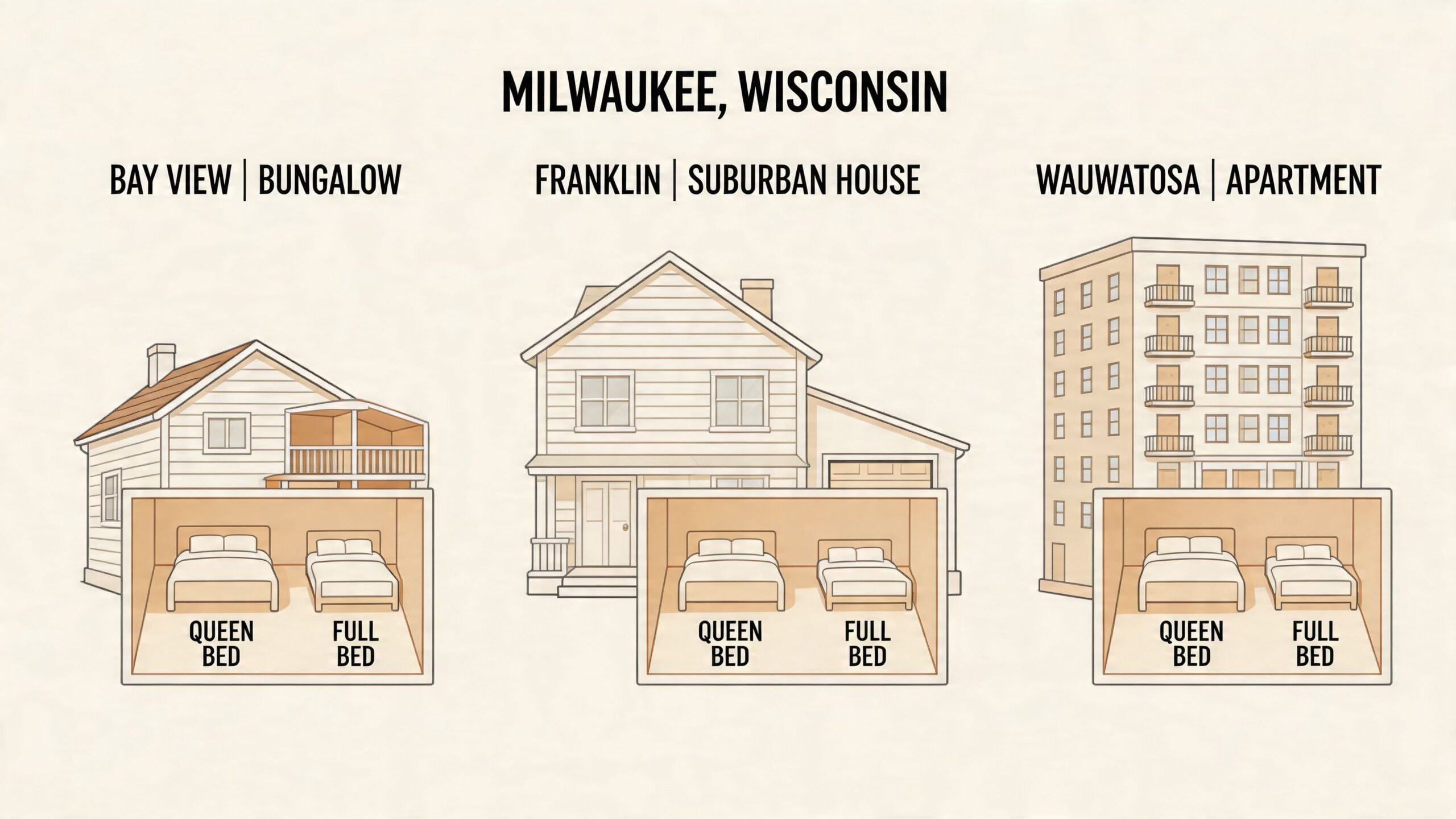
My honest take for Milwaukee-area homes is simple. If the bedroom is modest and you’re sleeping alone, choose the full and enjoy the extra floor space. If the room is open enough and two people will sleep there every night, make room for the queen.
Why Our Mattresses Outlast the Competition
Size matters. Construction matters more.
A lot of mattress shopping goes sideways because people focus on width and length, then ignore what’s inside the mattress and what’s holding it up. That’s how you end up replacing a bed earlier than you expected. Long-term value comes from build quality, support, and how evenly the mattress wears.
Bigger isn’t automatically stronger
A queen has more surface area, so it may distribute weight better than a full under the same load. But that does not mean every queen is automatically tougher. Build quality still decides the outcome.
What matters is whether the mattress and frame were made for real-life use. For heavier-duty setups, that can be a meaningful difference. According to Juna Sleep’s queen vs full mattress discussion, heavy-duty queen frames are often built to support 800 to 1000 lbs, compared to 600 to 800 lbs for fulls.
That matters for couples, seniors, caregivers, and anyone who wants a bed that feels steady getting in and out.
Why two-sided mattresses deserve more attention
This is one of the most overlooked parts of buying a bed. A lot of people have never even tried a two-sided mattress, and that’s a shame.
Flip-able mattresses let you use both sleeping surfaces. Rotate and flip them properly, and wear spreads out more evenly over time. That’s a practical advantage, not a gimmick. If you’re comparing a queen size bed vs full size bed and planning to keep it for years, construction like this can matter more than the final size choice.
Here’s where long-term value shows up:
Evener wear: You’re not using the same top surface the whole time.
Better support retention: The mattress has more opportunity to settle gradually instead of developing body impressions in one direction.
Smarter for guest rooms too: A bed that sits unused for stretches can still benefit from being rotated and flipped back into service.
If you haven’t looked into that style before, this guide to the benefits of a two-sided mattress explains why many shoppers still prefer them.
Local homes need practical durability
In real Milwaukee homes, beds do hard work. They go upstairs in old houses. They support couples, kids on Saturday mornings, visiting grandkids, and sometimes a pet that refuses to move.
That’s why I’m opinionated here. If durability is high on your list, don’t buy based on size alone. Look at the frame, edge support, mattress construction, and whether the setup is made for years of use. A well-built full can outlast a flimsy queen. A heavy-duty queen can be a great investment for shared sleep. The right answer depends on who’s using it and how demanding the setup will be.
Budgeting for Your New Bed and Bedding
A bed budget isn’t just about the mattress. It’s the whole setup. Mattress, foundation or frame, sheets, mattress protector, and bedding all count. If you ignore those pieces, the “good deal” can stop looking like one in a hurry.
In general, a full will cost less than a queen across the whole package. The mattress is smaller, the frame is smaller, and bedding usually stays a little easier on the wallet too. If you’re furnishing a guest room, teen room, or first apartment, that lower total spend can make a full the obvious choice.
Think in total ownership, not just sticker price
The smarter question is this. What will this bed cost you over time?
A cheaper mattress that breaks down fast isn’t a bargain. A stronger frame and a better-made mattress often hold up better and feel better for longer. That matters a lot if the bed will be used nightly, or if you want to avoid replacing pieces one by one.
A queen can still be worth the extra spend if it solves a comfort problem you’ll deal with every night. For couples especially, paying a bit more for room to sleep comfortably often makes better sense than trying to save money on a bed that feels cramped from day one.
Budget priorities that actually matter
When shoppers are trying to decide where to spend and where to save, I’d rank it this way:
Mattress quality first: That affects comfort and support every single night.
Frame strength second: A weak frame can make even a decent mattress feel worse.
Bedding after that: Sheets and comforters are easier to upgrade over time.
Style last: Nice-looking matters, but sleep matters more.
If you’re trying to set a realistic budget before shopping, this guide on how much a good mattress costs is a helpful starting point.
My advice is blunt. If the room and budget are both tight, buy a better full instead of stretching for a lower-quality queen. If you know you need the extra sleeping space, spend for the queen and do it right the first time.
Our Family's Advice for Choosing Your Bed
After doing this for so many years, our advice is pretty plain.
Choose a queen if two people will sleep there regularly. Also choose a queen if you’re a solo sleeper who’s tall, restless, or likes extra room around you. Most adults who upgrade from a full to a queen don’t miss the smaller bed.
Choose a full if you’re furnishing a guest room, teen room, apartment bedroom, or smaller condo space where every inch matters. A full isn’t a second-place option. In the right room, for the right sleeper, it’s the smartest one.
The best choice depends on what you value most
Some shoppers care most about open floor space. Others care most about personal sleeping room. Some want a bed that feels substantial without taking over the room. Others want the widest, longest option that still fits the house.
That’s why this decision works best when you rank your priorities:
Choose space efficiency if room layout is the biggest constraint.
Choose sleep comfort if you share the bed or move around a lot.
Choose durability-focused construction if you want stronger long-term value.
Choose a simpler setup if this is for occasional use, like a guest room.
Buy for the way you sleep now, not for the way you hope you’ll tolerate sleeping later.
My direct recommendation
If you asked me for the shortest possible answer, here it is.
For one person in a smaller room, buy the full. For two people, buy the queen. For tall solo sleepers, skip the full unless room size leaves you no choice. For long-term everyday use, prioritize construction quality over shaving off a little upfront cost.
And if you’re torn after all that, lie down on both sizes before deciding. That settles the debate faster than any chart.
Common Questions About Queen and Full Beds
These are the questions people ask all the time when they’re narrowing things down.
Is a full bed big enough for two adults
It can be, but I don’t recommend it for most couples as an everyday bed. It works better for occasional use, shorter stays, or situations where room size leaves you limited options. If two adults will sleep there nightly, a queen is usually the more comfortable choice.
Is a queen too big for one person
Not at all. For many solo sleepers, a queen feels fantastic. If you like to sprawl, use extra pillows, or just want more room to move, a queen can be a great one-person bed, assuming your bedroom has the space.
Is a full better for a guest room
Often, yes. A full is a smart guest-room size because it feels welcoming without taking over the room. It also leaves more flexibility for nightstands, dressers, or a home office setup if the room does double duty.
Can I use queen sheets on a full mattress
You can, but you probably won’t like the fit. The extra fabric usually looks loose and feels sloppy. Bedding fits better and stays in place better when it matches the mattress size.
Can I put a full mattress on a queen frame
I wouldn’t. The sizing mismatch can affect support and stability, and it usually looks awkward too. Mattress and frame sizes should match.
What if I’m tall but my room is small
That’s where a Full XL can be worth looking at for a solo sleeper. It keeps the narrower full width while adding length. It won’t be the right answer for everyone, but for a tall person in a tighter room, it can be a smart middle ground.
Does delivery and setup matter when buying a bed
Absolutely. Beds are bulky, awkward, and not much fun to wrestle through hallways or stairwells. Good delivery and setup make the process easier, especially with heavier mattresses, solid wood furniture, or tricky room layouts.
Should I buy based on the mattress alone
No. Think about the whole sleep setup. The mattress, frame, bedroom size, bedding, and how long you plan to keep everything all matter. A bed that looks fine in a spec sheet can still be the wrong choice in your actual home.
If you want honest help sorting out a queen size bed vs full size bed, visit BILTRITE Furniture-Leather-Mattresses in Greenfield. We’ve been helping Metro Milwaukee families since 1928, and we’d love to help you compare sizes, try different mattress feels, and find a setup that fits your room, your budget, and your everyday life. Come see us in person and talk with a team that treats you like a neighbor, not a number.