3 DAY MATTRESS SALE! TUESDAY - WEDNESDAY - THURSDAY!
LABOR DAY SALE EXTENDED ENDS SATURDAY, OCTOBER 3RD AT 5PM!
NO CREDIT CARD FEES!
1000's of Items IN-STOCK + 500 Mattresses!
Largest selection of USA Made Furniture & Mattresses + Amish Made!
FREE In-Store Design Services!
BUY LOCAL & LOVE YOUR HOME!
3 DAY MATTRESS SALE! TUESDAY - WEDNESDAY - THURSDAY!
LABOR DAY SALE EXTENDED ENDS SATURDAY, OCTOBER 3RD AT 5PM!
NO CREDIT CARD FEES!
1000's of Items IN-STOCK + 500 Mattresses!
Largest selection of USA Made Furniture & Mattresses + Amish Made!
FREE In-Store Design Services!
BUY LOCAL & LOVE YOUR HOME!
OPEN LABOR DAY | Tuesday-Thursday 10am to 6pm | Friday 10am to 7pm | Saturday 10am to 5pm | Sunday Closed To Be With Family & Friends | Monday Showroom Closed
5430 West Layton Ave, Greenfield - Metro Milwaukee
If you're shopping for furniture for heavy person needs, you may already know the frustrating routine. A chair looks sturdy in the store, then starts to wobble after regular use. A sofa feels cozy for a month, then one cushion sinks lower than the others. Getting back up becomes harder, not easier.
We hear these stories all the time in our Greenfield showroom. Families come in after dealing with sagging cushions, shaky dining chairs, or recliners that felt fine at first but didn't stay supportive. After four generations in the furniture business, we've learned something simple. Comfort isn't just about softness. It's about construction, fit, and how a piece supports real daily life.
That matters even more when weight capacity overlaps with mobility, aging knees, a sore back, or the need for sturdy arm support. A lot of guides stop at "big and tall." Real life is more specific than that.
Tired of Furniture That Just Doesn't Hold Up
A Milwaukee neighbor once described it better than any industry term could. She said, "I don't need fancy. I just need something that doesn't give up before I do." That's the heart of this whole topic.
Maybe you've had a kitchen chair start creaking every time someone sits down. Maybe your favorite recliner got harder to exit because the seat sank too low. Maybe the sofa everyone uses now has that sloped, tired look in the middle. Those problems aren't just annoying. They change how a room feels and how comfortable home feels.
For heavier adults, the stakes are a little higher. A weak chair isn't just inconvenient. It can feel unsafe. A cushion that bottoms out isn't just unattractive. It can put extra strain on hips, knees, and lower back. And if someone in the home is also older or dealing with limited mobility, those little failures stop being little.
That's why we take this category seriously. We've been helping Milwaukee-area families since 1928, and we've seen the difference between furniture that merely looks substantial and furniture that is built for long-term use. If you're browsing heavy-duty living room furniture, the goal isn't to buy something oversized just for the sake of it. The goal is to find something supportive, stable, and comfortable for the way your household lives.
What people usually want
Most shoppers who ask about furniture for heavy person use aren't asking for anything extreme. They're usually looking for a few practical things:
A seat that feels secure: No rocking, twisting, or flexing.
Cushions that keep their shape: Not something that looks worn out far too soon.
Arms you can push off from: Helpful for anyone who doesn't spring up as easily as they used to.
Quality that lasts: A piece that still feels dependable after daily use.
A strong piece of furniture should help you relax. You shouldn't be wondering what noise it just made.
That belief has guided our family business for a long time. We like furniture that works hard, feels welcoming, and earns its place in the home.
Why Standard Furniture Often Fails
A lot of people assume furniture is furniture. If two sofas look similar from the outside, they must be built about the same. That's usually not true.
The trouble starts inside the piece, where you can't always see the shortcuts. Standard furniture often focuses on appearance first. That's fine until the frame flexes, the joints loosen, or the cushion foam stops bouncing back.
The stress points are predictable
Furniture doesn't usually fail in random places. It fails where pressure repeats. Think about the front rail of a chair, the joints where the legs connect, the seat deck under a sofa cushion, or the reclining hardware that moves every day.
Research on chair construction found that for a 150 kg user, chair leg cross-sections needed to increase by 20% and side rail dimensions by 25%, which shows that standard designs need significant structural changes for higher body weight use over time (chair load-carrying research).
That tells us something important. If a piece wasn't engineered for higher loads from the start, it isn't enough to just make it look beefier.
Common reasons standard pieces wear out
Here are the weak spots we ask shoppers to watch for:
Thin frame parts: Narrow rails and undersized legs can flex under repeated use.
Weak connection points: Joints are where many failures begin.
Cushions built for showroom comfort: They can feel soft at first and then lose support fast.
Seats that sit too low: Once cushioning compresses, standing up gets tougher.
A lot of confusion comes from the phrase "weight capacity." People hear it and assume that means long-term comfort. It doesn't always. A piece may hold a person today and still wear out in a way that makes it uncomfortable or unstable down the road.
Why this matters for seniors too
This isn't only about body weight. It's also about repetition, force distribution, and ease of movement. When someone sits down and stands up several times a day, they put stress on the same spots again and again. If the seat edge collapses or the arms wobble, that movement gets harder.
Practical rule: If a chair feels soft but unstable, or sturdy but hard to get out of, keep looking. Good design has to do both jobs.
That's why furniture for heavy person use should be judged by engineering, not just by size or padding.
The Unseen Strength of a Heavy-Duty Frame
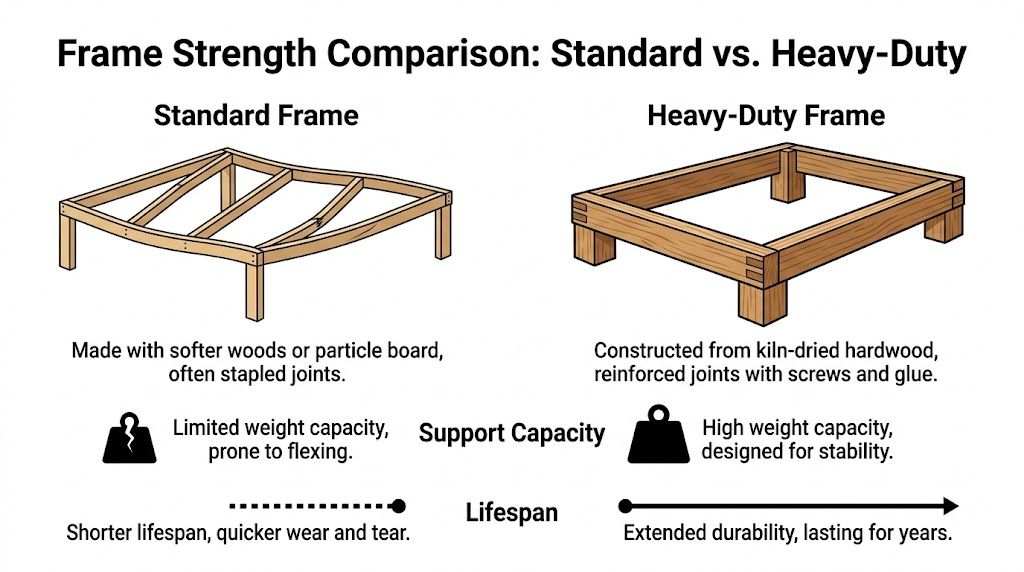
Frames are the hidden workhorses. If the frame is weak, no fabric, leather, or cushion upgrade can rescue the piece for long. That's why we always tell shoppers to start by asking what the furniture is made of and how it's joined.
Wood species matters
Not all wood frames behave the same way. Softer materials can work in lighter-duty applications, but for heavier-use seating, denser materials make a real difference.
Research on chair design notes that kiln-dried hardwoods such as oak or maple provide superior structural integrity, and that laminated wood can show even higher load-carrying capacity. The same research also points to corner blocks and double-doweled joints as key reinforcements at the failure points where conventional sofas often break down (frame engineering research).
Kiln drying matters because it reduces excess moisture in the wood. That helps the frame stay more stable over time. When wood is properly prepared, the joints hold better and the frame is less likely to shift as the seasons change.
Joints tell you a lot
You don't need to be a carpenter to spot a better-built frame. You just need to know what to ask.
Here's a quick comparison:
Frame feature
What it usually means
Stapled or lightly fastened joints
Faster production, less long-term stability
Corner blocks
Added support at stress points
Double-doweled joints
Stronger alignment and connection
Mortise and tenon joinery
Traditional, durable wood-to-wood construction
If you're curious about traditional craftsmanship, our guide to mortise and tenon joinery shows why that old-school method still matters.
What Amish and USA-made construction often gets right
American and Amish craftsmanship often stands out. Many of those builders still focus on real wood selection, slower assembly, and stronger joinery methods. They aren't just wrapping upholstery around a box and hoping for the best.
When we look at a sofa, chair, or dining piece for heavier use, we pay attention to:
The thickness of the rails
How the corners are reinforced
Whether the arms feel integrated into the frame
Whether the seat foundation feels planted, not springy in a bad way
A good frame has a quiet feel. It doesn't squeak when weight shifts. It doesn't twist when someone uses the arm to stand.
A simple showroom test
Try this when you're shopping in person:
Sit down normally.
Shift your weight side to side.
Push lightly on one arm as if you're standing up.
Listen and feel.
A well-built piece should feel composed. Not stiff and uncomfortable. Not loose and chatty either. Just solid.
Strong furniture often feels calm. No drama, no creaks, no wobble.
For furniture for heavy person use, that calm feeling is often the first sign that the hidden structure is doing its job.
Decoding Cushions and Support Systems
A strong frame keeps furniture from failing. Cushions and support systems decide whether the piece stays comfortable after months and years of real use.
That's where many shoppers get tripped up. A seat can feel plush in the first minute and still be the wrong choice for long-term support. Soft isn't always supportive. Firm isn't always uncomfortable. What matters is how the layers work together.
Why foam density matters
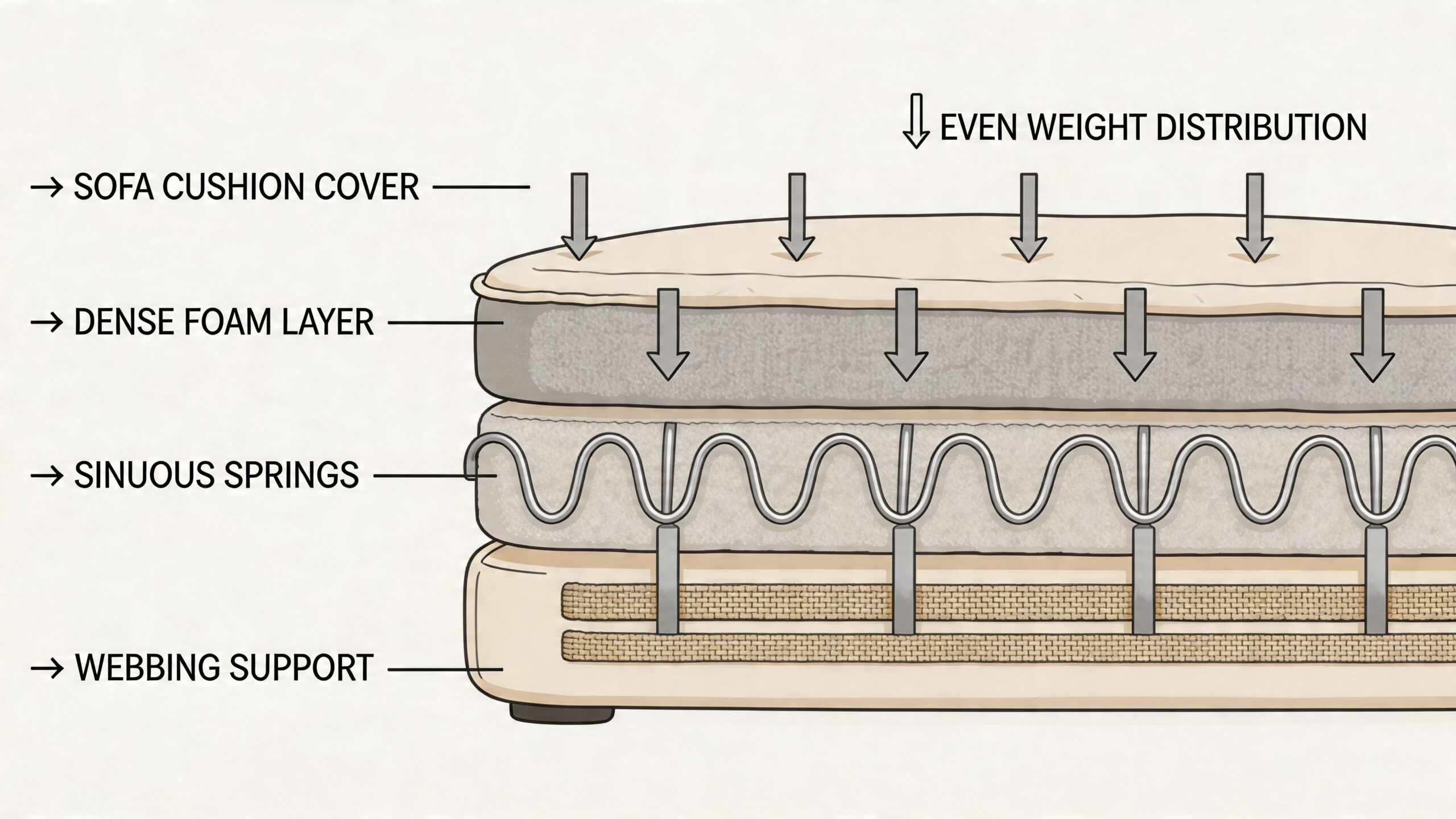
The most important cushion detail for heavier-use seating is foam quality. One source puts it plainly: high-density foam is the most critical variable in heavy-person furniture, while standard foams can compress and sag within 2-3 years. That same source notes that high-density options resist compression and help sofas rated for 400-600 pounds or more maintain shape and support (high-density foam guide).
That doesn't mean every seat should feel hard. It means the core of the cushion should have enough resilience to push back and support the body instead of collapsing under it.
What happens inside a weak cushion
A weak cushion usually follows a familiar pattern:
It feels inviting in the store.
The top layer softens quickly.
The body starts sinking deeper into the same spot.
Standing up takes more effort.
The seat looks uneven even when no one is sitting there.
If someone spends long stretches on that sofa, this gets old fast.
Support under the cushion matters too
Foam doesn't work alone. Under the cushion, you have a support system that carries the load and affects the feel of the seat.
Some seats rely on webbing. Some use sinuous springs. Higher-end construction may use more advanced coil systems. The names matter less than the result. You want a seat that feels even across its surface and doesn't create a hammock effect in the middle.
A common approach is to sit for ten seconds and decide. That's not enough for furniture for heavy person use. Try this instead:
Stay seated a bit longer: Give the cushion time to respond.
Lean back, then forward: Notice whether the seat helps you move or traps you.
Test the front edge: That's the spot many people use when standing.
Switch positions: A good cushion shouldn't only feel good one way.
If the cushion swallows you, it may feel cozy for a moment and frustrating every day after that.
One more tip. Don't judge a seat by the top puff alone. Some overstuffed cushions look generous but don't have the dense core needed for long-term use. The better seat often feels balanced rather than marshmallow-soft.
Finding a Mattress That Truly Supports You
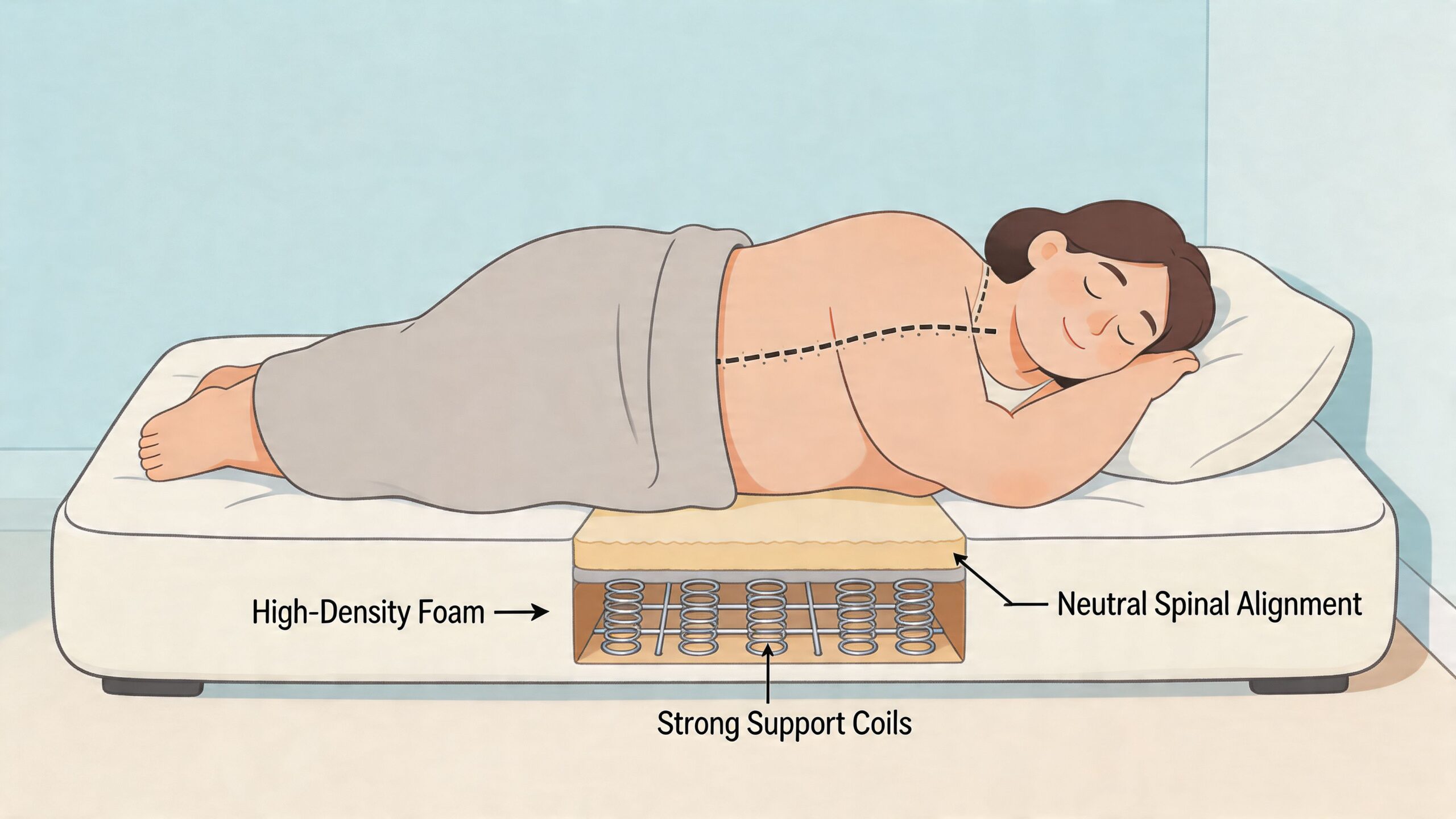
A mattress has a hard job. It supports the body for hours at a time, night after night, in the same pressure zones. When that support breaks down, you feel it in the morning.
For heavier sleepers, sagging is one of the biggest complaints. A mattress can still look decent on the outside and already be failing where it counts. Hips sink too far, the center softens, or the edge starts feeling less stable.
Look past firm and soft labels
"Firm" sounds like the easy answer, but labels can be misleading. What you really want is a mattress built to keep its support over time.
One source notes that many brands cap support at 275-300 lbs per person, while heavy-duty flip-able options are built to fight sagging. The same source says high-density foam in USA or Amish solid-wood frames retained 95% of its shape after 10,000 cycles, which points to the long-term value of stronger support materials (heavy-duty mattress durability discussion).
Why two-sided mattresses make sense
We're big believers in flip-able mattresses because they spread wear more evenly. That's especially helpful in households where one or both sleepers put more pressure on the mattress over time.
A two-sided design gives you more usable surface life. Instead of the same comfort layers taking the same pressure in the same direction year after year, you can rotate use and help the mattress wear more evenly.
What to check in person
When you're testing mattresses, pay attention to more than surface feel.
Use this checklist:
Edge stability: Sit near the side. It should feel supportive, not collapsed.
Mid-mattress support: Lie where your hips normally land and notice whether you stay level.
Ease of movement: You should be able to turn without feeling stuck.
Surface consistency: The mattress shouldn't feel noticeably weaker in one area.
This is one area where in-person testing really matters. BILTRITE Furniture-Leather-Mattresses offers a category of mattresses for heavy people along with flip-able options, which gives shoppers a chance to compare support styles directly rather than guessing from a product photo.
A mattress should help, not fight you
For seniors and anyone with limited mobility, mattress support affects more than sleep. It affects getting in and out of bed safely. If the edge caves in, the whole routine gets harder.
That's why we like mattresses that feel supportive across the full surface, not just in the center. A bed should help you rest and help you move.
Prioritizing Everyday Comfort and Safety
Weight capacity gets most of the attention, but daily usability is just as important. A chair can be strong and still be a poor fit if it sits too low, has deep seating that traps the body, or lacks arms sturdy enough to help with standing.
Furniture for heavy person needs often overlaps with senior living needs. The overlap is bigger than most stores acknowledge.
Seat height changes everything
A lower seat might look modern, but it can be a nuisance if getting up already takes effort. One accessibility source reports that over 40% of adults with a BMI over 30 face mobility impairments, and notes that seat heights of 20-22 inches plus shorter seat depths can make standing easier (mobility-focused furniture guidance).
That makes practical sense. When the seat isn't too low and the depth doesn't force your knees too far forward, it's easier to plant your feet and push up.
Features worth paying for
If comfort and safety both matter in your household, these features deserve attention:
Supportive armrests: They should feel firm enough to assist with sit-to-stand movement.
Manageable seat depth: Too much depth can make people slide forward instead of sitting back comfortably.
Stable reclining action: The movement should feel smooth and controlled.
Lift assistance when needed: A good lift chair can make daily life much easier.
A lot of shoppers wait too long to consider a lift chair because they think it looks too medical. Many current models look much more residential than people expect. And more important, they can help someone stay independent longer.
Why this matters in real life
Think about the moments furniture gets used most. Getting up to answer the door. Sitting down after dinner. Standing from a recliner before bed. These aren't rare situations. They're everyday motions.
If the furniture helps with those transitions, people notice immediately. If it makes them harder, people feel that too.
Here's a quick comfort-and-safety comparison:
Feature
Why it helps
Higher seat profile
Easier standing and sitting transitions
Shorter seat depth
Better leg position and less scooting
Firm arms
Added leverage and confidence
Smooth mechanism
Safer, more predictable movement
Good furniture should support the whole motion, not just the sitting part.
That's a simple standard, but it eliminates a lot of disappointing choices.
How We Build and Source Furniture for You
When people come into our showroom, they often ask some version of the same question. "How do I know what's built better?" Fair question. Most furniture tags don't tell the whole story.
We've tried to make that easier by identifying the things that matter most on the floor. If a piece is heavy duty, real solid wood, USA made, or Amish made, we want shoppers to be able to spot that quickly and ask the right questions.
What we look for before a piece earns a place on the floor
We don't judge by appearance alone. We look at construction details, how the seat feels under pressure, whether the frame has the right kind of reinforcements, and whether the design works for real homes and real bodies.
For recliners, mechanism strength matters a lot. Industry guidance notes that premium heavy-duty recliners can support up to 500 lbs, with models such as the Homestretch Kong King Comfort Recliner using a 7-gauge reclining mechanism and an extended layout for larger users (heavy-duty recliner specifications).
That kind of specification matters because a recliner isn't static. It moves. The hardware takes stress every time the footrest opens and closes, every time someone leans back, and every time they push forward to stand.
The markers that help shoppers shop smarter
When you're in our store, these identifiers can save time:
Heavy Duty icon: Helps flag pieces built for stronger support.
USA Made icon: Useful if you want domestically built furniture.
Amish Made symbol: A sign to take a closer look at wood quality and craftsmanship.
Solid wood indicator: Helpful for shoppers trying to avoid weaker substitutes.
Heavy-duty and mobility-friendly furniture is hard to judge from a screen. You need to sit, stand, recline, shift, and compare. A chair that looks roomy online might have the wrong seat depth. A recliner that sounds sturdy might have arms that don't help enough during standing.
That hands-on part still matters. So does talking to people who've helped families sort through these issues for years.
We also know delivery can be part of the challenge. Some homes have narrow stairs, tight corners, or smaller rooms. That's why practical options like come-apart sofas, small-scale pieces, and in-stock heavy-duty models can make the buying process less stressful.
Your Family's Partner in Comfort and Quality
Furniture for heavy person use shouldn't feel like a niche problem or an awkward conversation. It's just good furniture shopping with better questions. Is the frame built right? Will the cushion keep supporting me? Can I get in and out of it comfortably? Will it still feel dependable down the road?
Those questions matter whether you're shopping for yourself, a parent, a spouse, or a whole family room that gets daily use. They matter even more when comfort and mobility go hand in hand.
Our family has been helping Metro Milwaukee shoppers with those choices since 1928. We're proud of our local roots, proud of our USA-made and Amish-made selection, and proud that we still believe furniture should be seen, touched, and tested in person. That's also why we're closed on Sundays. Family time matters to us, and we know it matters to our customers too.
If you've been burned by sagging seats, shaky chairs, or furniture that looked better than it lived, don't settle for another round of the same. Better construction isn't hype. It's what makes the piece feel better on day one and still feel dependable years later.
We'd love to help you sort through the options in a way that feels friendly, useful, and low pressure.
Come visit BILTRITE Furniture-Leather-Mattresses in Greenfield and try the furniture for yourself. Sit in it, recline in it, test the seat height, and talk with our experienced team about what fits your home and your daily life. We'd be happy to help you find supportive, long-lasting furniture that feels right the moment you use it.