Elevate Your Space: How to Decorate with Leather Furniture

You’re probably in one of two spots right now. You either love the look of leather furniture and worry it will make your home feel too stiff, or you already own a leather sofa and you’re trying to make the room feel warmer, softer, and more like you.
Good news. Leather works beautifully in real homes. Not showroom-only homes. Real Milwaukee homes with kids, dogs, guests, movie nights, winter blankets, smaller rooms, and daily traffic.
We’ve been around furniture our whole lives in this city, and one family lesson keeps proving itself: leather does best when you treat it like a hardworking foundation, not a fragile showpiece. If you choose the right scale, balance it with softer materials, and take care of it properly, it can carry a room for years.
Why Leather Furniture is a Fantastic Family Choice
A lot of folks still think leather is formal. We disagree.
Leather is one of the smartest choices for a busy house because it can look polished without acting precious. It handles everyday life better than many people expect, and it picks up character along the way instead of looking tired right away.
The broader market tells the same story. Leather makes up 34% of all upholstery sales at retail in the U.S., which says plenty about how many households still trust it for everyday living spaces, according to Furniture Today’s leather market data.
It fits family life without looking casual
Think about a normal week. Somebody drops onto the sofa after work. Kids climb over the arms during a movie. A grandparent wants supportive seating that feels sturdy. The room has to do a lot.
Leather rises to that challenge because it has presence. Even one well-chosen sofa can make the room feel grounded and finished.
At the same time, it doesn’t lock you into one style. A leather chair can lean farmhouse with solid wood tables, paired with clean-lined lamps, or relaxed with a chunky knit throw and a faded rug.
Tip: If you want a room that looks pulled together even on a messy day, start with leather. It gives the space structure fast.
It ages with your home
Leather particularly excels in this area. Fabric often looks its best on day one. Leather often looks better after it has been lived in.
That softening, that slight patina, that broken-in comfort. Those are not flaws. That is part of the appeal.
Here’s the family-minded case for it:
- Daily use matters: Leather is a practical option for homes where the main seating gets used constantly.
- Style stays steady: Trends shift, but leather rarely looks dated.
- It plays well with other materials: Wood, metal, linen, wool, and cotton all work with it.
It is warmer than people think
The “leather feels cold” concern usually has less to do with the leather and more to do with the rest of the room. If the space has hard floors, bare windows, and no soft layers, almost any seating will feel stark.
Add texture, a rug, better lighting, and a few soft accessories, and leather becomes the anchor instead of the problem.
That is a key secret to how to decorate with leather furniture. Don’t ask the leather piece to do all the emotional work. Let it be the durable backbone, then build warmth around it.
Finding Your Ideal Leather Piece at BILTRITE
Start with the piece itself. Decorating gets easier when the furniture is right from the beginning.
Too many people choose leather based only on color. Big mistake. Comfort comes first, then scale, then construction, then color. That order saves people from buying something that looks sharp for five minutes and annoys them for the next decade.
Global consumer preference lines up with that approach. 55% of consumers prioritize comfort in leather sofas, while 45% emphasize design, and the global leather furniture market was valued at USD 11,820 million in 2024, reflecting ongoing demand for comfort and prestige, according to Deep Market Insights on leather furniture.
Buy for the way you live
A leather sofa for a Bay View condo should not be the same sofa you’d choose for a busy family room in Waukesha.
Some homes need a small-scale silhouette that keeps walkways open and doesn’t overpower the room. Others need heavy-duty seating that can handle years of hard use. Some households need a come-apart sectional because getting furniture through tight stairs or narrow entries is half the battle.
That’s why we always tell people to shop by use case first.
- For apartments and condos: Choose tighter arms, shallower depth, and cleaner profiles.
- For family rooms: Look for supportive seats, durable cushions, and construction that feels planted.
- For long-term value: Prioritize USA-made and Amish-made craftsmanship, especially if you care about sturdiness and repairability.
What quality looks like in person
You can spot a better leather piece once you know what to check.
Use this quick guide when you shop:
| What to examine | What you want to see |
|---|---|
| Seat comfort | Supportive, comfortable sit without feeling overly hard or overly sinky |
| Scale | Proportion that fits the room, doors, and nearby furniture |
| Frame feel | Solid, steady construction without wobble |
| Leather character | Natural variation, a rich hand, and a finish that suits your lifestyle |
| Overall design | A shape you’ll still like years from now |
If you want a deeper buying checklist, this guide on what to look for when buying a leather couch is worth a read.
My direct recommendation
If you want leather to work in a real Milwaukee home, skip trendy oversized pieces unless you have the room for them. Go with a sofa or sectional that matches your floor plan, your doorway situation, and the way your household sits.
A slightly smaller, better-built leather piece will usually beat a giant one that dominates the room and wears out your patience.
Arranging Leather Furniture for Any Room Size
Layout makes or breaks leather.
A leather sofa has visual weight. That can be a huge plus when the room needs an anchor. It can also make the space feel heavy if you place it badly or pair it with furniture that is too bulky.
Research backs that up. Improper layout and contrast can lead to 75% of rooms feeling “heavy.” In rooms under 200 square feet, limiting leather to two pieces max helps prevent a cave-like feel, and come-apart sectionals can fit 80% of tricky entries, according to this layout-focused leather furniture guide.
Small rooms need breathing room
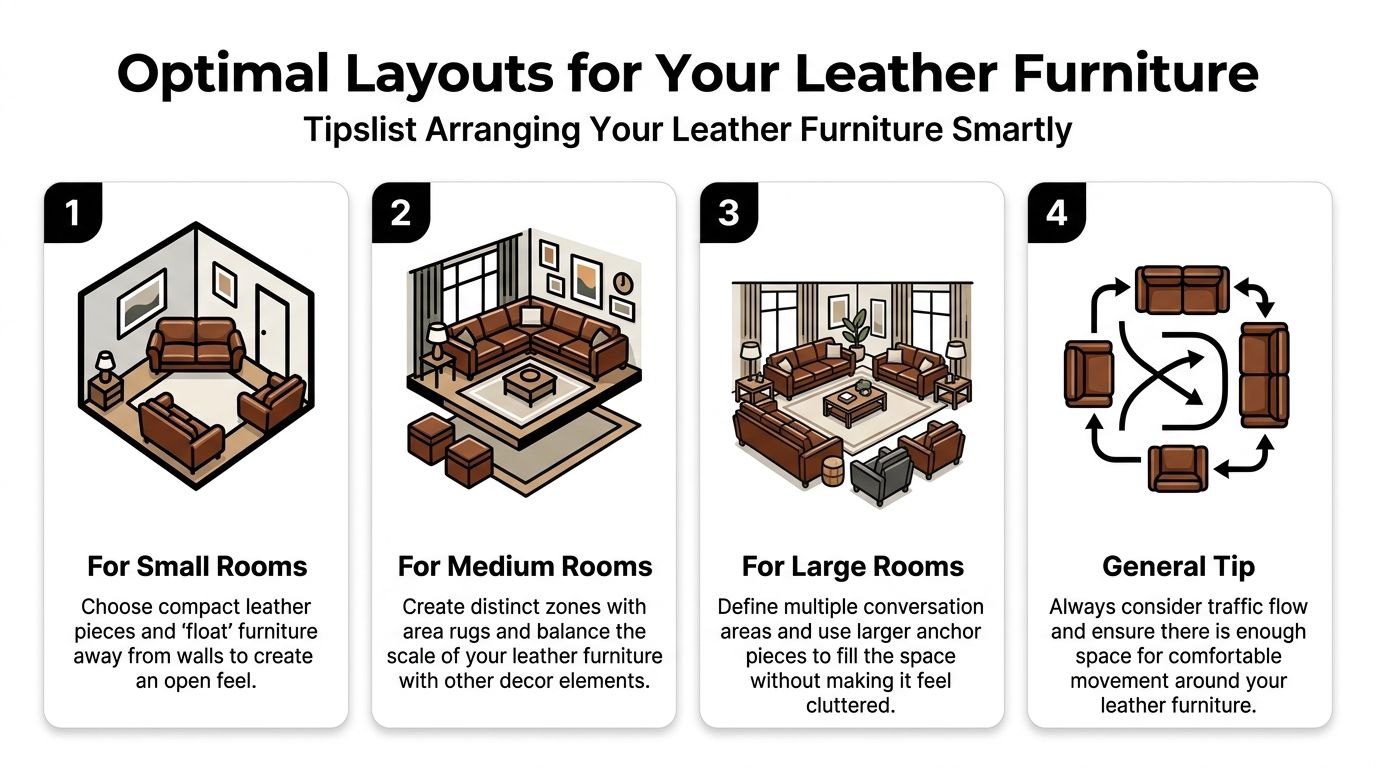
If you have a smaller living room, don’t shove every piece against the wall and call it done. That usually makes the center feel awkward and the perimeter feel crowded.
Instead, use one leather anchor piece. A sofa or loveseat is often enough. Then add lighter-looking companions, like an upholstered chair, slimmer tables, or an open-base coffee table.
A few rules I swear by:
- Leave visible floor around the furniture: That open area makes a room feel less packed.
- Choose the hero piece: One leather sofa usually does more than a sofa plus matching leather chair plus ottoman in a compact room.
- Respect traffic paths: If people have to squeeze sideways to move through the room, the layout is wrong.
Key takeaway: In a smaller room, leather should anchor the space, not swallow it.
Medium and large rooms need zones
Bigger rooms create the opposite problem. People buy one nice leather sofa, set it against a far wall, and the room still feels unfinished.
That’s because larger spaces need groupings. Use the leather piece to define the main conversation zone, then support it with a rug, side chairs, accent lighting, and a table arrangement that keeps everyone connected.
Try this simple room-size approach:
| Room feel | Best move |
|---|---|
| Compact | One leather anchor piece, fewer companions |
| Balanced | Sofa plus mixed-material accents and a grounding rug |
| Spacious | Create separate zones for conversation, reading, or TV viewing |
If you want more placement ideas, this article on family room furniture layout ideas gives helpful room-planning inspiration.
Don’t forget the doorway test
This is one of those old-school furniture lessons people learn the hard way. Measure the room, yes. But also measure the path into the room.
In Milwaukee bungalows, older colonials, condos, and upper flats, delivery access can be a significant design issue. Come-apart leather sectionals are a smart fix because they solve a practical problem without forcing you to settle for a style you don’t want.
Creating a Cozy Vibe with Colors and Textures
Leather looks best when something soft pushes back against it.
That contrast is what keeps a room from feeling flat or severe. And it matters more than people realize. Unbalanced leather-heavy rooms feel “cold” in 80% of client feedback, while a successful approach is a 60/40 ratio, with leather carrying 60% of the visual weight and softer surfaces like wool or linen covering the remaining 40%, based on Ballard Designs’ decorating guidance for leather furniture.
Start with the leather color you already have
Don’t overcomplicate this. Work from the biggest piece.
If your sofa is dark brown, lean into warm neutrals, wood tones, creams, camel, rust, olive, and textured ivory. If it’s black, soften it with oatmeal, taupe, muted patterns, and natural materials. If it’s gray leather, warm it up with beige, brass, wood, and layered textiles.
The mistake is trying to match everything too closely. Matching makes a room feel flat. Contrast gives it life.
A useful next step is browsing this guide to the perfect color palette if you want help narrowing your scheme.
Use softness on purpose
You do not need a pile of random pillows to make leather feel inviting. You need the right textures in the right spots.
Try this layering order:
Begin underfoot
Put down a rug with visible texture or pattern. That immediately softens the sharpness leather can bring.Add a throw where the eye lands
Fold one over an arm or drape one casually across a corner seat. It breaks up the solid expanse.Mix pillow materials
Use linen, boucle, cotton, or wool. They should feel different from the leather, not imitate it.Bring in another natural surface
Wood, woven baskets, greenery, and pottery all help.
My favorite combinations
Some pairings almost always work:
- Brown leather and cream textiles for a warm, grounded look
- Black leather and light oak for a cleaner, modern room
- Gray leather and rust or olive accents for softness without fuss
- Leather with plaid, linen, or chunky knit for a lived-in Midwest feel
Tip: If the room feels chilly, don’t replace the leather first. Add a rug, a throw, better lamps, and textured pillows. That usually fixes it.
The Finishing Touches with Rugs and Lighting
Here, the room starts feeling personal.
I’ve seen leather sofas look too stiff in one home and wonderfully relaxed in another, and the difference usually comes down to the finishing touches. The sofa stayed the same. The rug, lamps, art, and surrounding pieces changed everything.
Rugs do more than fill floor space
A good rug settles leather furniture into the room. It softens the look, absorbs some visual heaviness, and tells your seating where it belongs.
If the leather sofa feels like it is floating, the room needs a rug with enough size and presence to hold the arrangement together. If it already feels dominant, choose a rug with warmth and texture instead of another dark, heavy surface.
This guide on how to place an area rug in the living room can help you avoid the too-small-rug problem, which is one of the most common decorating mistakes we see.
Lighting changes the mood fast
Leather reacts strongly to light. In daylight, it shows grain and depth. At night, it can either glow warmly or fall flat depending on the lamps around it.
I prefer layered lighting over one bright overhead fixture.
- A floor lamp near the sofa makes the seating area feel intentional.
- A table lamp on an end table adds warmth at eye level.
- Wall art and greenery keep the room from feeling overly uniform.
One of my favorite room formulas is simple: brown leather sofa, light rug, warm lamp, wood table, plant in the corner, and art with a little age or texture. That combination feels settled and welcoming, not staged.
Keeping Your Leather Looking Great for Years
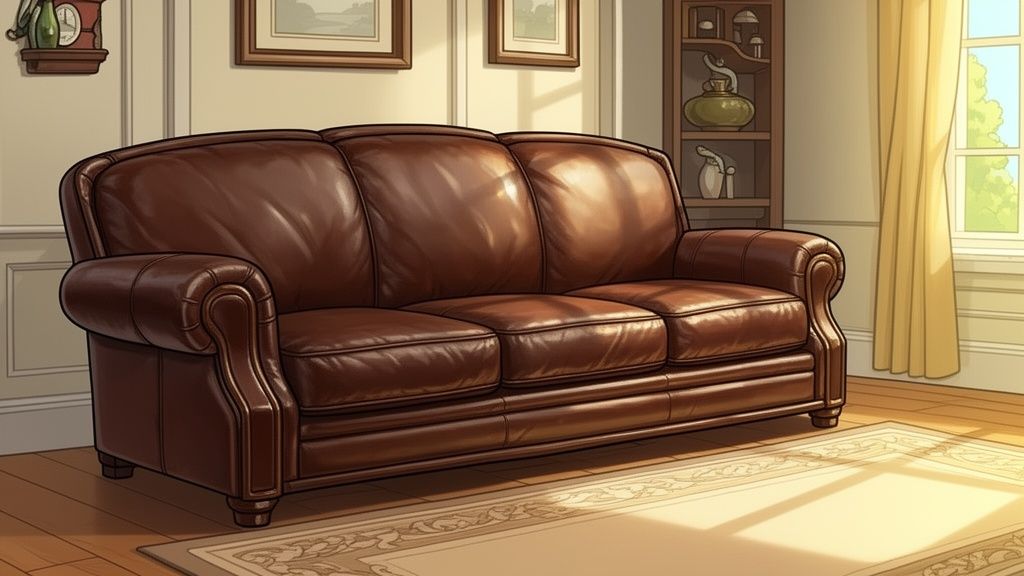
Here’s the plain truth. Good leather is durable, but it is not self-maintaining.
High-quality leather like full-grain or top-grain is more durable and fade-resistant, and in climates like Wisconsin, seasonal humidity changes and winter heating can affect leather, so regular conditioning matters if you want the piece to age well, as noted in Brumbaugh’s guidance on styling and maintaining leather furniture.
Keep the routine simple
You do not need a fussy ritual. You need consistency.
A practical leather care routine looks like this:
- Dust regularly: Use a soft, dry cloth so dirt does not settle into the surface.
- Clean spills quickly: Blot, don’t scrub. The faster you respond, the better.
- Keep it out of harsh sunlight: Direct sun can dry and fade leather over time.
- Mind heat sources: Don’t park leather right next to vents, radiators, or intense heat.
- Condition on a regular schedule: Wisconsin homes go through dry indoor heat and seasonal shifts. Leather notices.
For more hands-on guidance, this article on how to condition a leather sofa is a helpful place to start.
What I recommend for Milwaukee homes
Our climate is rough on furniture in sneaky ways. Dry winter air can pull moisture out of leather. Summer humidity can change how a room feels. If your sofa sits near a bright window, that adds another layer.
So here’s my opinionated advice:
- Choose better leather from the start.
- Rotate where people sit when you can.
- Don’t let spills linger.
- Keep the room conditions steady if possible.
- Condition the leather before it starts looking thirsty, not after.
Key takeaway: The best leather rooms are not the ones people are afraid to use. They are the ones people use often and care for properly.
Leather furniture earns its keep. It gives you durability, comfort, style, and a look that doesn’t feel disposable. Decorate around it with softness, light, and the right scale, and it will serve your home beautifully for years.
If you’re ready to see better-quality leather furniture in person, we’d love to help. Visit BILTRITE Furniture-Leather-Mattresses in Greenfield and talk with our family-owned team. We’ve been serving Metro Milwaukee since 1928, we’re proud of our USA-made and Amish-made options, and we’re always happy to help you find leather that fits your room, your budget, and your everyday life.