Heavy Duty Mattress Bag: Mils, Sizes and Care

Could a thicker mattress bag keep trouble out on the truck but trap moisture during storage? It can. A heavy-duty bag is a short-term barrier, not a fire cover, a mold cure, or a way to make a worn mattress suitable for donation.
For a rough move, thicker film helps resist rubbing and pressure at corners. For longer storage, a tight seal can hold moisture against the mattress, so the room matters as much as the bag. A bed crossing Greenfield faces door frames and truck floors; one stored in a Milwaukee basement also needs a dry, suitable environment.
Table of Contents
- Which Mil Thickness Fits Your Move
- Bag Sizes for Every Bed
- What the Bag Blocks and What It Does Not
- How to Bag a Mattress for the Trip
- When a Tighter Bag Traps Moisture
- Donation Recycling or a Pickup Instead
- Come Test a Mattress in Greenfield
Which Mil Thickness Fits Your Move
Which part of your move is hardest on the bag? A mil rating helps you compare film thickness: one mil equals one-thousandth of an inch.
The mattress-bag guide from Infun Plastic describes 1.5–2 mil film for a short, careful move, 3–4 mil as ordinary heavy-duty film, and 5–6 mil as extra-heavy-duty film. It recommends 4 mil or more for longer-distance moves, repeated handling, or storage lasting more than a month.
Mil thickness by move and storage job
| Job | Thickness | Best for | Still add |
|---|---|---|---|
| Short local move, careful carry | 1.5–2 mil | A careful trip where the main concern is dust | Blankets over stairs and door frames to reduce rubbing |
| Everyday heavy-duty move | 3–4 mil | The extra abrasion protection needed for corners and a truck ride | Corner guards over hardware that could puncture the film |
| Rough handling or storage past a month | 4–6 mil | Repeated lifting, stacking, or longer storage | A fully dry mattress before bagging |
| Long-term storage with a taped close | About 6 mil | A taped barrier against dust and incidental spills | Off-floor storage in a dry space |
| Thin listed full-size example | About 1.1 mil | A light cover rather than a mover bag | Don't rely on it to protect a mattress during a move |
The extra padding matters because a guard covers a hard point, such as a bolt, while thicker film only adds material around it. Even a heavy-duty bag can tear if exposed hardware presses into the same spot.
Match the bag to the hardest part of the job
Distance alone doesn't determine how much stress a bag takes. A short move with repeated loading and repositioning can be tougher on the film than a careful carry straight into a nearby bedroom.
Before choosing, consider the full route:
- Handling: Count transfers between bedrooms, vehicles, staging areas, and storage.
- Obstacles: Check for narrow stair turns, rough thresholds, protruding screws, and metal rails.
- Closure: See whether the opening zips shut or leaves enough extra film for a folded, taped seal.
- Film information: Check the polymer type and whether the material is virgin or recycled polyethylene. Neither label by itself shows how well the finished bag resists tearing.
Polyethylene blocks liquid water, but the bag's construction, seams, fit, and handling also affect whether it holds up. Choose film for the roughest part of the route, then protect likely snag points with a blanket or corner guard. Clear the path and keep sharp bed parts separate from the bagged mattress.
Bag Sizes for Every Bed
Mattress sizes and the bag fit to check
| Bed | Bag to shop for | Fit check |
|---|---|---|
| Twin | Wider than the mattress plus its depth | Corners aren't stretched tight |
| Twin XL | Extra-long bag matched to measured length and depth | Slack remains at the foot |
| Full | Larger than a tight 52 × 81 listing | Measure width before buying |
| Queen | Queen bag with several inches of slack | Zipper clears the corner |
| King | True king width and length | Slide the bag on; don't drag the seams |
| California king | California king bag matched to the actual length | Don't fold the mattress to force a fit |
A size name is a starting point, not a fit guarantee. The useful measurements are the mattress's actual width, length, and depth, including its tallest pillow-top or padded edge.
The packaging-film discussion in Baking Business illustrates the specification problem with a full-size bag listed at approximately 52 × 81 inches and 1.1 mil, compared with other mattress bags made from 4 mil polyethylene. A full-size label shouldn't replace a tape measure, especially when the listed footprint looks close to the mattress's measured width.
Depth uses more bag than expected
A deep mattress needs film to travel around its sides, not just cover its sleeping surface. A bag that looks generous while lying empty can become tight once a thick mattress fills it.
Use a tape measure along the widest and longest edges, then measure vertically from the bottom border to the highest part of the top. The guide to measuring a mattress can help organize those checks before shopping.
Leave enough slack for the film to settle around the corners without stretching. The closure also needs room to work; a zipper pulled tightly around a corner is difficult to close and easy to strain.
- Pillow-tops: Include the raised surface rather than measuring only the side panel.
- Bases: Bag the mattress separately from its foundation or adjustable base. An attached base adds weight, moving parts, and sharp edges.
- Handles: Use mattress handles only as the mattress maker permits. Some are positioning handles, not lifting handles.
- Large beds: Helpers should support the mattress itself rather than hauling it by loose plastic.
Check the material without overreading the label
HDPE generally offers better tear and puncture resistance than LDPE, but it's less flexible and can be more brittle. That trade-off matters when stiff film must bend around bulky corners.
A polymer name alone doesn't reveal seam strength or finished-bag performance. Look for clear dimensions, thickness, closure details, and any stated mechanical testing rather than assuming that the heaviest-sounding description wins.
The final fit check is simple: film shouldn't feel drum-tight over a corner. If the opening barely reaches or the zipper needs force, a larger bag is the better choice.
What the Bag Blocks and What It Does Not
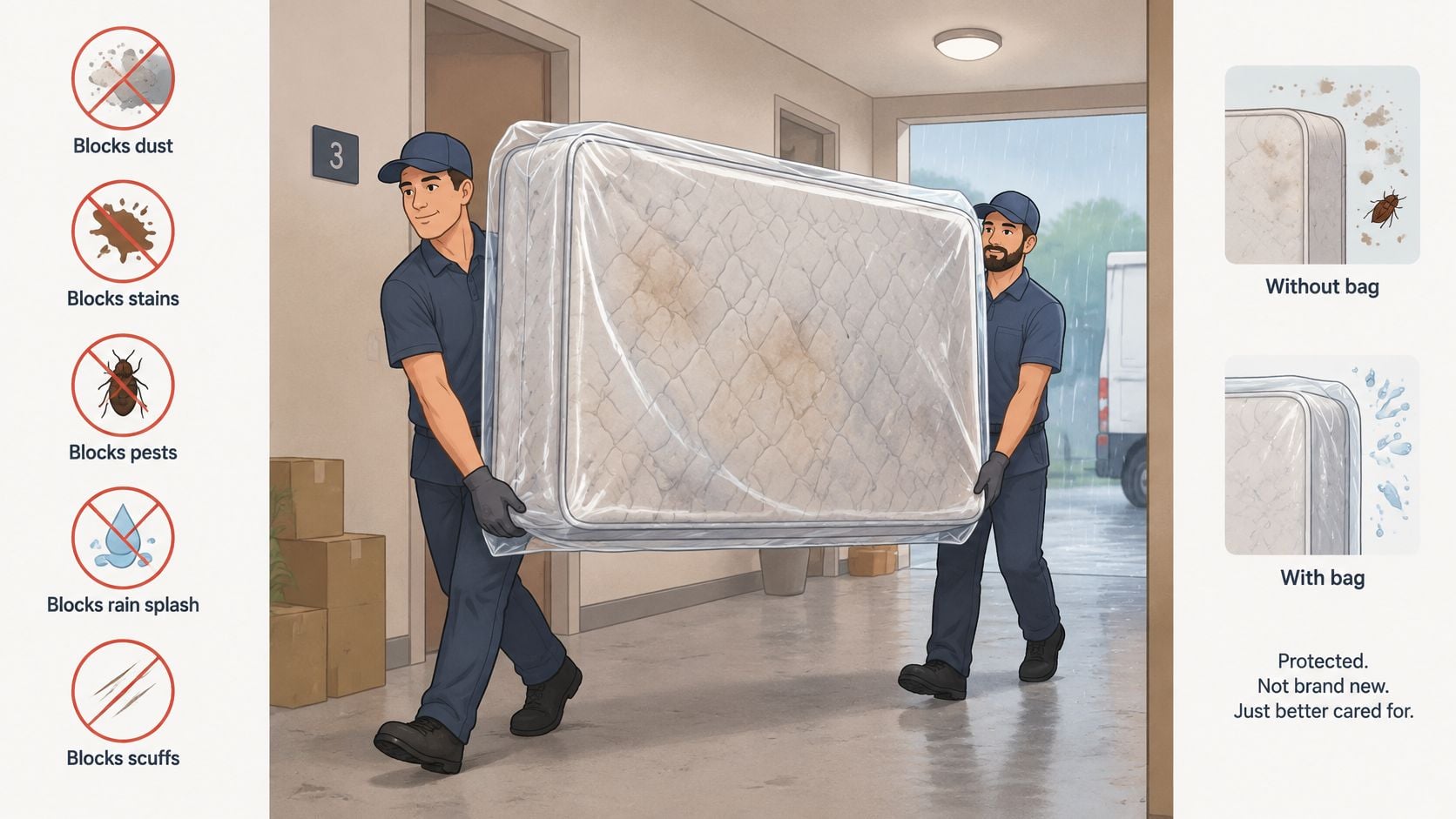
A mattress bag is a raincoat for the trip, not a new mattress underneath it. Say a family carries a bed through a dusty hallway, past a damp entryway, and into a moving truck. The bag helps keep that outside mess away from the fabric.
It can also limit exposure to stains, scuffs, and pests while intact and properly closed. It isn't a pest treatment, and enclosing an already infested mattress doesn't make it clean.
Fire safety belongs to the mattress
The Consumer Product Safety Commission's open-flame standard announcement explains that 16 CFR Part 1633 applies to mattresses manufactured on or after July 1, 2007, and estimated that the rule, once fully effective, could prevent as many as 270 deaths and 1,330 injuries annually. Those protections concern the mattress's regulated construction, not an added plastic moving bag.
A transport bag doesn't add a fire barrier. It also doesn't repair broken internal components, flatten a permanent body impression, or restore support to a worn-out bed.
A clean covering changes what touches the mattress. It doesn't change the condition of the mattress inside.
Different covers do different jobs
A moving bag is meant for handling and transport. An everyday mattress protector serves a different purpose beneath the bedding; the guide to mattress protectors explains that separate category.
After delivery, remove the transport packaging before making the bed. Keep plastic away from children and pets, and don't leave loose packaging in a bedroom.
Labels deserve attention during packing, too. Don't tape over, cut away, or write across safety labels and care instructions, and arrange the closure so the next handler can reach them without damaging the mattress cover.
If the mattress is being replaced because it no longer feels supportive, the bag only helps with its journey out. Comfort comes from the next mattress, not from stronger wrapping. Leave the original labels readable so its construction and handling instructions remain available.
How to Bag a Mattress for the Trip
A calm packing sequence beats a rushed tug-of-war in the hallway. Before starting, set out a vacuum with an upholstery attachment, the correctly sized bag, heavy packing tape, moving blankets, and a clear place to work.
The packing illustration shows the general process; the numbered checks also cover handling and inspection after the bag goes on.
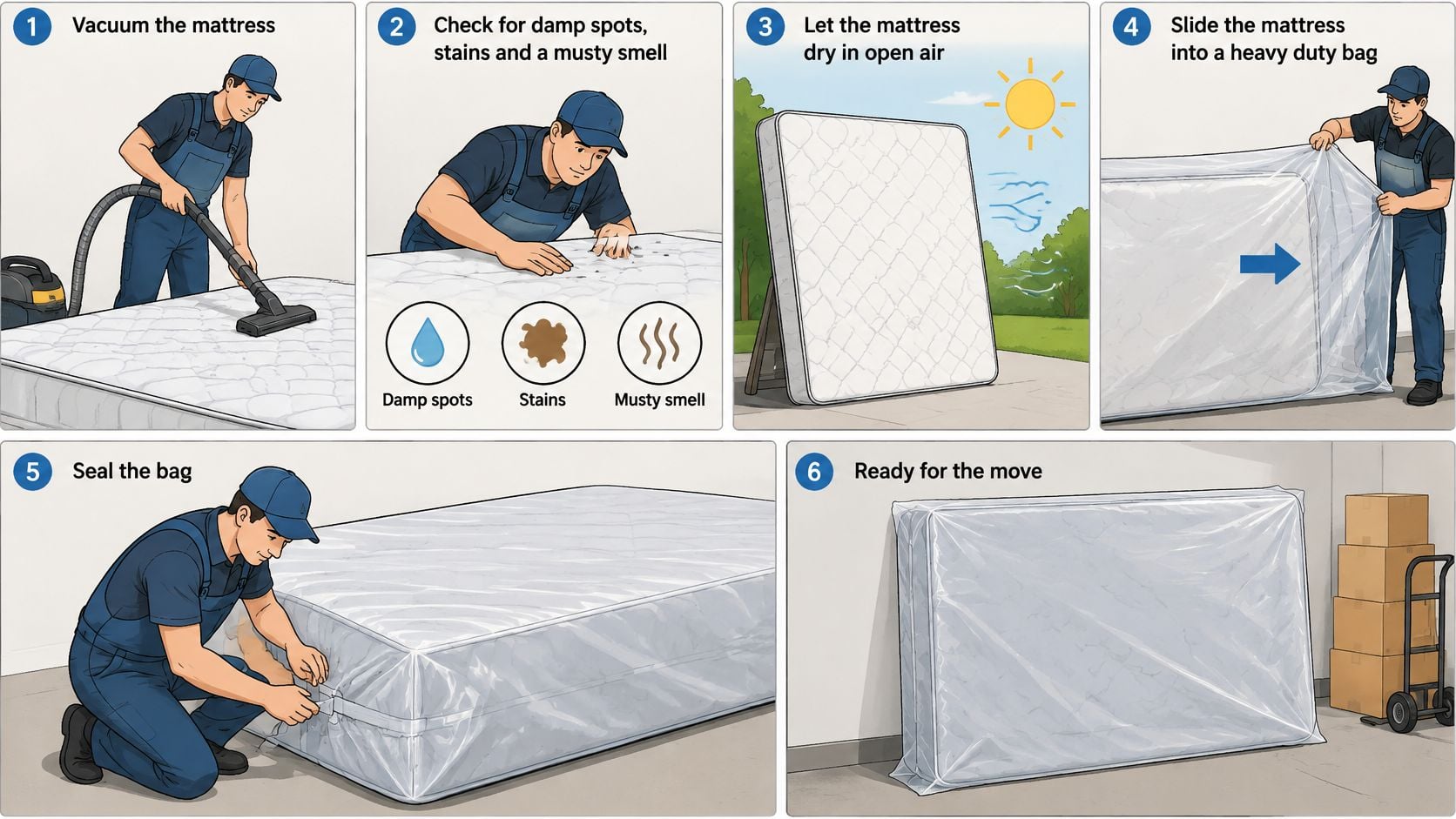
Pack in a controlled sequence
Inspect and vacuum. Remove bedding, vacuum the surface and seams, and check for damp patches, stains, or a musty smell. Cleaning loose debris is different from treating contamination; unexplained odor deserves attention before packing.
Allow complete drying. Leave any damp area exposed to circulating air until it's thoroughly dry. Sealing a surface that merely feels dry on top can hide moisture deeper in the padding.
Slide the bag on from the foot. Have helpers support the mattress while easing the film around each corner. Loose plastic sheeting is a common shortcut, but a mattress-shaped bag gives more dependable coverage and a usable closure.
Settle the film. Gently redistribute excess material instead of pulling hard at the opening. Leave working room around corners and check that no fold has caught beneath a supporting hand.
Close the opening securely. Zip it shut, or fold the open end over and apply heavy packing tape across its full width. Don't assume a zipper or zipper seam is completely waterproof.
Pad the contact points. Add moving blankets where the mattress may meet door frames, stair rails, or nearby hardware. Keep tape on the packaging, not on the mattress fabric.
Carry without scraping. Support the mattress flat or on edge as its construction allows. Don't drag a seam over concrete or bend the mattress sharply to get around a turn.
Inspect at every stop. Look for stretched corners, split seams, and punctures before reloading and after delivery. Replace badly damaged packaging rather than relying on a patch across a stressed corner.
Make the storage decision separately
The Thomas Acres mattress-storage guide recommends a 6-mil bag and a fully taped closure for long-term storage. That is a packaging recommendation, not permission to store a mattress anywhere that has an empty corner.
For a stay beyond the move itself, select a dry destination before closing the package. Keep the mattress raised away from damp flooring and avoid compressing it under boxes.
Households arranging help can review mattress delivery and removal considerations before moving day. Confirm the route, access, and old-mattress condition in advance so nobody discovers an acceptance problem halfway down the stairs.
When a Tighter Bag Traps Moisture
After a wet week, a Milwaukee basement can feel damp even when the floor looks dry. If a room hygrometer reads above 60% relative humidity, take extra care before wrapping a mattress for storage. Indoor humidity below 60% is generally recommended, with 30–50% a preferable range for reducing moisture-related risk, according to the U.S. Environmental Protection Agency's guidance on indoor humidity.
Polyethylene blocks liquid water, but it can also hold dampness against the mattress. Temperature changes may cause condensation inside the bag, much like droplets forming on a cold glass in warm air.
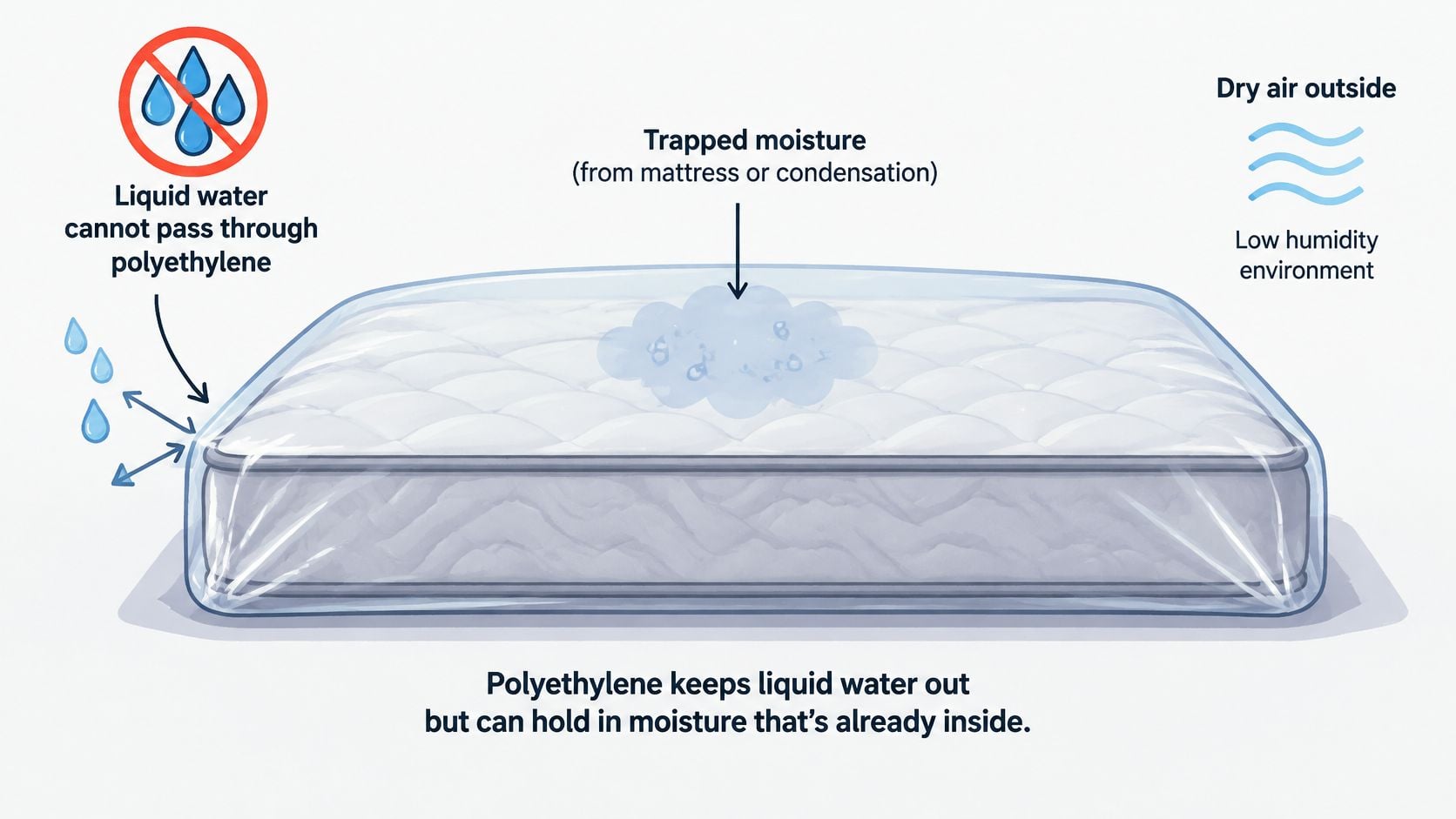
The length of the stay changes the decision
For a same-day move, a bag can shield a dry mattress from outside conditions during transport. Once it reaches the bedroom, remove the bag and let the surface air before making the bed.
A few days in a truck or staging area calls for more attention to temperature swings. A cold mattress moved into warm, humid air may collect condensation, and a parked truck or garage is different from a lived-in bedroom.
For storage lasting months, consider the room as carefully as the wrapping. Milwaukee basements, attics, and non-climate-controlled units can expose a mattress to humid summer air and changing temperatures. A small room hygrometer helps you check conditions instead of guessing by feel.
Inspect the environment, not just the plastic
Choose a clean, flat, raised support, away from plumbing leaks, foundation seepage, and spots where condensation collects. A basement may look tidy while still holding damp air near an exterior wall.
- Check the enclosure: Look for droplets, cloudy patches, or dampness against the film.
- Check the smell: A new musty odor is a reason to open the package and investigate, not add tape.
- Check the room: Use climate control or dehumidification where needed, then check that the space stays dry.
Film helps resist abrasion; dry air helps protect a mattress in storage. Each solves a different problem.
Can a heavy duty mattress bag cause mold? Sealing residual dampness inside can create conditions where mold grows. If condensation appears, open the package in a dry, suitable space and address the moisture before resealing.
Plastic held against damp upholstery or wood can also contribute to odors and material damage. Use the bag as a short-term barrier, not a fire cover, mold cure, or reason to delay checking the mattress.
Donation Recycling or a Pickup Instead
A mattress's condition helps determine where it can go. Recyclers commonly reject mattresses that are heavily soiled, moldy, or infested with bed bugs. The EPA's bulky-items guidance reports that up to 75% of a mattress may be recyclable. That figure describes recoverable materials, not a promise that a local program will accept a particular bed.
Condition comes before destination
A dry, intact mattress with no pest history may meet a donation program's rules. A mattress exposed to basement flooding calls for a different disposal plan. Before arranging transport, give the receiving organization or service a clear account of:
- Stains and odors: Describe visible marks and persistent smells.
- Moisture: Mention leaks, flooding, damp storage, or suspected mold.
- Pests: Report known or suspected bed bugs before scheduling a pickup.
- Physical damage: Explain torn fabric, exposed components, or structural problems that could affect handling.
Donation, recycling, municipal pickup, and delivery-related removal can each have different acceptance rules. Confirm the requirements before placing a mattress outside or loading it into a vehicle.
Choose a suitable route
A mattress bag can help contain debris during an approved disposal trip. It also keeps the mattress covered during handling, but the receiving service still needs an honest description of its condition.
The guide to disposing of a mattress outlines options to consider. Check local bulky-item rules and the receiving service's requirements before choosing a destination.
If you're buying a replacement, ask the showroom team which old-mattress removal and white-glove delivery options are available. Some arrangements require the old mattress to meet donation-condition standards, so confirm eligibility before booking.
An early conversation can save a family from wrestling a king mattress down a Milwaukee stairwell only to find that the planned destination won't accept it.
Come Test a Mattress in Greenfield
What will the next mattress feel like in your usual sleeping position? A hands-on comparison can show comfort differences that a label or photograph can't.
BILTRITE is a fourth-generation, family-owned showroom serving Metro Milwaukee since 1928. The Greenfield store offers more than 60 mattress models to try in person.
Make the visit useful
The guide to testing a mattress offers a practical way to compare options. Lie in your usual sleeping position, take time to assess firmness, and ask the team about support and room access.
- Bring measurements: Include the mattress space, stair turns, and narrow doorways.
- Describe your household: Share sleeping preferences, mobility needs, and who will handle the move.
- Ask about the transition: Clarify packaging, available delivery options, and old-mattress condition requirements.
Local value and selection
The showroom's selection includes small-scale furniture for compact spaces and heavy-duty options for busy households. USA-made, Amish-made, and real solid wood pieces reflect BILTRITE's focus on affordable, better-quality furniture.
Power lift recliners are also available. The showroom is closed Sundays and Mondays, so plan your visit for another day.
Take the time you need to compare comfort, fit, and practical details before choosing.
BILTRITE Furniture-Leather-Mattresses offers affordable, better-quality furniture and a broad mattress selection, with knowledgeable help as you choose a new bed. Visit the Greenfield showroom to test comfort, bring mattress measurements, and ask questions about bags, delivery, and removal.