OPEN MONDAY, NOVEMBER 23 10AM TO 6PM!
GREBE'S DONUT GIVEAWAY MONDAY, NOVEMBER 23 ONLY!
BLACK FRIDAY + SMALL BUSINESS SATURDAY DEALS ON NOW!
NO CREDIT CARD FEES!
1000's of Items IN-STOCK + 500 Mattresses!
Largest selection of USA Made Furniture & Mattresses + Amish Made!
FREE In-Store Design Services!
BUY LOCAL & LOVE YOUR HOME!
Tuesday-Thursday 10am to 6pm | Friday 10am to 7pm | Saturday 10am to 5pm | Sunday Closed To Be With Family & Friends | Monday Showroom Closed
5430 West Layton Ave, Greenfield - Metro Milwaukee
The dining table looks right in the photo, but a closer look raises questions. Will the chairs feel comfortable through a family dinner? Are the drawers well built, and does Amish-made mean rustic, traditional, or something else entirely?
Modern Amish furniture is best understood through hands-on checks, not a style label alone. A shopper can start with the shape and finish, then examine the joints, wood, moving parts, and repair terms. That approach makes it easier to choose furniture that fits both a room and the family using it.
Clean-lined contemporary furniture lets the wood and proportions do most of the decorating. A shopper should run a hand along the tabletop edge, comparing a crisp square profile with a softened edge that may feel friendlier in a busy family room.
Modern Shaker offers a lighter-looking silhouette through recessed panels and slender, tapered legs. In person, the useful check is where the taper begins and whether the legs leave comfortable space beneath a dining table or desk.
Mission-influenced furniture makes structural details part of the appearance, particularly through slats and exposed tenons. A chair's slatted back deserves a seated test because attractive spacing doesn't necessarily suit every person's back.
Transitional farmhouse combines relaxed shapes with painted bases, contrasting tops, or softened edges. Shoppers should examine the finish where the tabletop meets its edge, especially if a deliberately worn appearance might be mistaken for damage.
Modern case goods include storage pieces such as dressers, cabinets, and media consoles with simple fronts and low profiles. Opening and closing a drawer reveals whether its front sits evenly within the cabinet and whether an integrated pull feels comfortable.
Choose the room before the label
These families overlap. A walnut dresser might combine contemporary drawer fronts with Shaker-inspired legs, while a dining table might pair a farmhouse finish with a clean, understated base.
Style describes appearance, not construction. A flat door doesn't reveal its internal materials, and an exposed decorative detail doesn't prove that every hidden connection is equally well made.
Showroom shortcut: Compare pieces from the same viewing distance, then move close enough to inspect edges, seams, and hardware.
Which room comes first? A family kitchen, quiet bedroom, or compact home office gives shoppers a practical starting point for narrowing the table to a few appealing styles.
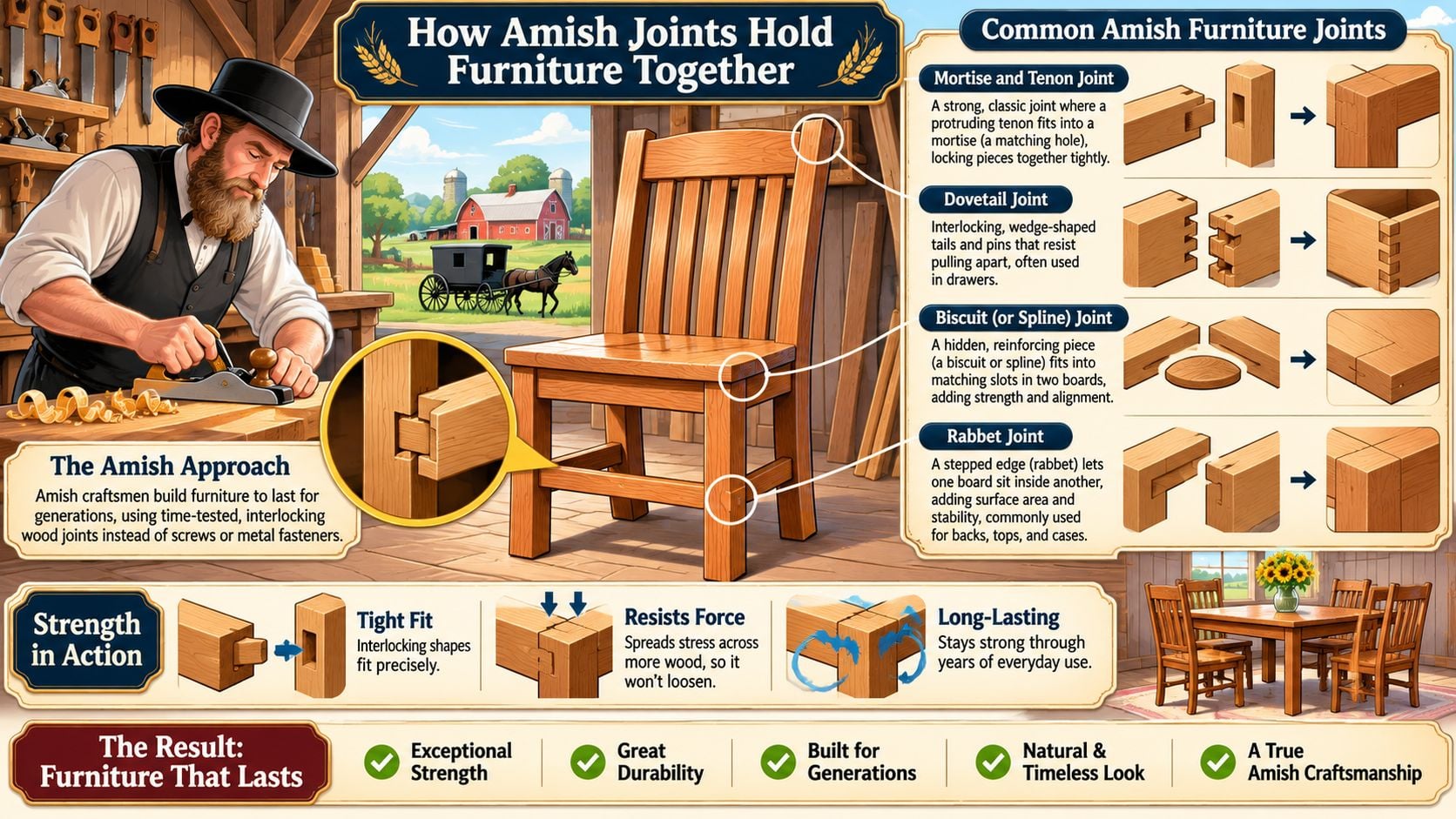
How Amish Joints Hold Furniture Together
A joint is the place where furniture parts connect. Its design matters most where people lean, sit, pull, or shift their weight.
The woodworking methods guide describes mortise-and-tenon construction, in which a projecting wooden tenon fits inside a recessed mortise. That broad connection is useful in legs, rails, posts, and furniture frames; dovetail drawer corners use interlocking pins and tails to resist pulling forces.
Joints to check in modern Amish furniture
Joint
Where it appears
What it does
Showroom check
Mortise-and-tenon
Legs, rails, posts, table aprons, bed frames, chair frames
Creates a broad wood-to-wood connection that spreads stress
Look for tight shoulders and closed seams; ask whether it's glued and pinned
Dovetail
Drawer corners and some case goods
Interlocking pins and tails resist drawer-opening forces
Open the drawer and inspect its corners, not just its front
Tongue-and-groove
Tabletops, panels, cabinet backs, long flat surfaces
Aligns adjoining boards; movement depends on the assembly and attachment
Check alignment, gaps, and provision for seasonal movement
Dowel
Chair and table joints, including some lower-cost construction
Uses round wooden pins and glue; performance depends on fit and loading
Ask about reinforcement and the intended load
A peer-reviewed oak-joint study found mortise-and-tenon joints stronger than dowel joints in its tested configurations. That isn't a guarantee for every chair: fit, adhesive, grain direction, and joint dimensions still matter.
A hands-on joint inspection
Test gently. With permission, apply light pressure to a chair and watch rail connections for opening seams. Don't force or tip it.
Inspect the shoulders. Where legs meet rails, look for close-fitting contact rather than visible gaps.
Open the drawers. Examine the corners for interlocking pins and tails.
Ask about hidden connections. Confirm whether structural joints combine suitable joinery and adhesive rather than relying on staples or narrow screws alone.
Match construction to use. For a custom order, identify the joint carrying each load-bearing connection.
The mortise-and-tenon explanation offers a useful reference for recognizing the parts. Assembly hardware can be appropriate, especially for furniture that comes apart, but it shouldn't compensate for a poorly designed primary connection.
Choosing Solid Wood That Suits Your Home
Choose wood for daily life, not color alone. Grain, weight, surface feel, and the visibility of wear all affect whether a piece remains enjoyable to use.
Common solid wood species compared
Wood
Grain and color
Typical use
Watch for
Hard maple
Fine, pale, even grain
Tabletops, bed frames, dining chairs
An understated appearance unless stained
White oak
Open grain, golden to gray-brown
Tables, Mission-style pieces, doors
Width movement; ask about quartersawn options
Red oak
Bold open grain, warm reddish tone
Dining sets, cabinets
Open pores; filler may be needed for a very smooth finish
Ash
Straight, pale grain with light figure
Chairs, frames, casual seating
Strong grain remains visible through stain
Cherry
Smooth grain that darkens with age
Dining tables, case goods
A softer surface that can show scratches sooner
Walnut
Rich brown with dramatic figure
Statement tables, desks
Often a higher-cost choice; softer than oak
Hickory
Contrast between pale sapwood and dark heartwood
Chairs, rockers, sturdy tables
Weight and pronounced color variation
Hardness ratings describe resistance to indentation, not overall furniture quality. A hard tabletop can still have poor attachments, while a softer wood may be a sensible choice when its appearance and repair options suit the household.
The guide to choosing furniture wood helps frame that decision. In the showroom, comparing actual samples is more useful than assuming a stain name will look identical across different species.
Solid wood still needs room to move
According to the USDA Forest Products Laboratory wood handbook, furniture hardwood is typically kiln-dried to approximately 6–8% moisture content; a 12-inch flatsawn white-oak panel undergoing a six-percentage-point moisture change can move roughly one-quarter inch across its width under standard shop calculations.
That movement isn't automatically a defect. Trouble begins when a wide panel is rigidly restrained across the grain.
Look beneath tabletops. Clips or elongated fastener holes can let the top change width without pulling against the base.
Examine doors and end panels. Floating panels sit within frames rather than being locked rigidly across their width.
Ask about breadboard ends. Properly designed end pieces must accommodate the main tabletop's movement.
A durable finish slows moisture exchange. It doesn't turn solid wood into a motionless material.
At home, steady indoor humidity helps, and furniture should sit away from radiators, heating vents, and strong localized sunlight. A useful maker question is straightforward: What moisture range and attachment method are used for this tabletop?
Finishes, Repairs and Long-Term Costs
A finish is the wood's protective surface, and the quality of that surface is decided long before the final coat. Well-prepared furniture begins with boards that are selected and dried, flattened and squared, cut into parts, joined, clamped square, then sanded through progressively finer grits before several coats of finish go on with light sanding between each one.
That sequence explains why two tables in the same stain color can feel completely different under your hand. Preparation controls smoothness. The finish system controls cleaning, wear, and repair options. Run a palm across the tabletop, then look along it at a low angle under the showroom lights. Ripples, dust nibs, and uneven sheen reveal themselves faster in raking light than face-on.
Re-oil worn areas as the specific oil system directs
Water-based polyurethane
Clear, with sheen options
Stands up well to everyday spills and wear
Damp-cloth cleaning; compatible products handle small scratches
Conversion varnish
Smooth, sealed, even sheen
High resistance to moisture and daily exposure; heat still calls for a trivet
Sanding and recoating usually needs professional assessment
Lacquer
Thin, clear, classic sheen
Good everyday protection; sensitive to some solvents
Worn areas can often be buffed or recoated with compatible lacquer
Paint or milk paint
Opaque color that hides the grain
Depends on the paint itself and any protective topcoat
Chips take light sanding and a matching topcoat
Repairability belongs in the price discussion
Scratches, dents, and worn spots each call for a different repair. Sanding and recoating can fix some damage, and a spot repair may leave a sheen difference or a visible edge, especially on a stained or catalyzed finish. Before you buy, ask whether the finish on that piece can be repaired in place and what the repair involves. The answer matters more on a dining table than on a bookcase.
For day-to-day care, the wood furniture maintenance guide walks through cleaning and upkeep by finish type. Before any abrasive repair, identify the finish and confirm that the proposed product is compatible with it.
Upfront cost drivers include:
Wood species. Hickory and walnut usually cost more than maple or oak, although the specific piece matters.
Joinery complexity. More demanding connections add fitting and assembly work.
Finish type. Color matching and layered effects add steps.
Custom dimensions. Altered proportions can require changes beyond a longer board.
Delivery. Access and handling belong in the total comparison.
A worked example makes the long-term math easier to see. Take a hypothetical $2,000 table kept for 20 years: the initial purchase cost works out to $100 per year. Run the same table at a 10-year service life and the annual figure doubles, which is why assumed lifespan belongs in any price comparison. The calculation leaves out maintenance and repairs, and it makes no promise about how long a piece will last.
At BILTRITE Furniture-Leather-Mattresses, depending on the product and its age, there is a charge for parts, labor, and transportation that manufacturers and Amish builders don't cover. The order should record the finish and repair terms, including whether those costs are covered.
How to Tell Modern Amish-Made From Marketing
Amish-made identifies a making tradition and workshop network, not one brand or decorating style. The label works like a "farm fresh" sign at a market: it tells you something only when the seller can say which farm grew the produce. An origin claim becomes more useful the same way, when a seller can explain who built the piece and how its important parts are constructed.
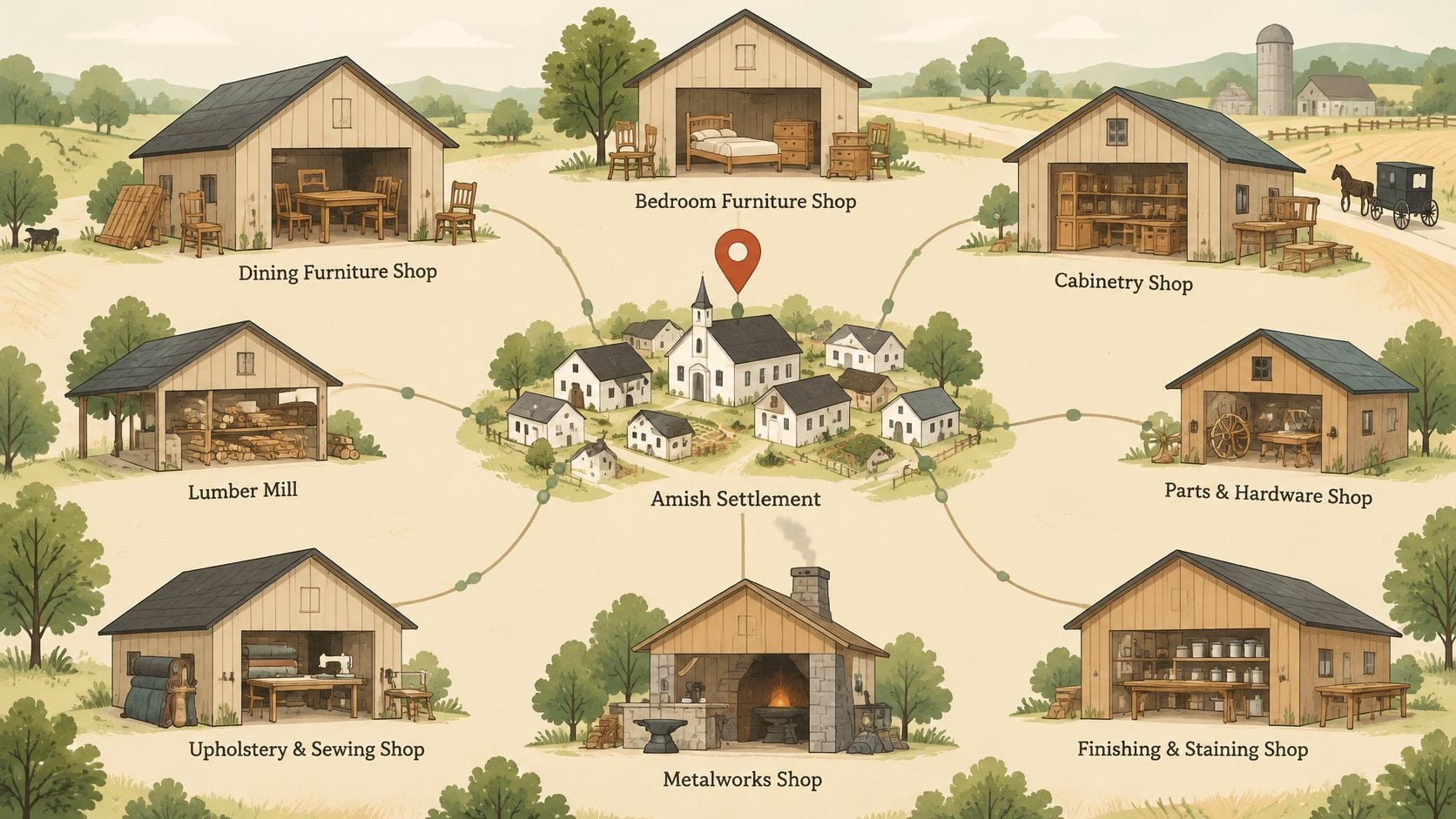
A U.S. Forest Service study of the Ohio Amish furniture cluster describes Holmes County, Ohio, as home to the world's largest Amish settlement and roughly 400 furniture-related shops and supporting businesses. The same study reports approximately 44 million board feet of annual hardwood consumption by the Ohio Amish cluster, about 11% of Ohio hardwood production and 19% of its appearance-based hardwood use. In 2005, those firms averaged 7.2 employees, with a median of 4, and the average firm dated to around 1994.
Those figures describe a regional supply network of small workshops, sawmills, lumber suppliers, and component makers. They don't certify an individual dresser.
Questions that make an origin claim useful
Identify the workshop. Ask where the piece was made and which workshop built it. A seller working with genuine Amish builders can usually name the shop or the community it belongs to.
Clarify the materials. Establish which components are solid wood, veneer, or engineered material, since all three can appear under the same style label.
Identify structural connections. Ask which joints carry the furniture's working loads, and look for those connections at the corners and stress points.
Confirm panel attachment. Request an explanation of how the top, doors, and end panels accommodate seasonal movement.
Get the answers in writing. Ask for the workshop details and finish identification to be recorded with the order.
The Amish furniture quality guide can help shoppers organize those questions before a showroom visit. Clear answers matter more than a rustic stain or a decorative exposed fastener.
Buying principle: Judge the maker and the build, not whether the piece looks old-fashioned.
A clean-lined contemporary cabinet can be Amish-made just as a Mission-style table can. Traceable construction information makes either claim more meaningful. BILTRITE has carried Amish furniture made in Holmes County since 2008, so shoppers in the Greenfield area can put every question on this list to a salesperson in person.
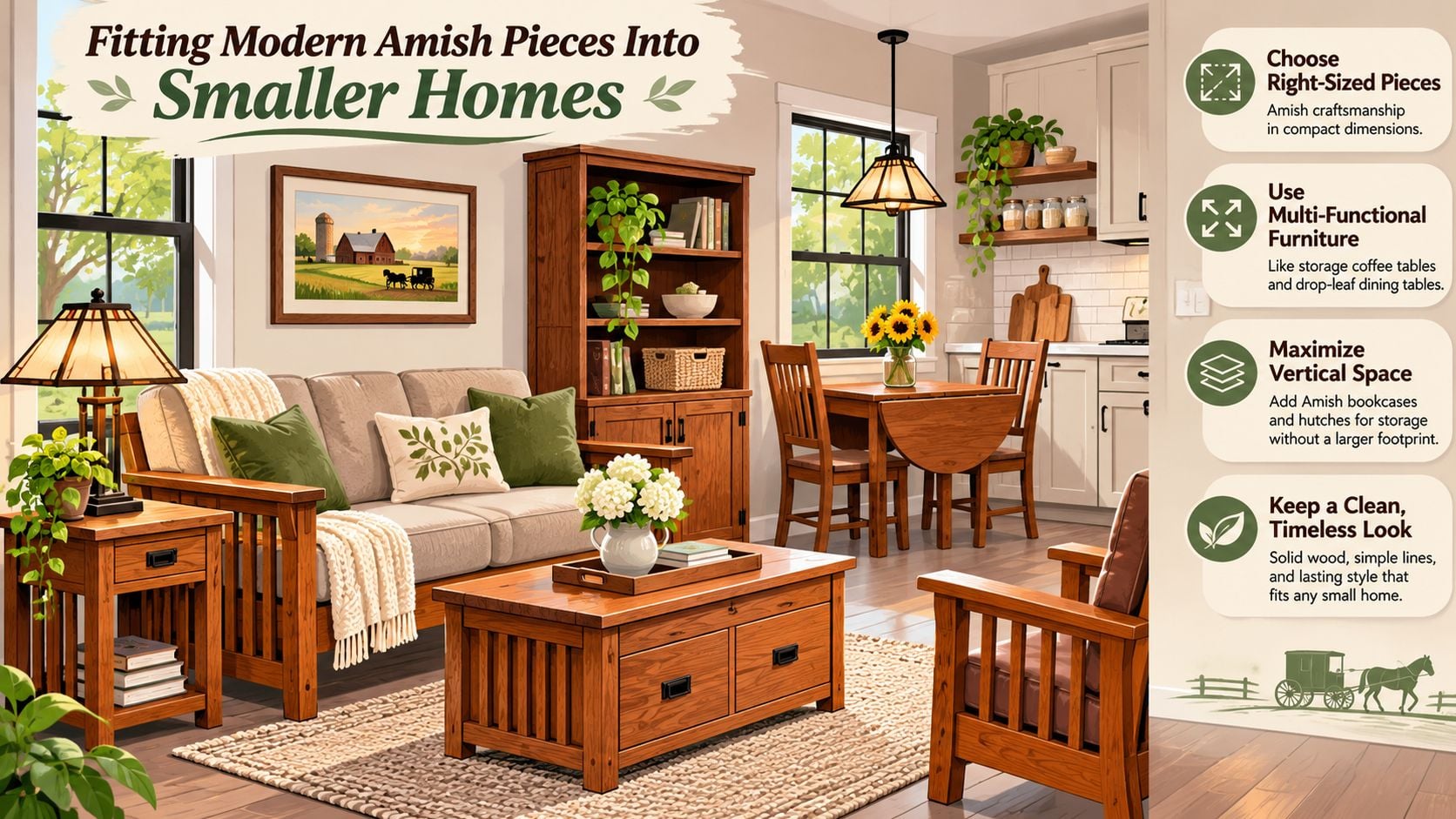
Fitting Modern Amish Pieces Into Smaller Homes
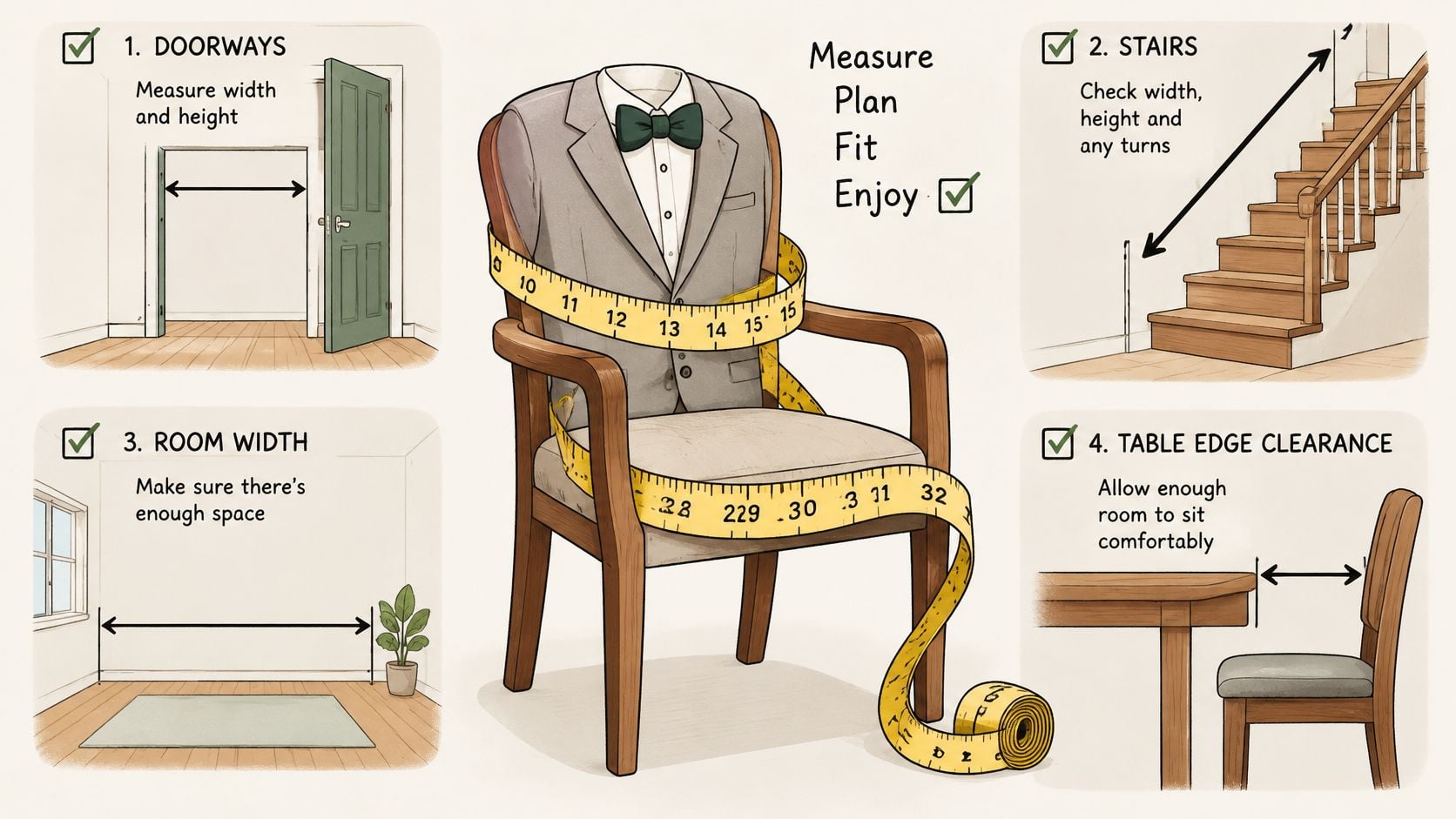
Fitting solid-wood furniture into a small home is like tailoring a suit: measurements matter more than the label. A compact-looking cabinet can still be difficult to maneuver through a stair landing, while a substantial table may fit easily if its base separates for delivery.
Start at the narrowest doorway. Record the clear opening, not just the door's nominal size, and account for handles and trim.
Check stairs and turns. Include landing depth, overhead clearance, and the space needed to rotate the piece.
Mark the footprint. Painter's tape can outline furniture on the floor. Chairs and drawers need operating space beyond that outline.
Test the walking route. A family member using a walker should be able to approach, turn, and leave without squeezing around corners.
Ask about delivery sections. Confirm whether a table base detaches or an upholstered piece has an approved come-apart design.
The small-space furniture guide offers another way to organize room planning. Delivery access and comfortable daily use should remain separate checks.
Match the piece to the person
In a studio, a nesting dining arrangement may free floor space between meals. In a condo, a bed with storage drawers can reduce the need for another cabinet, provided the drawers clear nearby walls and bedding.
For a senior-living room, a lower-profile chair may look less bulky, but its actual seat height must still support comfortable standing. Firmness, arm placement, and foot contact matter more than the silhouette.
Frequently used drawers should fall within the user's comfortable reach. Tall case goods need appropriate wall anchoring, and caregiver pathways should remain clear even with a recliner extended or a drawer open.
The time to discuss these needs is before ordering, when dimensions and delivery requirements can still guide the selection.
Confirm Your Style and Visit Our Greenfield Showroom
The most useful showroom visit starts with a short list: preferred styles, room measurements, delivery-route details, and questions about joints, wood, or finishes. Photos of existing furniture and flooring can help keep the conversation focused.
In-person testing answers questions that a photograph can't. A shopper can sit through more than a quick first impression, check arm clearance beneath a table, open drawers fully, and feel whether an edge is comfortable against a forearm.
Make the visit hands-on
Try normal movements. Sit, stand, reach, and pull a chair toward the table rather than judging comfort while standing beside it.
Compare actual surfaces. Look at finish samples beside room photos and ask how lighting may change their appearance.
Bring practical questions. A sketch showing doors, windows, vents, and existing furniture helps explain constraints.
Take clear notes. Record the selected materials, dimensions, and agreed terms before placing an order.
BILTRITE Furniture-Leather-Mattresses is a fourth-generation, family-owned store whose family has served customers' home furnishing needs since 1928. Its Greenfield showroom serves Metro Milwaukee with an emphasis on personal, practical guidance.
The store carries USA-made and Amish-made furniture and mattresses, including solid-wood furniture, small-scale choices, and heavy-duty options. Custom furniture options include fabric, leather, wood, finish, and hardware; the mattress department also offers over 60 models for households furnishing a bedroom.
BILTRITE doesn't sell online, so the showroom is the place for hands-on comparisons and questions without pressure. It's located at 5430 West Layton Avenue in Greenfield and is closed Sundays and Mondays to support family time, so checking hours before traveling is a good idea.
A thoughtful visit doesn't require an immediate decision. Comfortable seating, clearly explained construction, and room-ready dimensions are worthwhile things to establish before choosing.
BILTRITE Furniture-Leather-Mattresses offers affordable, better-quality USA-made and Amish-made furniture, solid-wood choices, and mattresses for family homes. Bring room measurements and wood, finish, or construction questions to BILTRITE Furniture-Leather-Mattresses in Greenfield for a no-pressure opportunity to sit, open drawers, feel the surfaces, and find the right fit.