How Do Lift Chairs Work? Motors, Safety and Choosing One

Two power lift recliners can carry the same weight rating, wear the same fabric, and cost about the same, and only one of them will help a particular person stand up safely. What separates them isn't motor size. It's the shape of the motion and the fit of the chair to the body sitting in it.
That's the part most shopping conversations skip. A lift chair is a controlled transfer aid first and a comfortable recliner second, and once you picture the mechanism as a hand that guides you forward rather than a crane that hoists you up, the whole category makes sense. Here's how the motor, frame, and handset work together, where the honest safety limits sit, and what to check before one comes home.
Table of Contents
- What Happens When You Press the Lift Button
- Parts Inside a Lift Chair and What Each Does
- Specs and Ratings to Check on Any Lift Chair
- Safety Features and Daily Pinch Point Habits
- Who Benefits Most and What a Lift Chair Cannot Do
- Keeping Your Lift Chair Working Well for Years
- Choose Your Lift Chair and Test It in Greenfield
What Happens When You Press the Lift Button
Sitting in the chair, the user presses and holds the lift button. Under the upholstery, an electric actuator begins to extend, and the whole chair starts to move.
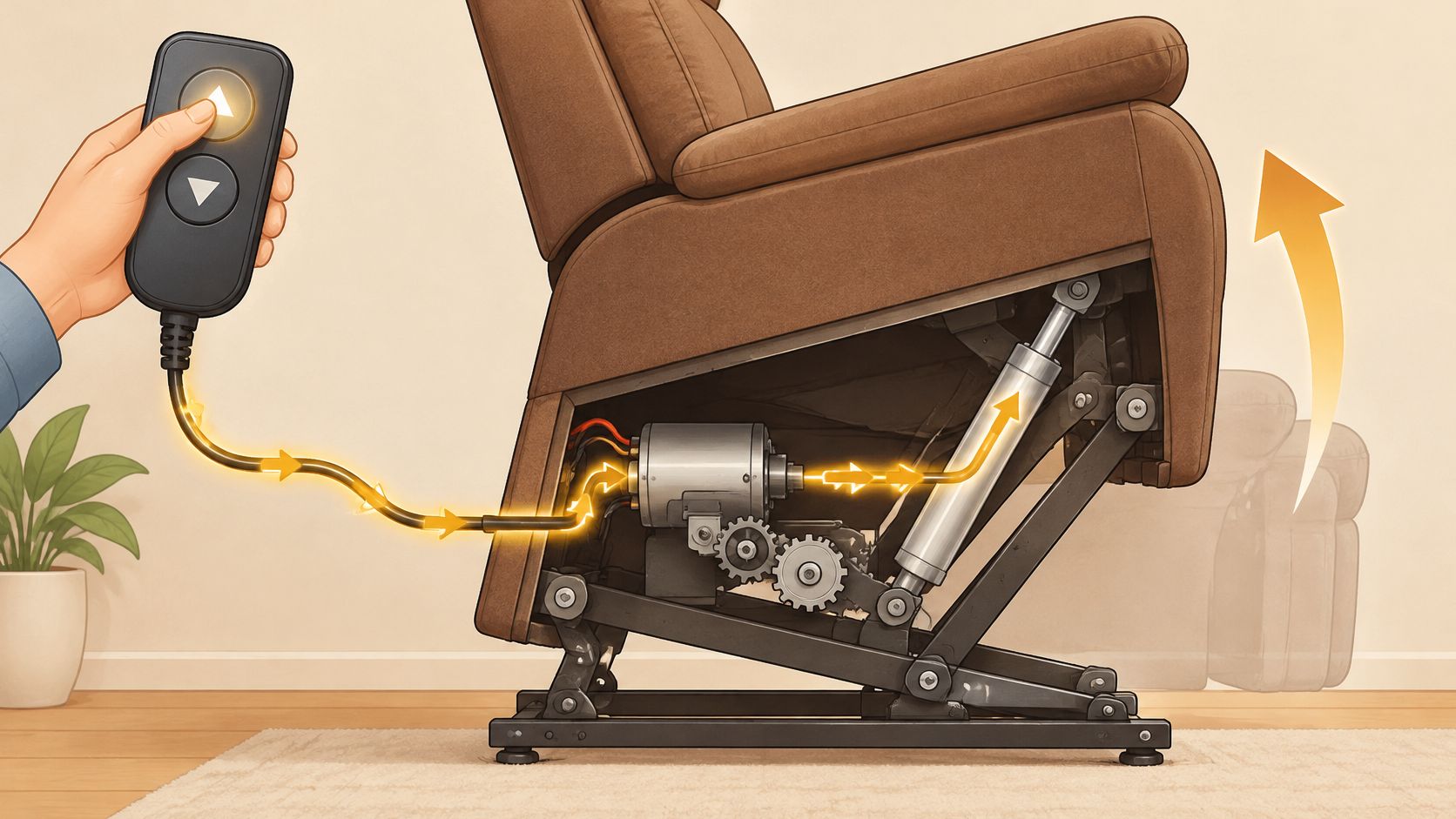
How do lift chairs work, then, when the frame has to move a person and not just a cushion? Here's the sequence, beat by beat.
- The actuator extends. A small motor turns a screw or drives a rod, and the actuator lengthens by a few inches. That short push is the entire power source for the lift.
- The seat rises and tilts forward at the same time. The linked seat, back, and footrest change geometry together, so the chair pivots and translates upward and forward rather than jumping straight up.
- Weight moves over the feet. Because the seat travels forward as it climbs, the user's center of mass ends up over their feet instead of behind them. That single detail is what makes standing easier.
- Knees and hips do less work. With the body already raised and tipped forward, the extension demand on the knees and hips drops away. Standing turns into a short step.
- Recline reverses the motion. Pressing the recline control sends the actuator back, and the backrest and footrest settle into a resting position.
Think of a hinged stepladder. As it opens, the top tips toward you and moves up, and stepping onto it feels easy because it has already carried you halfway. A lift chair does the same thing with a seat instead of a step.
Why the Forward Tilt Does the Real Work
Vertical lifting alone would raise a person without helping them stand. If the seat only went up, the user's weight would stay behind their feet and they'd still have to push off hard, just from a higher starting point. The forward travel is what changes the physics.
Powered standing-assistance systems work the same way, passing actuator force through sliding assemblies and joints so the upward force supports the user's weight while the frame controls posture and stability.
Reported elevation times run from approximately 3 to 60 seconds depending on actuator capacity, geometry, and control strategy, according to a technical review of lift and standing-assistance mechanisms. Slow is not a flaw here. A gradual cycle gives the user time to keep their feet planted and their balance settled.
Try this in the showroom: press lift and watch the seat's path, not the motor. If it moves forward as much as it moves up, the chair is doing the work the user's knees would otherwise do.
Some designs use independent motors for lift and recline, with separate control for leg elevation, which allows finer positioning. Others run everything from one motor. Neither is automatically better. What matters is whether the motion feels steady and whether the user can stop it at any point along the way.
Parts Inside a Lift Chair and What Each Does
From the outside, a lift chair looks like a recliner with a handset. Inside, a small set of parts does the work, and once you can name them, a repair question or a shopping conversation gets much easier.
An FDA-cleared lift-chair design shows the arrangement plainly. The chair is mounted on a welded-steel lifting frame and driven by a 24-volt DC motor and actuator, with a handheld controller that lets the user select sitting, reclining, or standing positions, as described in the federal device documentation for a powered lift chair.
The handset. This is the command center: lift, recline, and on some chairs a separate footrest control. It sends a low-voltage command, and the chair should respond continuously, moving only while the button is held.
The motor and actuator. The motor spins. The actuator turns that spin into a straight push or pull. This is the part that changes the chair's shape.
The lifting frame. The welded-steel structure under the seat carries both the chair and the person in it. It's the piece that has to hold up over years of cycles.
The power supply. Household current never reaches the moving parts directly. One documented system reduces standard household power of 100 to 240 volts AC to roughly 24 or 39 volts DC through the chair's own power supply before the handset directs the actuator, per the manufacturer's lift chair operating manual.
The reclining linkage. A separate arm of the mechanism extends and retracts the backrest and footrest, and the chair passes through several stages of recline as the actuator moves.
The cord and outlet. The chair plugs into a standard wall outlet. The cord is the part most likely to be damaged, because it lives next to a moving frame.
Why the Voltage Drops Before It Reaches the Motor
That step-down is a design choice with practical consequences. Sending low-voltage DC to the actuator separates the chair's moving electrical components from direct household alternating current, and it lets a compact actuator do the heavy work of lifting and reclining. Low voltage doesn't make the chair foolproof. It does mean the parts near your hands and feet are running on a modest current rather than full household power.
Hydraulic linear actuators also show up in powered mobility designs alongside the electromechanical kind, usually in heavier-duty equipment. For a residential lift chair, the practical question isn't which type sounds more advanced. It's whether the motion is smooth and the frame is rated for the person using it.
The One Check to Make in the Showroom
Press lift and watch the frame and the cord together. A well-built chair moves through its cycle without dragging the cord into the mechanism or letting the linkage bind. Ask the team to run it from full recline to full lift while you watch from the side, which is where problems show up first.
Specs and Ratings to Check on Any Lift Chair
The tag on the chair tells you the fabric and the price. The label on the back, or the manual that comes with it, tells you whether the chair suits the person. Those two sets of information aren't equally useful.
Start with the numbers below, and treat motor wattage as the least informative of the group. A big motor on a light frame is a problem, not a feature.
| Spec | What to Look For | Why It Matters |
|---|---|---|
| Rated occupant load | Maximum user weight stated by the manufacturer | Frame and actuator must both be rated for it |
| Lift-cycle time | How gradually the chair travels from seated to standing | A smooth, controlled cycle matters more than speed |
| Seat-to-floor height | Height of the seat when fully lifted | Should match the user's standing reach |
| Usable seat depth | Distance from backrest to front edge | Too deep blocks foot contact; too narrow limits posture |
| Independent leg elevation | Separate motor for the footrest | Gives finer control over the leg rest |
| Battery backup | Whether the chair returns to a safe position in an outage | Ask about it before buying |
Rated occupant load is a two-part promise. The manufacturer states a maximum user weight, and both the frame and the actuator have to be built for it. A higher-capacity model helps only when its frame, armrests, and base are rated to match, because extra capacity in the motor can't compensate for weak structural support underneath.
Seat-to-floor height decides whether standing feels natural. Measure the height of the seat at the top of its travel and compare it to the user's standing reach. If the chair stops short, the last few inches of the stand still come from the knees.
Usable seat depth is where most poor fits come from. Run a tape from the backrest to the front edge. Too deep and the user's feet won't load the floor at the end of the lift. Too narrow and posture gets cramped and laterally unstable.
Independent leg raising means the footrest runs on its own motor, so the leg rest rises without tipping the back. It's a comfort feature with a practical edge for anyone who raises their legs to manage swelling.
What a Heavy-Duty Rating Really Means
Heavy-duty is a package deal, not a motor upgrade. The rating is only meaningful when the frame, lift points, armrests, and foundation are all built for the same load. If a spec sheet brags about capacity but stays quiet about the base, ask what the base is rated for.
Our own guide to lift chair weight capacity walks through how the ratings stack up across sizes, which is useful homework before a showroom visit.
Write each number down from the label or the manual, and ask the team to confirm it against the floor model before you decide. A chair that fits the body in it beats a chair with the biggest motor every time.
Safety Features and Daily Pinch Point Habits
Safety in a lift chair comes from three things working together: controlled motion, a structure that carries the load, and protection when something fails. Residential lift chairs aren't governed like commercial patient-transport equipment, but the U.S. medical-device requirements for powered patient lifts give a useful engineering benchmark. The federal device safety requirements name the pieces that matter: protection against free fall after a failure, resistance to the rated load with an appropriate safety factor, measures to prevent a user from falling, and electrical and electromagnetic compatibility.
That list translates neatly into questions any shopper can ask.
Four Questions to Ask About Any Lift Chair
- Does the motion stop when I release the button? A handset or control circuit should allow continuous user control, and limit switches or electronic controls should stop the actuator at the end of its designed travel.
- Is there battery backup? A backup system that returns the chair to a safe position during a power outage is the difference between a mild inconvenience and a long wait in a reclined seat.
- Is the maximum user weight printed on the chair? Documented limits tell you the manufacturer tested to a number. An unstated limit tells you nothing.
- Are the lift points reinforced, and does the chair respond to an obstruction? Ask directly. A seller who knows the mechanism will have answers.
The handset rule: the chair should move only while the button is held. If it keeps traveling after you let go, stop using it and have it checked.
The Moving Parts Deserve Respect
The scissor-style lifting frame and the space beneath the footrest are genuine pinch and crush points. Manufacturer safety instructions single out those zones and warn users to keep hands, feet, children, pets, and loose objects clear whenever the mechanism is running, as the lift chair safety manual spells out.
An object left under the footrest can interfere with movement, damage the chair, or cause an injury when the chair reclines or comes back upright. Cords need the same care: a cable caught between the frame and the lifting mechanism can be pinched or cut. Leave clearance in front of and behind the chair so the footrest and backrest can complete their full range without meeting a wall or a side table.
For households that worry about outages, this look at lift chairs with battery backup explains what the backup does and how long it lasts.
Upholstery, cushion firmness, and a soft armrest are not the safety story. Ask for the label, watch the cycle, and keep the floor clear.
Who Benefits Most and What a Lift Chair Cannot Do
A chair suits someone who can bear weight but cannot rise from a standard seat without help. Standing up from a low, soft cushion takes leg strength and balance working together, and when one of those fades, the whole move stalls. A lift chair tilts the seat up and forward so the user begins the standing move from a higher, steadier position, more like rising off a tall stool than climbing out of a hole.
That is why motion quality matters more than the motor's rating. Coverage standards draw a line between smooth, user-controlled mechanisms and spring-release designs that propel the occupant upward in a sudden, catapult-like motion. Spring designs are excluded because uncontrolled movement creates real safety risk, as the Medicare coverage determination for seat lift mechanisms sets out.
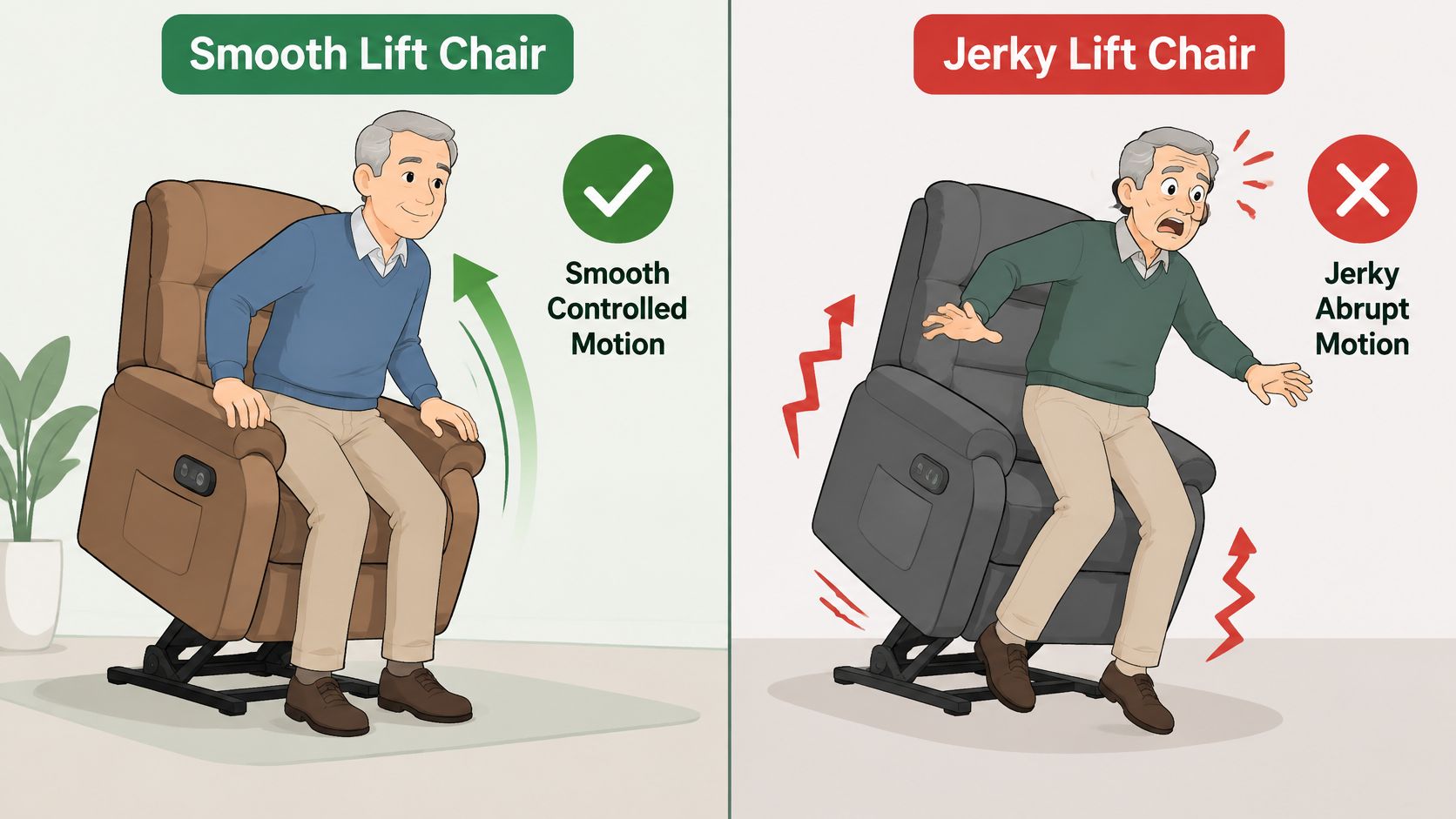
The person who gets the most from one struggles to rise from an ordinary chair but can still bear weight, follow the handset, keep their feet placed safely, hold their balance through the transition, and walk or transfer once upright. For that person, the payoff is practical: getting up for meals and visits without waiting for help, and less strain on the spouse or family member who used to do the pulling.
Where the Chair Stops Helping
A lift chair handles one job: the seated-to-standing transition. A powered patient lift does a different job entirely. The FDA describes powered patient lifts as devices intended to move patients from one place to another, with improper use linked to serious injuries including head trauma, fractures, and death, per the agency's guidance on patient lifts.
A chair will not hoist someone who cannot bear weight, and it will not carry anyone across a room. The occupant stays on the seat while the mechanism moves, so the lift only ends well when the user's feet are ready and the floor around the chair is clear before it starts. Anyone who needs full-body transfer assistance needs equipment rated for that job and a clinician's guidance on using it.
When the transfer itself is the hard part, a chair is the wrong tool.
Run through this before buying:
- Smooth motion first. Test the lift several times and watch for jerks or a sudden finish.
- Independent control. The user should be able to stop and reverse the chair wherever they like.
- Clearance for feet and a walker. Measure the space in front, not just the space the chair takes up.
- Stable placement. A chair that rocks or sits on a thick rug pile is a balance risk.
- A therapist's opinion when balance is in question. A physical or occupational therapist can assess the transfer before money is spent.
If you're weighing whether a chair is the right step for someone you care about, this overview of lift chair benefits is a calm place to start the conversation.
Keeping Your Lift Chair Working Well for Years
A lift chair is a motorized piece of furniture, so it rewards a little routine attention. None of it is complicated, and most of it takes less time than making coffee.
Before each use, glance at the floor under and around the footrest. Look at the cord where it meets the frame, and check that nothing has slipped into the lifting mechanism. That ten-second habit prevents most of the damage people bring to a service desk.
A Two-Minute Weekly Check
Run the chair through a full cycle once a week: press lift, watch how the seat and footrest move together, then recline back to rest. Listen while it runs.
- Grinding or squealing points to a worn actuator or a dry joint.
- Jerky or uneven travel suggests the frame is binding or something is obstructing the path.
- A slower trip than when the chair was new can mean the motor is working harder than it should.
- A cord that's warm, frayed, or pinched means stop and call for service.
Any of those signs is a reason to stop using the chair and contact the seller or a qualified service technician rather than pushing through. Keep the outlet and cord clear of furniture legs, pet traffic, and footpaths. Wipe the handset and the visible surfaces, and keep the controls out of reach of small children.
Write down the model number and purchase date and keep them somewhere you'll find them, since a technician can help faster with both in hand. Leather and bonded covers wipe clean easily, and this guide to leather lift chairs covers care for those surfaces. If anything about the motion seems off, ask the showroom team to demonstrate what normal looks like on a floor model.
Choose Your Lift Chair and Test It in Greenfield
A lift chair works as a controlled transfer aid, so the quality of the motion and the fit to the person sitting in it matter more than raw lifting power. Fabric, heat and massage, and the cup holder are extras layered on top of that core job.
BILTRITE Furniture-Leather-Mattresses has been family owned since 1928, four generations serving Metro Milwaukee, and the Greenfield floor carries 48 models of power lift chairs alongside USA-made and Amish-made solid wood furniture. The range runs from small-scale chairs sized for apartments and senior living residences to heavy-duty options for bigger frames, which matters because fit drives everything else about how the chair performs.
Here is how to get the most from a visit. Sit in a few chairs and press the handset yourself. Watch the seat travel forward and up, and pay attention to whether the motion feels steady or rushed, since a smooth rise is what makes standing easier on knees and hips. While you are still in the chair, ask about the rated load, the seat depth, and whether a battery backup is included. Wheelchairs are available in the stores as needed, so nobody has to walk the whole floor to reach the lift chairs.
Measuring your room first helps too. Bring the numbers with you, and this guide to lift chair dimensions covers the clearance questions that decide which chairs will fit your space.
One planning note: the showroom is closed on Sundays and Mondays, so plan a Tuesday through Saturday visit. When you go, try two or three chairs side by side, because the difference between a smooth lift and a jerky one is easier to feel than to read about. You will find BILTRITE Furniture-Leather-Mattresses at 5430 West Layton Avenue in Greenfield.