




Lift Chairs with Battery Backup: A Practical Guide

The power goes out just as an older family member settles into a lift chair for the evening. The chair is reclined, the remote is within reach, and suddenly the motor stops. For someone who relies on powered assistance to stand, that quiet room can feel frightening. A lift chair with battery backup can help, but the important question isn't just whether the chair has a battery. It's what that battery can do, and how long it can do it.
BILTRITE Furniture has helped families compare supportive seating for years, and the clearest advice is always the same: understand the backup system before choosing the chair. Some systems provide one emergency movement. Others use rechargeable packs designed for repeated operation. The difference matters for safety, independence, and peace of mind.
Why Battery Backup Matters When the Lights Go Out
A storm, a neighborhood grid failure, or a tripped breaker can interrupt power without warning. If someone is comfortably seated, the outage may be a minor inconvenience. If that person is reclined and depends on the chair's motor to return to a sitting or standing position, the situation changes quickly.
A powered lift chair tilts the seat forward and upward to help the user stand. Without electricity, that assistance may stop. A person who has limited strength, balance, or joint mobility may not be able to push out of the chair independently. They might also be farther from a phone, a lamp, or another person who can help.

The backup is about mobility first
A battery backup turns an unexpected interruption into a controlled exit. It may let the chair return to a seated or raised position so the user can get up safely, rather than leaving that person waiting for household power to return.
That support can protect more than physical safety. It also preserves dignity and independence. A family member may feel less anxious knowing the chair can provide essential movement during an outage, while the user can retain a measure of control instead of immediately needing assistance.
Not every battery system provides full chair operation. One manufacturer's manual states that battery power supports only three functions, returning the chair to its home position, lifting, and lowering. The same manual says that recline, massage, and heat are blocked to conserve energy, operating speed is reduced, and the power supply uses two 9-volt alkaline batteries. These details show why a backup should be viewed as an emergency mobility feature, not automatically as a replacement for household electricity. The manufacturer's lift-chair documentation provides the technical explanation.
Practical rule: A backup battery should first help the user reach a safe position. Comfort features come after safe movement.
Families comparing supportive seating can also review lift chairs suited to older adults and consider how the chair's size, controls, and backup design fit the user's daily routine.
How a Lift Chair Works During an Outage
A power failure can leave someone seated in a lift chair with no wall power. The chair may still offer a controlled way to move, but the available action depends on how its backup circuit is designed.
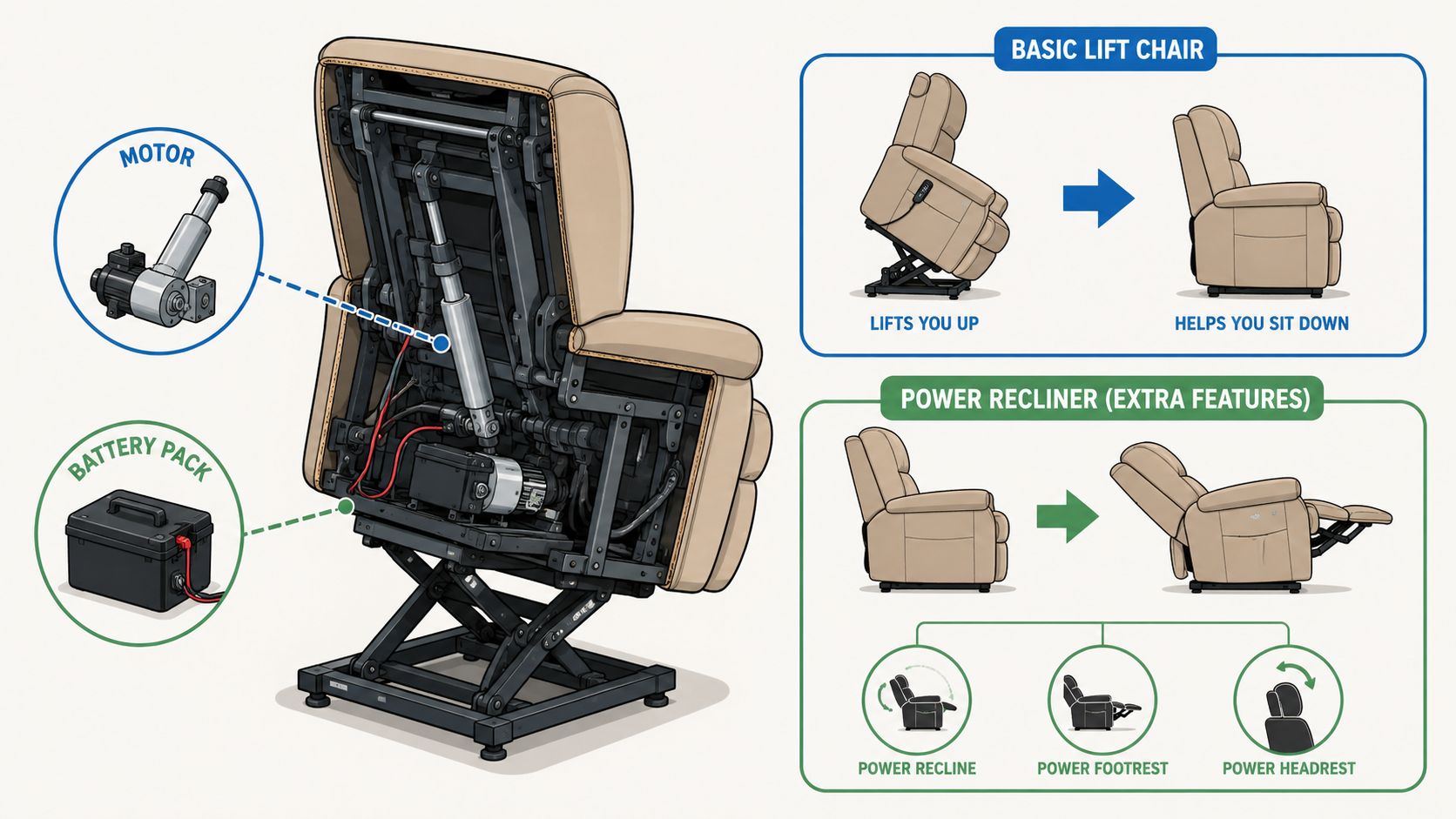
A lift chair and a standard power recliner may look similar, yet their mechanisms serve different purposes. A power recliner adjusts the backrest and footrest for comfort. A lift chair uses a motorized base that tilts the seat forward and upward, helping the user move from sitting toward standing. During an outage, that lifting function matters more than ordinary reclining. This comparison of lift chairs and power recliners explains the difference.
The movement happens in a few basic steps
- The chair normally receives electricity from a wall outlet through its power supply.
- The remote sends a signal to the motor or actuator.
- The actuator moves the lifting or reclining mechanism.
- When household power drops, the backup circuit sends limited electricity to that motor.
- The user operates the control to reach a safer position, following the model's manual.
The process works like a car starter. A starter motor draws a strong burst of energy to turn the engine, rather than running every vehicle feature indefinitely. A lift chair's backup battery serves a similar purpose. It provides power for a short, demanding movement, not continuous operation of every chair function.
What usually stays available
The exact response varies by model, but backup systems commonly prioritize lifting, lowering, or returning the chair to a seated position. These movements can help the user exit the chair without waiting for household electricity to return.
Heat, massage, and USB charging ports may stop working. Reclining may also be unavailable, and movement can be slower because the battery supplies less sustained power than a wall outlet. Treat the backup as a short emergency circuit, not as normal chair operation.
One lift-recliner manual states that its backup may not raise the chair fully and recommends even, continuous pressure on the control to conserve energy. It identifies two 9-volt alkaline batteries as the backup source. The lift-recliner operating manual shows why each household should learn its chair's exact control procedure.
Before an outage, check which buttons work without wall power and how the chair responds. Unless the documentation specifically confirms otherwise, assume that massage, heat, charging ports, and full-speed reclining will be unavailable.
Two Kinds of Backup Systems and How They Differ
Lift-chair backup systems vary by design. The two broad categories are disposable battery circuits and rechargeable lithium packs. They aren't interchangeable in maintenance, expected operation, or suitability for a household that experiences frequent outages.
A disposable circuit is usually built into the chair's power supply and uses 9-volt alkaline batteries. It's compact and straightforward, but it's intended for limited emergency movement. A rechargeable lithium pack is designed as a longer-term power component. It recharges while the chair is connected to household electricity and can support repeated movements, depending on the chair and battery design.
| Feature | Disposable 9V Circuit | Rechargeable Lithium Pack |
|---|---|---|
| Power source | Replaceable alkaline batteries | Rechargeable lithium battery |
| Primary purpose | Short emergency operation | Repeated emergency movements |
| Maintenance | Replace after use or according to the manufacturer's schedule | Keep connected and monitor the charge indicator |
| Outage suitability | Occasional interruptions and one-time exit support | Households seeking more repeated movement during outages |
| Available functions | Usually limited to essential movement | May support more movement, but model limits still apply |
| Main question | Has the battery been replaced and is it ready? | Is the pack charged, healthy, and compatible? |
Match the architecture to the household
A disposable system can make sense when the main concern is helping a user get out of the chair during an occasional brief outage. It has a low maintenance burden in daily life, but it can be forgotten until the moment it's needed.
A rechargeable pack may fit a storm-prone home, a user who spends much of the day in the chair, or someone who wants repeated movement while waiting for power to return. It still isn't automatically a whole-home power source. The chair's motor load, user weight, selected position, and enabled features all affect performance.
Some systems are designed for a single emergency use and should be replaced after an outage or on a regular maintenance cycle. Others are rechargeable and intended to remain operational through repeated interruptions. This emergency-backup usage guide shows why the words “battery backup” aren't enough. The retailer or caregiver needs to ask what kind of backup is installed.
Families comparing powered seating can explore different types of power reclining seating and ask which backup architecture belongs to each model.
What You Can Realistically Expect From Run-Time
A power outage begins while someone is fully reclined, and the first question is practical: can the chair help that person return to a safer position? A backup battery does not necessarily keep every feature available. It usually gives priority to movement, much like a reserve fuel tank intended to get a car off the road rather than support a long trip.
A disposable 9-volt system may provide only a limited number of movements. One technical manual describes backup support for returning the chair to its home position, lifting, and lowering, while recline, massage, and heat remain unavailable. It also notes slower operation and the use of two 9-volt alkaline batteries. The technical manual therefore points to a specific purpose: preserving basic mobility during an emergency, not recreating normal daily operation.
| Feature | 9V Emergency Circuit | Rechargeable Lithium Pack |
|---|---|---|
| Expected role | Emergency return or lift movement | Repeated movement when the pack has charge |
| Runtime description | Limited and model-specific | Longer or repeated operation, model-specific |
| Best use | Getting safely seated or standing | Supporting more than one movement during an outage |
| Feature restrictions | Often significant | Still subject to chair-specific restrictions |
| What changes performance | Battery age, prior use, and motor demand | Charge level, motor demand, user load, and usage pattern |
| Buyer's priority | Confirm replacement and readiness | Confirm recharge behavior and tested capacity |
Why advertised runtime can mislead
Runtime depends on the work the motor must perform. Lifting a person generally places more demand on the mechanism than moving an empty chair. User weight, chair design, motor configuration, starting position, and selected movement can all change the energy used. If the backup permits heat or massage, those features consume power too and may reduce the available capacity sooner.
A better question is how many essential movements does the user need during a typical interruption? One person may need a single return from recline to a safe seated position. Another may need repeated transfers while waiting for household power to return. Those situations call for different backup expectations.
A manufacturer's backup guidance says the built-in system may not lift the chair fully and recommends a separate 300VA UPS when uninterrupted lift function is required. The manufacturer's backup guidance highlights the difference between a small emergency circuit and a larger external power system. One supports a limited chair function. The other is intended to provide a broader, steadier supply.
Ask for the test condition behind any runtime statement. Does the stated capacity describe a full lift, a return from full recline, several short movements, or another setup? The answer matters more than a general promise, especially when reaching a fully raised position affects the user's safety.
A compatible battery power pack for a power recliner can be another option to discuss. Confirm the chair's connection, battery type, recharge behavior, and expected movement before purchasing.
Keeping the Backup Ready Year After Year
A backup system only helps if it still holds usable charge. Batteries can sit unnoticed behind a chair, which makes maintenance easy to postpone. A simple written reminder near the remote or electrical connection can keep the task visible.
A practical maintenance rhythm
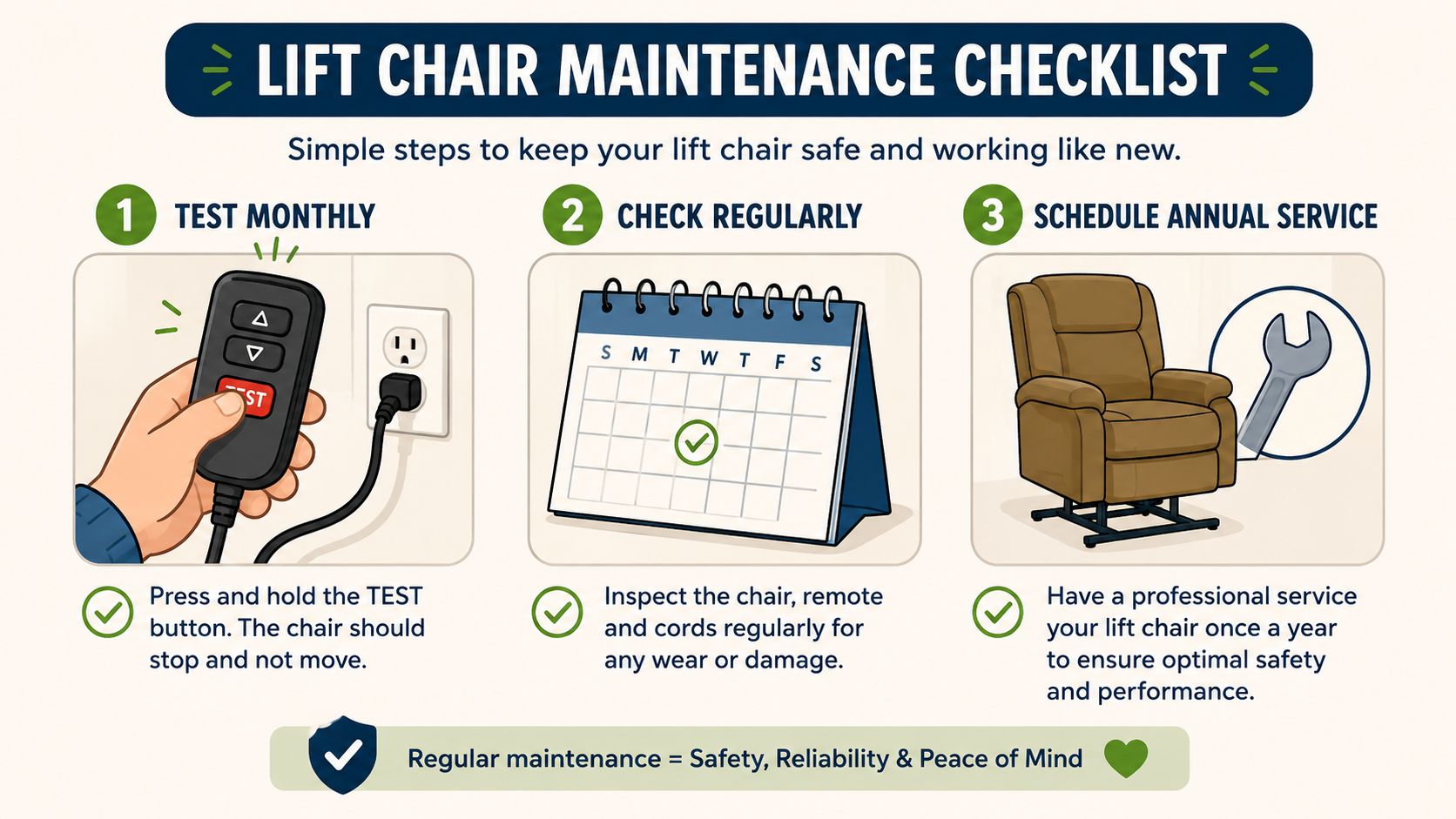
Every few months, inspect the power cord, the battery compartment, and any indicator light. For a disposable system, check whether the batteries are installed correctly and whether the chair's manual provides a safe test procedure. A test should follow the manufacturer's instructions, not involve repeatedly running the chair until the batteries are exhausted.
Once a year, replace disposable batteries when the manufacturer calls for annual replacement. Some manuals also require replacement after one emergency use. Golden's documentation says its backup has enough energy to return the chair from a reclined position to seated, isn't intended for prolonged operation without household power, and should be replaced after one use and changed yearly. The owner's manual gives the model-specific guidance.
Rechargeable packs need attention too
A rechargeable lithium pack should remain connected as directed so the chair can restore its charge. The indicator should show normal charging status, and the user should pay attention to changes such as slower movement, warning sounds, or a flashing low-battery light.
A lithium pack that won't hold a charge needs service rather than guesswork. The same is true if the battery appears swollen, the chair produces a burning smell, or the motor makes an unusual noise. Electrical components can create safety hazards when opened or modified without the proper knowledge.
Maintenance reminder: A backup battery is emergency equipment. Treat its readiness like a flashlight or smoke-alarm check, not like a feature that can be forgotten after delivery.
For upholstery, cords, mechanisms, and other furniture-care questions, families can review BILTRITE's maintenance guidance. Professional service is the right choice for damaged wiring, battery swelling, persistent warning signals, or a backup that fails its model-approved test.
Choosing the Right Lift Chair for Your Home
The right chair starts with the user's actual routine. A person who needs help standing after an occasional interruption may have a different priority from someone who lives alone in an area where outages are a recurring concern.
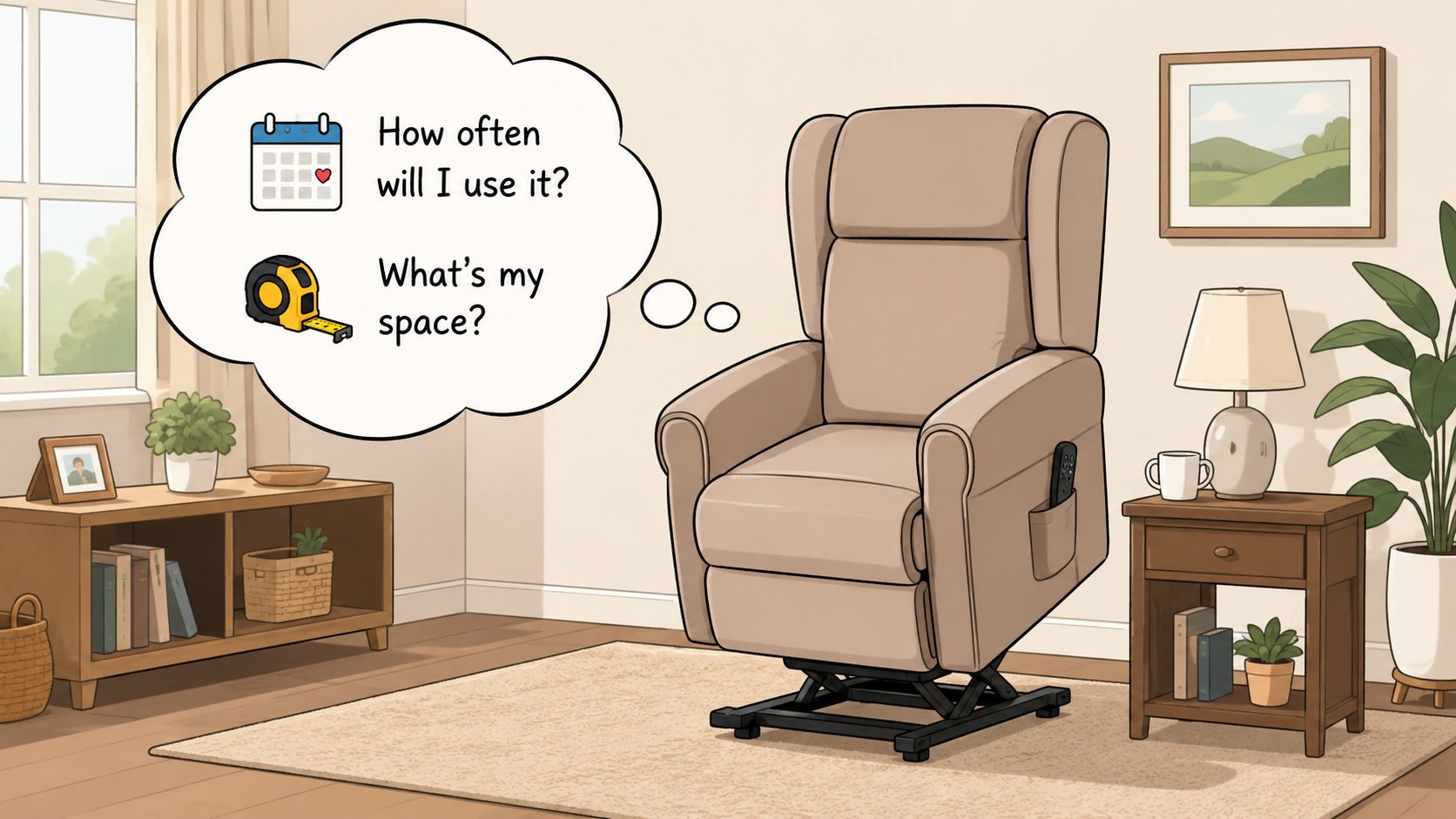
Begin with the household questions:
- Outage pattern: Do interruptions happen rarely, or does the home regularly prepare for storms and grid problems?
- User support: Can another person help during an emergency, or must the chair provide essential movement independently?
- Daily use: Is the chair used for short periods, or does the user spend much of the day there?
- Room size: Will the chair fit comfortably while leaving a clear path for walking and assistance?
- Body fit: Do the seat height, width, and depth support the user's frame?
Evaluate the chair beyond its battery
The motor configuration affects how the chair moves. A single-motor chair may coordinate the back and footrest, while a dual-motor or infinite-position design can provide more independent adjustment. The user's weight and body dimensions must also fall within the chair's stated limits. Details about lift-chair weight capacity should be checked before focusing on upholstery or extra features.
Heat, massage, and USB ports can add comfort during normal household operation, but they shouldn't be treated as guaranteed backup functions. The chair's manual should identify which features remain available during an outage and whether the motor can complete the required movement under load.
Questions worth asking in a showroom
A helpful in-store conversation should answer practical questions, not just describe the chair's appearance.
- What type of backup does this model use? Disposable batteries and rechargeable packs require different care.
- Which functions work during an outage? Ask specifically about lifting, lowering, reclining, heat, massage, and charging ports.
- Can the chair reach a fully raised position on backup power? Partial movement may not meet the user's needs.
- How is the backup tested and maintained? The answer should include replacement or charging guidance.
- Where is the indicator light or battery compartment? A hidden status light is easy to overlook.
- What electrical components does the warranty cover? Confirm the coverage before making a decision.
- Can the user try the chair? Sitting, lifting, and lowering reveal fit and control comfort better than a specification sheet.
BILTRITE Furniture-Leather-Mattresses is a fourth-generation, family-owned showroom serving the Metro Milwaukee community since 1928. Its Greenfield location carries supportive seating alongside affordable, better-quality furniture, USA-made and Amish-made pieces, solid-wood furniture, small-scale options, heavy-duty choices, and a mattress department with over 60 models. The sales associates bring over 400 years of combined experience, so families can ask questions without feeling rushed.
BILTRITE Furniture-Leather-Mattresses can help families compare lift chairs, backup options, seating sizes, and supportive furniture in person at the Greenfield showroom. Visit BILTRITE Furniture-Leather-Mattresses to learn more, then come on down, test the chairs, and speak with the team about a setup that fits the user and the home.