Contemporary Reclining Loveseat Buying Guide

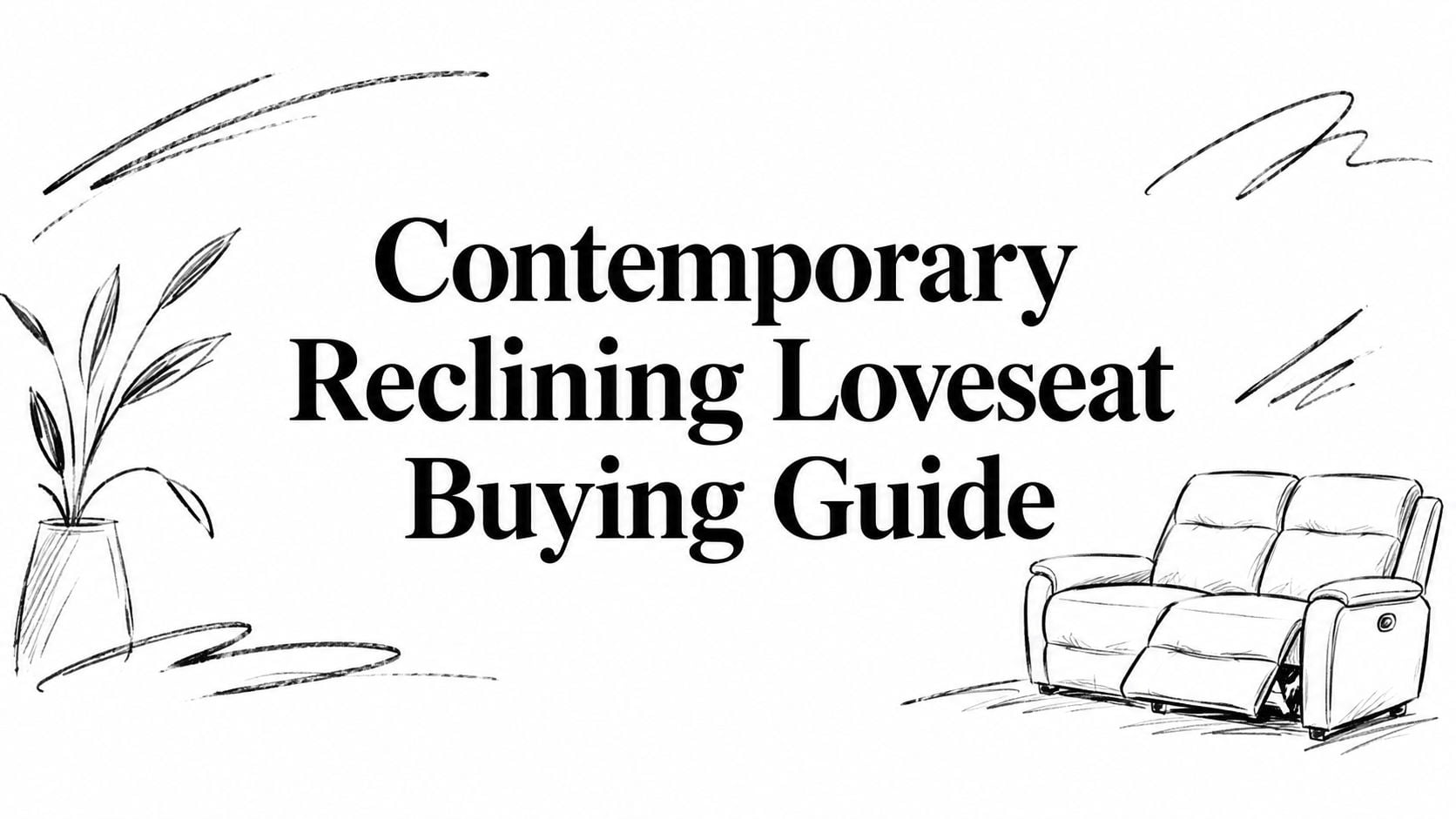
The loveseat seemed like the easy choice: two seats, less room than a sofa, and a cozy spot for movie night. Then someone reclines, the footrest reaches toward the coffee table, and the narrow path to the kitchen disappears. A contemporary reclining loveseat can be a smart fit for a Metro Milwaukee home, but only when its moving footprint, delivery path, and support suit the people using it.
BILTRITE has served Metro Milwaukee as a fourth-generation, family-owned furniture business since 1928. That history comes with a practical point of view: measure the room, test the motion, and choose a piece that works for everyday life, not just for a quick look in a showroom.
Table of Contents
- Why a Loveseat Earns Its Spot in Your Living Room
- How Reclining Loveseats Are Built to Move
- Sizing That Fits Your Room
- Upholstery and Finish Choices Worth Knowing
- Fitting Tight Spaces, Narrow Doorways, and Tricky Deliveries
- Senior-Friendly Features Without a Clinical Look
- Your Showroom Checklist Before You Buy
Why a Loveseat Earns Its Spot in Your Living Room
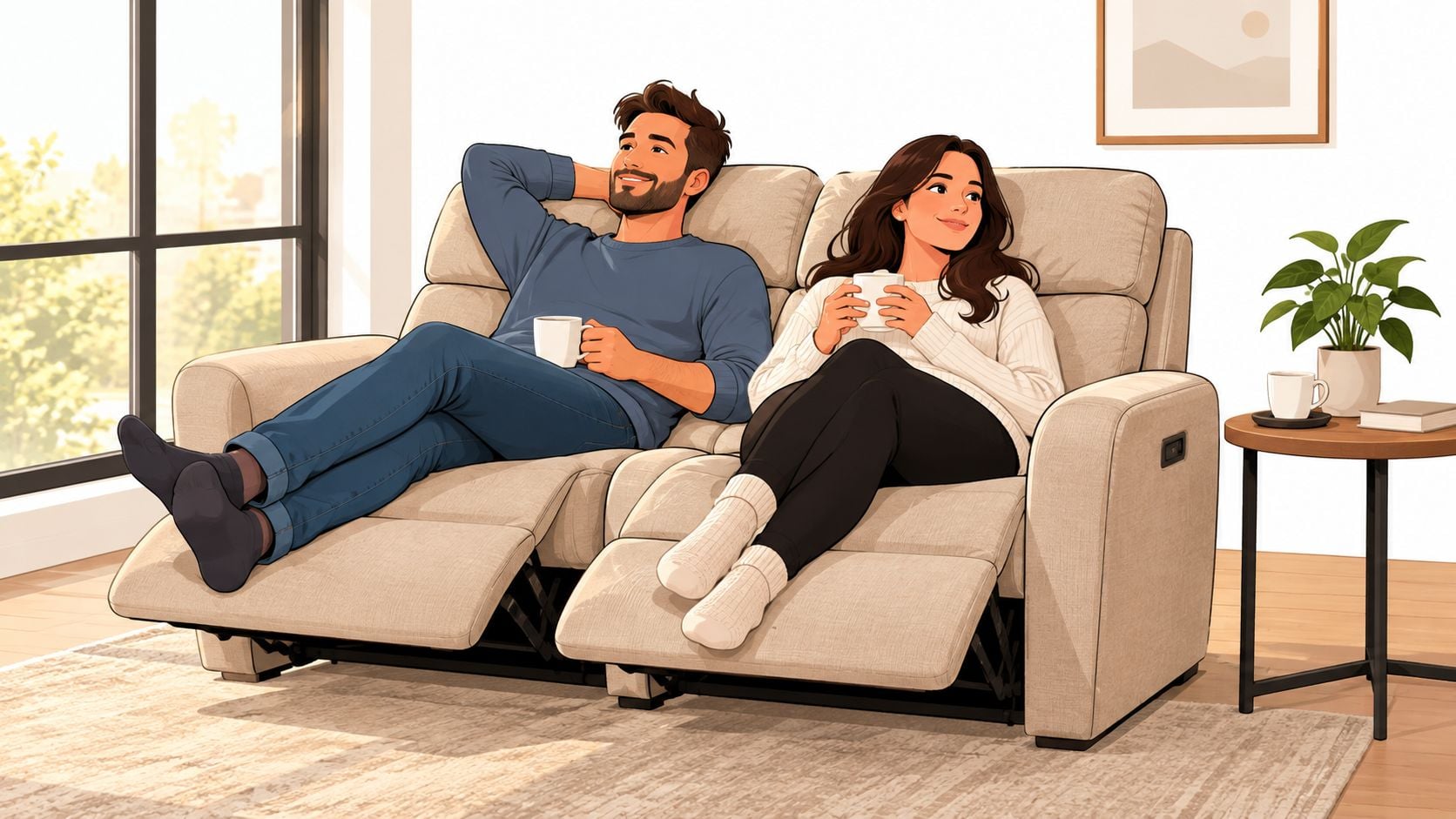
A contemporary reclining loveseat does more than give a room a smaller sofa. It puts two reclining seats in one shared piece, so a couple can sit together without giving up the option to stretch out. That's different from a traditional loveseat, which offers shared seating but no built-in leg support, and different from two separate recliners, which let each person choose a seat but take up more visual and floor space.
The comparison with a reclining sofa is less simple. A sofa can seat more people, but its full width may crowd a compact living room. A loveseat may leave more room for a side table or a clear walkway, but the open footrests still need space. Closed dimensions alone don't tell the whole story.
The useful question isn't just “Will it fit?” It's “Will the room still work when both seats are open?”
Think about how the household uses the room. Two people who watch television together may value independent recline controls, while a family that often has guests may need extra stationary seating more than two footrests. In a smaller home or apartment, a loveseat can provide a comfortable shared spot without committing to a full reclining sofa, provided there's enough space in front for the seats to move.
A single recliner can be a better choice when only one person needs reclining support or when the room's shape makes a two-seat frame awkward. But a loveseat often feels more settled as the main living-room seat, and it keeps two people close without requiring them to share one recline position.
The category has a long mechanical history. In 1928, cousins Edwin Shoemaker and Edward Knabusch created a wooden reclining porch chair whose seat moved forward as its back leaned. They introduced an upholstered indoor model in 1929, and the company had expanded to reclining sofas and modular furniture groups by 1969 (the history of reclining furniture at The Henry Ford). Today's two-seat version builds on that basic idea, but the right choice still comes down to room geometry, comfort, and who needs to use it.
How Reclining Loveseats Are Built to Move
A reclining loveseat has a moving frame beneath its upholstery. Before judging the fabric or color, ask to see how the seats operate. A showroom demonstration can reveal whether each person gets a separate recline, how the footrest opens, and how much the frame shifts during the motion.
Manual or powered operation
A manual mechanism typically uses a lever or pull handle to release the footrest and recline the seat. It doesn't need a power outlet, but users may need to apply more physical effort, and the motion may offer fewer stopping positions.
A power mechanism uses buttons or switches to move the seat. Some models include USB charging ports, but features vary, so check the actual controls rather than assuming they're included. Ask whether each side operates independently. With separate controls, one occupant can recline while the other stays upright. A shared mechanism moves both sides together, which may suit a household that prefers matching positions but gives each person less control.
For a broader look at powered seating styles, compare types of power reclining seating.
Wall-hugger or standard travel
A wall-hugger mechanism is designed to recline with less distance between the loveseat and the wall. A conventional mechanism generally needs more clearance because the seat and back travel farther as the user reclines. Neither design removes the need to measure the open footprint. The label is a starting point, not proof that the piece will clear a coffee table or walkway.
Integrated footrest and delivery construction
The footrest is part of the reclining mechanism, not a separate ottoman. Try it through its full movement and notice whether it supports the lower legs comfortably. Also ask whether the frame is come-apart construction, meaning it separates into manageable sections for delivery through narrow entries.
That delivery detail matters as much as the motor or handle. A loveseat can fit the room on paper and still fail at the front door if its frame can't make the turn. Keep the operating style, room clearance, and delivery route in mind together.
Sizing That Fits Your Room
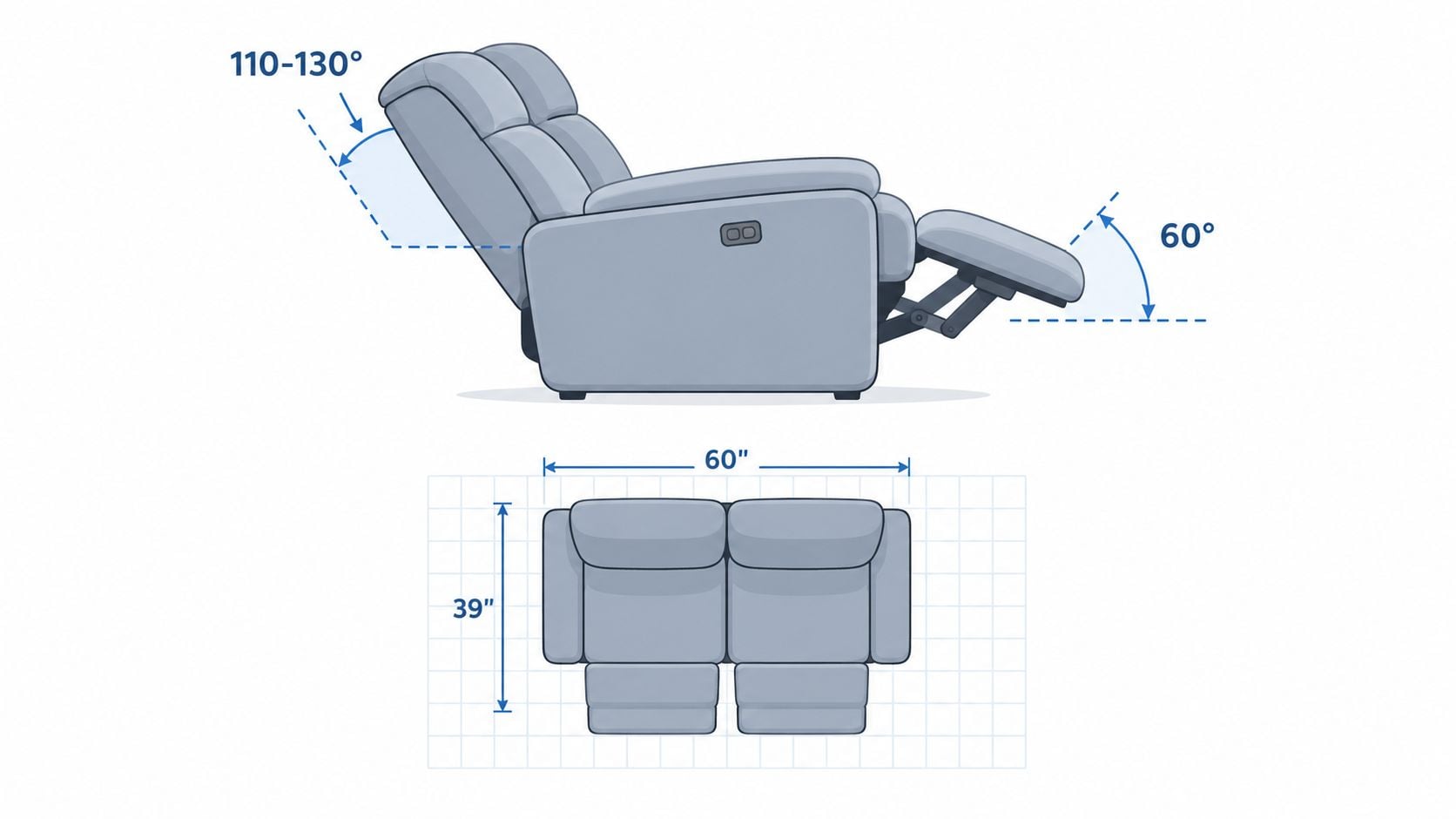
A loveseat can fit between the walls and still crowd the room once its footrests open. Measure it both upright and fully reclined before you buy. The open position determines whether someone can pass, reach the coffee table, or cross the room without squeezing by.
Use this checklist:
- Room width: Measure the usable floor area where the loveseat will sit.
- Closed depth: Measure from the back to the front edge when the loveseat is upright.
- Open depth: Ask for the full depth with the footrest extended, then mark it on the floor at home.
- Wall clearance: Confirm the gap required behind the specific mechanism.
- Traffic path: Check that open footrests leave a clear route between doors, seating, and other parts of the room.
- Entry route: Measure doorways and tight turns between the entrance and the intended room.
Mark both the closed and open outlines with tape. Set a stand-in for the coffee table, then walk the route you use every day. A narrow loveseat can still block the only clear path across the room when its seats are reclined. For more guidance on loveseat dimensions and sizing, compare the listed measurements with your room before visiting a showroom.
Check fit while seated
Room measurements are only half the test. Cornell's ergonomic chair guidance reports that lumbar-disc pressure and back-muscle activity are lowest when the back is supported at approximately 110 to 130 degrees (Cornell's ergonomic chair guidance). Sit in the loveseat and check that your lower back stays supported as you recline, your head rests comfortably, and the footrest supports your lower legs without pressing behind your knees.
A recliner study involving young adults found the strongest combined comfort and physiological response near a 125-degree backrest angle. It suggested a footrest range of roughly 40 to 70 degrees, with an optimum near 60 degrees. Use these findings as a starting point, not a universal fit rule, especially for older adults or anyone with mobility limitations.
Your body matters as much as the floor plan. Bring your room measurements to the showroom and test the loveseat in both positions. A good fit leaves enough room to move and supports your seated posture without forcing an awkward position.
Upholstery and Finish Choices Worth Knowing
The upholstery has to suit daily life as well as the room's style. Fabric can offer a softer, more casual look, while leather has a smoother surface that many households find straightforward to wipe down. Performance covers are designed for practical use, but care needs vary by specific material. Check the care instructions for the actual cover, especially if pets, snack spills, or heavy everyday use are part of the picture.
| Material | Best For | Watch For |
|---|---|---|
| Fabric | A softer feel, varied textures, and a broad choice of colors | Check cleaning instructions and how the weave may handle pet hair or spills |
| Leather | A smooth surface and a more tailored appearance | Confirm the care routine and whether the surface suits the household's day-to-day use |
| Performance cover | Busy rooms where easy upkeep matters | “Performance” alone doesn't explain the fabric's feel, cleaning needs, or construction |
Check the compliance label
For upholstered furniture made, imported, or reupholstered for U.S. consumers, 16 CFR Part 1640 requires compliance with the TB 117-2013 test method. The rule evaluates the cover fabric, resilient filling, barrier material, and decking material, and furniture covered by the rule must carry a permanent label with the required compliance statement (the U.S. Consumer Product Safety Commission's upholstered furniture guidance).
Ask to see the label and don't assume that a flame-resistant cover on its own confirms that the whole piece meets the standard. If the loveseat is reupholstered later, ask whether the replacement materials preserve the tested construction. Compliance helps reduce ignition risk, but it doesn't make furniture fireproof. Keep smoking materials, candles, heaters, and overloaded electrical components away from upholstered furniture.
Choose details that fit the room
Wood tones, leg finishes, and stitching can make a reclining piece feel more refined and contemporary. Look at the full outline, including the arms and footrests. Bulky padded arms may feel comfortable but visually fill more space; a different arm shape can make the same general type of seating look lighter.
If a stock fabric or finish doesn't suit the room, ask whether custom options are available and what changes are possible. BILTRITE offers furniture with fabric, leather, wood, finish, and hardware choices, so shoppers can ask about the available options in person. Use this fabric selection guide to organize upholstery questions before a showroom visit.
Fitting Tight Spaces, Narrow Doorways, and Tricky Deliveries
A loveseat must make it through the house before it can make the living room comfortable. Measure the full delivery route, not just the front door. A piece may clear the doorway but fail at a hallway turn, stair landing, or entry into the room.
Measure the route
- Measure every doorway. Record the clear opening between the door frame, not the door's listed size.
- Check turns and stair landings. Note tight corners and places where the frame would need to tilt or rotate.
- Measure the diagonal. Compare the available opening and turning space with the loveseat's largest dimensions. Ask the showroom team how the piece should be oriented during delivery.
- Confirm the frame construction. Ask whether the loveseat comes apart and whether those parts can be reassembled in the destination room.
In older bungalows and apartments around Milwaukee, a narrow entry or stair turn may be the limit. A come-apart frame can help when the full loveseat can't make the route in one piece. BILTRITE carries come-apart sofas, loveseats, sectionals, and recliners for difficult delivery paths. For more planning guidance, review furniture options for narrow doorways.
Leave room for everyday use
Compare a wall-hugger with a conventional mechanism based on the actual distance available behind the loveseat, then check the forward space needed for the footrest. Don't solve a tight wall-clearance problem only to place the extended footrest across a main path.
Before delivery, make a quick home checklist:
- Outlet location: Confirm the outlet is close enough for a powered mechanism and the cord can reach safely.
- Cord route: Plan where the cord will sit so it won't cross a walking path.
- Floor protection: Have suitable furniture sliders ready for hardwood floors, and follow the delivery team's advice on moving the piece.
- Final placement: Clear the route and mark the intended location, including the open-footrest area.
A smaller frame isn't automatically the easier fit. The best candidate is one that reaches the room, clears the walls, and leaves the household enough space to move around it.
Senior-Friendly Features Without a Clinical Look
A stylish reclining loveseat can support aging adults and caregivers without looking like medical equipment. The trick is to judge how easily someone can sit down, stay supported, and stand back up, not just how far the seat reclines.
Research on senior-friendly seating found that more than 60% of surveyed seniors wanted a chair that supports comfortable reclining, 76% of people aged 60 and older said armrests make sitting down and standing up easier, and 92% of existing reclining-chair users wanted the function again (the senior seating study). Those findings support a practical point: reclining can matter, but it only helps when the seat also supports safe, manageable movement.
Test the transfer, not just the recline
A low, firmly cushioned seat may feel inviting but can make standing harder. Check whether the user can sit down in control, plant both feet, and push up using stable armrests. Cushion firmness, seat height, and the amount of support around the lower back all affect that movement.
Try the same transition several times in the showroom: upright to seated, seated to reclined, and reclined back to standing. Watch for sliding, reaching, or a need for another person to pull the user forward. If those actions feel difficult during a brief test, the loveseat may become frustrating at home.
Comfortable seating should make getting back up manageable, not merely make sitting down pleasant.
Make controls easy to use
Manual handles require physical effort, while power controls can move the seat with less direct force. Ask whether each person can control their side independently and test whether the buttons are easy to find and operate. For powered seating in public or commercial settings, ADA guidance sets maximum reach heights of 54 inches for a side reach and 48 inches for a forward reach (ADA accessibility guidance). Those benchmarks can also help families think about reachable controls, though residential furniture isn't automatically governed by every ADA requirement.
Ask how the seat returns upright if the power supply is interrupted, and how the power cord can be routed without becoming a trip hazard. A loveseat doesn't become easy to exit just because it reclines at the press of a button. For more considerations on supportive seating, read about comfortable sofa choices for seniors.
Your Showroom Checklist Before You Buy
Bring your room measurements and a list of who will use the loveseat. A quick sit can reveal whether the back feels pleasant; a more careful test shows whether the seat fits the room and household.
Use this checklist during a showroom visit:
- Dimensions: Compare closed depth, open depth, wall clearance, and the space needed around the footrests.
- Comfort: Check lumbar contact, head support, footrest position, and whether the seat feels supportive rather than too soft.
- Mechanism: Try every handle or button. Confirm whether the seats operate separately or together.
- Accessibility: Test sitting down, using the armrests, reclining, returning upright, and standing.
- Delivery: Ask about come-apart construction, then verify the doorways, hallway turns, and stair route at home.
- Materials: Review the cover's care instructions and locate the permanent fire-safety compliance label.
BILTRITE is a fourth-generation, family-owned business serving Metro Milwaukee since 1928, with USA-made and Amish-made furniture, small-scale and heavy-duty options, and a team whose sales associates bring over 400 years of combined experience. The team can help with questions without pressure. BILTRITE doesn't sell online and is closed on Sundays and Mondays to support family time, so the showroom visit is the hands-on way to compare fit and operation. Wisconsin shoppers should also ask about power lift recliners, which are exempt from Wisconsin sales tax.
Come on down to the Greenfield showroom with the measurements, questions, and anyone who'll use the loveseat. Sitting in the actual furniture is the easiest way to check comfort, test the controls, and catch a fit problem before delivery.
BILTRITE Furniture-Leather-Mattresses offers furniture for Metro Milwaukee homes, including small-scale seating, come-apart options, and American-made and Amish-made pieces. Visit BILTRITE Furniture-Leather-Mattresses in Greenfield for a no-pressure chance to test a contemporary reclining loveseat and ask the team about fit, movement, and delivery.