Leather Sectionals with Power Recliners: A Buyer’s Guide


Friday night in Milwaukee: the kids have picked a movie, someone's looking for the popcorn, and the family room is about to get busy. A sectional with power recliners sounds inviting, but it also needs to look at home when relatives visit and work for the everyday moments between movie nights.
That's why this purchase deserves more thought than counting seats or choosing a color. Leather upholstery, a sectional layout, and powered reclining mechanisms all have to work together. The right choice should handle Tuesday-night lounging and Sunday-afternoon naps without creating headaches over fit, cords, or repairs.
Table of Contents
- Picture the Family Room You Actually Want
- How Power Reclining Mechanisms Actually Work
- Understanding Leather Grades and What Each One Means
- Durability Testing in Plain English
- Layout, Delivery, and Room Preparation
- Safety, Accessibility, and Caregiver Considerations
- Customization, USA-Made Options, and Your Buy-for-10-Years Checklist
- Come Try It Out in Greenfield
Picture the Family Room You Actually Want
A family room gets a real workout. Kids stretch out across the cushions, guests need a place to sit during the holidays, and someone wants to put their feet up while everyone else is still chatting. A leather sectional with power recliners can bring those needs together, but only if the configuration suits how the household uses the room.
Start by thinking about who'll use the reclining seats and when. If several family members like to recline, powered seats may earn their floor space. If only one person regularly stretches out, a sectional with fewer reclining seats may be the wiser layout. And if the main concern is having enough room for guests, prioritize the number and shape of seats over extra controls.
A useful test: Picture an ordinary evening, not a staged showroom. Where does everyone sit, and what needs to stay clear for people to walk through the room?
The industrial history behind upholstered furniture is substantial. The U.S. upholstered-household-furniture industry had 5,896 establishments in 1997, and a Congressional Research Service review reported $84.3 billion in U.S. furniture and related-product shipments in 2005, including $48.5 billion in household furnishings. Those historical figures help explain why a sectional combines established but distinct parts: upholstery, connected seating, reclining mechanisms, and electrical components. They don't tell you whether a particular model is well made, so judge its construction piece by piece. (Census Bureau Economic Census)
How Power Reclining Mechanisms Actually Work
A power recliner uses a motor to move the seat mechanism. When you press its control, linkages underneath the seat shift the back and footrest. The result is convenient, adjustable movement, but every powered seat adds components that need room to operate and a safe route to electricity.
Wall-hugger designs are often a sensible choice in sectionals placed near a wall. They're built to recline with less space behind the seat than a traditional reclining design, though the exact clearance depends on the model. Don't rely on the name alone: ask how far the back moves and how much room the extended footrest needs.
A single motor generally moves the reclining action along one path. A separate headrest motor, when included, lets the user adjust head support independently. That can help someone find a comfortable angle for reading or watching television, but more motors shouldn't be the deciding factor. Try the controls and see whether the seat feels stable and moves smoothly.
Sectional pieces connect to keep the seating aligned. Each reclining seat also needs its own electrical connection, and its movement shouldn't pull against the neighboring section. Ask how the connectors work, whether seats can be separated for delivery or service, and what the warranty covers for motors, controls, and wiring.
For a plain-language overview of the options, BILTRITE has a guide to types of power-reclining seating. In the showroom, test every control yourself. A motor count on a label won't tell you whether the seat feels natural when you lean back.
Understanding Leather Grades and What Each One Means
You're choosing a sectional your family may use for years, so start with what covers the seats and moving footrests. “Leather” describes several materials, and the grade and construction affect the feel, appearance, and wear. Ask which material covers the seats, arms, backs, and sides.
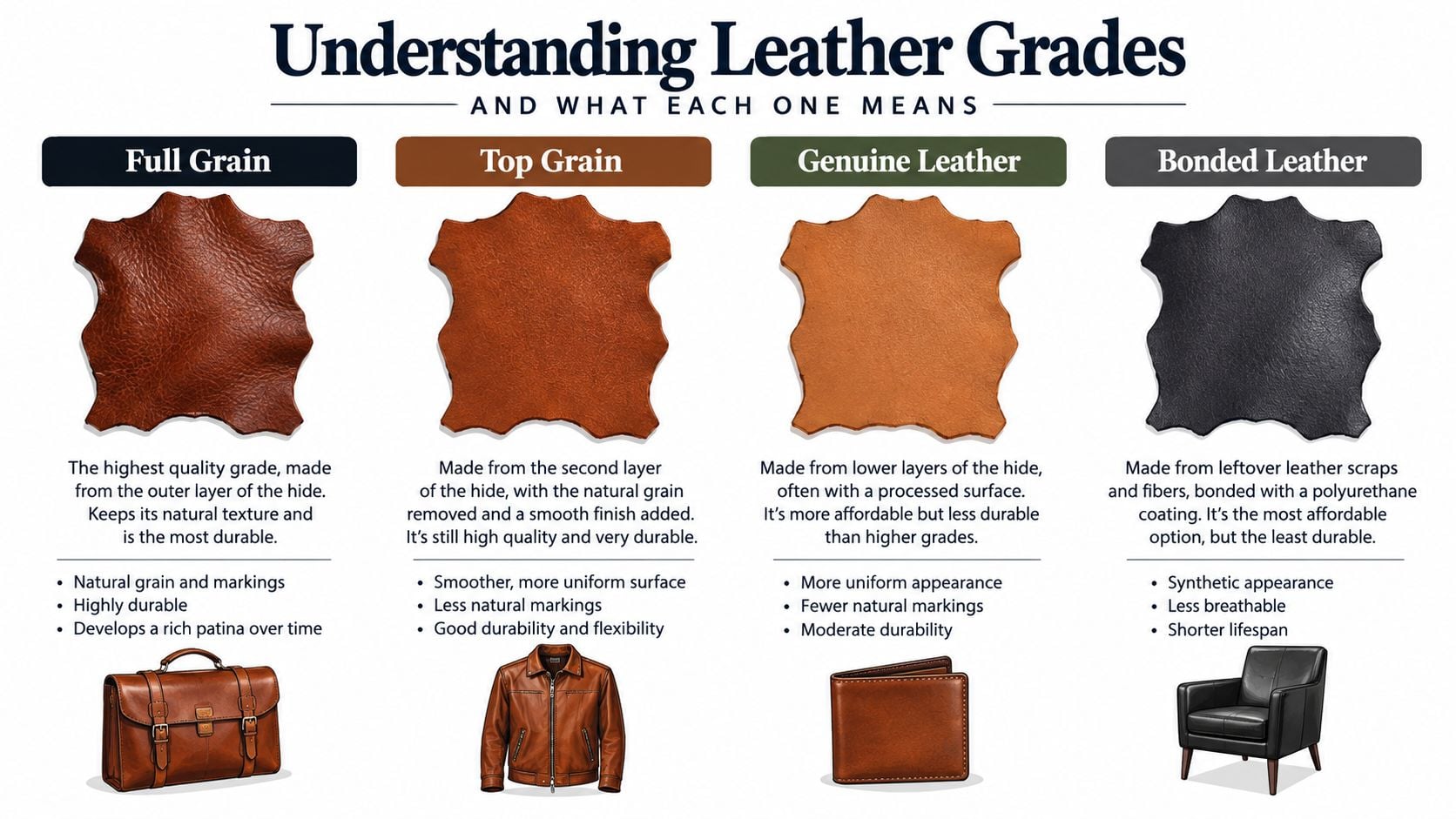
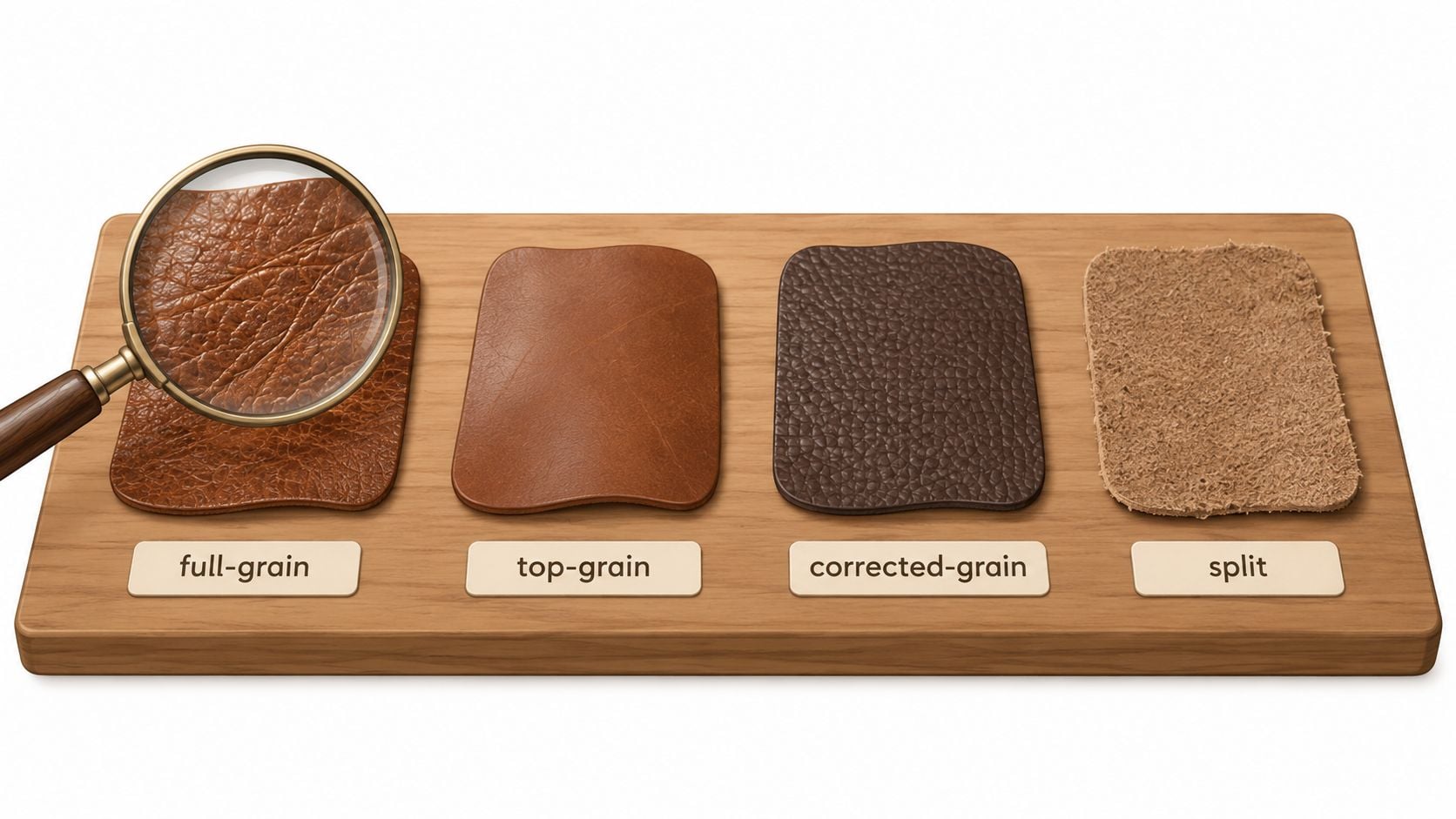
Full-grain leather keeps more of the hide's natural markings and can develop a patina over time. Top-grain leather is also made from a hide, but its surface is often sanded or finished for a more uniform look. Corrected-grain leather receives more surface treatment to even out its appearance and may have a protective finish. For a closer comparison, read this guide to the difference between top-grain and full-grain leather.
Split leather comes from a lower layer of the hide. A sectional may use different materials on different panels. In a leather-match design, leather may cover the seats while coordinated non-leather material covers the backs and sides. Get the coverage details in writing before you choose.
Bonded leather combines leather fibers and other materials under a surface coating. It is widely reported to crack, peel, or delaminate within a few years of daily use. Ask how it wears at the seat and footrest folds, where reclining puts repeated movement on the upholstery.
“Genuine leather” alone doesn't tell you how the hide is constructed or how much of the sectional is leather. Ask for the specific material category and a panel-by-panel explanation. A retailer's guide to material and repairability can also help you prepare questions about upkeep and repairs. For a purchase you expect to keep, understand the upholstery construction before comparing features.
Durability Testing in Plain English
Abrasion test results can help compare leather surfaces, but they aren't a countdown to a replacement date. Martindale and Taber tests measure resistance to repeated rubbing using different methods, so their results aren't directly interchangeable. Martindale cycles shouldn't be treated as equivalent to Wyzenbeek double rubs, either.
For a general reference, independent technical guidance places light-residential upholstery at around 15,000 Martindale cycles, residential or contract use at 25,000–40,000, and heavy commercial use at 50,000–80,000. Public high-traffic settings are placed at 100,000 or more cycles. These are test benchmarks, not guarantees of years in service. (Eurofins guidance on leather testing)
| Use Band | Martindale Cycles (approx.) | Best For |
|---|---|---|
| Light residential | 15,000 | Occasional use |
| Regular residential or contract | 25,000–40,000 | Frequent home use |
| Heavy commercial | 50,000–80,000 | Demanding daily use |
| Public high-traffic | 100,000 or more | High-traffic shared settings |
Abrasion isn't the only concern on a reclining sectional. The seat-to-back transition and footrest folds flex, and exposed arms may receive different wear from stationary backs. ASTM D7255 covers rotary abrasion, ASTM D2097 tests flexing-crack resistance, ASTM D1912 addresses cold-crack resistance, and ASTM D7912 covers heat-aging stability. ASTM cautions that lab abrasion cycles provide comparative rankings, not direct predictions of service life. (Leather and Hide Council of America finish-durability guidance)
Ask for the leather category, the testing methods and results, and the care requirements. Then sit on the actual upholstery and inspect the high-flex areas. A high abrasion result is useful, but it doesn't establish frame quality, seam durability, or how easily a motor can be serviced.
Layout, Delivery, and Room Preparation
A sectional that fits the wall can still fail the delivery test. Measure the route from the entrance to the family room, not just the space where the furniture will sit. A narrow turn, low ceiling, or tight hallway can matter more than the room's overall dimensions.
Use this checklist before ordering:
- Room footprint: Measure the wall lengths and note windows, doors, vents, and traffic paths.
- Reclined position: Ask for the full reclined depth and the clearance behind each seat. Check that footrests won't block walkways.
- Delivery route: Measure the narrowest doorway and turning point, plus any stairs or low ceilings along the route.
- Connectors: Find out where sectional pieces join and whether the pieces can be separated to pass through tight areas.
- Electrical access: Plan an outlet for the reclining seats. Keep cords away from moving footrests and pinch points, and don't hide them under rugs.
- Access needs: Leave space for walkers, transfer aids, and caregivers if anyone in the household uses them.
A come-apart sectional can make delivery easier in older homes, apartments, and condos with narrow entryways. Ask how its sections disconnect and reconnect, and confirm that the delivery path works for each piece. BILTRITE's guide to measuring a sectional sofa is a helpful place to start.
Leather also needs a stable environment. One technical upholstery guide recommends 10–25°C and 50–75% relative humidity, with cleaning and conditioning two to four times annually, depending on use. Conservation guidance recommends protecting leather from wetting and humidity above 65%, with a commonly used stable range of 40–60% RH. (Upholstery care guidance) For a Milwaukee home, keep leather away from radiators, heating vents, wood stoves, and strong sunlight. Wisconsin seasons can bring dry indoor air and summer humidity, so placement matters.
Safety, Accessibility, and Caregiver Considerations
Powered reclining can make adjusting a seat easier, but that doesn't automatically make every sectional suitable for an older adult or someone with limited mobility. Ordinary power recline and lift-assist are different functions. A reclining seat changes position; a lift chair is designed to assist someone as they rise. Treat a lift option as a separate mobility conversation, not as a standard sectional feature.
Test the controls from the seated position. Can the user reach them without twisting? Are the buttons easy to distinguish by touch and understand? Check whether the seat remains steady as the person sits down and stands up, and whether the armrests provide a useful place to push from.
A Canadian geriatric review described incidents involving people who fell while being lifted by power-lift chairs, including older adults and people with mobility or cognitive limitations. The review recommended applying accessible and universal-design principles to these products. Rehabilitation guidance also indicates that powered tilt and recline can improve comfort and support participation in daily activities. The practical point is straightforward: the benefit depends on fit, controls, supervision, and safe transfers, not on a “senior-friendly” label. (Canadian geriatric review of power-lift chair safety)
Before choosing a powered seat, ask:
- Control use: Can the person reach and operate the buttons independently?
- Outage plan: What happens if electricity fails, and does the mechanism have a backup or manual release?
- Transfer space: Is there room for a walker, transfer aid, and caregiver?
- In-person trial: Can the intended user practice getting in, sitting down, reclining, and standing up?
BILTRITE's information on wheelchair-accessible furniture can support a broader conversation about access and layout. A supervised showroom test is more useful than relying on a label.
Customization, USA-Made Options, and Your Buy-for-10-Years Checklist
A sectional's ownership experience comes down to more than how many motors it has. Leather construction, seat configuration, delivery access, warranty terms, and repair options all matter. Custom choices can help match a sectional to the room and household, but only if the details are clear before the order is placed.
A practical checklist to take into the showroom:
- Write down the leather category and coverage. Confirm what's used on the seats, arms, backs, and sides, and note cleaning restrictions.
- Get the warranty details. Ask what the frame, reclining mechanism, motor, controls, and wiring coverage includes.
- Ask about replacement parts. Find out whether motors, switches, wiring, and other service parts are available.
- Check how sections come apart. Confirm whether individual seats can be disconnected for delivery or repair.
- Plan the room and power. Bring measurements, identify outlet locations, and check the reclined footprint.
- Test the seat. Sit upright, recline, use the controls, and see how the upholstery feels across the seat and footrest.
USA-made and Amish-made options may offer the craftsmanship and service details a buyer is looking for, but origin alone doesn't answer every construction question. Inspect the frame, ask how the reclining components are serviced, and read the actual warranty. BILTRITE offers USA-made leather furniture alongside custom choices in leather and configuration.
BILTRITE is a fourth-generation, family-owned business serving Metro Milwaukee since 1928. The showroom focuses on affordable, better-quality furniture, including USA-made and Amish-made choices. The advice stays simple: choose the leather and service plan you can explain back in plain English, then make sure the sectional can get into the room.
Come Try It Out in Greenfield
Before deciding, bring the room measurements and focus on three questions: What leather is used on each panel? What does the mechanism warranty cover? Will the sectional fit through the delivery route and recline comfortably in the room? Those answers matter more than a long feature list.
At our Greenfield showroom on Layton Avenue, you can sit in the seat, work the controls, and compare materials in person. Our sales associates have over 400 years of combined experience, and they're there to help you sort through choices without pressure. BILTRITE doesn't sell online, so the showroom is where you can try the furniture before making a decision.
We've been part of Metro Milwaukee since 1928, and our family values include making time for our own families. We're closed on Sundays and Mondays. Neighbors from Greenfield, New Berlin, Franklin, Oak Creek, Muskego, Waukesha, and nearby communities are welcome to stop in with questions and measurements.
There's no need to rush. Sit, stretch out, try the reclining controls, and decide whether the sectional feels right for your home.
BILTRITE Furniture-Leather-Mattresses offers leather sectionals, USA-made and Amish-made furniture, and a hands-on showroom experience for comparing comfort and construction. Visit BILTRITE Furniture-Leather-Mattresses in Greenfield to test reclining seats, ask about leather and repairability, and find a configuration that suits your family room.