Power Sectional with Chaise Buying Guide


Family movie night has a familiar rhythm. Someone wants to stretch out, someone else needs a clear view of the television, and another family member is already claiming the corner seat. A power sectional with chaise can bring those needs together, but it has to fit more than the room's wall. It also needs to fit the family, the delivery route, the walking paths, and the years of daily use ahead.
The smartest way to shop is to look beyond cupholders and upholstery color. A power sectional changes shape when its seats recline, its chaise occupies a generous portion of the room, and its electrical and mechanical parts deserve the same careful attention as its frame and fabric. The following guide helps Metro Milwaukee households evaluate comfort, access, fit, and long-term ownership before bringing one home.
Table of Contents
- The Evolution of the Power Sectional With Chaise
- Measuring the Dynamic Footprint and Room Layout
- Ergonomic Comfort and Safe Positioning
- Evaluating Fabric Durability and Long-Term Repairability
- Navigating the Delivery Route and Showroom Testing
- Experience the BILTRITE Difference in Greenfield
The Evolution of the Power Sectional With Chaise
A family settles in for the evening, and the seating starts doing different jobs at the same time. One person wants to stretch out fully, another prefers a more upright position, and someone else needs a clear path through the room. A power sectional with chaise grew out of that kind of everyday living. It combines shared seating, a dedicated lounging spot, and individual adjustment in one piece.
The form itself came together in stages. Earlier sectionals were built from multiple upholstered pieces that could connect to create one larger seating area. The chaise came from a different tradition, one centered on supporting the legs and back in a more relaxed posture. Put those ideas together, and you get a furniture type that serves both the room and the person using it.
From separate furniture to one flexible system
A traditional chaise gave one person a long place to recline. A sectional brought several seats into one connected arrangement. The powered version adds a motorized mechanism that changes the user's position with the touch of a button, so comfort is no longer locked into one fixed angle.
That change matters because a power sectional is not just a bigger sofa. It is a system with moving parts, changing clearances, and different comfort settings from seat to seat. In practical terms, the sectional helps organize the room, the chaise supports full-leg lounging, and the power feature lets each user fine-tune support for reading, watching television, or resting.
A simple rule: the sectional serves the room, the chaise serves the lounger, and the power mechanism serves the individual user.
The format remains modular by nature because it contains two or more connected seating sections. Some layouts place the chaise on the left, others on the right, and some collections allow more than one configuration. That choice should follow traffic flow, sightlines, and how the household really relaxes, not just the angle shown in a photo.
There is also a long-term ownership side to this evolution. Once reclining becomes powered, the sectional includes components that may someday need service, such as switches, motors, or control parts. That does not make it fragile. It means smart shoppers should view the piece the way they would view a recliner or adjustable bed. Comfort matters on day one, and repair access matters later.
A family furniture perspective
BILTRITE has served the Metro Milwaukee community as a fourth-generation, family-owned and operated business since 1928. That history shapes a practical point of view. Furniture has to feel good in the showroom, then keep working in a real home with real routines, real walkways, and years of daily use.
A power sectional can help define a seating zone in an open-plan space without relying on several separate pieces. It can also give a smaller household one dependable lounging position without adding another chair. The best fit depends on who uses it, how often the power seats will move, and whether the design will still be serviceable and comfortable after the novelty wears off.
Measuring the Dynamic Footprint and Room Layout
Saturday night is when this question shows up. The family is settled in, one seat reclines, a footrest lifts, and the path to the hallway suddenly feels tight. That is why a power sectional has to be measured as a moving piece of furniture, not just as a tidy shape on a sales tag. Its closed footprint matters, but its operating footprint is what determines whether the room still works once people use the power features every day.
Begin with the room, not the sofa. Measure wall lengths, door swings, vents, outlets, and the narrowest delivery and walking route into the seating area. Then map the chaise projection and the open recline space, because those are the parts that usually change how a room functions. For a step by step method, including taping out the room and checking circulation, use BILTRITE's guide on how to measure for a sectional sofa.
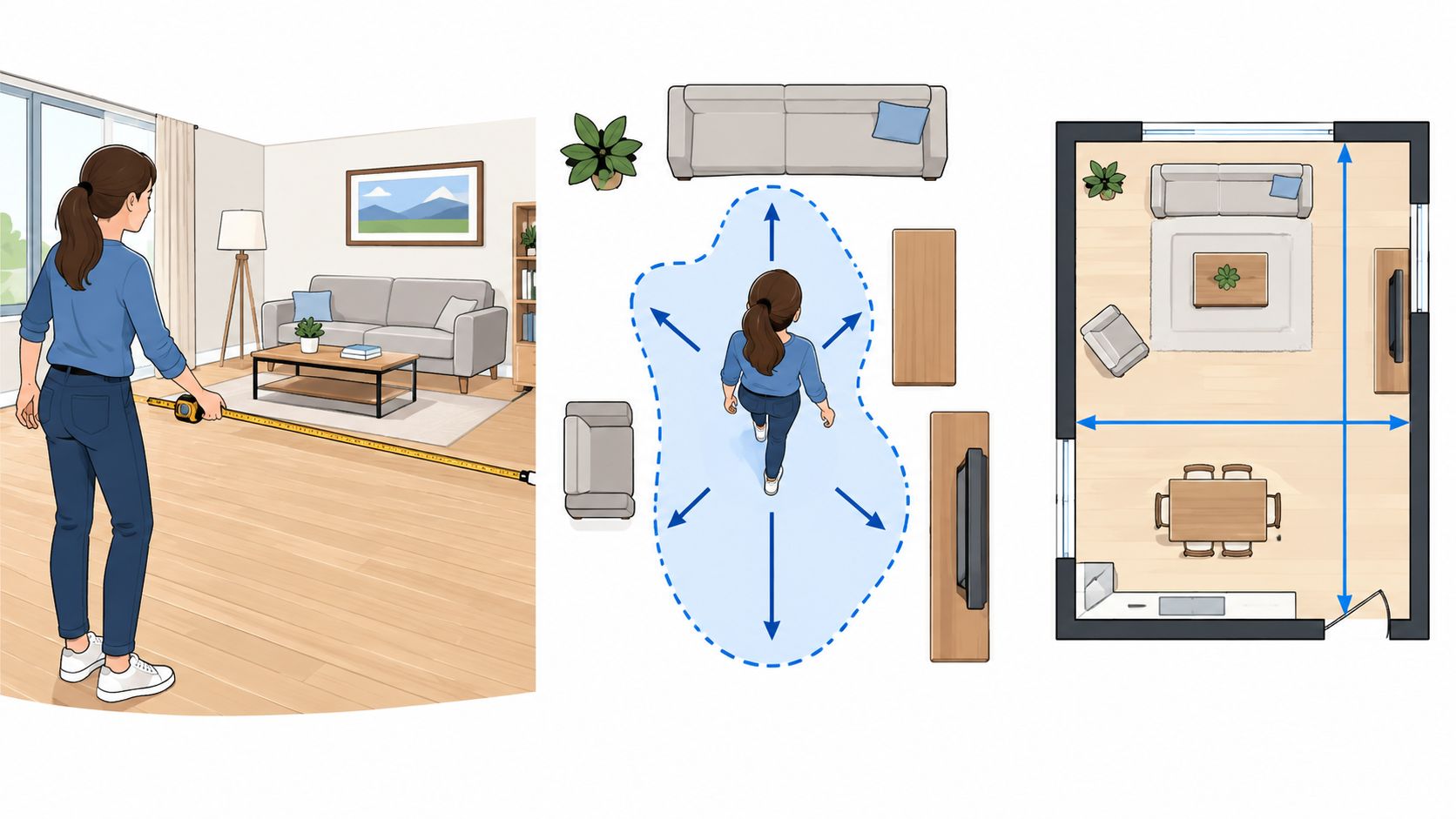
Mark the furniture before ordering
Painter's tape helps people see the room clearly. It turns a floor plan into a life size test, which is useful because a power sectional works a bit like a parked car with the doors open. The parked size is only part of the story. Mark the full upright outline first, then add the farthest reach of each powered seat when the footrest is up and the back is reclined. Include the coffee table, nearby chairs, cabinet doors, drawers, radiators, and the path people use to cross the room.
A practical sequence looks like this:
- Mark the back and side edges. Use the listed overall width and depth, including the chaise.
- Add the reclined position. Measure from the back wall to the farthest point reached by the open footrest and back.
- Walk the route. Have one person sit inside the taped outline while another walks from the main entrance toward adjoining rooms.
- Open everything nearby. Test cabinet doors, drawers, closet doors, and room entrances.
- Check the cord. Confirm that the power cord reaches an accessible receptacle without crossing a walking path or becoming pinched beneath the frame.
Choose the chaise side around movement
The chaise side changes traffic flow more than many shoppers expect. If the main route runs along one side of the sectional, placing the chaise on the opposite side often keeps the room calmer and safer. In a compact Metro Milwaukee living room, a shorter return or a smaller scale configuration can protect circulation better than trimming the lounging space people bought the chaise to enjoy.
The outlet matters too. Power furniture needs a practical electrical connection, and a stretched cord across a walkway creates a hazard that is easy to prevent with a better layout.
Practical rule: measure the sectional in the position the household uses every day, not only the position it occupies when the room is empty.
Ergonomic Comfort and Safe Positioning
Soft cushions can feel inviting for a few minutes, but lasting comfort depends on support and fit. A power mechanism is valuable because it lets the user adjust the body position gradually rather than forcing everyone into one fixed angle.
Cornell ergonomics guidance associates supported reclined sitting at approximately 110° to 130° with the lowest lumbar-disc pressure and back-muscle activity. The same guidance warns that pressure behind the knee can affect circulation or compress nerves. These findings make seat depth, leg support, and lumbar support practical shopping questions, not technical extras.
Look for support that follows the body
A good showroom test starts with the feet on the floor and the back supported. The user should be able to sit upright without the knees pressing against the front edge, then recline while maintaining continuous lower-back support. The chaise should support the lower leg without pushing the pelvis forward.
Independent controls matter because family members don't share the same body proportions. One person may want more backrest movement, while another may need a different amount of leg elevation. Controls should be easy to understand and reachable without awkward stretching.
The adjustable lumbar support information can help shoppers identify why lumbar adjustment deserves attention during a hands-on test. A recliner that feels comfortable only in one position may not serve the household as well as one that supports several everyday positions.
Accessibility requires a movement check
A power sectional can offer meaningful comfort for seniors, caregivers, and people with mobility limitations, but articulation alone doesn't guarantee safe use. Rehabilitation guidance indicates that powered tilt, recline, and elevating leg rests can improve comfort, reduce fatigue, and lower transfer-related fall or injury risk for some users. It also warns that remaining reclined can allow the body to slide forward, increasing pressure around the coccyx and sacrum. The guidance further notes that returning upright may require a specific sequence of adjustments, so high-level randomized evidence remains limited. Those points are summarized in RESNA's position paper on tilt and recline.
A careful in-store check should answer practical questions:
- Seat height: Can the user sit down and rise without excessive effort?
- Seat depth: Do the knees remain clear of the cushion edge?
- Arm support: Do the arms help with repositioning and transfers?
- Remote usability: Can the user identify and operate each control?
- Upright return: Can the user return to an upright position without assistance?
- Clearance: Is there enough room beside the seat for a caregiver or mobility aid?
For users managing edema or similar lower-limb concerns, clinical seating literature summarized by RESNA discusses elevating the legs above the heart by roughly 30 cm, combined with tilt and recline, as a possible way to improve lower-limb hemodynamic conditions. The evidence is limited, so the useful buying principle is adjustability rather than a promised universal angle.
More movement isn't automatically better. A sectional can improve comfort in a reclined position while creating posture or transfer difficulties if the user can't control the sequence, the chaise is too long, or the footrest interferes with the approach to the seat.
Evaluating Fabric Durability and Long-Term Repairability
A power sectional earns its keep over years, not in the first five minutes on the sales floor. The fabric has to handle daily contact, and the powered parts have to stay serviceable when something eventually wears out.
Start with the upholstery tag and the test method behind it. The Wyzenbeek test measures abrasion in double rubs, with one back-and-forth motion counted as a double rub. For practical showroom use, that number works like a traffic rating on a road. It helps you sort fabrics by expected wear, but it does not tell you everything about stains, pilling, fading, seam performance, or damage from the wrong cleaner. If you want a plain-language guide to reading those numbers, BILTRITE's fabric durability ratings guide explains how to compare them with real household use.
Use the rating as a screening tool
The rating is best used to narrow the field, then you check the rest of the story. A lower-rated fabric may be fine in a quieter room. A busy family room with pets, kids, or nightly reclining calls for a tougher choice, especially on the seat, chaise, and footrest areas where bodies slide, pivot, and press against the same spots again and again.
| Double Rub Rating | Best Use Case |
|---|---|
| 10,000 to 25,000 | Typical residential upholstery and lighter household use |
| Above 30,000 | Extra-heavy-duty use, including demanding family-room settings |
Ask the salesperson which abrasion test was used, what the number means for that specific cover, and what cleaning method the maker recommends. Those three answers matter more than a soft handfeel alone. On a power sectional, the moving parts change how the fabric wears because the seat and leg rest keep shifting pressure points during use.
Repairability matters just as much. A power sectional is a system of fabric, frame, motors, transformers, cables, hand controls, and control boards. If one small component fails, the core question is whether a technician can reach it without tearing into the upholstery or turning a simple fix into a major shop job.
Before you order, ask these service questions:
- Parts access: Can a failed motor or control be replaced without damaging upholstery?
- Availability: Will replacement motors, handsets, cables, and transformers remain available?
- Standardization: Are the electrical and mechanical parts standardized or proprietary?
- Service design: Does the sectional separate for service and reassembly?
- Support: Does the manufacturer provide practical service assistance and component information?
That checklist protects long-term value. A handsome sectional can become frustrating fast if a proprietary switch or control box is hard to source or expensive to install.
Broader policy work points in the same direction. The European Commission's furniture policy document identifies furniture as a priority product group for future ecodesign and energy-labelling efforts, with attention to durability, spare-part availability, and resource efficiency. For a shopper, the lesson is simple. Judge the whole ownership picture, fabric wear, parts access, and repair design, not just the color and the first sit.
Navigating the Delivery Route and Showroom Testing
Saturday arrives, the truck is outside, and everyone is ready to relax by evening. Then the largest section reaches a tight stair turn or a narrow apartment entry, and the whole plan stops there. A power sectional with chaise has to fit the house in motion, not just the spot where it will sit.
Start at the curb and trace the full path to the room. Measure exterior doors, interior doors, hallways, stair landings, railings, elevator openings, low ceilings, and the final turn into place. Keep doors open while you measure, and include trim, hardware, packaging, feet, and any fixed obstruction that steals an inch or two.
The shape of the piece matters as much as the listed size. A chaise can swing wide at the wrong moment, and a corner unit is often the awkward part because width and turning angle meet at the same time. The diagonal of the largest separated section often decides whether delivery works. A piece that looks too wide on paper may still pass when tilted carefully, but only if the route allows that movement and there is space to control it safely.
That is why it helps to ask early whether the sectional comes apart, how bulky the connectors are, and how much floor area the crew will need for staging and reassembly. BILTRITE's guide to sectional sofa delivery explains how to check route details before delivery day, especially in older homes, condos, and upstairs rooms where one tight corner can decide everything.
Then test the sectional the way your household will use it.
Photos flatten everything. They cannot show whether the headrest hits at the right spot, whether the footrest opens into a walkway, or whether the chaise supports the legs without pushing the pelvis forward. Broader buying patterns in U.S. furniture retail market data still point to the value of seeing furniture in person before purchase.
A useful showroom test looks like this:
- Sit in every powered seat. Try upright, partially reclined, and fully open positions.
- Check the chaise carefully. Your thighs and lower legs should feel supported, not stranded at the edge.
- Watch the moving footprint. Open the recliner and have another person walk past, the way family members or guests would at home.
- Check sightlines. Look toward the television, a side table, and the main conversation area from each seat.
- Listen and look during motion. The mechanism should operate smoothly, without sudden jerks that can feel unsafe for older adults or anyone getting in and out slowly.
- Inspect the cord path. The power connection should reach an outlet without crossing a main traffic lane.
- Ask delivery questions on the spot. Confirm separation points, connector access, in-home assembly needs, and whether the model can be serviced again if it ever has to come back out.
Experience the BILTRITE Difference in Greenfield
You can learn a lot from measurements and photos. Then there comes the moment when a household needs to sit down, run the controls, and feel whether a power sectional with chaise works for real life. That showroom step matters because these pieces change shape as they recline, and comfort depends on more than how they look from across the room.
BILTRITE Furniture-Leather-Mattresses is a fourth-generation, family-owned business serving Metro Milwaukee since 1928. That history gives shoppers a useful kind of continuity. The store has long focused on affordable, better-quality furniture, with many USA-made and Amish-made choices, including solid-wood furniture. For someone comparing a compact sectional for a condo with a sturdier setup for a busy family room, that range makes side-by-side testing easier.
Guidance without pressure
In a showroom, good guidance should feel like having an experienced neighbor point out what you may miss on your own. BILTRITE's sales associates help shoppers compare configurations, talk through chaise orientation, and check whether a sectional fits both the room and the people using it. That kind of conversation is especially helpful with power furniture, where moving parts, wall clearance, transfer ease, and future service access all affect long-term satisfaction.
The same practical approach carries through the rest of the store. Shoppers can compare mattresses in a large department with over 60 models, and they can ask about dining room furniture, bedrooms, home offices, entertainment spaces, home décor, lift chairs, senior living furniture, come-apart sectionals for tight delivery routes, and two-sided mattresses. The point is not to pile on options. It is to help a family match furniture to daily routines, space limits, and repair realities.
Wisconsin shoppers looking at mobility seating should ask about tax treatment before buying. Power lift recliners can qualify for Wisconsin sales and use tax exemption when they meet the state's rules for medical or mobility-related equipment, and staff can help confirm the details for a specific purchase with the Wisconsin Department of Revenue. A power lift recliner is different from a power sectional, but that distinction matters when a household is weighing comfort, transfers, and support.
A local rhythm that reflects family values
BILTRITE does not sell online, so an in-person visit carries real weight. The business is also closed on Sundays to spend time with family, which lines up with its family-first, buy-local approach. Shoppers can plan a visit through the Greenfield showroom and locations page.
Bring room measurements, a doorway sketch, photos of the space, and your questions. A good test drive should leave you confident about comfort on an ordinary Tuesday, and about whether the sectional can still be serviced years later.