Solid Wood Furniture Feet: A Buyer’s Guide for Homeowners


A dining chair scrapes across the hardwood during a busy family meal. One leg rocks, another leaves a fresh mark, and suddenly a small furniture detail becomes a household nuisance. The same thing can happen with a solid wood table, dresser, or sofa when its feet aren't matched to the furniture, the floor, or the room's changing moisture.
Solid wood furniture feet do more than complete a design. They carry weight, manage movement, meet the floor, and influence how long a well-built piece stays stable. The right choice can help protect flooring and preserve the character of USA-made or Amish-made furniture for years. The wrong choice can lead to wobbling, scratches, loose joints, and avoidable repairs.
Table of Contents
- Why Furniture Feet Deserve a Second Look
- Anatomy and Common Styles of Solid Wood Furniture Feet
- Best Wood Species for Furniture Feet and How They Compare
- Measuring and Matching Feet to Your Furniture
- Load Ratings, Joint Strength, and Long-Term Durability
- Installation, Replacement, and Everyday Care
- Customization Options and the Amish-Made Difference
- Shopping Locally and What to Bring to the Showroom
Why Furniture Feet Deserve a Second Look
A homeowner may notice the problem at the worst possible time. Guests are seated around the dining table, a child shifts in a chair, and one foot catches on the floor. Or a heavy case good gets moved for cleaning, revealing a trail of scuffs beneath the base. The visible issue may look minor, but the foot is part of the furniture's primary support system.
A foot absorbs pressure when someone sits, leans, or pulls a chair backward. It also receives repeated impact when a table is nudged or a dresser is shifted across the room. A broad, properly finished hardwood foot can spread that pressure more evenly than a narrow or worn glide, while a sound joint helps keep the entire frame square.
Practical rule: Treat the point where furniture meets the floor as a structural connection, not an ornament.
Floor protection matters just as much. Grit trapped beneath a foot can act like sandpaper and gradually mark wood flooring, while an unprotected end grain may take on moisture from spills or damp cleaning. Guidance for solid wood care recommends using felt or other low-friction protection and keeping indoor humidity above 30% to reduce movement-related alignment issues and small cracks, as explained in solid wood furniture care guidance.
Durability starts below eye level
Well-made solid wood furniture can have a long service life. One industry guide estimates that high-quality solid wood pieces may last 30 to 50 years or more, while mass-market furniture is often estimated at 5 to 15 years, depending on materials and construction, as documented in this furniture longevity guide. Feet don't create that durability alone, but weak feet can undermine an otherwise strong frame.
A good foot also makes maintenance easier. Felt can be replaced, a finish can sometimes be renewed, and a properly joined hardwood component can remain useful as the furniture ages. That repair-friendly quality is one reason families often look closely at real solid wood when furnishing a busy home.
Anatomy and Common Styles of Solid Wood Furniture Feet
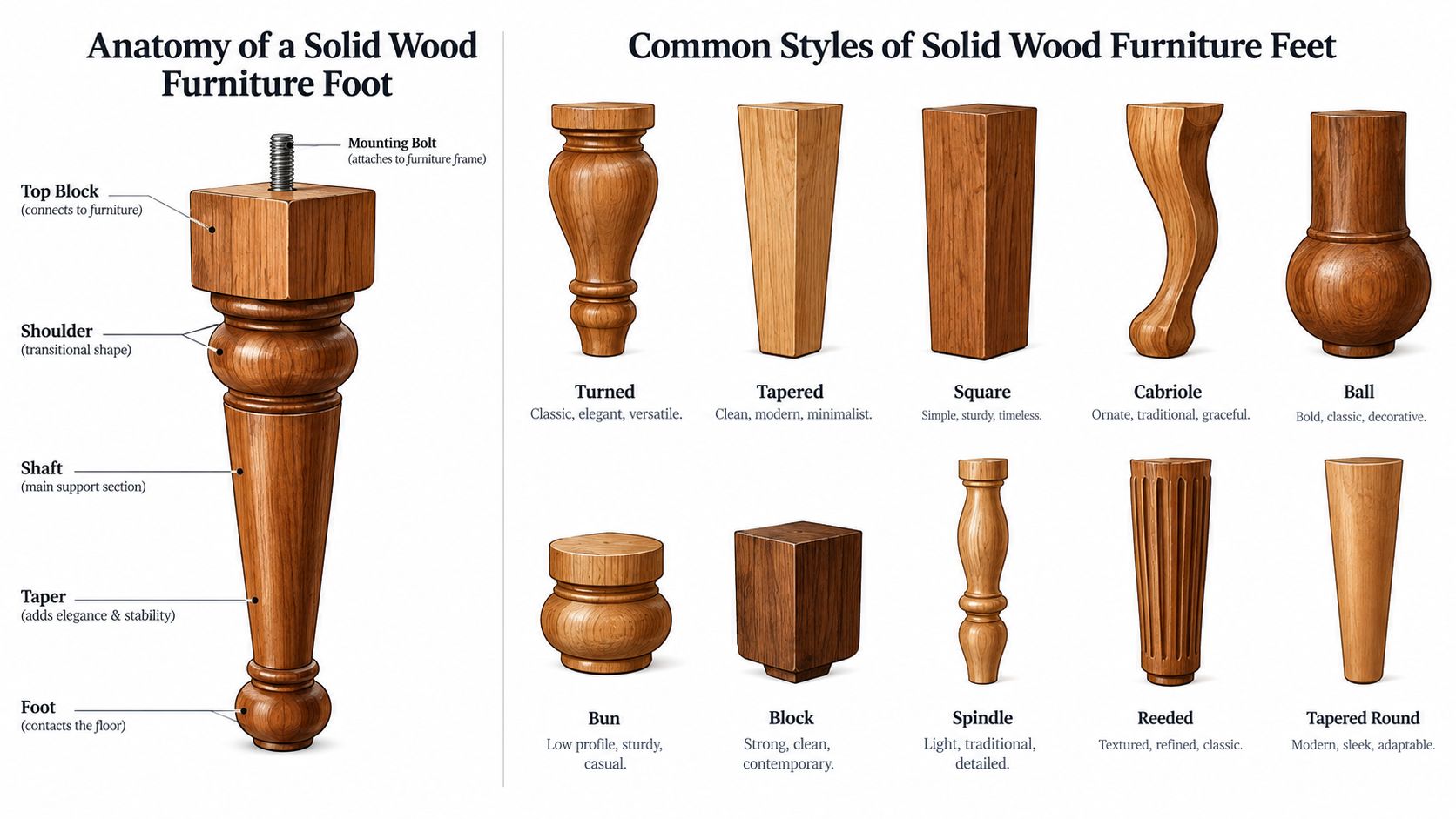
A cabinet can look perfect in the showroom, yet its feet determine how safely it settles on your floor years later. Solid wood feet have three working areas: the mounting area joins the frame, the shaft or body forms the profile, and the floor-contact area carries the load while holding a glide, felt pad, or cap. Read them like a small piece of joinery. A beautiful shape cannot make up for a weak connection or a contact surface that concentrates pressure and scratches flooring.
Begin with the furniture's visual language and proportions. A low cabinet needs a different foot height from a dining chair, while a formal display piece may suit carving that would overwhelm a plain bedroom case good. Historical styles offer useful clues. Ball feet appeared as early as the 1600s. Bun feet carried through the 1600s into the 1800s, and ball-and-claw feet emerged in the 1700s, according to this history of furniture feet.
Match the profile to the piece
- Bun feet are short and rounded, with a broad base suited to dressers, chests, and traditional case goods. Their low profile helps a large piece feel grounded.
- Ball-and-claw feet combine a carved sphere with talon-like forms. Their formal detail suits period-inspired cabinets or china storage more than a simple contemporary table.
- Tapered legs narrow toward the floor and work well on dining chairs, desks, and modern furniture. Their clean outline keeps the piece visually light.
- Turned legs use rounded sections, rings, and curves. They add detail to traditional tables and chairs without requiring full carving.
- Bracket feet flare outward with fairly flat faces. Under dressers, sideboards, and cabinets, they create a settled base and spread contact near the floor.
For replacement work, BILTRITE's guide to furniture legs and their styles can help identify a compatible profile. Compare height, mounting method, grain direction, and floor contact, not just the silhouette. The right match should look intentional across the room and remain steady when gentle side pressure tests the joint.
Best Wood Species for Furniture Feet and How They Compare
A dining table may look perfect in the showroom, yet its feet face the hardest routine work: weight, shifting floors, cleaning, and repeated contact. Wood choice therefore affects floor protection and service life, not just appearance. Hardness helps resist dents, density affects weight and compression resistance, and grain direction helps a foot handle force. The foot should work like a well-made fence post, with sound material and joinery sharing the load.
The comparison below uses approximate Janka ratings for commonly used species. For a deeper comparison of hardwoods, see this guide to choosing the right hardwood for longevity and style. A sample still matters because grade, moisture, finish, and construction can change how the completed foot feels and performs.
| Wood Species | Janka Hardness (lbf) | Typical Color | Best Furniture Styles |
|---|---|---|---|
| Red oak | Approximately 1,290 | Light to medium brown with visible grain | Mission, farmhouse, rustic, traditional |
| Hard maple | Approximately 1,450 | Pale cream to light brown with subtle grain | Shaker, contemporary, clean-lined dining |
| Cherry | Approximately 950 | Warm reddish brown that deepens with age | Traditional, heirloom, formal case goods |
| Walnut | Approximately 1,010 | Brown to deep chocolate with expressive grain | Contemporary, executive, refined traditional |
Choosing function before color
Red oak suits a hardworking family table because its open grain and sturdy character support casual interiors. Hard maple offers a quieter surface and a harder working face, useful where feet may meet grit or uneven flooring. Cherry brings warmth to a traditional room, while walnut supplies a darker visual anchor.
Color is only the starting point. A foot's size, finish, grain orientation, and mounting joint can matter as much as species. Real wood also moves with changes in moisture, so careful makers allow for that movement rather than trapping the part rigidly. Amish-era joinery traditions emphasize accurate fitting, sound shoulders, and connections that distribute force. A dense hardwood with a shallow, poorly supported joint can perform worse than a slightly softer species used in a properly fitted foot. Choose the wood and the joint together.
Measuring and Matching Feet to Your Furniture
Replacing one damaged foot is less like buying a random hardware part and more like matching a small architectural detail. The replacement needs to fit the furniture's height, profile, mounting method, finish, and floor conditions.
A practical measuring routine
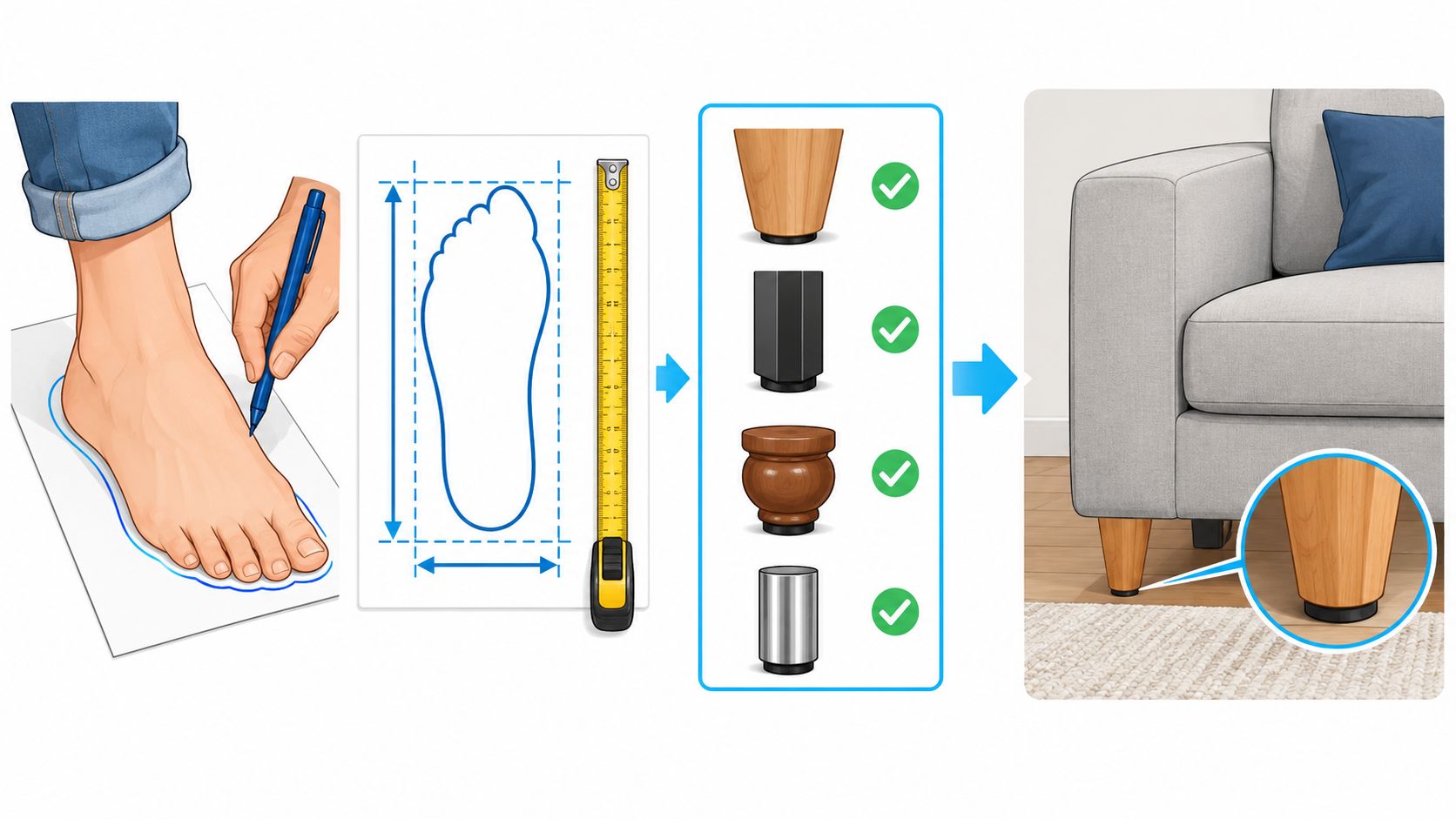
- Measure overall clearance. Record the distance from the floor to the underside of the frame or apron. For a chair, check how that height affects the sitter's leg position. For a table, account for the apron and any glide thickness.
- Measure the top connection. Record the diameter or width where the foot meets the leg or frame. A replacement that's too narrow may look pinched, while one that's too wide can interfere with the apron.
- Measure the floor footprint. Note the width of the bottom contact area. A larger footprint generally distributes weight more gently, but it must still fit the furniture's proportions.
- Identify the mounting style. Look for a threaded insert, dowel, hanger bolt, corner bracket, or another connector. The shape alone isn't enough to determine how the piece should be attached.
Photograph the surviving foot next to a ruler and capture the front, side, and underside. If one leg remains intact, a showroom professional can use its profile as a tracing reference. A stain chip from the furniture or nearby cabinetry can also make color matching easier.
Wood changes across the grain as indoor conditions shift. A Purdue furniture reference notes that a 6% moisture-content change in sugar maple can produce about 2.5% dimensional change in a furniture part, with a conservative 2% movement allowance commonly used in service, as explained in this wood movement reference. That doesn't mean every foot will change by the same amount, but it does explain why a close measurement and a movement-aware joint matter.
Load Ratings, Joint Strength, and Long-Term Durability
A solid wood foot can look substantial and still fail at its connection. Furniture feet carry vertical weight, resist sideways racking, and absorb sudden impacts during everyday use. Someone leaning against a dining table or shifting on a bench sends force through the foot and into the apron or frame. That makes the joint a floor-protection decision as well as a durability decision: movement or failure at the connection can leave a piece unstable and let its feet scrape or press unevenly against the floor.
Hardwood legs around 2 to 3 inches thick commonly suit substantial household furniture when the design and joinery are sound. Heavier pieces may call for legs around 3.5 to 5 inches thick with bolt-on installation. These figures serve as design guidance; actual capacity depends on species, grain, length, joint geometry, fasteners, and how the load is applied.
| Leg Thickness | Hardwood (Oak, Maple, Walnut) | Softwood (Pine, Poplar) |
|---|---|---|
| About 2 to 3 inches | Often suitable for substantial household furniture when properly joined | Requires careful design and strong reinforcement |
| About 3.5 to 5 inches | Better suited to heavier pieces with bolt-on installation | May still need additional structural engineering |
| Thin turned profile | Depends heavily on grain and joint design | More vulnerable to flexing, dents, and connection wear |
The joint carries the argument
A peer-reviewed study of cantilevered leg joints measured a typical bending moment capacity of 39.23 N·m, compared with 62.82 N·m for a reinforced T-shaped version. The reinforced design increased capacity by more than 60%, demonstrating how geometry and reinforcement can strengthen the leg-to-frame connection. The findings are detailed in this study of reinforced cantilevered leg joints.
A deeper interlocking joint spreads the connection across more wood and resists racking better than a simple butt connection. Mortise-and-tenon joinery suits solid wood tables, chairs, and benches because the joint works with the wood's structure instead of relying on a small fastener alone. Its traditional logic also reflects Amish-era furniture knowledge: careful fit, durable materials, and a frame designed to handle movement over time. Explore this guide to mortise-and-tenon joinery.
Installation, Replacement, and Everyday Care
A damaged foot needs more than a matching shape. Support the furniture securely, remove the loose part, and inspect whether the failure is in the wood, screw, dowel, or surrounding frame. A rubber mallet, wood block, drill, and compatible hanger bolt or dowel can suit a straightforward replacement. If the frame is cracked or the joint has pulled apart, ask a furniture professional to assess it.
A wobbly chair also needs diagnosis before anyone slides a coaster underneath. Uneven flooring can leave a gap, while a loose joint or cracked leg can produce the same symptom. Repairing the joint or tightening a sound corner brace keeps the load where the frame was designed to carry it. Improvised shims can shift as the chair moves and may leave the foot bearing unevenly.
Protect the contact point
Felt pads collect grit, and that grit can scratch flooring. Replace pads regularly, especially on furniture that moves often. Practical guidance recommends replacement every 6 to 12 months, as described in this floor-protection guide. Wool-blend sliders may suit rugs, while appropriate plastic protectors can help furniture move across hardwood when the foot design permits it.
Keep solid wood feet away from direct heating vents and manage indoor humidity. Wood expands and contracts as moisture conditions change, so steady conditions help reduce stress around joints and fasteners. Technical guidance places a practical stability range at roughly 35% to 55% relative humidity, with an ideal target around 45% RH, according to this wood-furniture humidity guide.
Floor-care habit: Lift furniture when possible instead of dragging it, then inspect the pad whenever a piece feels rough or sounds noisy.
Clean feet with a soft, lightly damp cloth and follow the finish instructions for the furniture. Waxed surfaces need compatible care, while exposed wood may require a finish intended for that product. Sealing exposed end grain can help in some situations, but indoor heirloom furniture should receive only a finish system suited to its wood and existing coating, as discussed in this wood-foot sealing guide. For broader care routines, see this guide to wood furniture maintenance. A furniture specialist can identify the safer approach.
Customization Options and the Amish-Made Difference
Customization turns a furniture foot from a generic replacement into part of the piece's identity. A homeowner may choose a species that matches an existing table, a lower profile for a sofa, or a finish that lets the grain remain visible. Each decision changes the furniture's visual weight and may also affect availability, labor, and delivery timing.
| Option | Common Choices | What It Affects |
|---|---|---|
| Wood species | Oak, maple, cherry, walnut, reclaimed wood | Hardness, color, grain, weight |
| Profile | Tapered, turned, bun, block, carved cabriole | Period character and visual weight |
| Height | Low sofa foot, chair leg, table leg | Clearance, comfort, proportion |
| Finish | Natural oil, stain, painted, distressed | Color, sheen, coordination with the room |
| Hardware | Hanger bolt, dowel, bracket, other connector | Installation and structural behavior |
Craftsmanship shows in the connection
Amish-made furniture is often associated with small-shop production, careful fitting, hand-sanding, and traditional joinery. Those details matter because the foot must belong to the frame, not merely attach to it. A well-fitted mortise and tenon, sensible grain direction, and a finish that reaches vulnerable edges can make a greater difference than decorative carving alone.
BILTRITE serves Metro Milwaukee as a fourth-generation, family-owned business established in 1928, with a focus on affordable, better-quality furniture and USA-made and Amish-made pieces. The showroom carries options ranging from small-scale furniture for apartments and senior living spaces to heavy-duty furniture for active families. Its team includes sales associates with more than 400 years of combined experience, giving shoppers a place to discuss proportions, finishes, hardware, and room needs in person.
Readers unfamiliar with the tradition can explore this overview of Amish furniture construction. A local showroom can't make every repair simple, but it can help a buyer compare samples instead of trying to judge wood, color, and scale from memory.
Shopping Locally and What to Bring to the Showroom
A productive furniture visit starts before the car leaves the driveway. Shoppers don't need a truck full of samples, but a few small details can prevent a frustrating mismatch.
Bring the following:
- Measurements: Record the current foot height, top connection, bottom footprint, and nearby apron dimensions.
- Photos: Photograph the entire furniture piece, the existing foot, the underside, and the surrounding floor.
- Floor information: Note whether the furniture will sit on hardwood, carpet, tile, or another surface.
- Color references: Bring stain chips or a small removable sample from nearby cabinetry or flooring when available.
- Hardware details: Photograph screws, bolts, dowels, brackets, and any damaged connection.
- Room limits: Measure doorways and turning areas if the furniture is large or difficult to move.
Calling ahead can help showroom staff prepare matching wood samples, finish options, and mounting hardware. If the actual chair, removable foot, or drawer sample can be transported safely, it often communicates more than a description. A physical sample reveals scale, sheen, grain, and wear in a way a phone image can't.
Local questions worth asking
Milwaukee-area shoppers can ask whether a store stocks or custom-orders Amish-built pieces, whether delivery reaches Waukesha, Wauwatosa, Brookfield, and nearby suburbs, and how custom-order returns or exchanges are handled. They can also ask how the furniture's feet are finished, what floor protection is included, and whether replacement parts may be available later.

BILTRITE's Greenfield showroom offers furniture, leather seating, Amish and USA-made solid wood pieces, small-scale and heavy-duty options, and a mattress department with more than 60 models. Since the business doesn't sell online and closes on Sundays to support family time, an in-store visit gives shoppers the chance to see the furniture, test stability, compare finishes, and speak with a knowledgeable associate.
BILTRITE Furniture-Leather-Mattresses offers USA-made, Amish-made, and solid wood furniture in styles and sizes suited to apartments, family rooms, dining spaces, and larger homes. Visit BILTRITE Furniture-Leather-Mattresses in Greenfield with measurements and photos of the existing feet, then let the local team help connect floor protection, joinery, finish, and everyday comfort.