Wall Mounted Units for TV: A BILTRITE Guide

That big new TV is still in the box. The couch is in place. The family is already debating movie night. Then the primary question hits. Where is this thing going to go?
We hear that one all the time in our showroom.
At BILTRITE, we've been helping Metro Milwaukee families furnish their homes since 1928, and wall mounted units for tv are one of those projects that sound simple at first, then suddenly involve furniture height, wall strength, cable clutter, and a dozen opinions from everyone in the house. A good setup can make the room feel calmer, cleaner, and easier to live in. A rushed setup can leave you with a sore neck, visible cords, and a cabinet that never quite fits the space.
That's why it helps to think about the TV, the mount, and the furniture underneath as one connected plan. If you're setting up a family room, condo living area, apartment, or den, a little planning goes a long way.
So You've Got a New TV Now What
A lot of folks start in the same place. The TV arrives, everybody's excited, and for a day or two it leans against a wall while you decide whether to set it on furniture or hang it up.
That pause is smart.
Wall mounted TV setups have become very common. In fact, rising demand for wall-mounted TVs grew 33% in 2023, and more than 38% of U.S. households installed TV mounts that year, according to television mount market reporting. That tells you this isn't some niche designer trick. It's a normal, practical home upgrade.
For many Milwaukee-area homes, the reason is simple. Floor space matters. In an apartment, condo, bungalow, or smaller family room, getting the TV off the furniture can open up the room and make everything feel less crowded. In a larger room, wall mounting can help create a cleaner focal point.
Practical rule: Don't choose the mount first and the cabinet second. Start with how your family uses the room.
Maybe you want a low wood console for games, remotes, and a sound bar. Maybe you want a floating look with less visual bulk. Maybe you've got kids, grandkids, or pets and you'd rather keep the screen up off little hands and busy tails.
A helpful starting point is to look at the room the same way we do in the store. How wide is the wall? Where do you sit most often? How much closed storage do you need? If you want more guidance on the furniture side, our tips on shopping for TV stands can help you sort through the basics before you ever pick up a drill.
Wall Mount or Freestanding Console
Some homes are clearly better candidates for wall mounted units for tv. Others are happier with a freestanding console. Neither choice is “right” for everybody.
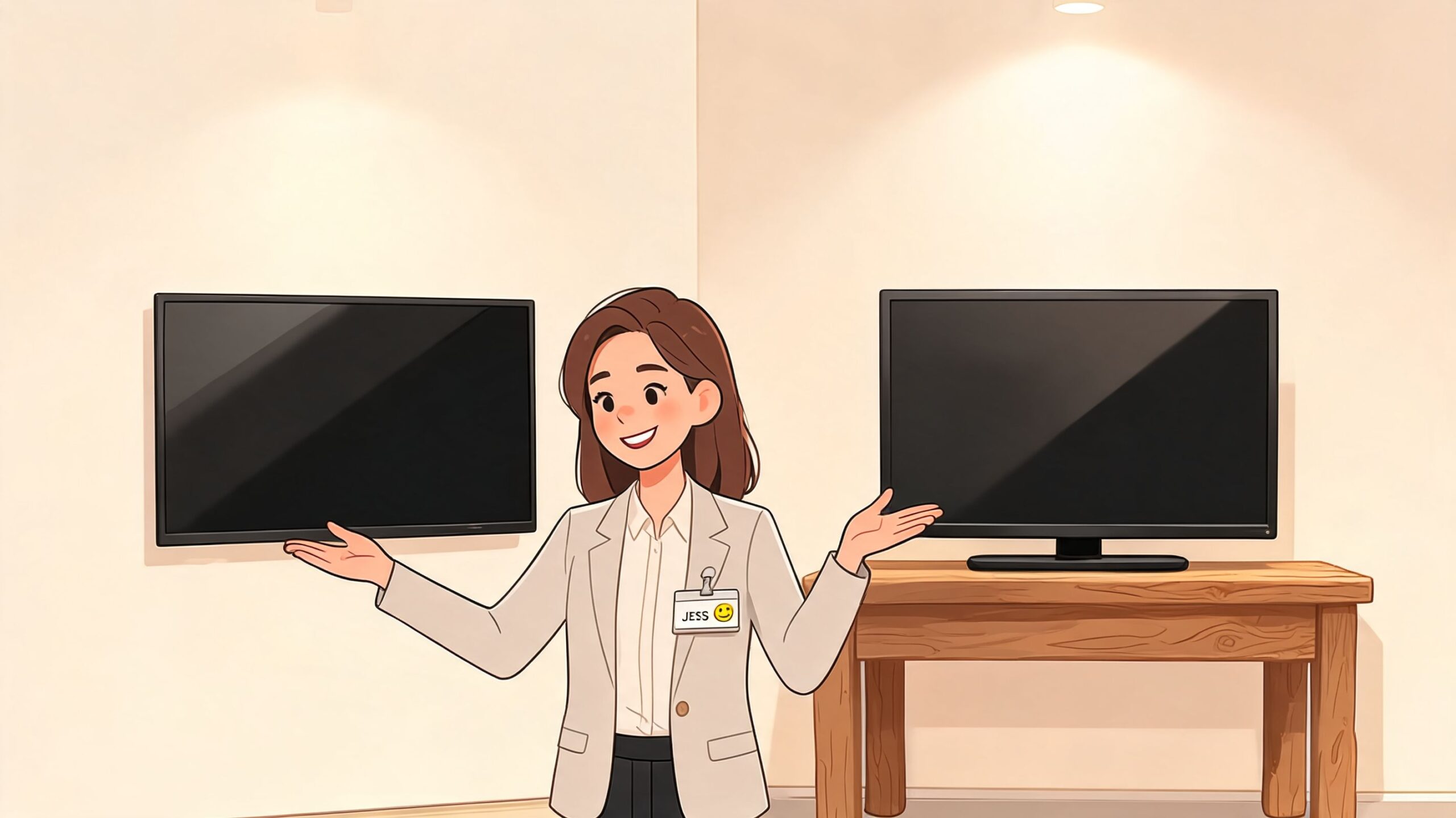
The trick is to compare them based on real life, not just photos.
When wall mounting makes sense
Wall mounting usually works well when you want a lighter look in the room. You free up floor area, cleaning gets easier underneath, and the TV can sit above a lower cabinet instead of taking over the whole top surface.
That can be especially useful in smaller homes or rooms where every inch counts. If your seating stays in one place and you already know which wall should be the focal point, a mounted screen can feel very intentional.
A few good fits for wall mounting:
- Small-space living: Apartments and condos often benefit from furniture with a lower visual footprint.
- Kid-conscious layouts: A mounted TV can keep the screen farther from bumps and grabs.
- Clean-lined rooms: If you like a modern, uncluttered look, wall mounting supports that style.
When a freestanding console may be the better call
A freestanding setup is often easier to live with if you like flexibility. You can move it, rearrange it, or change rooms later without patching walls and remounting hardware.
It can also be a practical choice if your wall is the unknown part of the project. Older plaster, tricky stud locations, or rental restrictions can push you toward a more grounded solution.
Here's a simple side-by-side look:
| Option | Usually works well for | Watch out for |
|---|---|---|
| Wall mount | Smaller rooms, modern layouts, open floor feel | Less flexible once installed |
| Freestanding console | Easy setup, future rearranging, rentals | Uses more visible floor space |
If you're furnishing a smaller TV area, browsing examples like a TV stand for a 36 inch TV can help you picture how scale changes the decision. A modest screen in a compact room may not need a dramatic wall treatment at all.
Sometimes the smarter choice isn't the flashier one. It's the one that fits your wall, your storage needs, and how often you change your room around.
Understanding Mounts Weight and VESA
This is the part that sounds technical, but it's not as intimidating as it seems.
Two things matter right away. Will the mount fit your TV? And can it safely hold the weight? If you answer those clearly, you avoid a lot of headaches.
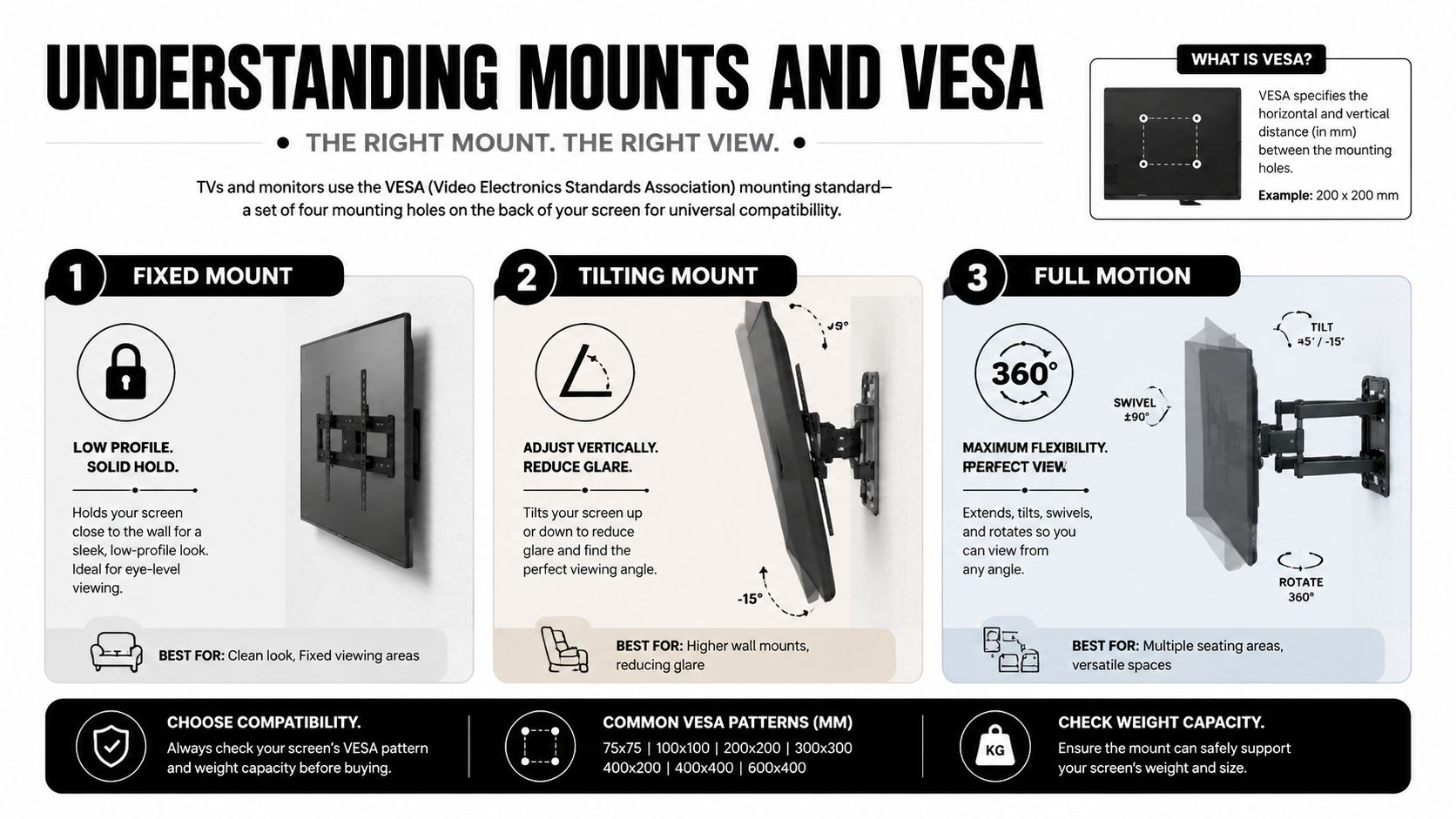
What VESA means
VESA is the hole pattern on the back of your TV. It's the spacing between the four mounting holes, measured horizontally and vertically in millimeters. The mount has to match that pattern.
According to Vogel's guide to VESA patterns, smaller TVs often use 100×100 mm, many 55-inch sets commonly use 200×200 mm, larger TVs often move to 300×300 or 400×400 mm, and TVs larger than 65 inches may use 600×400 mm. That range is why screen size alone doesn't tell the whole story.
If you're shopping in person, one easy move is to bring the TV model number and the rear-hole spacing. If you're unsure how to size the furniture around it, our guide on how to measure furniture is a handy companion.
The three mount types
Mounts usually fall into three main categories:
Fixed mount
This sits closest to the wall. It's tidy, simple, and usually the least fussy choice.Tilting mount
This lets the screen angle slightly up or down. It helps when the TV must sit a bit higher than ideal.Full-motion mount
This swings and extends. It's useful if you watch from different spots or need more angle control.
Why weight limits matter
Many shoppers get tripped up at this stage. A mount isn't judged by TV size alone. It also has a tested load capacity, and the type of mount changes that limit.
Industry guidance from Mount-It's explanation of TV wall mount weight limits notes that fixed mounts can often hold 100 to 200 lbs, while full-motion mounts may have a lower capacity of 50 to 150 lbs because extending the arm creates additional force. That mechanical pressure increases stress at the wall connection.
Here's the plain-English version:
- Fixed mounts keep the TV close to the wall, so the weight pulls more directly downward.
- Full-motion mounts pull outward too, which adds force at the bracket and fasteners.
- Your wall matters as much as the mount because all that force has to go somewhere.
A full-motion mount may look more flexible, but it asks more from the wall behind it.
If you want the safest route, check four things before you buy:
- TV weight: Use the actual weight, not a guess based on screen size.
- VESA pattern: Match the holes exactly.
- Wall type: Drywall alone is not the same as solid framing.
- Use habits: If the arm will move often, choose hardware and installation with that repeated stress in mind.
Where to Place Your Wall Mounted TV
A TV can be mounted securely and still feel wrong. Usually that comes down to height.
The goal is comfort. You shouldn't have to tip your chin up for a whole movie or slump down to watch the news. Good placement keeps the screen where your eyes naturally land when you're seated.
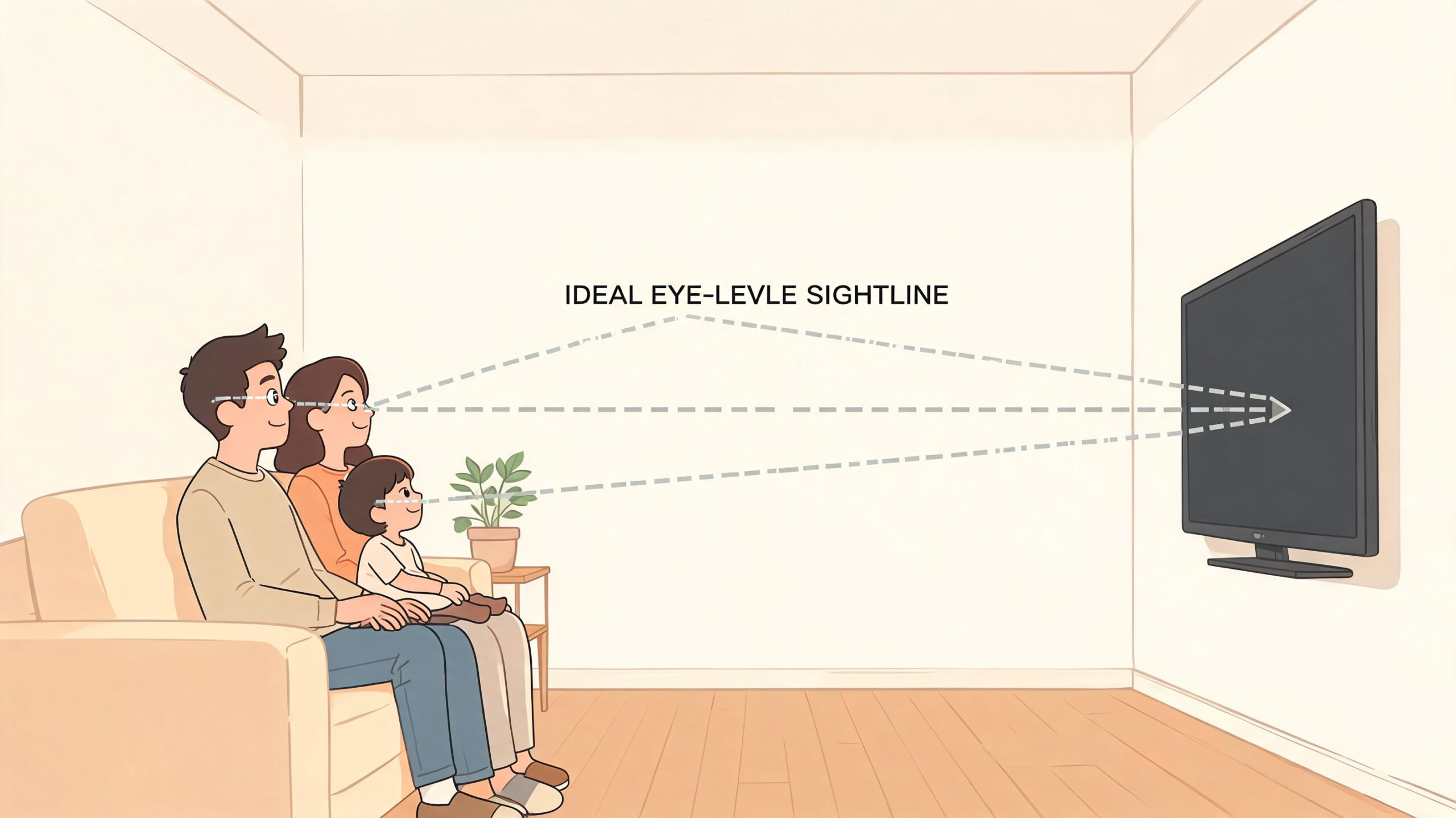
Start with seated eye level
A helpful reference point comes from this console and wall-mount placement guide, which suggests the center of a 65-inch TV should be about 65 inches from the floor, paired with a media console that is 24 to 30 inches tall. That combination tends to support a comfortable viewing angle from the sofa.
That doesn't mean every room should copy those exact numbers. It means there's a relationship between the mounted screen and the furniture under it. If the cabinet is too tall, the TV often ends up too high. If the cabinet is very low, the wall can feel empty unless the proportions are handled carefully.
A simple placement checklist
Before anything gets installed, stand in the room and check these:
- Seating position: Sit in your usual seat and note where your eyes naturally rest on the wall.
- Window glare: Daylight can turn a beautiful setup into a mirror.
- Room traffic: Don't place the screen where people constantly walk across it.
- Furniture width: The console should visually support the TV, not look undersized.
For more room-planning help, our complete guide to finding optimal TV positioning walks through the layout side of the decision.
Think of the whole wall, not just the screen
A mounted TV works a lot like hanging artwork, except it also has to function every day. You want balance. If the TV sits above a cabinet, the spacing between them should look intentional and still leave room for a sound bar, décor, or access to components.
The room feels better when the TV height, the cabinet height, and the seating height all agree with one another.
That's why we often encourage people not to rush this step. Painter's tape on the wall can help you outline both the TV and the cabinet before anything is permanent.
Finding Cabinetry for Your Wall Mounted TV
The room starts to feel like home instead of a tech project at this point.
A mounted screen handles the viewing side. The cabinet underneath handles the living side. It stores components, hides clutter, supports the style of the room, and softens the look of a large black rectangle on the wall. For many homes, the furniture is what makes wall mounted units for tv feel warm instead of cold.

Why material matters
You'll see a big difference between furniture that only looks good on day one and furniture that keeps working year after year. Solid wood, especially in well-built USA-made and Amish-made pieces, tends to bring more depth, character, and staying power to a room than lightweight alternatives.
That matters in a TV area because entertainment furniture gets used hard. Doors open and close constantly. Shelves carry components. Cords get adjusted. Remotes, game controllers, and speakers seem to multiply overnight.
A sturdy wood cabinet also helps visually anchor a mounted TV. That's especially useful if you're trying to blend modern electronics with a cozy, family-focused room.
Features worth caring about
A good-looking cabinet can still be frustrating if it ignores the practical stuff. One of the most useful pieces of guidance for modern media furniture is to think ahead. This discussion of future-proof media units points out that buyers should prioritize modular backs, removable shelves, and easy cable access so the unit still works when the TV changes in 3 to 5 years.
That's wise advice.
Look for details like these:
- Cable access: Openings in the back or removable panels make setup and troubleshooting much easier.
- Adjustable shelving: Components change. Storage should adapt with them.
- Ventilation space: Electronics need breathing room.
- Service access: You shouldn't have to empty the whole cabinet just to reach one cord.
- Flexible width and scale: The furniture should still look right if the next TV is a bit larger.
Floating look or grounded look
Some homeowners love a floating console under a mounted TV. It can look sleek and save visual space. Others prefer a low, grounded cabinet in solid wood because it brings warmth and makes the room feel more finished.
Here's a quick comparison:
| Cabinet style | What it gives the room | Best fit for |
|---|---|---|
| Floating console | Airy, modern, open floor look | Smaller rooms, minimalist spaces |
| Low solid wood cabinet | Warmth, presence, storage depth | Family rooms, mixed-style homes |
If you want to explore furniture built around your room and your storage needs, customized TV stands are one way to compare layouts, wood tones, and functional details before settling on a single direction.
Match the furniture to real life
A family that streams everything may need less enclosed storage than a family with gaming systems, a sound bar, media boxes, and chargers in every corner. A condo owner may want small-scale cabinetry with lighter visual weight. Someone in a long-term home may decide it makes more sense to invest in a heavier solid wood piece that can stay through future remodels.
This is also the one place where it makes sense to compare options in person. BILTRITE Furniture-Leather-Mattresses carries entertainment furniture and solid wood choices in a showroom setting, which lets shoppers compare scale, finish, storage design, and construction before making a room decision.
Buy for the cables, the components, and the next TV. Not just for the photo you saw today.
That mindset usually leads to furniture that keeps serving the room instead of becoming the next thing you need to replace.
Safe Installation and Smart Solutions
A beautiful setup still has to be safe. This is the part where caution pays off.
The most overlooked part of many wall mounted units for tv isn't the TV or the cabinet. It's the wall itself. Guidance on flexible TV wall mounts and structural fit notes that checking stud type and condition is especially important in older homes, and that a lower-profile mount is often the safer choice when the wall has limitations.
That point matters a lot around Metro Milwaukee, where one neighborhood may have newer construction and the next may have older plaster walls, changed framing, or surfaces that need a closer look.
When DIY is reasonable
Some installations are straightforward. If the wall structure is clear, the mount matches the TV, and you're comfortable locating framing and following instructions carefully, a simpler fixed setup may be manageable.
A few signs a project may be DIY-friendly:
- The mount is low-profile: Less movement usually means fewer complications.
- The wall framing is easy to confirm: You know where the studs are and they're in good condition.
- Cable plans are simple: You're not trying to hide a whole stack of components inside the wall.
When to bring in help
A professional installer is worth considering when the wall is questionable, the TV is large, the mount articulates, or the room has accessibility concerns.
That includes situations like these:
- Older home walls: Plaster, patchwork repairs, or uncertain framing
- Frequent movement: A full-motion arm that will be pulled out and turned often
- Senior-friendly viewing: Placement needs to reduce neck strain and keep cords out of walking paths
The safest setup often looks calm and uncomplicated. That's not boring. That's smart.
If delivery and setup support are part of your furniture purchase, ask what's included. Even when the furniture itself is simple, having experienced people help coordinate the cabinet, TV height, and room flow can make the project much smoother.
Come Say Hi and Plan Your Space
A wall-mounted TV project gets easier once you stop thinking about it as one decision. It's really a handful of connected choices. The wall. The mount. The cabinet. The viewing height. The way your family uses the room every day.
That's also why so many people like working through it in person. Photos can help, but they can't tell you how a wood finish looks in real light, how deep a cabinet feels in a smaller room, or whether one console height makes more sense than another once you stand in front of it.
We've been a fourth-generation family business since 1928, and helping neighbors think through these practical home questions is still one of our favorite parts of the job. Our team has over 400 years of combined experience, and we're here to talk things through without pressure. Bring room measurements. Bring a photo of the wall. Bring the TV model number if you have it. That's often enough to start narrowing the field in a useful way.
You'll also get to see the kind of furniture that makes a mounted TV feel more inviting. Real solid wood. Amish-made and USA-made choices. Small-scale options for tighter spaces. Heavier-duty pieces for busy family rooms. Since we don't sell online, the showroom experience is where all those details come together.
We're proud to be local. We're proud to be family-owned. And yes, we're closed on Sundays and Mondays so our families can be with each other, too.
If you're ready to sort out wall mounted units for tv with real furniture, real guidance, and a local team that's been doing this for generations, come visit BILTRITE Furniture-Leather-Mattresses in Greenfield. We'd love to help you measure it, picture it, and choose a setup that fits your home.