Made in USA Furniture Living Room: Built to Last

You're probably doing what a lot of Milwaukee families do when the living room starts falling apart. You're staring at a sofa with sagging cushions, a recliner that leans a little too far to one side, or a coffee table that looked fine online and now feels flimsy in real life.
That's usually the moment people start searching for made in usa furniture living room options. Good. I think that's the right instinct.
Our family has been helping Milwaukee-area neighbors furnish their homes since 1928. We're a fourth-generation furniture store, and we've learned one simple truth: if you want furniture that handles kids, pets, movie nights, guests, naps, and daily wear, you need to look past the sales tag and start checking what the piece is made of.
Why Choosing USA-Made Furniture Matters to Your Family
A living room isn't a showroom. It's where your dog jumps up before you can stop him, where grandkids build blanket forts, where you collapse after work, and where everyone somehow ends up during the holidays. Furniture for that room needs to work hard.
That's why I'll always lean toward American-made pieces when families ask for advice. They're often built with a very different mindset. Not “ship it fast and replace it later.” Built to last, built to be used, and built by people who still take pride in what leaves the floor.

American craftsmanship still matters
The U.S. furniture manufacturing industry employs 269,177 workers across 5,649 companies as of 2025, according to IndustrySelect's review of U.S. furniture manufacturing. Those aren't abstract numbers to me. That's a lot of people making frames, sewing upholstery, milling lumber, finishing wood, and keeping real craftsmanship alive.
When you choose American-made living room furniture, you're supporting that backbone of skilled work. You're also giving yourself a better shot at getting a piece with better materials, clearer accountability, and construction you can directly inspect.
Practical rule: Buy furniture like you buy tools. If you expect to use it every day, buy the one made to take a beating.
Why this matters in Milwaukee
Milwaukee homes put furniture through a lot. Wet boots in winter. Humidity in summer. Heat drying everything out in January. Tight bungalows, older staircases, condo elevators, family rooms, finished basements. This is not a market for disposable furniture.
We've believed that for a long time, and it's one reason we've stayed focused on better-built American options. If you want a quick primer on why so many shoppers still seek out domestic construction, our guide to the advantages of buying furniture made in the USA lays out the big reasons plainly.
Here's my opinion. If you're furnishing the room your family uses most, buying cheap is usually the expensive move.
Spotting True Quality in Amish and Solid Wood Pieces
The words solid wood get tossed around too loosely. Same with Amish-made. If you're shopping seriously, you need to know what those labels should mean when you put your hands on the piece.
Start with this. Real wood furniture feels different. It has weight. The grain looks natural, not printed on. The edges and underside usually tell the truth faster than the top surface. Open a drawer, look behind a door, crouch down and inspect the bottom. That's where shortcuts show up.
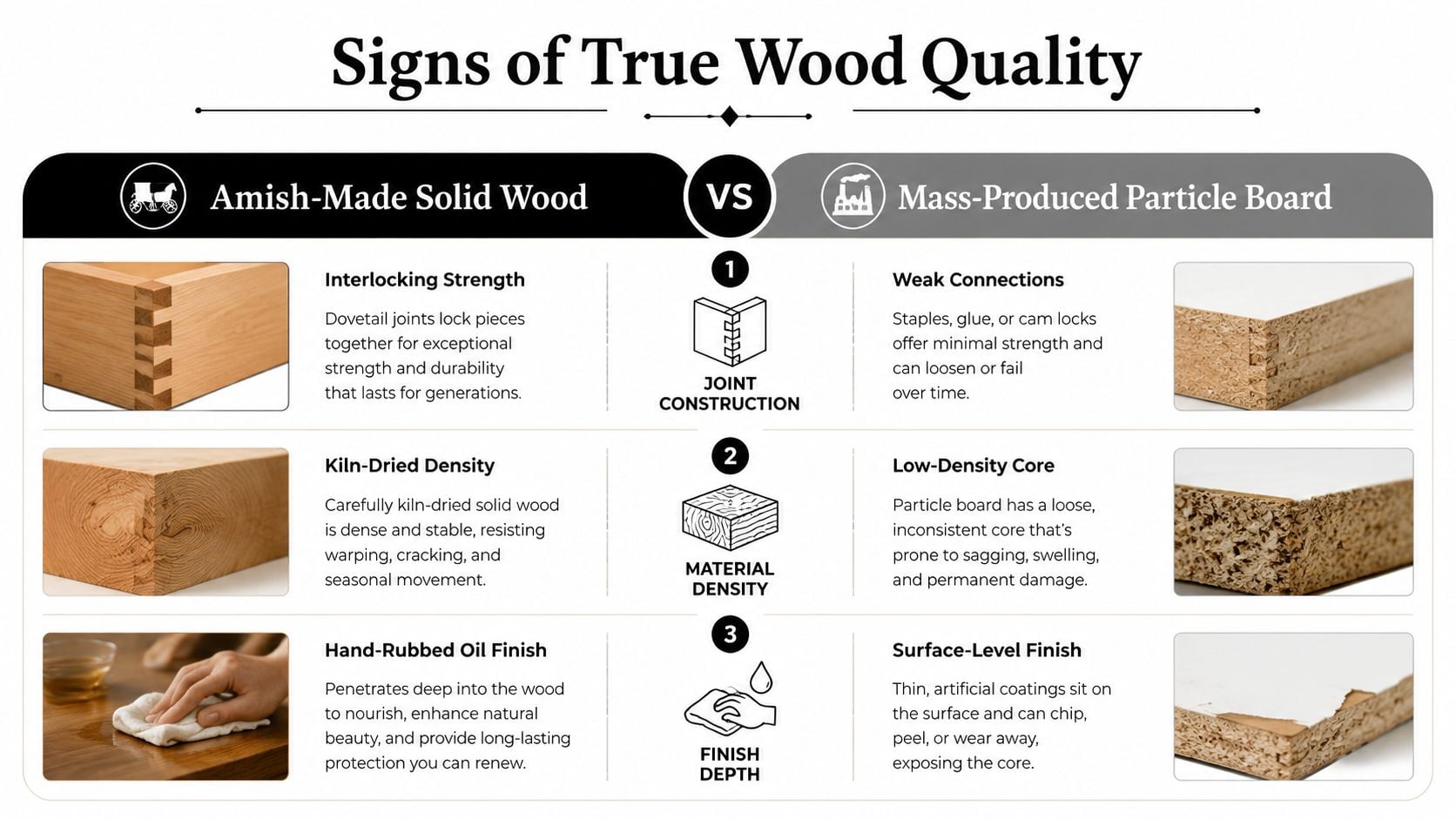
What actually separates good wood furniture from junk
According to this solid wood construction overview, USA-made solid wood furniture can have tensile strength 3 to 5 times greater than imported particleboard, and mortise-and-tenon joinery can create joints with shear strength over 2,000 lbs, while also resisting sagging better. That same source notes that proper kiln-drying helps prevent joint failures in changing Midwest conditions.
That matters here. Milwaukee weather swings are real. A living room table or entertainment console that isn't built from stable, properly dried material can loosen up, shift, or fail earlier than it should.
Solid Wood vs. Engineered Wood What's Inside Matters
| Feature | Solid Wood (Our Specialty!) | Engineered Wood (Particleboard/MDF) |
|---|---|---|
| Core material | Real hardwood such as cherry or hickory | Compressed wood fibers or particles |
| Joinery | Often traditional joinery such as mortise-and-tenon | More likely to rely on fasteners and mass-production methods |
| Feel in person | Heavier, sturdier, more substantial | Lighter, often hollow-feeling or less rigid |
| Response to years of use | Better suited for long-term daily wear | More likely to show breakdown at stress points |
| Repairability | Easier to refinish or repair | Harder to repair cleanly once damaged |
What Amish-made should tell you
Amish-made furniture usually signals a slower, more deliberate build process. You'll often see stronger joinery, better wood selection, and cleaner finishing work. Not flashy. Just honest construction.
When you shop in person, check these things:
- Drawer action: Open and close every drawer. It should move smoothly and feel stable, not rattle.
- Back panels: Look at the rear of the piece. Better furniture is usually more finished than you'd expect.
- Inside corners: Run your hand along them. Sloppy work hides there.
- Top surface: Look for depth in the grain and finish, not a plastic-looking skin.
A good wood piece should look finished even where most people won't look.
If you're specifically drawn to handcrafted American wood furniture, our page on the advantages of Amish furniture is worth a look before you visit the store.
Use the in-store shortcuts
We try to make this easier with clear in-store markers. If you see an Amish made icon or a Real Solid Wood icon, that helps narrow the field fast. Then do your own inspection anyway. I always encourage that.
You should never feel awkward checking the underside of a chairside table or opening every drawer in a console. Furniture that's built right can handle scrutiny.
How to Identify Authentic Made in USA Furniture
A lot of shoppers assume “Made in USA” means “assembled somewhere in America.” That's not enough. If you care about authenticity, ask sharper questions.
The Federal Trade Commission uses a stricter standard. For a sofa to carry a made-in-USA claim, the product must be “all or virtually all” made here. That means the meaningful parts and processing need to be domestic, not just the final stapling or boxing.

Ask what's under the fabric
According to BILTRITE's guide to American-made sofas, for a sofa to be labeled made in the USA under FTC guidance, it should be all or virtually all domestically sourced and assembled. That source also notes that high-resiliency foam at 2.5 lb/ft³ or higher can retain 90% of its shape after 100,000 compressions, and that this level of build quality is one reason some domestically made furniture offers 25-year warranties.
That's the kind of detail you want. Not vague language. Actual information about what's inside the seat, frame, and support system.
My in-store checklist for sofas and chairs
When you're shopping made in usa furniture living room pieces, ask these questions out loud:
Where is the frame made?
Don't settle for a fuzzy answer.What kind of foam is in the seat cushions?
High-resiliency foam matters because flat cushions ruin a sofa fast.Can the cushions be flipped or rotated?
That gives you more control over wear.What supports the seating area?
Springs and support systems make a major difference in comfort over time.What does the warranty cover? A long warranty doesn't fix bad furniture, but it can reveal how much confidence the maker has.
Store-floor advice: If a salesperson can't clearly explain the frame, cushion core, and support system, keep walking.
Bring your eyes, not just your phone
Online photos won't tell you enough. In person, you can sit in the chair, push on the arms, lift the cushion, and check how the deck and seams are put together. You can also compare solid wood pieces against look-alikes side by side.
If you want a better sense of how to spot genuine wood construction while you shop, read our guide on how to tell if furniture is real wood. It helps you separate attractive photography from real material quality.
Finding the Right Fit for Your Milwaukee Living Room
The “right” living room furniture isn't just about style. It's about scale, traffic flow, delivery access, and how your household lives.
That's especially true around Milwaukee, where one shopper may be furnishing a Bay View bungalow with tight doorways, another may be setting up a condo near downtown, and another may need supportive seating in a senior living setting. Those are three very different problems.

Three local room types we see all the time
A younger couple in a smaller apartment usually needs small-scale furniture. Not tiny furniture. Just pieces with cleaner proportions, tighter depths, and arms that don't eat up the whole room.
A growing family often needs heavy-duty seating. That means durable upholstery, stronger frames, and cushions that can handle real daily traffic without quitting early.
An older homeowner or caregiver may need easier seat height, firmer support, and straightforward access through halls, elevators, or narrower entrances. In those cases, come-apart sofas and sectionals can solve delivery headaches that stop other pieces cold.
The market has moved toward flexible living rooms
Mordor Intelligence's U.S. home furniture market report notes that living room furniture is the largest segment of the U.S. furniture market, that wooden furniture captured 39.26% share in 2025, and that current demand favors multifunctional, coordinated sets suited to modern living. The same report ties that demand to 1.47 million housing starts in 2024.
That matches what we see on the floor. People want sectionals that can anchor an open room, chairs that can move between conversation and TV seating, and tables that look good but also survive daily use.
What to measure before you shop
Bring these numbers with you:
- Room width and depth: Measure the usable space, not wall-to-wall if vents, radiators, or walkways cut into it.
- Doorways and stair turns: This matters more than shoppers think.
- Existing rug size: A new sofa can look wrong fast if the rug is undersized.
- TV wall or focal point: Your main seating has to work with where people look and gather.
One practical local option for shoppers who want to compare American wood construction in person is BILTRITE's solid wood furniture selection in Wisconsin, which includes living room pieces sized for different room layouts.
If a sofa fits the room on paper but blocks the path everyone uses, it doesn't fit.
My recommendation
Start with function, then choose style. Decide whether your room needs compact scale, deep comfort, firm support, modular flexibility, or tougher construction. Once you know that, the fabric, wood finish, and silhouette become much easier choices.
That's how you avoid buying a beautiful mistake.
Understanding Budget Durability and Long-Term Value
Let's talk money plainly. American-made solid wood and better-built upholstered furniture often costs more upfront. I still think it's the smarter buy for many households.
The reason is simple. Furniture isn't just a purchase price. It's a use-over-time purchase.
Cheap furniture gets expensive fast
According to Norwalk Furniture's made-in-USA overview, USA-made solid wood pieces have an average lifespan of 20 to 30 years, compared with 5 to 10 years for many imports. That same source says flip-able cushions can extend a sofa's life by 40%.
That is the essential budget conversation. If you buy one sofa and keep it for years with normal maintenance, that's one cost path. If you buy a cheaper one, fight sagging cushions, hate the way it looks after a few seasons, and replace it much sooner, that's another path.
What long-term value looks like
Here's where better construction pays off:
- Frames hold up longer: Less wobble, less creaking, fewer stress failures.
- Cushions stay useful longer: Especially if they can be flipped and rotated.
- Wood pieces are more repairable: Scratches and wear don't automatically end the piece's life.
- You're less likely to re-shop the same room: That saves money and aggravation.
Don't buy for move-in day only
A lot of people shop for how the room should look next weekend. I'd rather see you shop for how it should function years from now.
That doesn't mean buying the most expensive thing in the building. It means choosing the strongest value at the level your budget can support. For many Milwaukee families, that lands right in the sweet spot of affordable, better-quality American-made furniture.
If you want a practical framework for judging what's worth spending on, our guide on how to buy quality furniture is a good place to start.
Delivery Care and Maintaining Your Furniture
Delivery day matters more than people think. A well-built sofa can still get scarred, scraped, or forced through the wrong opening by careless handling. That's one reason local showroom buying still has an edge over mystery-box shipping.
We always tell shoppers to think through the path into the home before they fall in love with a piece. Measure doorways, stair landings, elevator depth, and hallway turns. If the room is tricky, ask about come-apart options early rather than after the sale.
Easy habits that protect your investment
A little maintenance goes a long way with living room furniture:
- Rotate seat cushions regularly: This helps wear stay more even.
- Flip cushions when the design allows it: That extends useful life and keeps favorite seats from wearing out first.
- Keep wood out of harsh direct sun: Sunlight can dry and fade finishes over time.
- Use a soft cloth for routine dusting: Don't attack wood with harsh household cleaners.
- Blot upholstery spills quickly: Rubbing usually makes a mess spread.
What to watch in Milwaukee homes
Season changes can be hard on both wood and upholstery. Dry indoor heat in winter and humid summer air can stress lower-quality materials faster. That's another reason stronger construction and stable materials matter.
Treat your sofa and wood tables like long-term household equipment, not disposable decor.
A good delivery team also helps set you up right from day one. They place the piece carefully, check fit, and reduce the chances of damage during setup. That kind of service is hard to appreciate until you've had the opposite.
Your USA-Made Furniture Questions Answered
People usually come in with a few of the same questions, so let's clear up the big ones.
Is Amish furniture always made in the USA
Usually, Amish-made furniture points to domestic craftsmanship, but you should still ask where the piece was built and what materials were used. Don't assume. Verify.
Does made in usa furniture living room style have to look traditional
Not at all. You can find American-made living room furniture in classic, transitional, and clean modern looks. What matters is the construction under the style.
Is solid wood always the right answer for every piece
For case goods like end tables, coffee tables, consoles, and bookcases, I'm strongly in favor of solid wood if the budget allows. For upholstery, the bigger focus should be frame quality, cushion construction, support system, and whether the piece fits your room and daily use.
Can smaller homes still use better-made furniture
Absolutely. Smaller spaces need smarter scale, not lower standards. In fact, tight rooms often benefit more from buying carefully because every piece has to earn its keep.
Why shop in person instead of rolling the dice online
Because you can test the seat, inspect the wood, check the scale, compare fabrics, and ask direct questions. You also get help from people who've seen what holds up and what doesn't.
That matters to us. We've been serving Metro Milwaukee since 1928. Our team brings over 400 years of combined experience, and we use that experience to guide people without pressure. We also don't sell online, and we're closed on Sundays and Mondays so our families can be with each other. We're proud of that.
If you want living room furniture that feels good, fits your space, and stands up to Milwaukee life, come into the showroom and test it with your own hands. That's still the smartest way to buy.
We'd love to see you at BILTRITE Furniture-Leather-Mattresses in Greenfield. Come say hi, bring your room measurements, and let our family help your family find living room furniture built for real life.