Round and Oval Dining Tables: Best Styles for 2026


You're probably doing what a lot of folks around Metro Milwaukee do when it's time for a new dining set. You stand in the room, look at the walls, look at the traffic path to the kitchen, and ask the same question we hear in our showroom all the time. Should I go round, or should I go oval?
That question matters more than people think. A dining table isn't just a style choice. It affects how your family moves through the room, how comfortably people sit, how sturdy the table feels during everyday life, and whether you'll still like it after years of dinners, homework, card games, and holiday meals.
We've been helping families sort this out since 1928, and our opinion is simple. Round tables are great for conversation and compact spaces. Oval tables are often the smarter pick when you want better seating capacity without the hard edges and traffic jams of a rectangular table. If you've got kids, guests, grandparents, or a tighter room layout, the details matter.
The Great Dining Table Debate
A young family walks in, and the story is usually familiar. They've got a dining room that isn't huge, a kitchen path that gets busy, and a wish list that sounds totally reasonable. They want enough seating for regular meals, enough strength for daily use, and a shape that doesn't make the room feel cramped.
That's where round and oval dining tables start to separate themselves.
A round table feels social right away. Everyone can see everyone. No one gets stuck at a far corner. In a breakfast nook or a square dining room, round often feels natural and relaxed.
An oval table solves a different problem. It gives you the longer seating profile many families need, but it softens the footprint. You keep better movement around the room, especially at the ends, and the whole setup usually feels easier to live with.
Our take: If your room is more square than long, start with round. If your room is narrow, open to another space, or used as a pass-through, start with oval.
We're a fourth-generation family business, so we think about furniture the same way many of our customers do. Not as a showroom prop. As part of real life. The dining table is where school projects land, where coffee turns into long conversations, and where everybody gathers when life gets busy.
What actually decides it
Selecting a table usually begins with aesthetics. That's normal. However, shape should be determined by three practical questions first:
How many people sit there most days
Daily use matters more than holiday overflow.How people walk around the table
If the room doubles as a walkway, shape changes everything.What kind of wear the table will take
A busy family needs a sturdier answer than a formal room used a few times a year.
If you answer those thoughtfully, the right shape usually becomes obvious.
How Many People Can We Seat
Saturday supper hits, the kids invite a friend, Grandma comes over, and suddenly the table that looked perfect in the showroom feels tight in real life. That is the moment table shape stops being about style and starts being about function.
For most Metro Milwaukee families, the right question is not how many people you can squeeze in once. It is how many people you can seat comfortably, week after week, without bumping knees, crowding plates, or fighting the base.
Here's the practical breakdown.
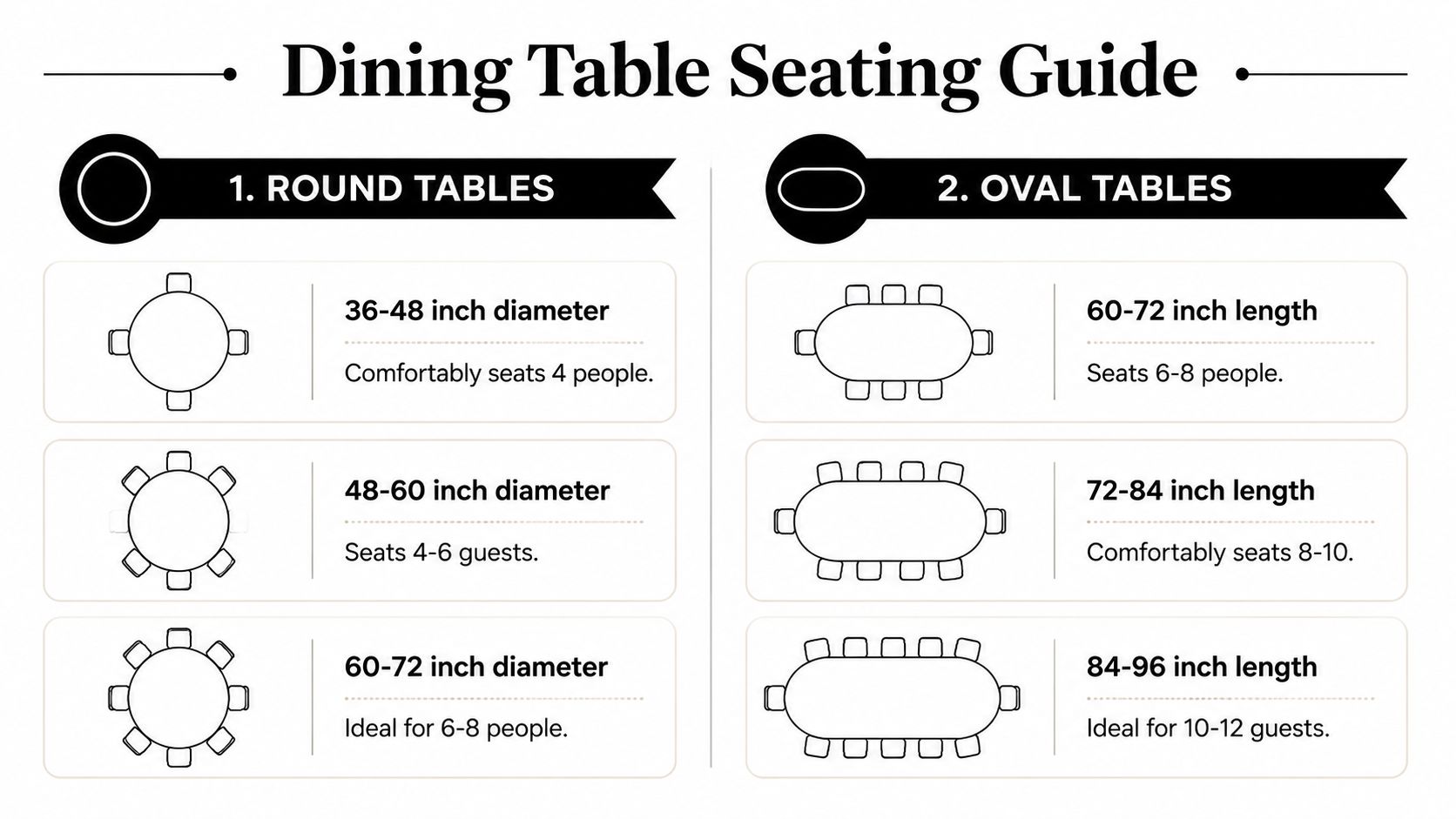
| Shape | Dimensions | Comfortable Seating | Maximum Seating |
|---|---|---|---|
| Round | 54" diameter | 4 to 6 | 6 |
| Oval | 71" x 39" | 6 | 8 squeezed |
| Rectangular | 72" x 36" | 6 | 8 squeezed |
Round tables are better for everyday conversation
A round table does its best work with four people. Six can work too, if the diameter is large enough and the chair size stays reasonable. That setup feels balanced, easy to reach across, and comfortable for long meals.
Push beyond that, and round starts asking more from the room and from the people sitting there. The tabletop gets bigger fast. Reaching the middle gets harder. Serving dishes and school projects need more surface than shoppers expect.
For couples, small families, empty nesters, and seniors who want softer edges and easier face-to-face seating, round is usually the smarter choice.
Oval tables handle growth better
Oval gives you a more usable seating line without the hard corners of a rectangle. That matters in real homes. A family of five or six can live with an oval table every day and still pull up another chair when cousins or neighbors drop by.
We recommend oval often for busy households, smaller homes that still need flexibility, and anyone who wants a table that can stretch with life. It is especially practical in solid wood with leaves, because you can keep it compact most of the time and expand it when the crowd gets bigger.
That is one reason Amish-made and USA-made oval tables have such staying power around here. Good construction, a stable base, and real hardwood make extra seating feel dependable instead of makeshift.
Our advice: buy for normal life first. Holiday overflow is easy to solve with a leaf or an extra chair. Daily crowding gets old fast.
Three sizing rules we give customers in our showroom
Count your regular diners first
If four people eat there most nights, buy for four to six comfortable seats, not the biggest number the table might handle once a year.Check the base, not just the top Pedestal bases usually make it easier to fit people around round and oval tables. Four-leg designs can steal knee room and limit where chairs fit.
Plan for real chairs
Wide, supportive dining chairs take up more space, and that is usually a good thing. Comfort wins. If you want help matching table size to chair width, our dining table size guide for room planning and seating fit lays it out clearly.
A good dining table should serve your family for years, not just photograph well on day one. Choose the shape that fits your everyday seat count, your room, and the way your household naturally gathers.
Creating Flow in Your Dining Space
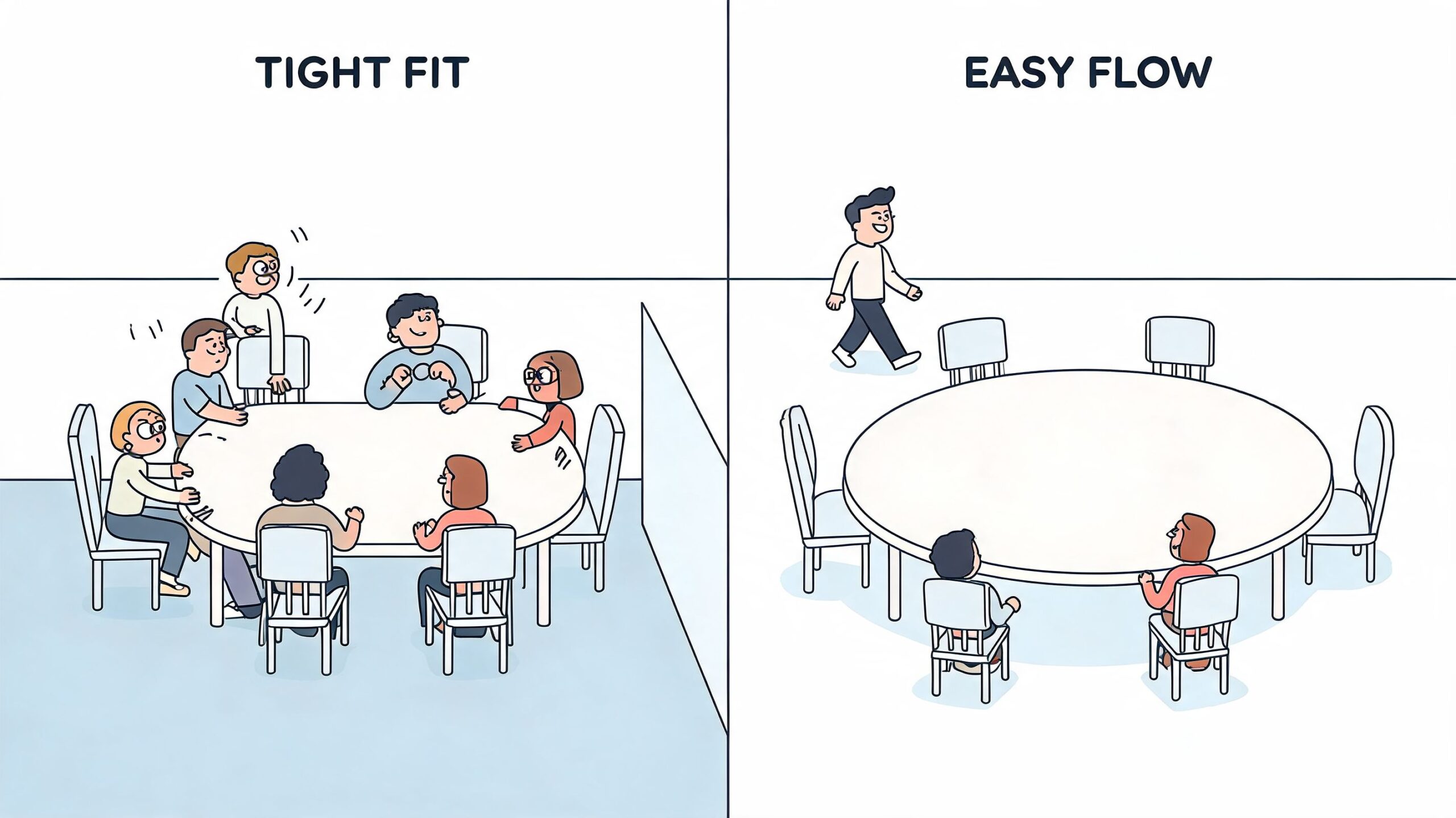
Dinner gets frustrating fast when the table blocks the path from the kitchen, forces people to squeeze behind chairs, or leaves someone catching a corner in the hip on the way through. Good flow fixes that. In busy Milwaukee homes, especially smaller dining rooms, open layouts, and condos, table shape changes how the whole space works every day.
Where round wins
Round tables are the easier fit in square rooms and tighter eat-in spaces. The curved edge keeps walkways softer and easier to use, which matters with kids circling the table, grandparents getting in and out of a chair, or anyone using a walker. No sharp corners also means fewer bruised legs and less visual bulk.
They create a friendlier center point, too. Everyone can see each other easily, and the room feels balanced instead of pulled toward one long side.
Where oval wins
Oval tables are our practical pick for more traffic-heavy layouts. You still get softened ends, but the longer shape does a better job in narrow rooms, open concept homes, and dining spaces that double as a pass-through. People can move around the table more naturally than they can with a hard-corner rectangle, and you gain length without making the room feel boxed in.
That is why oval works so well for real family life. It gives you more usable table surface, easier movement at the ends, and a shape that feels welcoming instead of stiff.
Our straight recommendation
Pick oval if your dining area sits between rooms, runs long and narrow, or gets crossed all day. It usually solves more problems.
Pick round if your room is close to square, your household is smaller, or you want the easiest movement around every side.
A simple rule helps:
- Choose round if you want the best fit for a compact, centered room.
- Choose oval if you need better traffic flow in a narrow or multi-use space.
- Choose curved edges over corners if your home has kids, seniors, or constant walk-through traffic.
We help Milwaukee families make this call every day at BILTRITE, and the right answer usually comes down to how the room works on a Tuesday night, not how it looks in a staged photo. If you want more layout ideas, our guide to maximizing your dining space with the right table shapes and seating arrangements walks through it clearly.
Choosing Materials Built for Family Life
A dining table for real family use has to do more than look good. It needs to stay steady through homework, holiday meals, elbows on the edge, and years of people getting in and out of their chairs.

Solid wood beats trendy shortcuts
We're proud to sell USA-made and Amish-made dining furniture because it holds up the way family furniture should. Solid wood has the weight, strength, and repairability that busy homes need. Scratches can be touched up. Wear usually adds character instead of ruining the top. And the table still feels substantial years later.
That matters in Metro Milwaukee homes where one table often does everything. Dinner happens there. Grandkids color there. Somebody sorts mail there. Somebody else pushes off the edge to stand up. In small homes, condos, and senior living spaces, the dining table earns its keep every day.
Independent guidance from the Forest Products Laboratory of the U.S. Forest Service supports what we see in our showroom all the time. Well-built solid wood furniture is repairable, refinishable, and made for long service. Cheap substitutes usually are not.
Base construction matters more than shoppers think
Round and oval tables put a lot of attention on the base, especially pedestal designs. That base has to carry the weight of the top and stay stable when people lean in, slide dishes, or brace themselves while sitting down. If the joinery is weak or the pedestal is underbuilt, you feel it fast.
We tell customers to look underneath. Check how the base connects to the top. Ask whether the builder uses solid joinery, such as mortise-and-tenon construction, and whether the table feels planted on the floor instead of top-heavy. Amish builders tend to get this right because they build for decades of use, not a quick trend cycle.
Our rule: If a table wobbles in the showroom, leave it there.
That advice matters even more for seniors and multigenerational families. A stable table is easier to use, safer to lean on lightly, and less annoying to live with.
What we tell families to avoid
Some materials do not age well in hard-working homes. We steer families away from these when durability is the priority:
Thin veneer tops in heavy-use spaces
Chips, edge wear, and peeling are harder to fix than normal wear on solid wood.Glass tops for everyday family dining
They show fingerprints fast, need constant wiping, and can feel unforgiving with kids around.Lightweight pedestal tables with small footprints
They may look clean, but they often lack the planted feel that makes a table comfortable for daily use.Fussy finishes that show every mark
If you know the table will be used morning to night, choose a finish that hides routine wear instead of advertising it.
One option many Milwaukee-area shoppers consider is BILTRITE Furniture-Leather-Mattresses, which carries USA-made, Amish-made, solid-wood, and heavy-duty dining choices in round and oval styles for family, apartment, and senior-living needs.
Wood species and finish still matter
Once the construction is right, then you can choose the look. Oak is tough and forgiving. Maple gives you a clean, versatile grain. Cherry brings warmth and a richer traditional feel over time. The right pick depends on how you live, not just what catches your eye on the sales floor.
Finish matters just as much as species. A table used every day should have a finish that stands up to spills, wiping, and routine wear. Our guide to the best wood finish for a dining table lays out what works best for active homes.
If you want one straight recommendation from our family, here it is. For busy households in Milwaukee, buy the best solid wood construction you can afford the first time. You will live with it longer, repair it more easily, and enjoy it a whole lot more.
How to Measure and Pick Your Chairs
A beautiful table that doesn't fit the room is still the wrong table.
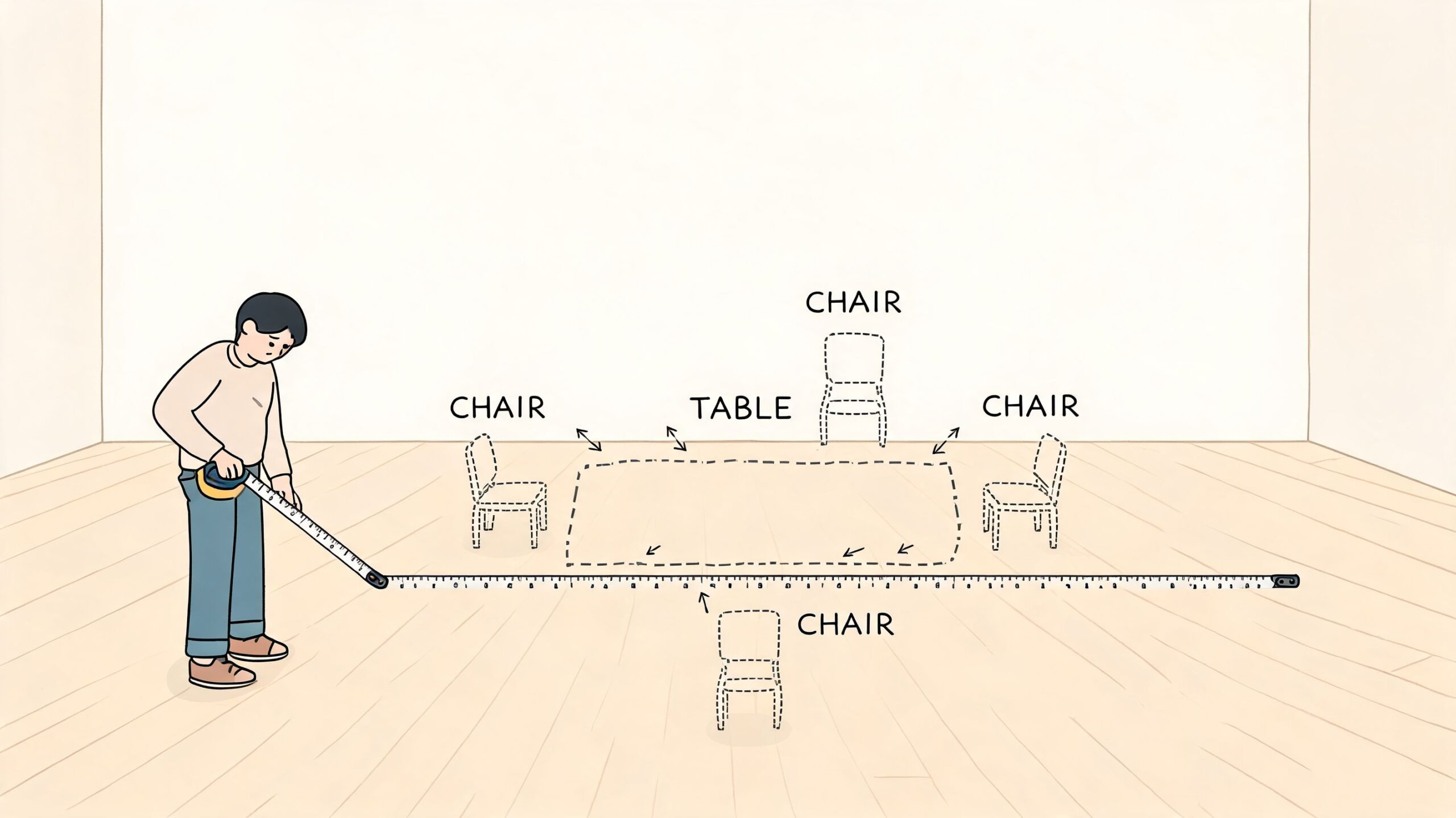
This is the part people skip, and it's usually the part that saves the most frustration. Before you fall in love with a round or oval shape, mark it out on your floor. We've been recommending this trick for years because it works.
Use painter's tape first
Take the dimensions of the table you're considering and tape the outline directly onto the floor. Then walk around it. Pull a chair into place. Pretend someone is sitting there while another person passes behind.
You'll learn more in five minutes of floor taping than you will from staring at dimensions on a product tag.
Tape the footprint. Walk the room. If it feels tight without chairs, it will feel worse after delivery.
Measure for movement, not just fit
A table can technically fit and still make the room annoying. You need space to sit down, slide chairs back, and move through the room without everyone doing a sideways shuffle.
Focus on these three checkpoints:
Chair pull-out room
Make sure diners can get in and out without scraping walls or nearby furniture.Walking paths
If the room connects to a kitchen, patio door, or hallway, leave enough room for traffic.End clearance
This matters a lot with longer tables and can decide whether oval makes more sense than another shape.
Chair choice changes the whole setup
Chairs don't just decorate the table. They affect capacity, comfort, and legroom.
A pedestal base usually gives you more freedom to place chairs where you need them. A table with legs or a heavier support structure may limit where chairs can go, especially at the ends. That's why we always tell shoppers to choose the table and chairs together if possible.
A few practical pairings work especially well:
Round table plus pedestal base
Great for easy chair placement and a softer, social look.Oval table plus slimmer side chairs
Helps keep the line of the table clean and makes extra seating easier.Busy family setup plus easy-clean chair surface
Looks matter, but cleanup matters too.
Chair scale counts too. Wide arms can eat up space fast. In a compact room, armless or lightly scaled chairs often make the whole set work better. If you're sorting through styles, our guide on how to choose dining chairs is a helpful place to compare options.
Come On Down to Our Showroom
Saturday afternoon hits. The kids are hungry, somebody drops a fork, Grandma needs a chair she can slide in and out of easily, and the patio door keeps swinging open behind the table. That is when table shape stops being a style choice and starts being a daily-life decision.
That is why our showroom matters.
You can read dimensions online all day. You still will not know how an oval table feels in a tighter condo dining area, how a round pedestal handles real chair movement, or whether a top and base feel solid enough for years of family use. In person, you can sit down, check the legroom, test the chair spacing, and put your hands on the wood, finish, and joinery. If you care about durability, that matters.
We have served Metro Milwaukee since 1928, and we still believe local service beats guesswork. Dining furniture questions usually come down to construction, comfort, delivery access, and whether the table will hold up in a busy home. That is the conversation we like having.
Why in-store matters with round and oval dining tables
Round and oval tables are easy to misread online. Photos flatten scale. A table that looks light and compact on a screen can feel bulky once chairs are in place. Another one can look large in a staged photo and turn out to fit beautifully in a smaller room because the corners are softened and the base leaves more knee space.
In the showroom, you can compare the details that change daily use:
Top thickness and edge profile
These affect comfort, visual weight, and how substantial the table feels.Base design and stability
Pedestals need to feel planted. A good one does.Solid wood construction
You can see and feel the difference between furniture built for a few years and furniture built for the long haul.Real chair fit
You can test whether the setup works for kids, guests, and older family members who need easier access.
Delivery matters too
A beautiful table does not help if it cannot get through the front door.
That problem comes up all the time in Milwaukee bungalows, condos, apartments, and senior living spaces. According to one manufacturer of come-apart tables, some round and oval designs over 48 inches can be disassembled, with pedestal sections removed to help them fit through standard residential doorways and tighter stair access in homes where entry is the primary challenge, not the dining room itself.
Smart table buying includes the path into the home, the turn at the hallway, and the staircase. We help customers sort that out before delivery day, not after.
A local family business still feels different
We are proud of what we sell and how we do business. Family-owned. Milwaukee-rooted. Focused on better-built furniture with USA-made and Amish-made options that stand up to real use. That means solid wood choices for families who want long-term value, smaller-scale options for condos and apartments, and sturdy tables that work well for seniors who need dependable function, not fuss.
If you want to compare shapes, wood species, finishes, and construction in person, visit our Metro Milwaukee showroom location. We will help you find a table that fits your room, your family, and the way you live.
If you are ready to sort through round and oval dining tables with real guidance, come visit BILTRITE Furniture-Leather-Mattresses in Greenfield. We will help you measure smart, compare solid wood construction, and choose a table that works for your family, your room, and your routine.