Shop Unique Accent Chairs for Living Room at BILTRITE

That empty corner in your living room can be surprisingly loud. You walk past it every day and think, “Something’s missing.” Not a giant sofa. Not another table. A chair. But not just any chair.
You want one of those unique accent chairs for living room spaces that changes the whole mood of the room. A chair with personality. A chair that feels inviting when friends stop by, looks good from across the room, and still feels solid years later.
That’s how a lot of folks arrive at our showroom. Our family has been helping Metro Milwaukee homes feel more comfortable since 1928, and after four generations, we’ve learned that “unique” means a lot more than unusual shape or trendy fabric. A chair can be special because of its design, yes, but also because of how it’s built, where it’s made, and how it fits your everyday life.
Welcome to Your Hunt for a Truly Special Chair
A lot of people start their chair search online, scroll for a while, save a dozen favorites, and end up more confused than when they started. That makes sense. There’s a lot out there, and demand is clearly strong. The U.S. market for accent chairs for living rooms sees 6,473 weekly searches on Amazon alone as of April 2026, and it sits within a $15.2 billion living room furniture market, with a 25% surge in demand for customizable, quality options that stand out, according to this accent chair market overview.
The trouble is, a screen can only tell you so much. It can show color. It can hint at shape. It usually can’t tell you whether the seat feels supportive, whether the frame feels sturdy, or whether that “special” chair will still look good after real family use.
That’s why we like to slow the process down a little.
A good accent chair does three jobs at once:
- It fills a need. Maybe you need extra seating, a reading spot, or a place to pull on shoes.
- It adds character. The chair should bring some energy to the room instead of blending into the background.
- It earns its place. It should feel worth the floor space it takes up.
Practical rule: If a chair is only interesting to look at, but you’d never want to sit in it for a full conversation, keep shopping.
If you want ideas before heading into a showroom, our guide to living room ideas with accent chairs is a helpful place to start. It can help you sort out whether you need a bold focal chair, a smaller-scale piece, or something classic that works with almost anything.
What Really Makes an Accent Chair Unique
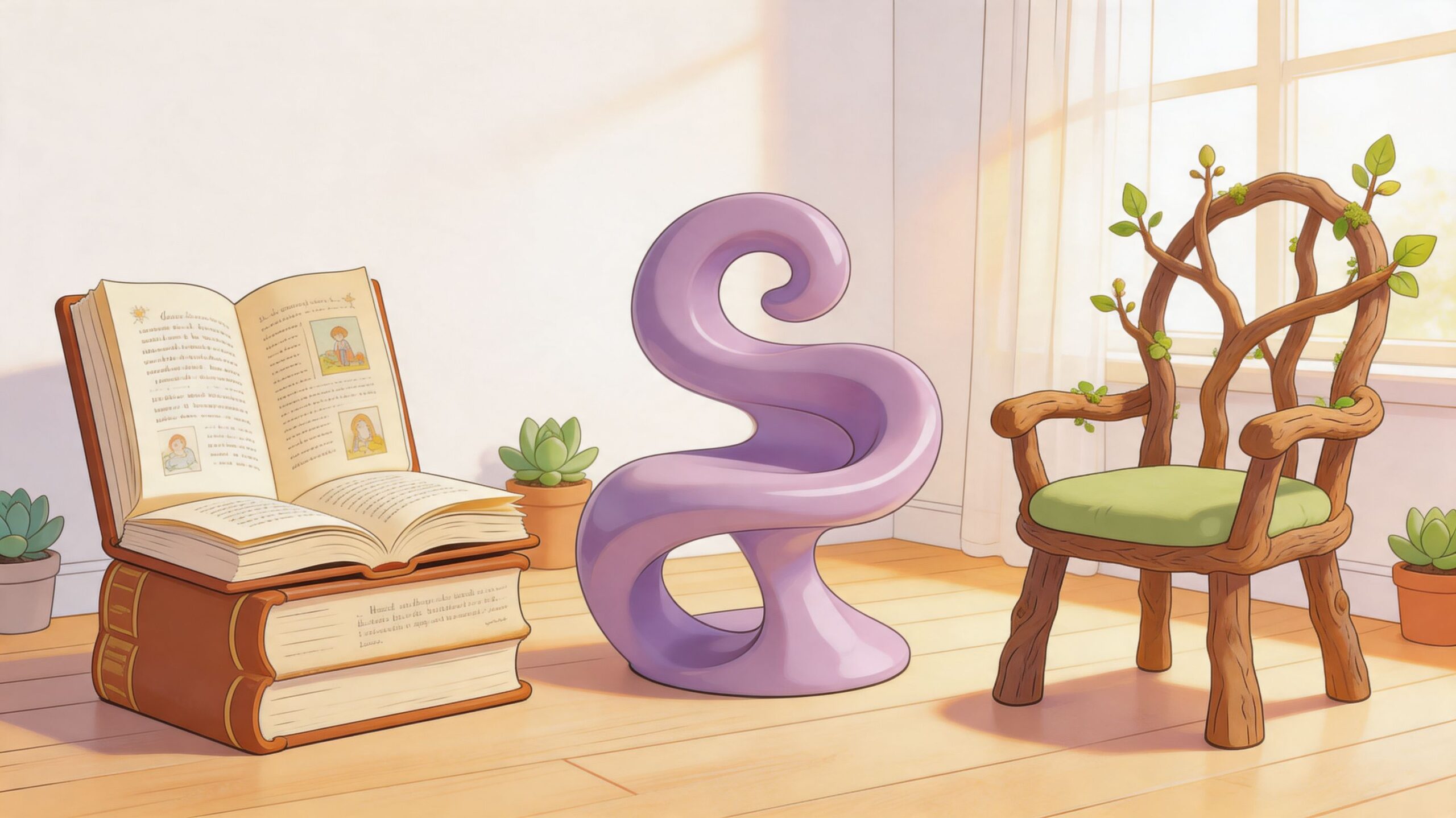
“Unique” gets used so often in furniture that it can lose meaning. A bright print gets called unique. A curvy arm gets called unique. A color nobody expected gets called unique.
Sometimes that’s fair. But a chair becomes more interesting when it has substance behind the style.
Unique starts with story
Accent chairs didn’t appear out of nowhere. They evolved from 18th-century English Windsor chairs, and the American Arts & Crafts movement helped turn solid oak seating into something people admired for craftsmanship as much as function. By 1950, post-war production in the U.S. had risen 300%, and accent chairs had become stylish focal points in the home, as noted in this history of accent chairs in the U.S. market.
That history matters because it explains why some chairs still feel grounded and timeless today. A chair with visible wood grain, shaped arms, or honest joinery carries a different presence than something built only to catch your eye for five seconds online.
Unique also means material choices
Two chairs can have a similar silhouette and feel completely different in person. One may have depth, warmth, and texture. The other may feel flat and temporary.
That’s where material becomes part of the chair’s identity.
| What you notice | What often creates it |
|---|---|
| Warmth and richness | Solid wood with visible grain |
| Character | Hand-finished details |
| Tailored look | Thoughtful upholstery choice |
| Staying power | Sturdier frame construction |
We’ve always had a soft spot for chairs that show their making. That might mean Amish-crafted oak, a USA-made frame, or upholstery with texture that gives the piece a little soul. If you want to understand how fabric and leather change the personality of a chair, our overview of upholstery materials makes that easier to sort out.
A chair doesn’t have to shout to be memorable. Sometimes the most distinctive piece in the room is the one that feels honest.
A special chair feels personal, not random
A unique chair shouldn’t feel like it wandered in from another house. It should bring contrast, but still belong. That could mean a wingback in a room full of softer lines. It could mean a small wood-framed chair that lightens a bulky seating group. It could mean leather in a room that needs more depth.
When people get stuck, it’s usually because they’re asking, “Is this chair different enough?” A better question is, “Does this chair add something my room doesn’t already have?”
That’s where uniqueness starts to become useful.
Finding Your Signature Style Among Timeless Designs
Some people know their chair style instantly. They walk in, sit down, and say, “Yep, that’s me.” However, that immediate recognition isn't universal. They just know what they don’t want.
That’s normal, and it’s why it helps to think in scenes instead of labels.
The chair for a calm, collected room
A mid-century inspired accent chair usually speaks in clean lines. Think exposed wood, tapered legs, and a shape that looks light on its feet. This style works well when your room already has enough softness and needs a little structure.
If your sofa is fuller and cushier, this kind of chair can balance things out. It gives the room some architecture without making it feel stiff.
The chair that says stay awhile
Traditional accent chairs have a way of making a room feel settled. Wingbacks, rolled arms, shaped legs, and classic fabrics all bring a little familiarity. If your living room has warm wood tones, layered rugs, or family pieces with some history, a traditional chair often feels right at home.
Our traditional accent chair inspiration is useful if you’re drawn to classic design but don’t want the room to feel formal.
Some chairs invite you to admire them. Traditional chairs tend to invite you to sit down with coffee and stay for a while.
The chair that softens a busy home
Modern farmhouse and casual cottage styles are popular for a reason. They feel approachable. These chairs usually lean cozy rather than dramatic, with gentle shapes, soft fabrics, and finishes that don’t feel fussy.
They’re especially handy in homes where the living room has to do a little bit of everything. Watch TV. Host family. Handle backpacks. Offer a quiet seat for unwinding. In that kind of room, a chair should still look good, but it also needs to feel easy.
The chair with a little edge
Industrial-inspired chairs often bring leather, metal, darker wood, or more clean lines into the room. If your space feels a bit too soft or too safe, this style can add contrast.
That doesn’t mean the whole room has to look like a downtown loft. One chair with a sharper profile can wake up a room full of neutral upholstery and rounded forms.
A quick style cheat sheet
| If your room feels like this | Try a chair style like this |
|---|---|
| Soft, full, and a little heavy | Mid-century or wood-framed |
| Warm, layered, and classic | Traditional or wingback |
| Relaxed and family-focused | Farmhouse or casual upholstered |
| Clean but missing contrast | Leather or industrial-inspired |
Don’t chase style labels too hard
The biggest mistake we see is people trying to force themselves into a category. They say, “My house is traditional, so I guess I need a traditional chair.” Not always.
Sometimes the most appealing rooms mix styles on purpose. A classic sofa can look terrific with a simpler wood-framed chair. A contemporary room can feel warmer with one piece that has heritage and texture. The room just needs a reason for the mix. Shared color, shared wood tone, or similar visual weight usually does the trick.
If you’re not sure what your signature style is, start with your reaction. Which chair makes you want to sit down again? Which one makes your room feel more like home in your mind? That instinct is often more useful than any label.
The Feel of Quality Choosing Materials Built to Last
A chair can look terrific on day one and still disappoint you later. That usually comes down to what’s under the fabric.
We talk about this a lot in our showroom because material quality is where long-term value lives. Fancy shape and nice color matter, but if the frame weakens or the seat goes flat, the charm wears off fast.
Why solid wood matters
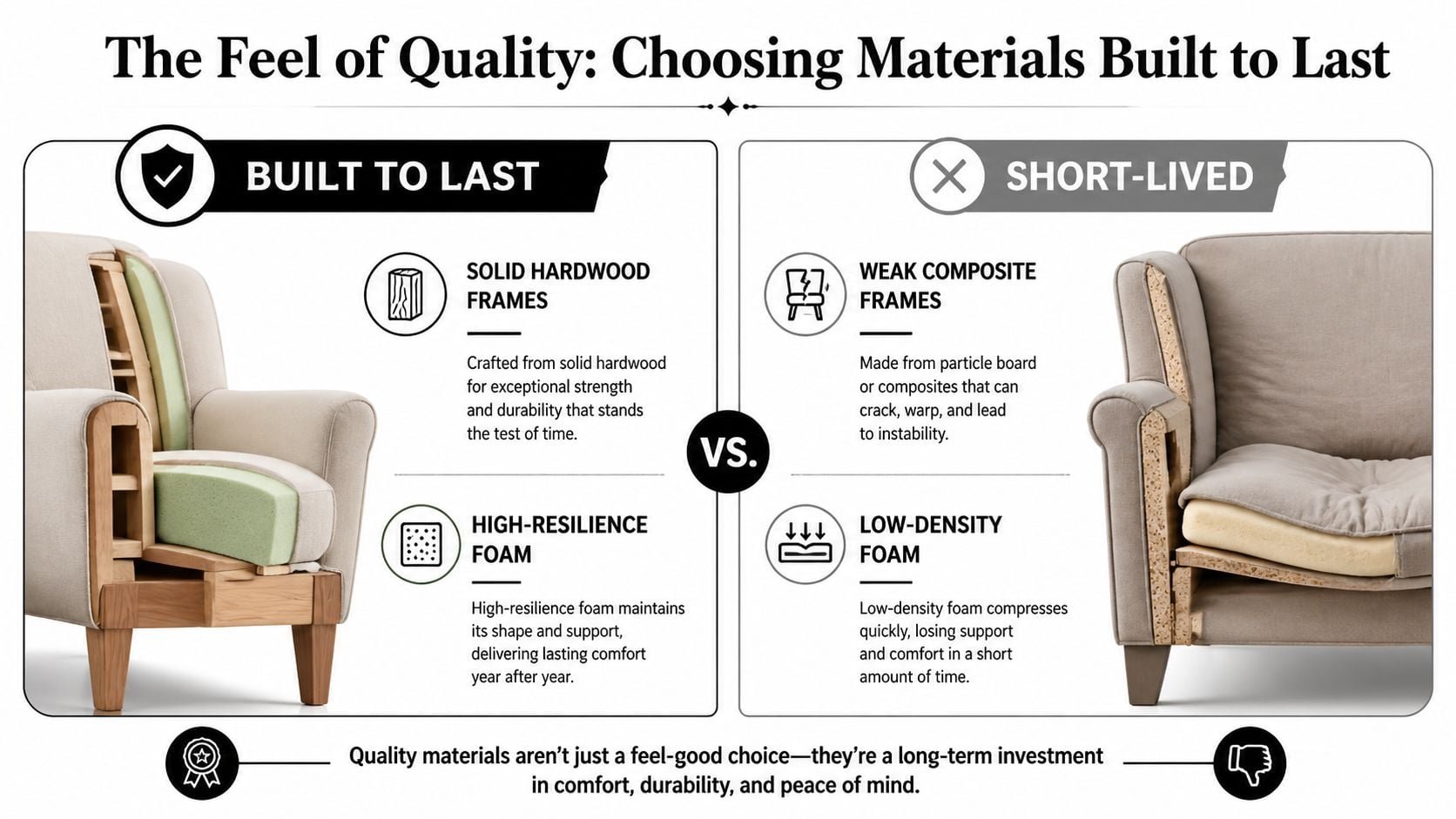
In high-quality Amish-made solid wood accent chairs, kiln-dried hardwoods like quartersawn white oak have a Janka hardness rating of 1,360 lbf, which is over 3.5 times stronger than pine. That kind of frame can endure over 50,000 compression cycles, support a 20-30 year lifespan under daily use, and reduce replacement frequency by 40% compared to engineered wood, according to this durability data on accent chair materials.
That’s a lot of technical language, so let’s translate it into everyday use.
If a chair frame is made from strong, kiln-dried hardwood, it’s more likely to stay square, stay steady, and handle regular sitting without loosening up too quickly. It also does a better job dealing with changing indoor conditions, which matters in Wisconsin homes where humidity and heating seasons can really put furniture through its paces.
Our family has always leaned toward furniture that reliably earns your trust. A solid wood chair often does exactly that.
For more on what makes wood furniture such a smart long-term choice, take a look at the benefits of solid wood furniture.
What to check when you sit down
People often focus on the back shape or arm style and forget to test the seat. Don’t. The seat tells you a lot.
Here’s what we tell shoppers to pay attention to:
- Sit all the way back. Your back should feel supported without forcing you into an awkward posture.
- Stay seated for a minute. Some cushions feel soft at first and uncomfortable a little later.
- Push on the arms gently. They shouldn’t wobble or feel loose.
- Notice the sound. A quiet chair usually signals tighter construction than one that creaks right away.
Takeaway from the floor: If the chair feels light in a bad way, shaky in the arms, or flat in the cushion, your body is telling you something useful.
Upholstery changes the ownership experience
Material choice isn’t only about looks. It shapes how the chair lives in your house.
A few common directions make sense for different homes:
Leather for depth and age
Leather often appeals to people who want richness and easier day-to-day cleanup. It develops character over time and can make even a simple chair feel a bit more grounded.
Textured fabric for softness
Woven fabrics, heathered solids, and touchable textures can warm up a room fast. They’re a good fit if your space needs softness or if you want the chair to feel welcoming instead of formal.
Performance-minded fabric for busy households
For homes with kids, pets, regular guests, or just real life happening, practical upholstery can be the smartest route. The look can still be interesting. It just has to handle use without making you nervous.
A simple quality comparison
| Part of the chair | Better sign | Riskier sign |
|---|---|---|
| Frame | Solid hardwood | Lighter composite feel |
| Seat feel | Supportive, springy comfort | Quick flattening feel |
| Arms and back | Stable and quiet | Movement or creaking |
| Upholstery | Tailored and durable feel | Loose, thin, or easily wrinkled |
Why this matters more than trends
There’s a real content gap online around durability. A lot of chair advice centers on aesthetics, while practical buyers are left wondering what will hold up. One option for comparing categories in person is BILTRITE Furniture-Leather-Mattresses, where shoppers can look for in-store icons that identify USA-made, Amish-made, real solid wood, and heavy-duty pieces.
That hands-on part matters because quality is easier to judge when you can feel the frame, test the seat, and inspect the tailoring for yourself.
Getting the Size and Scale Just Right for Your Room
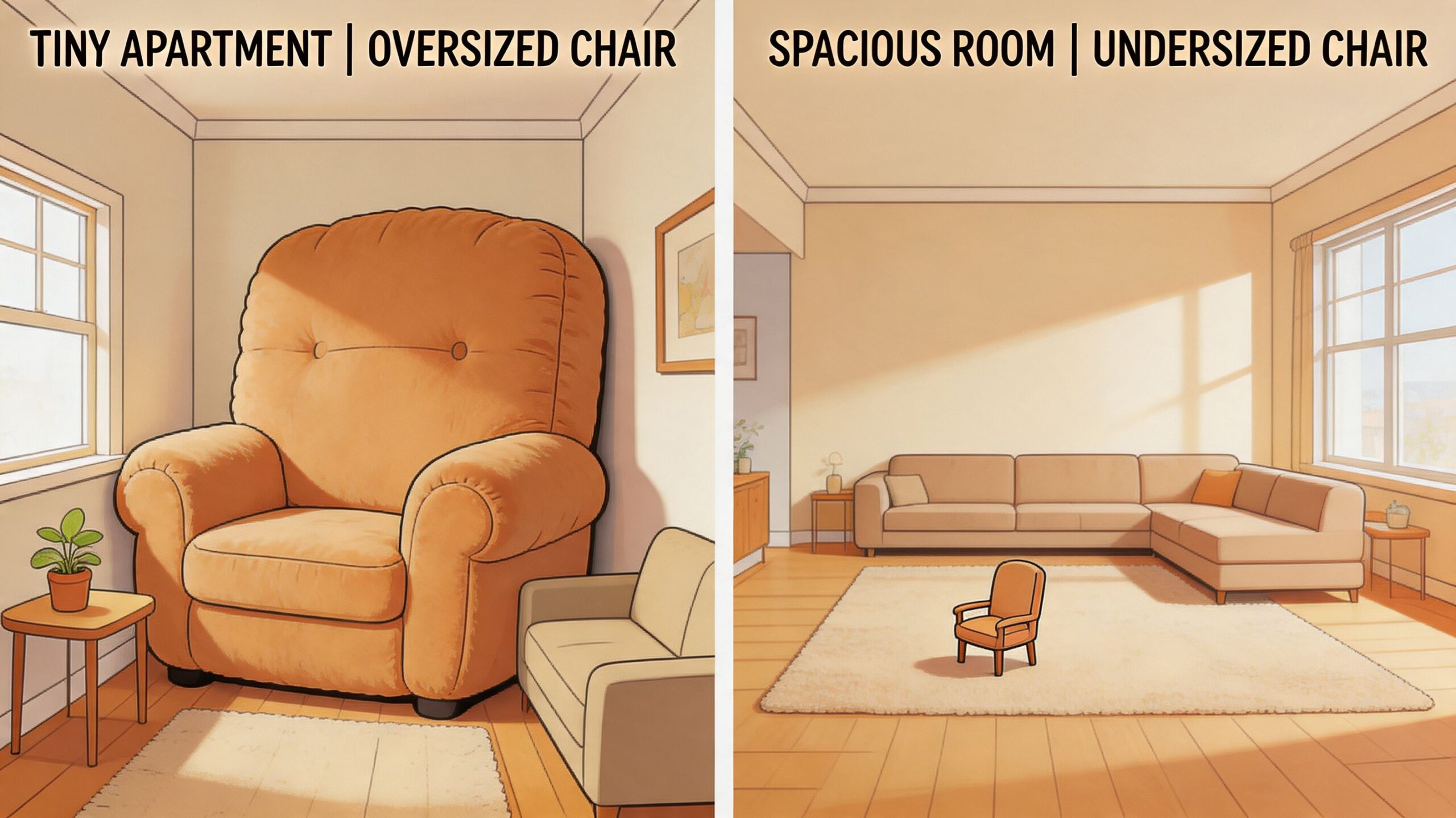
A chair can be attractive and still feel wrong in your room. Usually that’s a scale issue, not a style issue.
This happens all the time. Someone falls for a chair in a photo, brings it home, and realizes it blocks a walkway, crowds the sofa, or looks oddly tiny next to everything else. The fix starts before you shop.
Start with the footprint
The easiest trick is also one of the most effective. Measure the chair area, then mark that shape on your floor with painter’s tape. Don’t just guess.
That taped outline helps you answer practical questions fast. Can you still walk around it comfortably? Does it sit too close to the coffee table? Will it crowd a lamp, vent, or doorway?
If you want a step-by-step refresher, our guide on how to measure furniture is handy to keep nearby.
Actual size and visual weight are different
A lot of folks get tripped up on this point. Two chairs can have similar dimensions, but one feels much bigger in the room.
A chair can look heavier if it has:
- Wide rolled arms
- A tall tight back
- A skirted base or bulky cushion shape
A chair can look lighter if it has:
- Exposed legs
- Open arms or slimmer arms
- A wood frame that shows some air around it
In smaller rooms, visible space around and under a chair helps the room breathe.
A quick room-fit guide
| Room situation | What usually works well |
|---|---|
| Condo or apartment | Smaller profile, exposed legs, trim arms |
| Family room with bigger sofa | Chair with enough presence to hold its own |
| Reading corner | Deeper seat if comfort is the priority |
| Tight walkway area | Narrower chair with less arm bulk |
Don’t forget the chair’s job
A chair near a conversation area needs to be easy to get in and out of. A reading chair can be a little deeper if you plan to settle in for longer stretches. A corner chair that mainly adds balance may not need to be oversized at all.
We work with a lot of smaller-scale spaces, and the biggest win usually comes from choosing a chair that respects the room instead of dominating it. The right fit makes the whole space look more considered.
Mixing and Styling Your Accent Chair Like a Pro
A lot of people freeze once they’ve chosen the chair. They think the hard part should be over, but now they’re wondering where it goes, what to pair with it, and whether it has to match everything else.
Good news. It doesn’t.
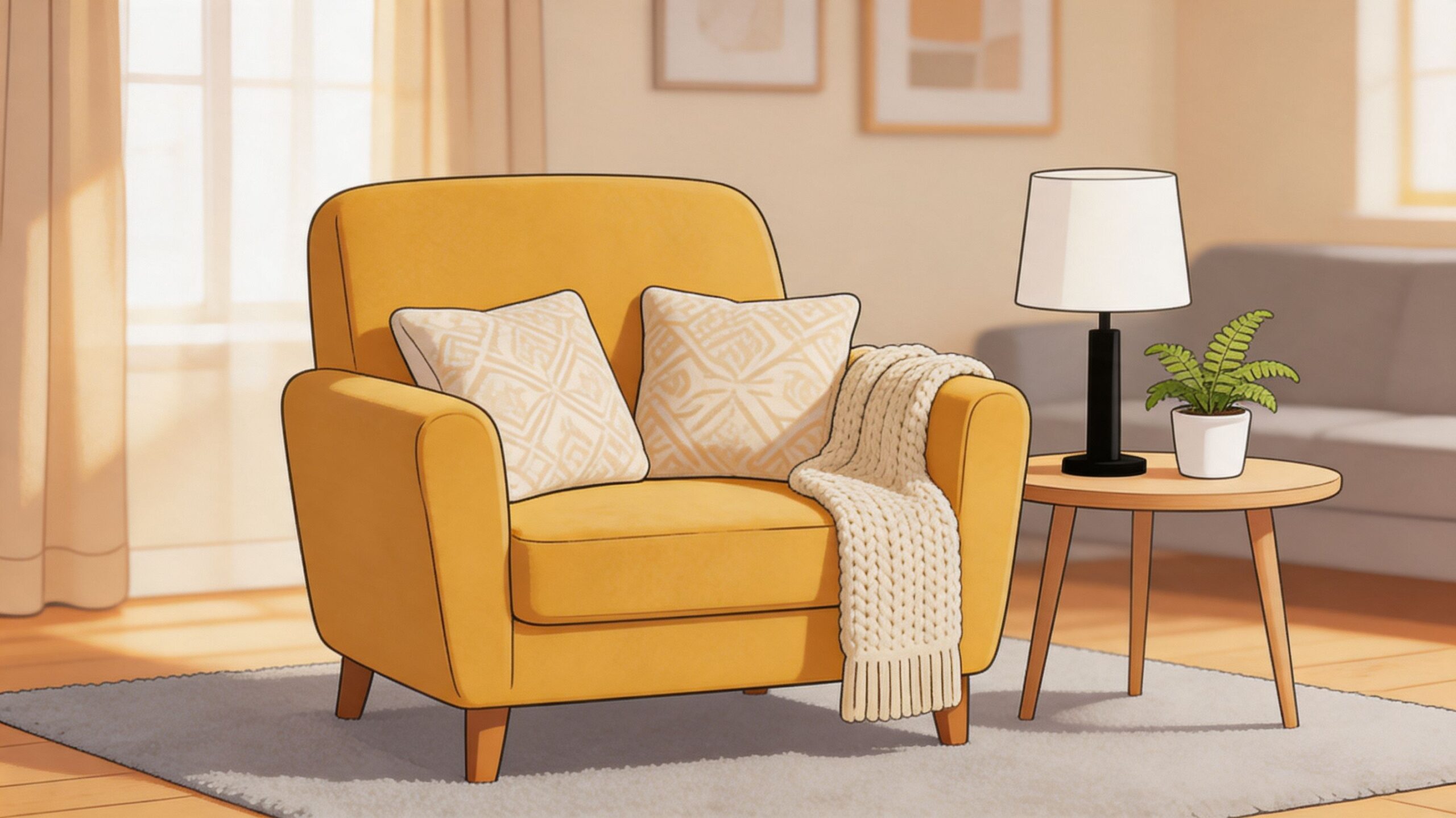
Matching is optional. Belonging is not.
An accent chair should relate to the room, but it doesn’t have to copy the sofa. In fact, the room often looks better when it doesn’t.
Here are a few easy ways to make a different chair feel connected:
- Repeat a color softly. If the chair has rust, blue, green, or cream in it, echo that shade somewhere else with a pillow, artwork, or rug.
- Borrow a texture. A leather chair can connect to wood tones, metal lighting, or another natural material in the room.
- Keep one line consistent. If your sofa is rounded, a chair with one soft detail can tie in even if the style is different.
Try one of these reliable placements
Some placements almost always work because they solve a room problem while making it look better.
The reading corner
Pair the chair with a floor lamp and a small table. That’s enough to create a useful little destination in the room.
The lonely corner fix
A bare corner can look unfinished. One accent chair, angled slightly with a pillow or throw, gives it purpose.
Across from the sofa
This is one of the classic conversation setups. It helps a room feel balanced and makes gathering easier.
Near a fireplace or window
These spots already attract the eye. A chair there makes the area more inviting and complete.
Styling gets easier when you stop asking, “What should go here?” and start asking, “How do I want this spot to be used?”
The finishing touches that help
A chair rarely needs much. In fact, too many extras can hide what made you like it in the first place.
A simple approach works well:
| Add-on | What it does |
|---|---|
| Small pillow | Pulls in color or pattern |
| Throw blanket | Adds softness and warmth |
| Side table | Makes the seat functional |
| Lamp | Turns the chair into a destination |
If the chair already has strong fabric, sculptural arms, or beautiful wood, let it breathe. If it’s quieter, accessories can give it more presence.
You can mix styles and still look pulled together
One of our favorite living rooms is the kind that feels collected over time. Not showroom-matched. Not rigid. Just thoughtful.
That might mean a traditional sofa with a simpler chair. Or a sleek room with one classic upholstered piece to soften it. The chair often becomes the bridge between everything else. That’s why unique accent chairs for living room spaces are so useful. They can introduce contrast without forcing a whole redesign.
The BILTRITE Difference Why Shopping Local Matters
Furniture shopping has gotten very fast. Click a photo, choose a color, hope for the best. Sometimes that works. A lot of times, it leaves people with something that looked better on a screen than it feels in real life.
We’ve seen that frustration for years, and it’s one reason our family has stayed committed to a different approach in Greenfield.
You can feel quality in person
A chair isn’t a poster. You need to sit in it, touch the fabric, look at the wood finish up close, and see whether the scale makes sense. That’s hard to do from a product thumbnail.
There’s also a durability problem hiding in a lot of chair advice online. According to this look at the durability gap in accent chair content, online content often fails to address durability, and 80% of buyer regret originates there. That’s a big deal if you’re trying to buy thoughtfully instead of replacing furniture too soon.
Shopping local helps because it turns furniture back into something physical and understandable.
Real help beats guesswork
Our team isn’t here to rush anybody. That matters more than people realize. Sometimes a shopper needs help sorting out style. Sometimes they need to know whether a chair is too deep for a shorter sitter. Sometimes they need something for a condo, a senior living apartment, or a family room that gets used hard every day.
Those are human questions. They usually get better answers in conversation than in filters and dropdown menus.
A few things local shopping does better:
- It makes comfort obvious. You know right away whether the seat suits you.
- It reveals construction. You can inspect seams, arms, legs, and finish work.
- It helps with scale. A chair’s size makes more sense when you’re standing next to it.
- It allows real comparison. You can sit in several styles back to back instead of relying on photos.
We’ve always believed furniture should be chosen with your hands and your eyes, not just your browser tabs.
Our family values show up in the shopping experience
We’re proud to be a fourth-generation family business serving Metro Milwaukee since 1928. That long history shapes how we do things. We care about better-quality furniture at fair value. We care about American-made and Amish-made craftsmanship. We care about treating customers like neighbors.
That also shows up in the choices we make as a business. We don’t sell online, because our showroom experience matters. We’re closed on Sundays and Mondays so our people can spend time with their families. We still believe local relationships count.
Why this matters for unique chairs
When people hear “unique,” they sometimes assume that means flashy or expensive or hard to live with. We don’t see it that way.
A unique chair can be:
- A solid wood piece with heritage
- A smaller-scale chair that solves a tricky room
- A heavy-duty build for long-term everyday use
- A custom fabric choice that reflects your taste
That kind of uniqueness is easier to find when you can compare real pieces and talk through the tradeoffs with someone who’s done this for a long time.
We also carry more than just living room seating, so people often end up solving more than one room while they’re here. If you’re also mattress shopping, our store has over 60 models and more than 500 mattresses in stock, which makes a visit especially worthwhile for households trying to get several decisions made at once.
Local shopping is slower in a good way
It gives you a chance to notice things. The grain in a wood arm. The difference between a chair that looks soft and one that is. The way a taller back changes the room. The way custom fabric can turn a familiar silhouette into something that feels like yours.
That slower process is often what keeps a purchase from becoming a regret.
Ready to Find Your New Favorite Seat?
The right accent chair doesn’t just fill space. It adds character, supports real life, and gives your living room a spot that people naturally drift toward. That’s why the search is worth doing carefully.
If you’ve been hunting for unique accent chairs for living room spaces, the biggest takeaway is simple. Unique isn’t only about a bold silhouette or an unexpected color. It can also mean solid wood you can feel, craftsmanship with history behind it, a scale that fits your room, and comfort that still feels good after the novelty wears off.
Our family has loved helping Milwaukee-area neighbors make these choices for generations. There’s something satisfying about seeing someone sit in a chair and immediately relax because it just feels right. That moment still never gets old.
We’d love to see you in our Greenfield showroom. Come say hi, take your time, sit in a few chairs, and let our experienced team help you sort through the styles, materials, and sizes that make sense for your home. The chair you’ve been looking for might be a lot easier to find once you can see it, touch it, and try it for yourself.
Come visit BILTRITE Furniture-Leather-Mattresses in Greenfield and explore accent chairs, solid wood furniture, leather seating, and our large in-stock mattress selection. We’d be glad to help you find a chair that fits your room, your style, and the way you live.