Antique Bed Frame Styles: Find Your Timeless Look


You’re probably here because you saw a bedroom that stopped you in your tracks.
Maybe it was a softly curved iron bed with little finials on the corners. Maybe it was a tall spindle bed that looked like it belonged in a family home with stories in every room. Or maybe you’ve been trying to make your bedroom feel less like a box of matching furniture and more like a place with some soul.
That’s where antique bed frame styles shine. They bring history, detail, and personality into a room in a way that many newer pieces do not. The good news is that you do not need to be an antiques dealer to understand them. You just need to know what you’re looking at, what fits your home, and where people often get tripped up.
We’ve been around furniture long enough to know this part matters. In a family business that has served Metro Milwaukee since 1928, you learn to appreciate pieces that last, pieces that feel solid, and pieces people talk about years later. Antique beds do that. So do well-made new beds inspired by classic design. Either way, the fun starts when you can recognize the style and understand why it still works today.
Dreaming of a Bedroom with Character?
A lot of bedrooms feel functional but forgettable. The bed is there, the dresser is there, and everything does its job, but the room never quite feels finished.
Then one day you spot an old iron bed frame in a photo, or a carved wood bed with dramatic lines, and suddenly the whole room makes sense. The bed is no longer background furniture. It becomes the piece that gives the room its mood.
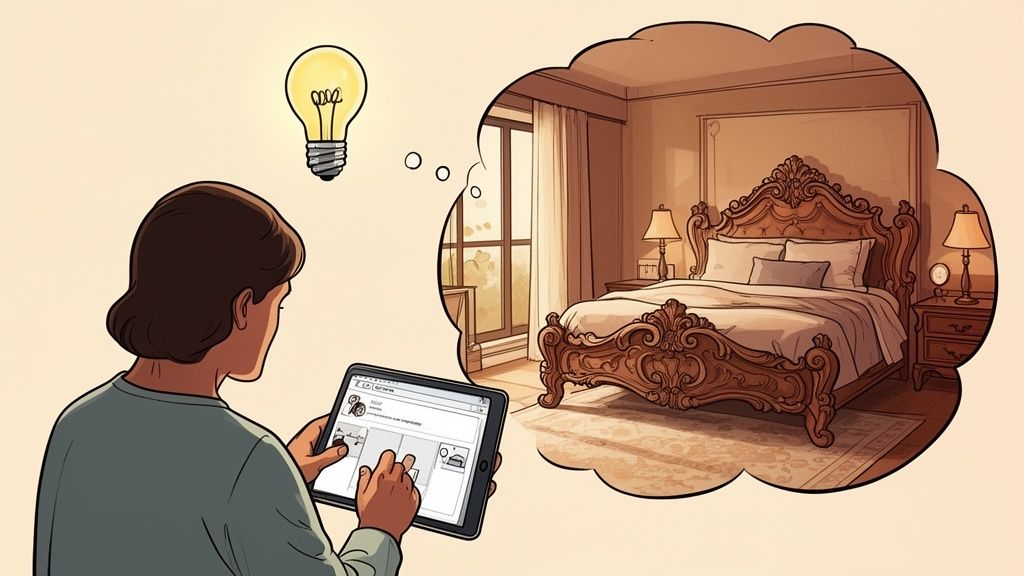
That’s the charm of antique style. It feels lived-in, collected, and personal. Even one strong piece can warm up a plain space.
Why these beds pull people in
Older bed designs often have details that catch your eye right away. Curves. Turned posts. Scrollwork. Brass accents. A taller headboard that frames the whole room.
Many readers get nervous at this stage because they think antique means fragile, fussy, or too formal. It doesn’t have to. Some antique-inspired looks are elegant and ornate. Others are simple and practical.
If you want help naming the look you’re drawn to, this guide to types of furniture styles is a handy starting point.
Tip: If a bedroom photo keeps grabbing your attention, study the bed first. In many cases, the bed frame is doing most of the design work.
Character matters more than matching
A room with character usually does not come from buying everything in one style set. It comes from choosing a few pieces with presence.
An antique bed, or a new bed based on antique lines, can do that beautifully. It can soften a modern room, add structure to a cottage look, or give a simple space one memorable focal point.
That’s why people keep falling for these styles generation after generation. They do more than hold a mattress. They help a room tell a story.
A Journey Through Timeless Bedroom Styles
Walk into an older Milwaukee bungalow with a bed that has real presence, and the whole room changes. The walls may be plain. The rug may be simple. Yet the bed gives the space a point of view.
That is why style matters here. Antique bed frames are often the piece that sets the tone first, then lets everything else fall into place. For many families we help at BILTRITE, the goal is not creating a museum bedroom. It is finding a style with history that still feels comfortable to live with every day.
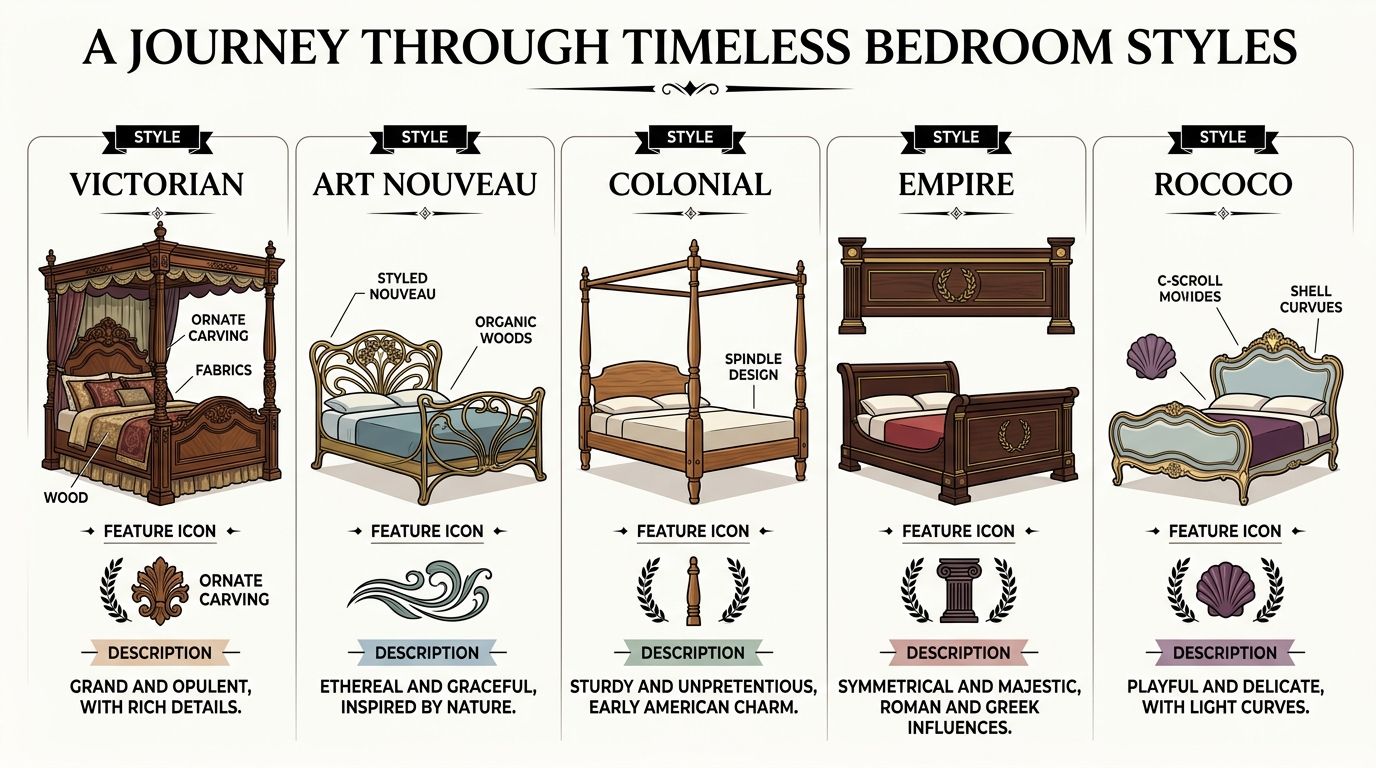
Four-poster and canopy beds
Four-poster and canopy beds act like the framework of a room. They draw your eye upward, add height, and make the bed feel established in a way a low, plain frame rarely can.
A four-poster bed has one post at each corner. A canopy bed builds on that shape with an upper frame, which historically could hold fabric for warmth, privacy, or a softer enclosed feeling around the sleeper.
These beds usually feel:
- Architectural: They give the room shape and vertical interest.
- Traditional: They pair naturally with classic wood furniture.
- Dramatic: Even simple linens look more intentional on them.
If you love bedrooms that feel rooted and gracious, this family of styles often speaks to you right away.
Sleigh beds
A sleigh bed is easier to recognize than to describe once you have seen one. The headboard and footboard curve outward, much like the side profile of an old horse-drawn sleigh.
That curve matters. It softens the room.
Sleigh beds often appeal to homeowners who want warmth and substance without the height of a poster bed. Many antique examples, especially those influenced by the Empire period, have a bold, confident shape but still feel welcoming rather than stiff.
People usually choose this style because they want:
- a bed with visual weight
- a classic shape that feels familiar
- a traditional look that works in everyday homes, not just formal ones
Iron and brass beds
Iron and brass beds have a different kind of charm. Where a wood bed can feel grounded and substantial, a metal bed often feels lighter on its feet, even when it has plenty of detail.
According to this overview of Victorian antique iron bed history, decorative iron beds became especially popular in the Victorian period as manufacturing made more ornate metalwork possible. That helps explain why so many people picture curved lines, finials, and brass accents when they hear the phrase antique bed.
Within this group, you will see a wide range of personalities:
- delicate and romantic
- crisp and structured
- ornate and decorative
These are often a smart fit for old Milwaukee homes, guest rooms, or smaller bedrooms where you want charm without the visual heaviness of a large wood footboard.
Spindle and Shaker-inspired beds
Some of the best antique-inspired choices are the quiet ones.
Spindle beds use repeated turned rods, which create rhythm without making the bed feel bulky. Shaker-inspired beds strip things back further. They favor clean lines, honest construction, and proportion over ornament.
That simplicity is practical. In a modern home, especially one where you are mixing old and new pieces, these styles give you character without crowding the room. They also pair beautifully with solid wood furniture, which is one reason they remain so popular with shoppers looking for lasting, USA-made quality instead of a throwaway trend.
For readers who gravitate toward classic rooms with restraint, this look often overlaps with traditional bedroom design principles.
Victorian, Rococo, Empire, and Art Nouveau touches
Some antique bed styles are identified less by the frame shape and more by the decoration applied to it. Shoppers sometimes get tangled up here, so a quick sorting method helps. Start with the silhouette. Then study the details carved, cast, or turned into the piece.
Here is a simple cheat sheet:
| Style | What to look for | Overall feeling |
|---|---|---|
| Victorian | scrolls, floral motifs, ornament | rich and decorative |
| Rococo | light curves, playful carving | graceful and airy |
| Empire | symmetry, bold scrolls, classical influence | stately and strong |
| Art Nouveau | flowing lines inspired by nature | soft and organic |
A single bed may borrow from more than one tradition, especially if it was made later as a revival piece. That is normal. The useful question is not, “Does this fit one label perfectly?” It is, “Does this shape and detailing give my room the feeling I want?”
Start with the broad family. Then notice the personality in the details. That approach makes antique bed styles much easier to recognize, and much more fun to shop.
Is It a True Antique? Spotting Quality and Authenticity
A bed can look old without being an antique. That’s where many shoppers get mixed up.
Some pieces are true antiques. Some are vintage. Some are modern reproductions made to capture an older look. None of those categories are automatically bad. You just want to know which one you’re buying.

What your eyes should check first
Before you get swept away by style, look at construction.
Authentic antique beds often have specialized support systems and non-standard sizing. Quality clues include hand-carved barley twist posts, which can increase torsional resistance by 20 to 30 percent, and hand-sawn marks under the frame. By contrast, machine-made pieces after the 1860s often show smooth, uniform under-surfaces (buying guide for antique beds).
That sounds technical, but the practical meaning is simple. Handmade work usually shows small variation. Machine work looks more uniform.
A simple inspection checklist
When you examine a bed frame, look for these clues:
- Underside evidence: Flip your attention to the less visible parts. Old hand work often shows saw marks or slight irregularities.
- Posts and turnings: If the bed has barley twist posts, study the carving. Handmade detail often feels more alive and less identical piece to piece.
- Joint condition: Check whether rails connect securely and whether the frame feels steady when assembled.
- Surface wear: Honest wear usually appears in places that make sense, like edges, corners, and spots touched by hands over time.
- Too-perfect uniformity: If everything looks flawlessly identical underneath, the piece may be later machine-made or a reproduction.
If you need a refresher on wood quality itself, this article on how to tell if furniture is real wood is useful alongside an antique inspection.
Antique, vintage, or reproduction?
This quick breakdown helps:
| Type | What it means | Why it matters |
|---|---|---|
| Antique | generally an older original piece from an earlier era | may have collector value and unique construction |
| Vintage | older, but not always from the antique period | often offers character with fewer expectations |
| Reproduction | newer piece made in an old style | gives you the look with modern build methods |
None of this should intimidate you. In fact, it should do the opposite.
Tip: Buy the bed in front of you, not the story attached to it. Style matters, but sturdiness, condition, and fit matter just as much.
Making an Antique Bed Work in Your Modern Home
One of the biggest myths in decorating is that an antique bed needs an antique room.
It doesn’t.
A bedroom works best when it feels layered, not staged. An older bed can be the one piece that gives balance to cleaner walls, simpler bedding, and newer storage furniture.
Mixing old and new usually looks better
A metal Victorian-style bed can look fantastic in a room with plain white bedding, simple nightstands, and modern lamps. The contrast helps the bed stand out.
A spindle bed can also soften a room that feels too sharp or boxy. If your bedroom has hard lines, painted walls, and minimal accessories, a turned-post bed brings in warmth without making the space feel crowded.
Here are a few combinations that work well:
- Ornate iron bed with modern bedding: This keeps the frame as the focal point.
- Simple spindle bed with contemporary art: Old and new balance each other nicely.
- Sleigh bed with clean-lined storage pieces: You get tradition without visual clutter.
- Canopy or poster bed with minimal accessories: The bed provides the drama, so the rest of the room can stay calm.
Match the mood, not every piece
People get stuck when they think every item must belong to the same historical style. A better approach is to match the room’s mood.
If the bed feels romantic, repeat that mood with softer textiles and curved lamps. If the bed feels precise and sturdy, echo that with structured nightstands or a more restrained color palette.
You are building a feeling, not a museum set.
A few design guardrails
If you want the bed to look intentional, keep these ideas in mind:
- Watch visual weight: A heavy carved bed may need lighter companion pieces.
- Let one piece lead: If the bed is dramatic, keep other furniture quieter.
- Use bedding carefully: A busy quilt on a highly detailed frame can sometimes compete.
- Respect scale: Tall beds need room around them so they can breathe.
Key takeaway: Antique bed frame styles succeed in modern homes when the bed becomes the anchor, not when every piece tries to compete with it.
The All-Important Fit and Mattress Compatibility
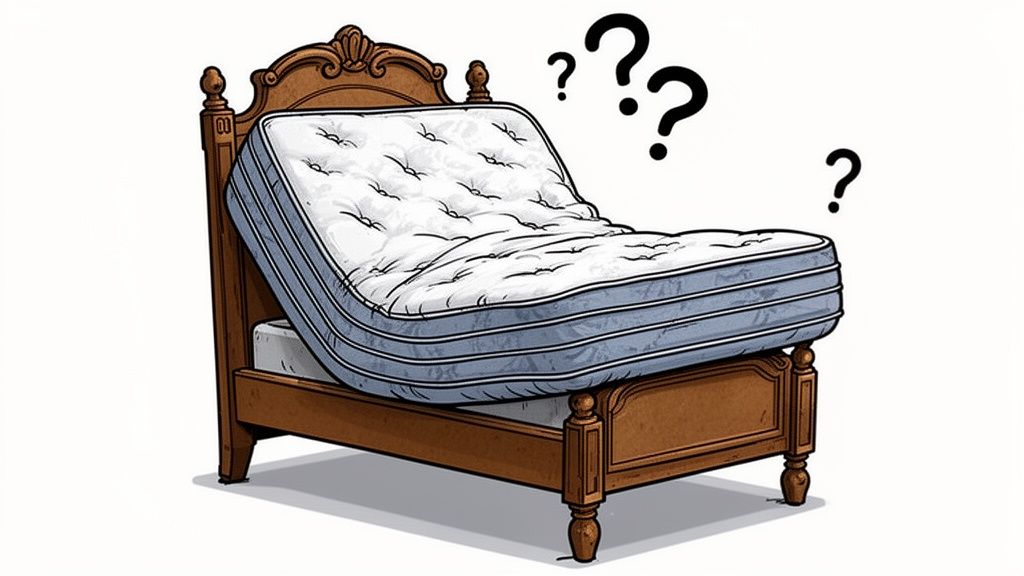
A lot of antique bed heartbreak starts the same way. Someone falls for a handsome old frame, gets it home, and then discovers the mattress fit is off by just enough to cause trouble.
That small mismatch can create big frustration. Sheets pull loose. The mattress slides. A beautiful bed starts feeling like a project.
Why older beds need a closer look
Antique beds were built in a time when sizing was less standardized. Some are close to modern twin or full dimensions. Others fall somewhere in between, which is why an old frame can look "almost right" but still not work well with a mattress off today’s showroom floor.
We see this question often at BILTRITE. Milwaukee families love the character of an older bed, but they also want a setup that works for real life. Good sleep still matters more than nostalgia, so the frame and mattress have to cooperate.
A bed works like a picture frame. If the opening is even a little off, what goes inside never sits quite right.
What to measure first
Start with the inside of the bed frame, not the outside. The headboard may be wide and dramatic, but that tells you very little about the mattress space.
Measure these points:
- Inside width from rail to rail
- Inside length from head to foot
- Support height from the floor to where the mattress or foundation will rest
- Corners, curves, or interior shaping that reduce usable space
If you want a quick reference point, our mattress size chart for standard bed dimensions makes it easier to compare an older frame with modern mattress sizes.
Write the measurements down. Memory gets fuzzy fast when you are standing in a showroom or comparing options online.
The fit problems that show up most often
Some issues are easy to spot right away. Others only appear after the bed is assembled.
- Side gaps: The mattress fits, but leaves extra space and shifts around.
- Too-snug sizing: The mattress technically goes in, but bedding bunches and the fit feels forced.
- Weak or missing support: Older frames may need updated slats or a better foundation under the mattress.
- Footboard clearance issues: Curved or high footboards can reduce usable length, especially with thicker modern mattresses.
None of these problems mean the bed is a bad purchase. They mean the bed needs the same kind of planning you would give any heirloom piece. Charm is part of the appeal. Practical setup is what makes that charm livable.
Smart ways to make an antique bed usable now
The good news is that many fit issues have straightforward solutions.
| Problem | Practical fix |
|---|---|
| Mattress leaves extra room | Choose a mattress size that better matches the interior opening, or add stable support to limit shifting |
| Slats are missing or tired | Install new solid slats sized for the frame |
| Frame shape is unusual | Use a foundation or support system that suits the bed’s interior layout |
| Bed sits too high or too low | Adjust the support layers and mattress profile for a more comfortable height |
This is one place where local guidance really helps. At a family business like BILTRITE, the goal is not just to sell a mattress. It is to help you pair a lasting bed with a sleep setup that feels right in an actual Milwaukee home.
Tip: Bring a tape measure before you bring your wallet.
Once you know the interior size, the support system, and the height you want, antique bed shopping gets much less intimidating. You can keep the romance of the old frame and still sleep on something that fits your life now.
Simple Care Tips for Your Heirloom Piece
Antique beds do not need constant fussing. They need sensible care.
A little routine attention goes a long way, especially if you want the frame to stay sturdy and attractive for years to come.
Keep cleaning gentle
Dust the bed regularly with a soft, dry cloth. That helps keep grime from settling into carvings, turnings, or metal details.
For wood, be cautious with heavy sprays or harsh cleaners. For metal, use light cleaning methods and avoid anything too abrasive that could damage the finish.
If you want a broader refresher on everyday upkeep, this guide on how to clean wood furniture covers the basics well.
Check the working parts
Beds are not just decorative. They handle movement, weight, and daily use.
Every so often, inspect:
- Rails and fasteners: Make sure connections stay secure.
- Slats or support pieces: Look for sagging, cracks, or shifting.
- Finish condition: Catch small issues before they turn into larger repairs.
Respect the age of the piece
Do not rush into stripping, sanding, or repainting unless the bed really needs restoration. Original surface character is often part of the appeal.
That soft wear, mellow sheen, or aged patina tells the story of the piece. Many times, preserving it is wiser than trying to make the bed look brand new.
Key takeaway: Think maintenance, not makeover. Most heirloom furniture responds well to regular dusting, gentle cleaning, and an occasional hardware check.
Find Your Timeless Style at BILTRITE
The nicest thing about antique bed frame styles is that they give you options. You can chase the romance of an old iron bed, the quiet charm of a spindle design, or the stately look of a sleigh or poster bed, all without making your bedroom feel stuck in the past.
That is why these styles continue to resonate. They offer history, shape, and character, but they can still work beautifully in the way people live now.
For many households, a brand-new bed inspired by classic lines is the sweet spot. You get the look people love, along with modern construction, dependable support, and the comfort of buying something built for everyday use. That is especially appealing if you love solid wood furniture, appreciate Amish and USA-made craftsmanship, or want something that feels substantial instead of disposable.
At our family business in Greenfield, we have always believed good furniture should feel welcoming, useful, and made to last. We have served Metro Milwaukee since 1928, and we still love helping people sort through style questions in a way that feels relaxed and human. No pressure. Just honest guidance from a team with deep experience.
If antique style has been on your mind, come see pieces in person. Open the drawers. Look at the wood grain. Compare silhouettes. Sit down and take your time. We are proud to be local, proud to be family-owned, and proud to close on Sundays and Mondays so our own families can be together too.
If you’re ready to explore timeless bedroom looks, visit BILTRITE Furniture-Leather-Mattresses in Greenfield. We’d love to help you find a bed and mattress setup that fits your style, your space, and your everyday life.