3 DAY MATTRESS SALE! TUESDAY - WEDNESDAY - THURSDAY!
LABOR DAY SALE EXTENDED ENDS SATURDAY, OCTOBER 3RD AT 5PM!
NO CREDIT CARD FEES!
1000's of Items IN-STOCK + 500 Mattresses!
Largest selection of USA Made Furniture & Mattresses + Amish Made!
FREE In-Store Design Services!
BUY LOCAL & LOVE YOUR HOME!
3 DAY MATTRESS SALE! TUESDAY - WEDNESDAY - THURSDAY!
LABOR DAY SALE EXTENDED ENDS SATURDAY, OCTOBER 3RD AT 5PM!
NO CREDIT CARD FEES!
1000's of Items IN-STOCK + 500 Mattresses!
Largest selection of USA Made Furniture & Mattresses + Amish Made!
FREE In-Store Design Services!
BUY LOCAL & LOVE YOUR HOME!
OPEN LABOR DAY | Tuesday-Thursday 10am to 6pm | Friday 10am to 7pm | Saturday 10am to 5pm | Sunday Closed To Be With Family & Friends | Monday Showroom Closed
5430 West Layton Ave, Greenfield - Metro Milwaukee
You know that little corner in the kitchen that’s almost useful? Too small for a full dining set, too important to leave empty, and somehow always becoming a catch-all for mail, keys, and grocery bags? That’s exactly where a small drop leaf round table earns its keep.
We’ve helped Milwaukee-area families furnish their homes since 1928, and this is one of those pieces that keeps coming back because it solves a very real problem. You want a table you can use, but you don’t want to give up half the room just to have one sitting there all day.
That’s especially true in condos, apartments, older homes, and senior living spaces, where every inch matters and furniture has to work a little harder. A good drop leaf table doesn’t just “fit.” It adapts. It gives you a spot for coffee in the morning, lunch for two in the afternoon, and cards, puzzles, or dinner when company comes by.
Your Guide to Space-Saving Charm
A lot of folks start looking for this kind of table after getting frustrated with their room, not excited about furniture. The room feels tight. Chairs bump into walkways. A standard round table looks nice, but it takes up space all the time, even when nobody’s sitting there.
That’s where this design feels so smart. A small drop leaf round table gives you the shape people love and the flexibility people need. It’s easy to live with in a way that big, fixed tables often aren’t.
Why this old idea still works
This style isn’t new at all. In fact, small circular drop-leaf tables were widely produced in 18th-century New England, where compact furniture mattered because homes had limited living space. A strong example is the Metropolitan Museum of Art’s Massachusetts Drop-leaf Dining Table, dated 1760–1790, made from mahogany, white pine, and tulip poplar, with dimensions of 27 1/4 x 33 3/4 x 34 inches in its catalog record, shown in the Metropolitan Museum of Art collection entry.
That history matters because it explains the design. People needed one piece to do several jobs. They didn’t have extra rooms to waste, so furniture had to earn its place.
A well-designed small table feels less like a compromise and more like a quiet little problem-solver.
We still see that same need today in Bay View apartments, Wauwatosa bungalows, condos, and smaller dining spaces. If you’re trying to make a home feel open without giving up function, our guide to small space furniture solutions is a helpful place to start.
The charm part matters too
There’s also something warm and welcoming about a round table. No sharp corners. Easier flow around it. A softer look in a room full of straight lines.
That’s why this piece works in so many homes. It isn’t only practical. It also has character. And when a furniture piece can save space while making a room feel friendlier, that’s a win in our book.
What Exactly Is a Small Drop Leaf Round Table
The name sounds more complicated than the table really is. The concept is simple.
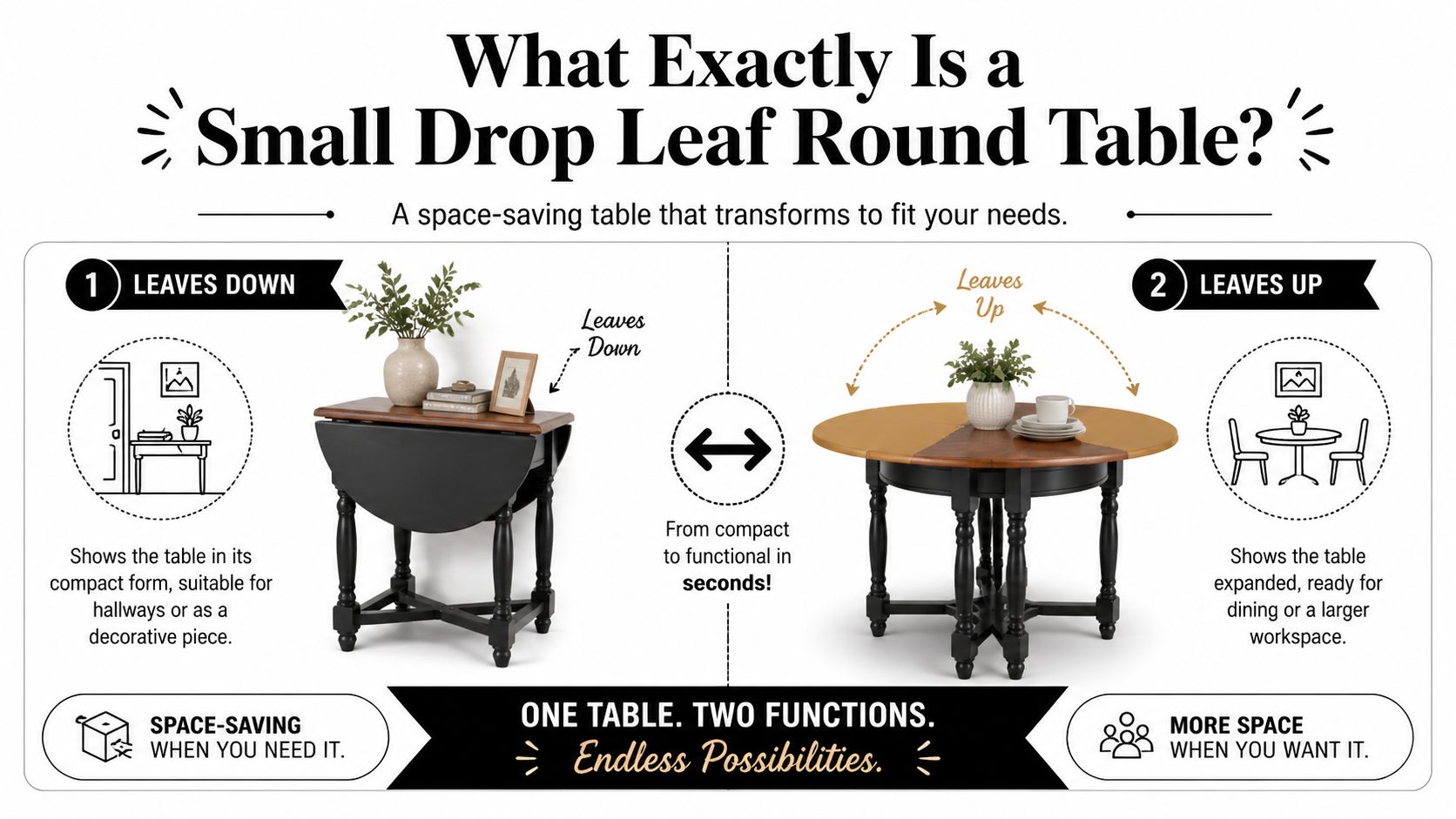
A drop leaf table has a center section with one or two hinged sides called leaves. When the leaves are down, the table takes up less space. When you need more room, you lift the leaves and support them underneath. On many tables, that support swings out from the base, almost like opening little wings.
How the shape changes
It's a table with built-in flexibility. In its compact form, it may sit neatly against a wall or in a breakfast nook. Then dinner rolls around, and it opens into a round surface that feels much more generous.
A clear example comes from the Beacon model. A typical 42-inch round drop leaf table can begin as a 28-inch square with the leaves down and open into a full round top, increasing usable surface area by about 2.37 times, seating 2 to 4 people, and recovering roughly 20 to 30 percent of floor space when not in use, as shown in the Beacon 42-inch round drop leaf table details.
That’s the part people sometimes miss. You’re not just buying a small table. You’re buying a table that changes size based on what your day looks like.
What supports the leaves
The support mechanism is what makes the whole thing work. On some tables, a leg swings out under the leaf. On others, the support is built into the base in a more compact way.
Here’s what to check when you see one in person:
Open and close the leaves: They should move smoothly and feel secure.
Look underneath: The support should be easy to understand and easy to operate.
Check the top when extended: It should feel even and stable, not flimsy or shaky.
Practical rule: If the table feels awkward to open in a showroom, it won’t become easier at home.
If you’d like to compare shapes and functions before you shop, our page on different types of tables helps put this style in context.
The Mighty Benefits for Milwaukee Homes and Apartments
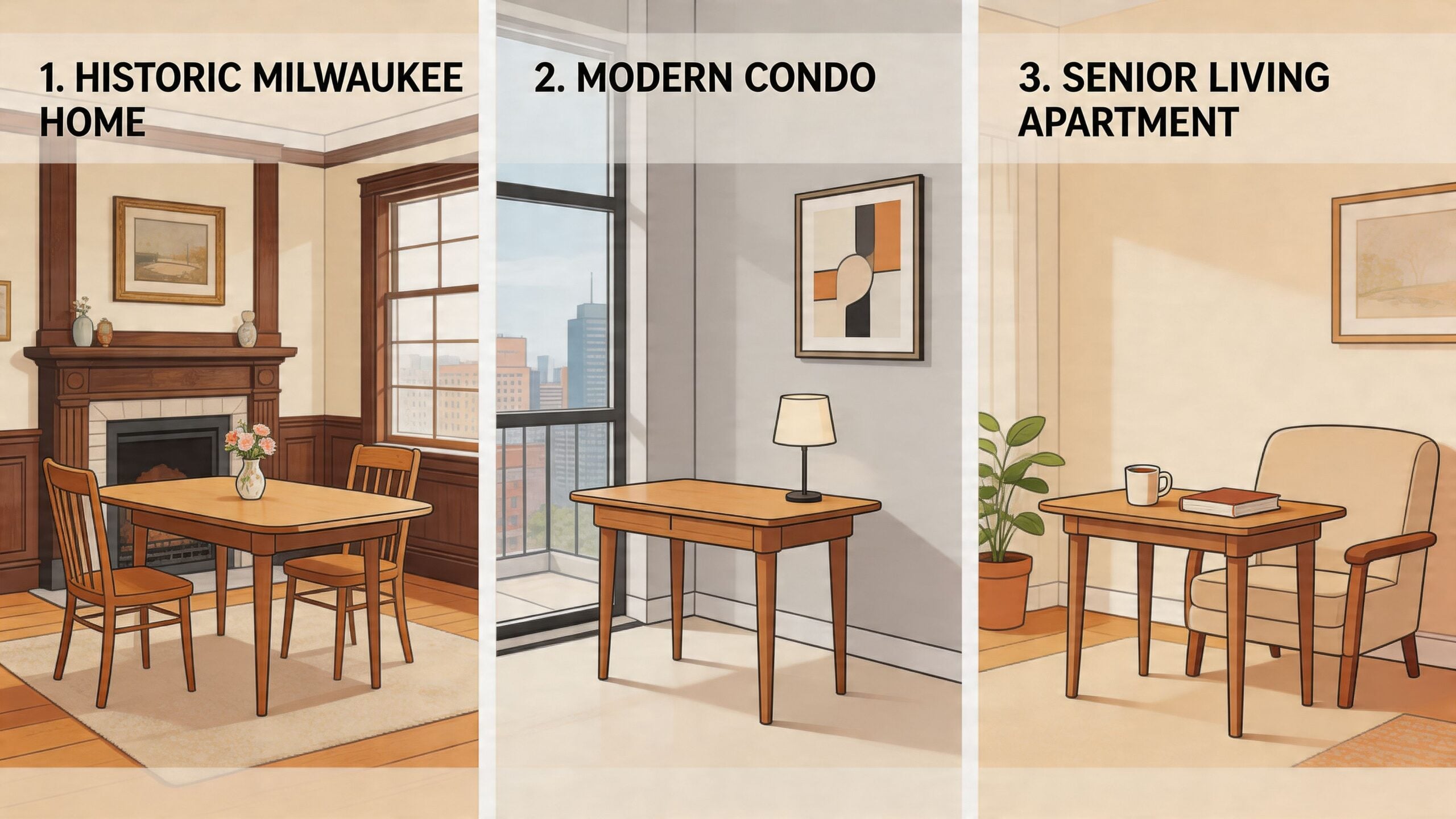
Some furniture only works in one kind of home. A small drop leaf round table isn’t like that. It fits city apartments, suburban condos, older kitchens, and senior living spaces because it solves the same problem in each one. You need usable surface space, but you don’t want furniture blocking the room when it’s not in use.
That flexibility is especially useful around Metro Milwaukee, where homes vary so much. One family needs a breakfast table in a starter home. Another needs a game table in a condo. Someone else needs a dining surface that feels steady and manageable in a senior apartment.
Why condo dwellers like them
In a smaller condo or apartment, the room often has to do double duty. The dining area may also be the walkway, work zone, or reading spot. A fixed table can make that room feel crowded every single day.
A drop leaf table changes that. Keep it compact most of the time, then open it when you need to eat, work, or host a friend. That’s a much more forgiving setup for tight floor plans.
This is the angle many stores skip. They talk about “small scale,” but they don’t answer the key questions. Is it easy to get in and out of the chair? Does the base get in the way? Does it feel steady enough for everyday use?
An analysis of the furniture market found a gap in guidance for senior living, especially around stability for mobility aids and ADA-compliant heights of 28 to 34 inches, which online listings often leave unaddressed, as noted in this round drop leaf table market review.
That’s one reason many people prefer a round top with a solid pedestal-style base. It often creates cleaner chair access and fewer leg obstructions than a busy four-leg setup.
Why families keep using them
For families, this table can shift roles all week long:
Breakfast spot: Cereal, coffee, backpacks by the door.
Homework station: Enough room for papers without taking over the house.
Weekend use: Cards, puzzles, snacks, and takeout night.
That’s a lot of value from one compact footprint. And when the table is sturdy, it doesn’t feel like “temporary furniture.” It feels like a real part of the home.
Choosing Your Table Material and Finish
Shoppers often get tripped up because two tables can look similar from across the room, but one will age gracefully and the other will show wear fast. With a drop leaf table, materials matter even more because you’re asking the piece to open, close, support weight, and stay stable over time.
We always tell people to start with the top and the construction. If those are solid, the table has a much better shot at serving you well for years.
Why solid wood matters
Solid rubberwood is one example of a practical furniture wood. It has a Janka hardness rating of 1,070 lbf and is 25% harder than common pine, which makes it more resistant to dents in daily use, according to the International Concepts round drop leaf table specifications.
That doesn’t mean every table has to be rubberwood. It means you should pay attention to whether you’re getting real wood construction and how that wood will behave in everyday life.
Construction matters as much as wood species
A drop leaf table has moving parts. Hinges, supports, joints, and the way the base connects all matter.
Amish-crafted tables often use mortise-and-tenon joinery, and that same source notes this type of construction can reduce hinge failure rates by 40% in cycle testing compared with simpler construction. That’s a meaningful detail because the table isn’t just sitting there. It’s working.
Good joinery is one of those things customers may not notice right away, but they sure notice when it’s missing.
Common table materials at a glance
Material
Key Benefit
Best For
Solid rubberwood
Harder surface that resists dents better than pine
Everyday dining, family use, value-focused solid wood shoppers
Other solid hardwoods
Long-term durability and a more substantial feel
Buyers who want furniture built for regular use
Veneer over engineered wood
Often offers a certain look at a lower upfront cost
Light-use spaces where budget is the main driver
Notice what’s missing from that chart. Fancy promises. The right choice depends on how you live.
Finish choice is about lifestyle
A dark stain can feel rich and formal. A medium wood tone often hides daily life nicely. A lighter finish can brighten a smaller room and feel more casual.
If you’re deciding between stain directions, our guide to the best wood finish for a dining table can help you think through maintenance, color, and room style.
One factual note worth knowing here: BILTRITE Furniture-Leather-Mattresses carries USA-made, Amish-made, solid-wood furniture with custom wood and finish options in its Greenfield showroom. That matters if you want to compare finishes in person instead of guessing from a screen.
Styling and Placing Your Drop Leaf Table
A small drop leaf round table is one of those rare pieces that can change jobs without looking out of place. In the morning it can act like a quiet little accent table. By evening it’s where everybody gathers with dinner plates, coffee mugs, or a board game that takes longer than expected.
That’s why placement matters. Don’t treat it like a backup table. Treat it like a working part of the room.
One table, several moments in the day
With the leaves down, it can sit against a wall with a lamp, a small plant, or a bowl for keys and mail. In a kitchen nook, it becomes an easy place for toast and coffee. Later, it can hold a laptop, school papers, or a sewing basket.
Then someone comes over. Up go the leaves, out come the chairs, and the room suddenly feels ready.
A versatile table should look natural both when it’s closed and when it’s opened up.
Places where it works especially well
Here are a few spots where we’ve seen this style make a room feel more useful:
Kitchen corners: Great for everyday meals without crowding cabinets or walkways.
Sunrooms: A cozy place for coffee, reading, or cards.
Behind a sofa: Leaves down, it can act almost like a console.
Entry-adjacent dining spaces: Helpful when one room has to do several jobs.
If you want to coordinate chairs, lighting, and nearby pieces, our article on how to style a dining room offers practical inspiration without making things feel too formal.
Your Pre-Purchase Checklist
Before buying any drop leaf table, grab a tape measure. That little step saves a lot of hassle later.
This design has been useful for a very long time. Drop leaf tables date back to late 16th-century England and became dominant in Colonial America, where homes were often under 800 square feet. Early American butterfly tables used wing-like supports that helped shape the space-saving mechanisms still seen in later designs, as described in this history of table leaves.
What our family would tell your family to measure
You don’t need a complicated worksheet. Just check the basics before you shop.
Measure the parked position The table lives here most of the time. Measure it with the leaves down.
Measure the working position Then measure the same area as if the leaves are up and chairs are in place. People often forget the chair space, not the table space.
Check the path in Look at doorways, hallways, corners, and stairwells. Delivery goes much smoother when you know what the route looks like.
Questions worth asking yourself
A few simple questions can narrow the field fast:
How many people usually sit here?
Will this be used daily or occasionally?
Do I want pedestal access or a more traditional base?
Will someone using a walker or wheelchair need clear approach space?
A smart trick that helps
Use painter’s tape on the floor to outline the table shape. It’s one of the easiest ways to see whether the room will still feel comfortable once chairs are pulled out.
That little tape outline can tell you more in five minutes than hours of online browsing.
Why Buying from BILTRITE Makes All the Difference
A drop leaf table is one of those pieces that really benefits from being seen in person. You want to lift the leaves yourself. You want to feel whether the top is substantial, whether the mechanism is smooth, and whether the table feels steady when you lean on it.
That’s hard to judge from a photo.
We’ve been a fourth-generation family business serving Metro Milwaukee since 1928, and we still believe furniture shopping works better when you can slow down, ask questions, and compare pieces side by side. We don’t sell online, and that’s intentional. Some things are easier to understand when you’re standing right in front of them.
What you can learn in a showroom
When you visit in person, you can do the things that matter most:
Test the motion: Open and close the leaves.
Check the feel: Sit at the table and see how the height and base work for you.
Study the finish: Real wood color looks different in person than it does on a screen.
Ask practical questions: Delivery access, maintenance, daily use, and how the piece fits your space.
Why local guidance still matters
Our team isn’t here to pressure anybody. We’re here to help you avoid mistakes and find something that suits your home and your routine. That matters even more with furniture for condos, apartments, and senior living, where scale and usability can make or break the choice.
We’re also proud to be part of the Milwaukee area, proud to focus on affordable, better-quality furniture, and proud to be closed on Sundays for family time. That’s not marketing language for us. That’s just how we’ve chosen to do business for generations.
When furniture has to solve a real problem, seeing it in person gives you confidence that a product page can’t.
If you’re shopping for a small drop leaf round table, come spend a little time with it. Open it. Sit at it. Walk around it. That’s how you find out whether it fits your life, not just your room.
We’d love to help you compare styles, sizes, wood finishes, and accessibility features in person. Visit BILTRITE Furniture-Leather-Mattresses in Greenfield and chat with our experienced team. We’ll help you find a small-scale table that makes everyday living easier.