3 DAY MATTRESS SALE! THURSDAY - FRIDAY - SATURDAY!
98TH ANNIVERSARY SALE-A-BRATION ENDS SATURDAY, NOVEMBER 7TH AT 5PM!
NO CREDIT CARD FEES!
1000's of Items IN-STOCK + 500 Mattresses!
Largest selection of USA Made Furniture & Mattresses + Amish Made!
FREE In-Store Design Services!
BUY LOCAL & LOVE YOUR HOME!
Tuesday-Thursday 10am to 6pm | Friday 10am to 7pm | Saturday 10am to 5pm | Sunday Closed To Be With Family & Friends | Monday Showroom Closed
5430 West Layton Ave, Greenfield - Metro Milwaukee
Does a taller chair automatically help someone stand? Many shoppers assume a high leg recliner is easier to leave because the seat looks higher and the silhouette looks lighter. That assumption can lead a family to buy a stylish chair when the person using it needs lift assistance. Visible legs change appearance and can change seat position, but they don't prove a safe transfer. The reliable test is simple: match the chair's loaded seat height to the user's knee height, place both feet flat, and stand without rocking forward for momentum.
High Leg Recliner or Lift Chair? Choose by Ability
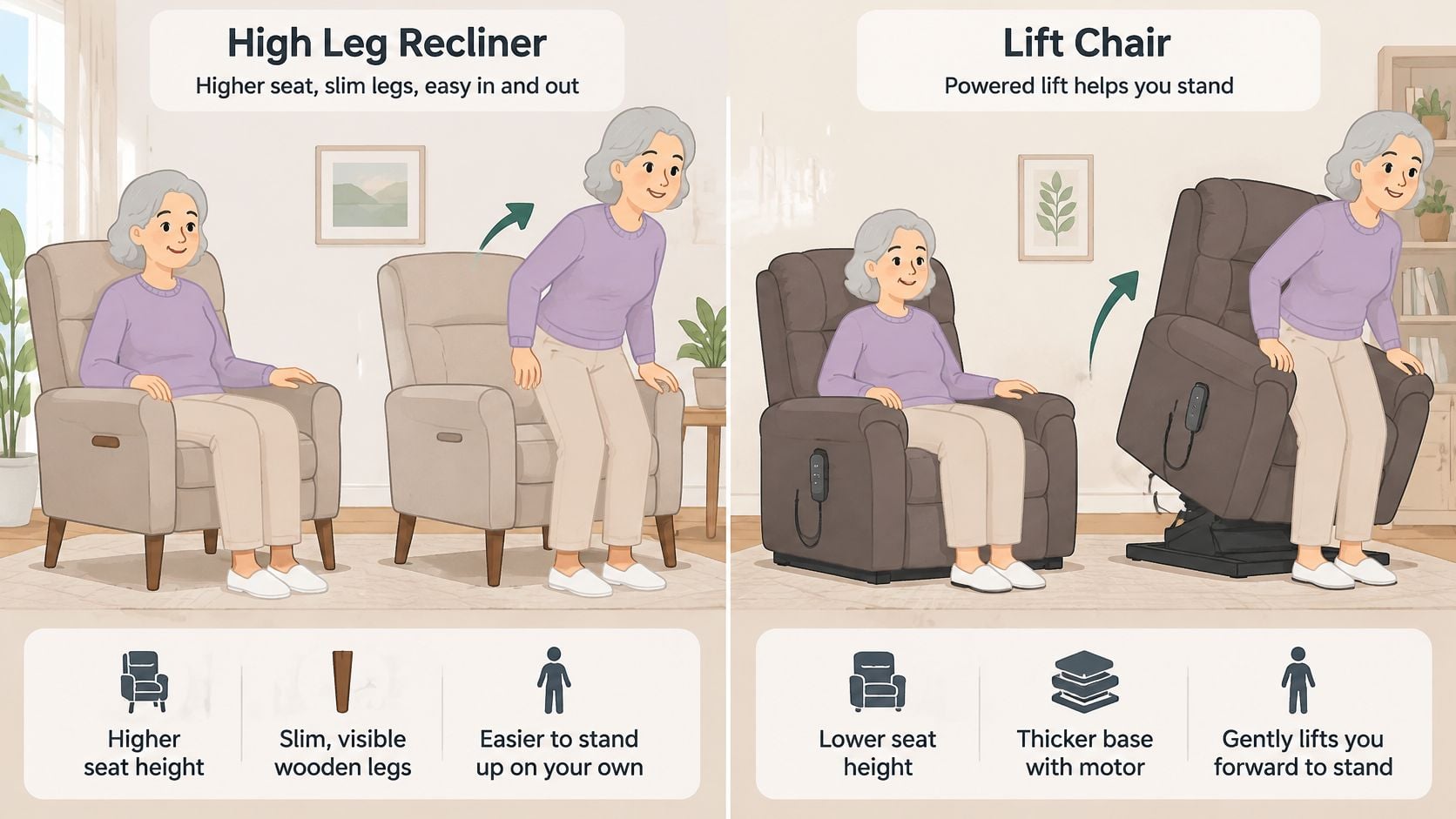
A high leg recliner is an upholstered recliner on visible legs under the seat, so it reads more like an accent chair than a bulky recliner. The reclining mechanism works in the same basic way as a standard recliner, moving the back and footrest. A power version can make that movement easier to control, but it still doesn't lift the seat toward standing.
That distinction decides the purchase. A power lift chair is designed to raise the user toward standing, while a high leg recliner is designed for reclining in a chairlike profile. Shoppers who can stand independently can choose based on fit and style. Shoppers who push repeatedly on the arms, need a hand from another person, or feel unsteady during the transfer should start with lift models.
Match the Chair to the Transfer
Situation
Better fit
Why
Stands up on your own and wants a lighter look
High leg recliner
Reclining and footrest work well once seat height suits you
Struggles to stand and needs lift assistance
Power lift chair
The lift raises the user toward standing
Caregiver shopping for someone who cannot come in
Power lift chair, after measuring
Bring measurements and the person's needs to the showroom
Recovering from surgery or with weaker legs
Power lift chair, tested in person
Needs can change quickly, so test the transfer rather than the look
Caregivers shouldn't guess from a photograph or a pretty leg finish. They should bring the user's floor-to-knee measurement, usual footwear information, room dimensions, and honest notes about leg strength and balance. A useful overview of lift chair options for seniors helps families prepare questions before testing models in Greenfield.
Recovery deserves extra caution. Strength can improve quickly, but it can also decline after surgery or during a long healing period. A chair that works during a strong week may frustrate the user on a tired evening, so the safest choice accounts for the hardest normal transfer, not the best one.
There's also a welcome cost point for Wisconsin families: all power lift recliners are exempt from sales tax in Wisconsin, which makes genuine mobility assistance more affordable. That savings shouldn't push anyone toward lift who doesn't need it, but it removes one barrier for households that do.
A high leg profile is a style and fit feature, not a substitute for a lift mechanism.
BILTRITE Furniture-Leather-Mattresses has served Metro Milwaukee since 1928, and that long local history often brings several generations into the same decision. A lift chair can absolutely be selected in a fabric or leather that suits the room. Function comes first, then upholstery, leg finish, and styling can make the safer chair feel at home.
Who a High Leg Recliner Suits Best
Who gets the most from this silhouette? Adults who stand up on their own and want a chair that reads lighter in the room than a puffy recliner. Seniors who want firm armrests and a back tall enough to support the head. And caregivers buying for a relative who stays steady during transfers but still wants supportive everyday seating. If one of those describes your household, the style earns a test sit. If it doesn't, no leg finish will fix the fit.
Arms and back height carry more of the load than the leg turnings do. A comparative study on senior-friendly sitting furniture analyzed responses from 627 seniors and found that 76% of respondents aged 60 and older said sitting down and standing up was easier when a chair had armrests. The same research reported that as many as 79% preferred a high backrest extending above the user's head, a preference tied to upper torso and head support.
Why Legs Alone Don't Settle Accessibility
Research on older adults has found that lower seat height, greater backward seat tilt, more backrest recline, and softer cushioning all make rising harder. Under the toughest combinations, some participants couldn't stand without real difficulty.
So a soft, deep high leg chair can be harder to leave than a firmer chair with a plainer base. Judge seat height, cushion firmness, armrest strength, seat depth, and recline angle together. Comfort while reclined matters, but safe entry and exit matter every time the chair is used. A tall leg is a style choice. It is not a transfer aid, and it never will be.
Reference seat heights by body profile, from petite users through taller adults, appear in the measurement checklist below.
Here's the question to ask on the showroom floor: does this high leg recliner let the user sit fully back with both feet flat and stand without rocking forward? Ask for a clear yes within the first few tries. Anything less means the chair is the wrong fit, no matter how handsome those legs look.
How to Measure Seat Height Before You Buy
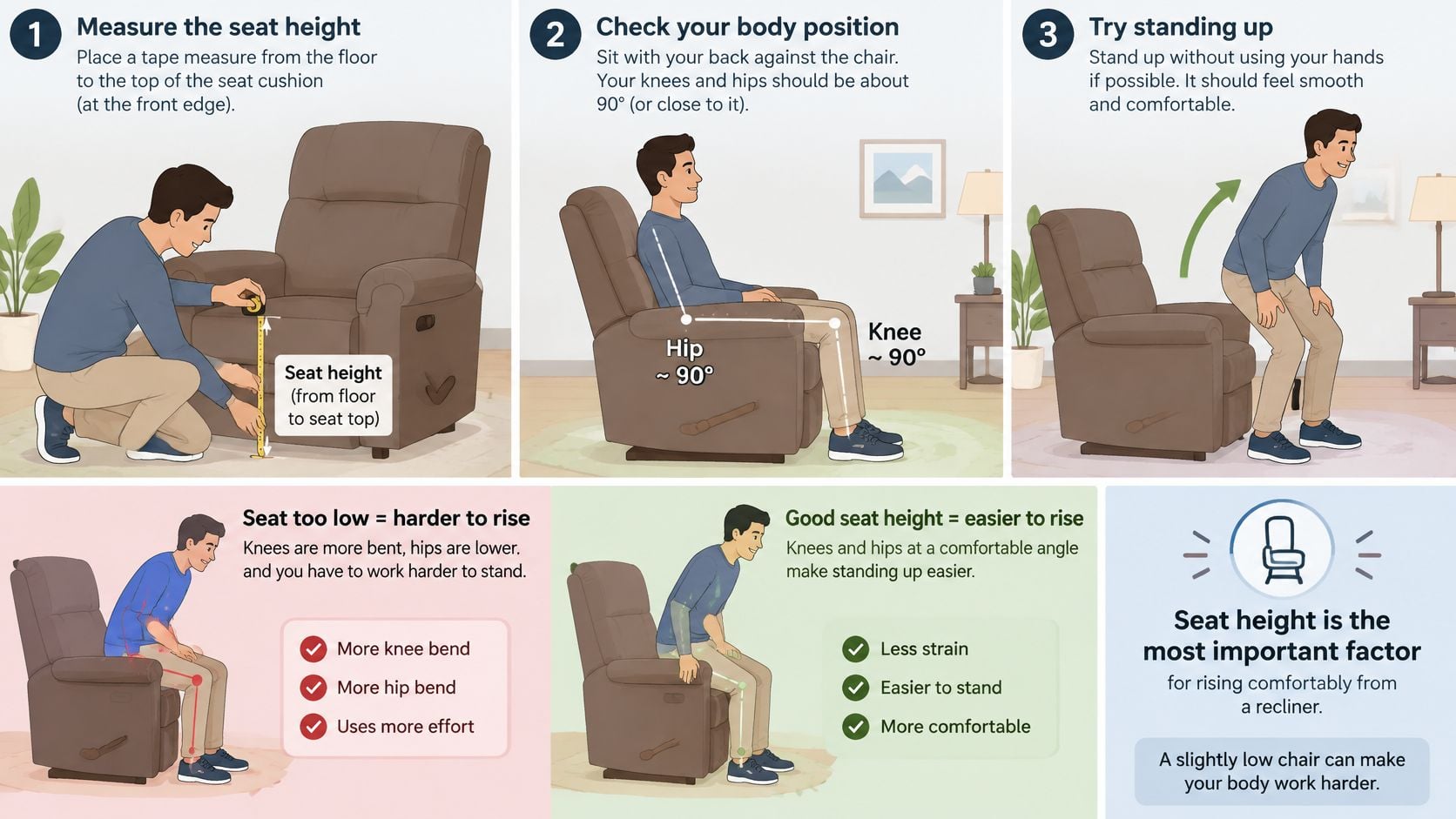
Seat height decides more about rising than leg style, upholstery, or manual versus power controls. A high leg silhouette is a look, not a transfer aid. A chair can have elegant legs and still leave someone straining to stand, and a plainer base can be easier to leave when the seat height and cushion suit the user. A biomechanical seat-height study found that lowering seat height from approximately 115% to 65% of knee height increased maximum hip-flexion moments by about 12% and knee-flexion moments by approximately 100%. A seat that is too low asks the hips and knees to work much harder.
For older users, the study offers a starting reference of approximately 430 mm (16.9 in), or about 470 mm (18.5 in) with a footrest. Treat that as a checkpoint, not a verdict. Your knee height and the cushion's compression decide the final fit, and the loaded measurement is the one to trust.
Measure at home in the shoes you wear indoors. Write down the floor-to-back-of-knee height, then repeat the same measurement once you are seated in the chair you are considering. That second number is the loaded seat height, and it predicts how the chair will feel on a normal evening.
Seven Checks in the Right Order
Measure in usual footwear: Measure from the floor to the back of the knee while wearing normal shoes. Socks produce a misleadingly low number.
Use loaded height: Sit for a minute, then measure from the floor to the top of the compressed cushion at the front edge. Cushion compression lowers the advertised height.
Plant both feet: Sit fully back and confirm that both feet contact the floor without forcing the toes down.
Check knees and clearance: Knees should remain near hip level, with roughly a small hand's clearance between the seat edge and knee crease.
Feel the lumbar contact: The lower back should meet the backrest without an exaggerated arch or a gap that encourages slumping.
Recline slowly: The integrated footrest should support the feet and lower legs instead of leaving them dangling.
Stand without rocking: Rise in one controlled movement, using the armrests normally rather than launching forward.
Those checks matter more than any single number. The chair has to pass the seated test in the showroom, and it has to pass it more than once. Guidance on how to measure furniture can help you record body and room dimensions before you visit.
Loaded height is the height that matters: Judge the cushion after it compresses, not while the chair sits empty.
Room Clearance and Delivery Checks for Smaller Homes
A high leg recliner often looks smaller because light passes beneath the frame and the legs create visual breathing room. Usable space is another matter. The chair occupies one footprint while closed and a larger area once the footrest extends and the back reclines, so apartments, condos, senior living rooms, and older Milwaukee homes need measurements rather than impressions.
The delivery route deserves the same attention as the final placement. Narrow hallways, tight stair turns, and older door frames can stop a chair that would fit beautifully against the living room wall. Shoppers should also ask whether a selected model comes apart for delivery, especially when the route includes a sharp turn.
Four Measurements From Door to Final Spot
Measurement
Where to take it
Compare it with
Doorway and hallway width
The entry route into the room
The chair's delivered width
Elevator and stair turns
Every turn on the delivery path
The chair's delivered depth and height
Closed footprint
Floor space the chair takes upright
The wall space and walkway you have
Maximum reclined projection
How far the front moves when reclined
The free floor in front of the chair
A wall-hugging mechanism can reduce the gap needed behind the chair, but it doesn't eliminate space needs. The footrest still projects forward, and the sides need room for arms, hands, and controls. A coffee table placed for the closed chair may block the recliner every evening.
Clearance is model-specific, so words such as wall-hugger and high leg shouldn't replace the specification sheet. Families comparing recliners for small spaces should bring a tape measure, doorway widths, stair details, and a rough sketch of the room and route. BILTRITE Furniture-Leather-Mattresses offers in-home delivery, and confirming those details before delivery day helps the chair reach its intended spot without last-minute surprises.
Construction, Durability and the Flammability Label
A chair's useful life depends on parts shoppers can't judge from the showroom aisle alone. The frame carries the load, the mechanism controls repeated movement, and the cushion filling and internal layers affect both support and shape retention. Exposed legs also need secure joinery because they concentrate the chair's weight at distinct contact points, unlike a fully enclosed base.
Ask direct construction questions before falling for a fabric. What supports the seat, how does the mechanism feel through its full travel, and what weight capacity appears in the model's specification? A guide to what to look for in a new sofa or chair gives shoppers a solid checklist for comparing frame, cushion, and upholstery details.
What the Federal Label Actually Proves
Under 16 C.F.R. Part 1640, upholstered furniture manufactured, imported, or reupholstered on or after June 25, 2021 must comply with California Technical Bulletin 117-2013. The rule tests smolder resistance in the cover fabric, resilient filling, barrier material, and decking material against char length, smoldering, and transition to open flaming. Covered products carry a permanent label stating, "Complies with U.S. CPSC requirements for upholstered furniture flammability."
That label is valuable, but its promise is narrow. It means the specified components meet smolder-resistance requirements, not that the recliner is fireproof. It also doesn't rate comfort, reclining smoothness, leg strength, weight capacity, or long-term durability.
Exposed wooden legs don't remove a chair from the rule's scope. The upholstered seat, back, and arms still count, and the layers under the visible cover matter as much as the fabric on display. Shoppers should inspect the permanent label and ask whether future reupholstery would preserve compliance.
Treat the flammability label as one safety check, then evaluate frame, mechanism, capacity, and fit separately.
USA-made and Amish-made solid wood furniture is a major strength at BILTRITE Furniture-Leather-Mattresses, giving shoppers a chance to examine real wood construction in person. For an upholstered high leg recliner, the smart approach combines that hands-on inspection with documentation. Confirm the label, review the model specifications, test the mechanism repeatedly, and make sure the cushion supports the user without bottoming out during a longer sit.
Care and Maintenance
Routine care protects both the upholstery and the mechanism, and it doesn't need to become a weekend project. Small habits prevent grit from abrading fabric, reduce uneven cushion wear, and reveal mechanism changes while they're still minor. Material matters, so the cleaning code and model instructions should guide every product choice.
A Simple Routine That Protects the Chair
Vacuum regularly: Dust and grit work into upholstery and wear fibers from within, especially along seams and the footrest.
Follow the cleaning code: Spot-clean only as the tag allows, and test any cleaner on a hidden area first.
Control heat and sunlight: Direct heat, strong sun, and very dry air can fade fabric, affect leather, and dry exposed wood.
Rotate loose cushions: Where the model allows it, rotation spreads compression and surface wear more evenly.
Move the mechanism slowly: Recline and return at a steady pace, keeping rugs, cords, toys, and pets clear of the footrest path.
Don't pull up on moving parts: Using the footrest or one arm as a grab bar strains the frame and linkage during standing.
Report new noises early: Grinding, catching, or uneven travel deserves attention before continued use turns a small issue into a repair.
Detailed upholstery cleaning tips can help households match the method to the cover material. Blot spills promptly rather than scrubbing them deeper, and avoid soaking seams or flooding the cushion beneath. Leather, performance fabric, and woven upholstery don't respond well to one universal cleaner.
Reupholstering or replacing a cover may affect the chair's flammability compliance, so that question belongs at the beginning of any refresh project. The BILTRITE team can discuss care for the specific model under consideration, including how its cushions, mechanism, and upholstery should be handled at home.
Test Your Fit in Our Greenfield Showroom
A photograph cannot show loaded seat height, armrest firmness, or how a transfer feels at the end of a long day. That is the point of sitting in the actual chair. In the Greenfield showroom, sit fully back, check that both feet rest flat, recline slowly, return upright, and stand several times. Test the same sequence on a high leg recliner and a lift chair if your ability is borderline. A high leg silhouette may look easier to leave, but only the seated and standing test proves whether it supports you.
BILTRITE Furniture-Leather-Mattresses stocks 150 styles of recliners, so you can compare high leg, small scale, heavy duty, and lift options side by side instead of judging from a web photo. Bring your measurements, a simple room sketch, and your questions so you can compare seat height, arm height, and clearance against the chairs on the floor. Call 414-238-2020 before you visit if you want to confirm a specific model is available to try.
BILTRITE has been family-owned and operated since 1928. The showroom is closed on Sundays and Mondays for family time, so plan your visit Tuesday through Saturday. Take the time to sit, recline, stand, and ask questions. The right chair should feel right when you are tired, not just when you are testing it for thirty seconds.
With affordable, better-quality furniture, USA-made and Amish-made solid wood pieces, and a knowledgeable local team, BILTRITE Furniture-Leather-Mattresses helps Metro Milwaukee shoppers test a high leg recliner the right way. Visit the Greenfield showroom, bring those measurements, and take all the time needed to sit, recline, stand, and ask every question you need answered.