Heavy Duty Bed Frame with Headboard: How to Choose One


The mattress still feels comfortable, but the bed creaks whenever someone rolls over. The headboard rocks during bedtime reading, and a new frame suddenly seems more important than new bedding. Shopping for a heavy duty bed frame with headboard starts with a practical question: what will keep the entire bed steady through everyday use?
A substantial-looking headboard and a large capacity number aren't enough. The better choice combines dependable mattress support, secure connections, a suitable finished height, and a footprint that fits the bedroom.
Table of Contents
- Heavy Duty Bed Frame Checklist at a Glance
- Why a Weight Rating Only Tells Part of the Story
- Matching Frame Size to Your Mattress
- Height and Daily Transfers for Every Sleeper
- Solid Wood, USA-Made and Amish-Made Frames
- Delivery, Assembly and Keeping the Frame Secure
- Test Your Next Frame in Our Greenfield Showroom
Heavy Duty Bed Frame Checklist at a Glance
These checks turn a showroom visit into something more useful than a quick look at the finish. Heavy duty should describe the complete bed system, not just the largest number on its tag.
Heavy duty bed frame checklist
| Check | What good looks like | Why it matters |
|---|---|---|
| Weight rating | Stated in writing, per sleeper or total, with mattress weight clearly included or excluded | Static weight is only part of the load a frame carries |
| Center support | Multiple center legs that reach a level floor | Helps prevent sagging and movement through the middle |
| Slat spacing | Closely spaced slats that meet the mattress manufacturer's support requirements | Wide, unsupported gaps let the mattress flex |
| Side rails | Reinforced rails that run continuously from head to foot | Transfers mattress loads toward the supports and legs |
| Headboard attachment | Through-bolts, threaded inserts, or structural fasteners into substantial posts | Short screws into thin panels can loosen under lateral pressure |
| Finished sleep height | Measured from floor to mattress top, including any foundation | Affects sitting, standing, and getting into bed |
The most useful inspection includes the underside of the bed. A handsome headboard can hide a lightly built platform, so the shopper should ask to see the center beam, rail connections, and leg adjustment points.
Safety guidance also looks beyond appearance. The European bed safety standard addresses secure load-bearing components and injury risks such as sharp edges and burrs. That makes exposed hardware, rough metal edges, and loose connections worth checking alongside strength.
Showroom shortcut: Anything hidden by a mattress deserves a question, not an assumption.
Bring the Checklist Along
BILTRITE is a fourth-generation, family-owned store in Greenfield, serving Metro Milwaukee since 1928. Its team can help shoppers work through the visible connections and identify details that need confirmation in the manufacturer's instructions.
Bring the table along, mark the items that can be verified by hand, and flag anything the tag doesn't explain. A missing specification is a reason to ask for documentation before choosing the frame.
Why a Weight Rating Only Tells Part of the Story
A big capacity number doesn't automatically mean a steady bed. How the frame carries weight matters as much as the stated limit.
Mattress and occupant forces pass through the slats or platform, into the supporting rails and center structure, through the legs, and finally into the floor. A weak connection anywhere along that path can cause movement even when the frame isn't overloaded.
The support arrangement becomes easier to understand when the individual parts of a bed are identified before comparing specifications.
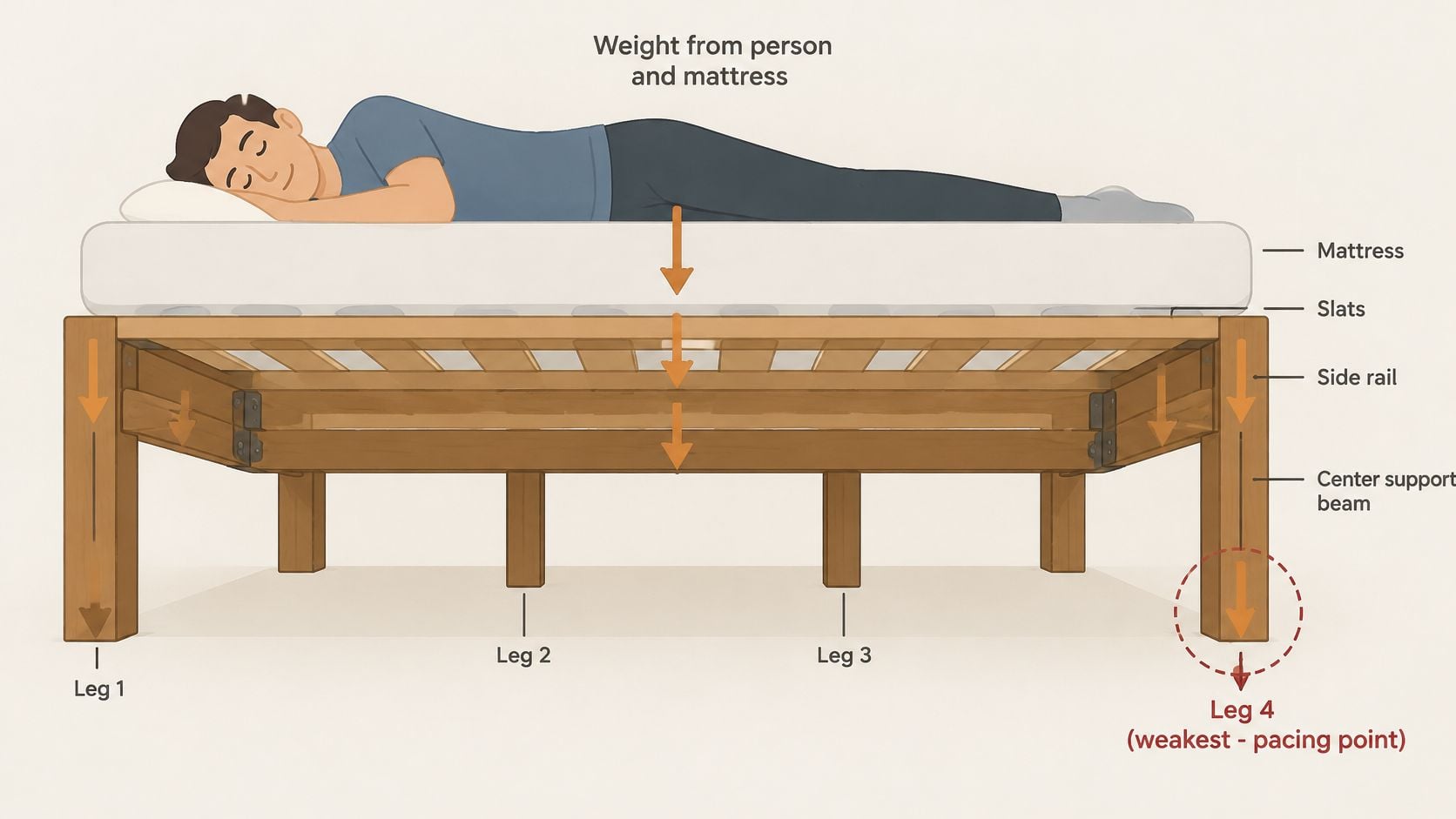
Static Capacity Isn't the Whole Job
Sitting on an edge puts force into a smaller area than lying across the mattress. Getting into bed adds a brief impact, while turning and repositioning repeatedly work the joints. Loose fasteners can become noticeable long before a rail visibly cracks.
Consider a couple who each interpret the advertised rating as an allowance for their own body weight. If the manufacturer means the entire supported load, their calculation leaves out both the other sleeper and possibly the mattress.
Before comparing models, the shopper needs clear answers:
- Rating scope: Does the capacity apply to the complete bed or each sleeper?
- Included weight: Are the mattress, foundation, and bedding part of the stated load?
- Required configuration: Which slats, center supports, and legs must be installed for that rating?
- Intended use: Does the manufacturer allow the frame to support the planned mattress and foundation combination?
Headboards Face a Different Kind of Pressure
Leaning against a headboard pushes sideways rather than straight down. Reaching, accidental bumps, and repeated pulling can rack the frame or loosen the headboard connection.
For a grandparent who uses the headboard while sitting up each morning, that distinction matters. A decorative panel shouldn't be assumed to function as a transfer aid, even when the frame beneath it has a substantial weight rating.
Mechanical connections into substantial posts are preferable to short screws into thin material. Where wall anchoring is appropriate, FEMA's furniture-securing guidance states that screws must penetrate wall studs because drywall, gypsum board, and plaster won't retain heavy furniture during an earthquake.
Request the load rating in writing before buying. The document should identify the configuration being rated, not merely repeat a showroom label.
Matching Frame Size to Your Mattress
A mattress can fit its size category and still sit poorly in a frame if the usable opening or support layout is wrong. Start with the mattress's nominal dimensions, then confirm the frame specifications and measure the actual mattress when possible.
| Mattress size | Typical dimensions (inches) | Frame measurement to confirm |
|---|---|---|
| Twin | 38 × 75 | Twin-compatible interior opening and support layout |
| Twin XL | 38 × 80 | Twin XL length, not a standard Twin opening |
| Full | 54 × 75 | Full-compatible rail-to-rail width and usable length |
| Full XL | 54 × 80 | Full XL length with matching mattress support |
| Queen | 60 × 80 | Queen interior opening and required center support |
| King | 76 × 80 | King width and length, not California King dimensions |
| California King | 72 × 84 | California King proportions and compatible support layout |
Use this mattress size chart as a starting point. Mattress dimensions can vary, so compare the actual mattress with the frame manufacturer's specifications. Allow for the specified assembly clearance. The fit should avoid unintended gaps and overhang without wedging the mattress tightly between the rails.
Measure the Sleeping Area and the Furniture Footprint
Measure the bed and the room as separate parts of the fit. The headboard may extend beyond the rails or add depth behind the mattress, particularly with thick posts or upholstery.
Record the usable interior between the rails and between the head and foot. Then measure the outside footprint, including posts, upholstery, brackets, and any footboard. Check the mattress thickness against the actual model specifications, and note room clearances around nightstands, outlets, closet doors, and walking routes.
A mattress's construction does not reliably indicate its thickness. Measure the specific hybrid, foam, latex, or innerspring model, especially if you plan to keep an existing foundation.
Make the Bedroom Work Around the Bed
For a queen hybrid in a narrow bedroom, the mattress may fit the frame while a tall headboard blocks an outlet or a projecting footboard crowds the closet door. Check the whole footprint before settling on a frame.
Painter's tape makes the floor plan easy to test. Mark the outer edges of the frame, including any projecting posts or footboard, and leave the tape in place as you check door swings, walking space, and nightstand positions. On the wall, mark the headboard's height and width to see how it relates to windows, switches, and artwork.
The CPSC's bed safety guidance explains that openings among the mattress, frame, headboard, footboard, and rails can create entrapment hazards. Choose compatible components and assemble them as specified rather than filling a poor fit with pillows.
Bring your room measurements, mattress thickness, and the frame's outside dimensions when comparing options in the showroom.
Height and Daily Transfers for Every Sleeper
A caregiver helping someone out of bed each morning has different priorities from a shopper choosing a headboard finish. The sleeper needs to reach the edge, place their feet securely, and stand without an awkward climb or deep push upward.
Finished sleep height means the floor-to-mattress-top measurement, including the frame, foundation, and mattress. Frame height alone leaves out much of the setup.
In a 2024 report published by Age Friendly Ireland, a six-month intervention that included optimizing bed height reported a 50% reduction in bed falls, particularly relevant to older residents who struggled to get out of bed. That result supports individualized height checks, not a universal height prescription.
The most useful bed height is the one that supports the particular sleeper's daily movements.
Run a Practical Transfer Check
- Measure the complete setup. Record the finished surface height with the intended mattress and foundation, rather than estimating from an empty display frame.
- Sit at the edge. With usual footwear or the normal bedtime routine in mind, check whether the sleeper can place their feet securely and maintain a comfortable seated position.
- Practice standing and repositioning. Assess the movement with appropriate assistance, but don't use the headboard as a grab point unless the manufacturer specifically approves that use.
A soft mattress edge can compress substantially while the sleeper sits down. That changes the transfer experience even when the unloaded mattress height looks suitable.
For seniors and people with mobility limitations, the adjustable bed height guide can help frame the discussion around the whole setup. A clinician or occupational therapist can advise when transfers require specialized support.
Leave Space for Safe Assistance
Caregivers also need room beside the bed to help without twisting around a nightstand. Headboard posts and projecting rails shouldn't block the intended approach or interfere with existing mobility equipment.
Adding a portable rail isn't a simple finishing touch. The ASTM consumer-product standards listing identifies a separate safety specification for portable bed rails, rather than treating them as ordinary headboards or frame components.
Check the rail's intended users, mattress compatibility, installation requirements, and spacing near the headboard before use. A sturdy-looking accessory isn't a substitute for a compatible, purpose-designed transfer setup.
Solid Wood, USA-Made and Amish-Made Frames
A heavy-duty bed depends on how its parts work together. A solid-wood headboard can still have a weak attachment, while a veneered headboard can perform well if the structural loads pass through properly designed posts and hardware rather than the decorative panel.
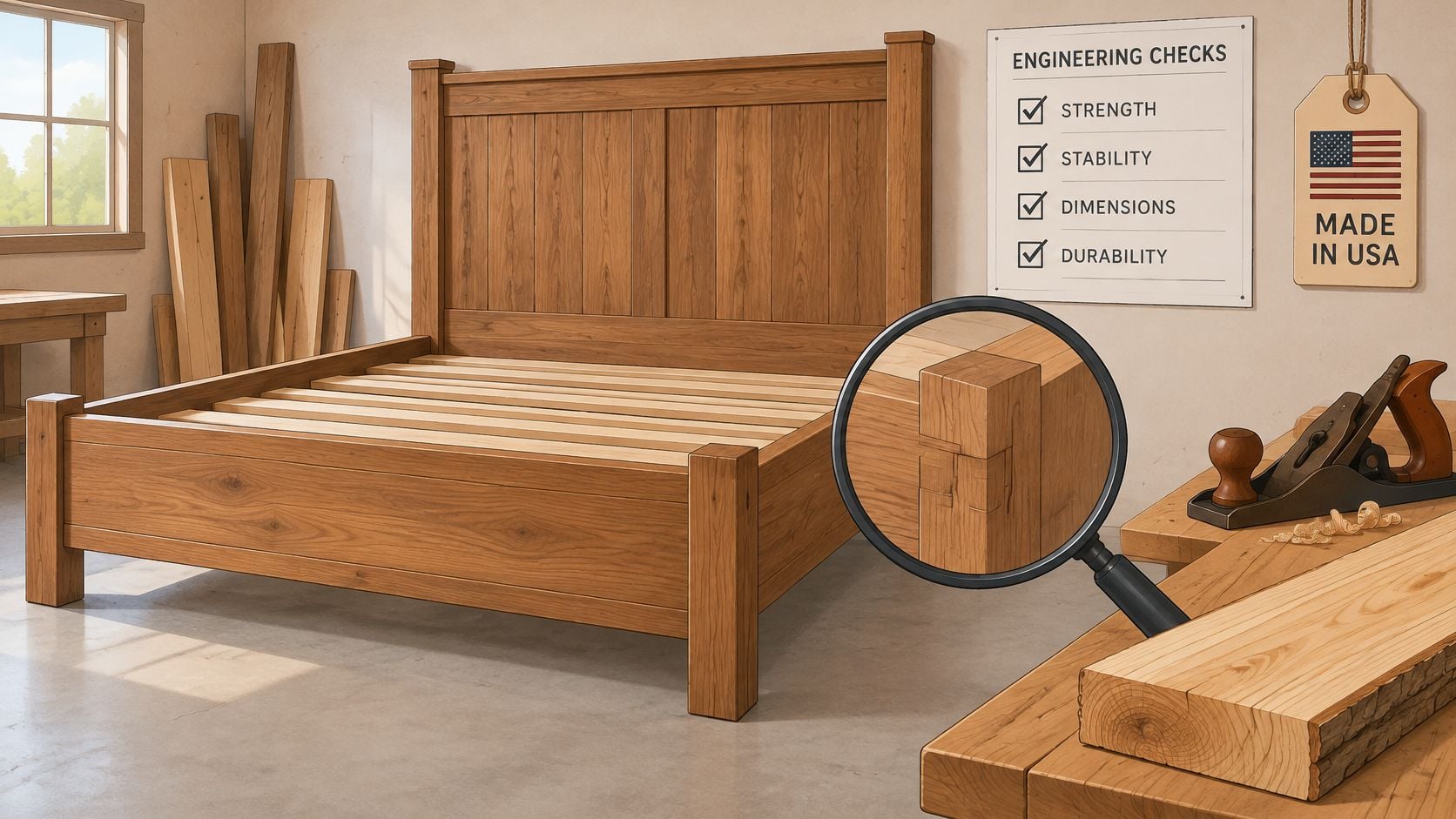
Solid wood and veneered panel compared
| Check | Solid wood | Veneered panel |
|---|---|---|
| Headboard core | Solid hardwood boards when specified as solid hardwood | Wood veneer over a core panel |
| Joinery | Look for well-fitted structural joints; mortise-and-tenon may connect rails and posts | Inspect panel-edge connections, supporting posts, glue, and fasteners |
| Fastener holding power | Through-bolts can provide secure connections through substantial posts | Short screws into a thin core can pull loose |
| Question to ask in person | Is the lumber kiln-dried for interior conditions? | Are the veneer edges sealed, and where do structural fasteners attach? |
Ask What the Origin Claim Covers
According to the Federal Trade Commission's Made in USA guidance, an unqualified claim generally requires U.S. assembly and no more than a negligible amount of foreign content. This standard concerns product origin, not bed-load capacity.
Ask where final assembly occurs, which components come from outside the country, and whether the origin statement covers the whole bed or just the headboard. Check the material description, too: solid-wood posts around a veneered panel are different from a headboard made entirely from solid boards.
Look Past the Glossy Finish
A mortise-and-tenon joint connects a projecting tenon to a matching opening. Dovetails interlock adjoining pieces and are particularly useful to inspect in drawer construction if the bed includes storage. Neither joint name guarantees that every connection on the bed is equally strong.
For rails and headboard posts, check how the joints fit and whether the bed can be disassembled without damaging the connections. Glue suits permanent joints; removable rail connections need hardware designed for repeated assembly.
Amish-made craftsmanship is best judged by visible details, not assumptions. Well-fitted joints, substantial supporting members, smooth edges, and an even finish tell you more about construction than decorative carving alone.
The solid-wood bedroom furniture guide can help you prepare questions about materials. At BILTRITE Furniture-Leather-Mattresses, shoppers can examine surfaces, edges, and accessible connections in the showroom.
Delivery, Assembly and Keeping the Frame Secure
Correct setup starts before the mattress goes on. Follow the specific frame instructions, and avoid substituting hardware just because a spare screw appears to fit.
- Lay out the parts. Match rails, brackets, slats, legs, and fasteners to the hardware list before starting.
- Connect the rails. Install every specified structural fastener at the headboard and footboard connections, keeping the frame square as directed.
- Set the center supports. Position the beam and support legs according to the assembly diagram.
- Install the slats. Use the required spacing and secure each slat wherever the instructions specify.
- Check floor contact. Adjust approved levelers so the supporting legs bear on the floor without lifting other legs.
- Recheck after use. Inspect for looseness after initial use and again after the frame has settled, following the manufacturer's tightening instructions.
Keep the hardware bag until assembly is complete, and don't discard an unexplained fastener. The bed-frame assembly guide offers a useful overview, but the model-specific instructions control the setup.
Diagnose Movement Before Modifying the Frame
Frame symptoms, likely causes and fixes
| Symptom | Likely cause | Fix |
|---|---|---|
| Headboard wobbles when leaned on | Loose connections or attachment to thin side rails | Tighten specified hardware; request an approved post-mounted or through-bolt connection |
| Frame creaks at night | Loose fasteners, rubbing joints, or uneven support | Check floor contact, center legs, and hardware |
| Middle of the bed sags | Inadequate center support or excessive slat gaps | Install manufacturer-approved support or slats |
| Headboard shifts or tips on the wall | Inadequate anchoring | Stop using it until secured appropriately into wall studs |
| Gap between mattress and headboard | Mismatched dimensions or incorrect positioning | Verify mattress compatibility and the assembled opening |
Structural changes should be approved by the manufacturer. Drilling extra holes or adding improvised supports can damage a rail or alter the intended load path.
Maintenance reminder: Tighten to the specified fit, not with maximum force. Overtightening can strip threads or crush material around a connection.
Protect the Wood and Plan the Delivery Route
The U.S. Forest Products Laboratory wood handbook reports that hardwood lumber for furniture and similar interior uses is commonly kiln-dried to approximately 6%–8% moisture content. That preparation helps limit later dimensional changes.
The U.S. Forest Service's wood-moisture guidance identifies keeping wood at or below roughly 20% moisture content during service as a key decay-prevention measure. That isn't a target for bedroom furniture; keep the frame dry and away from leaks, damp floors, persistent condensation, and wet basement walls.
Before delivery, measure doorways, hallway corners, stair turns, and elevator openings. Confirm whether the headboard and rails arrive separately, and ask BILTRITE's team which delivery arrangements apply to the address and purchase.
Test Your Next Frame in Our Greenfield Showroom
A frame can look sturdy and still feel wrong for daily use. In the Greenfield showroom, compare how the mattress sits, how the headboard connects, and whether the finished bed height suits the sleeper and anyone helping with transfers.
Bring Measurements and Questions
Bring the mattress model or its specifications, plus notes on the sleeper's mobility needs and preferred bed height. Ask to see the frame's written load rating and whether the headboard is designed to attach to that frame.
BILTRITE Furniture-Leather-Mattresses offers heavy duty furniture and mattresses, including solid wood, USA-made, and Amish-made options. Its mattress selection includes over 60 models. Select model sets include a free mattress protector or a free heavy duty bed frame; confirm which sets qualify and whether the frame fits your mattress and headboard.
Compare the full setup, not just the frame: mattress, headboard, connection points, and finished height.
A showroom visit lets you check comfort and ask about product details in person. Check the store's current hours before setting out.
BILTRITE Furniture-Leather-Mattresses offers affordable, better-quality furniture and mattresses for households choosing a supportive everyday bed. Visit BILTRITE Furniture-Leather-Mattresses in Greenfield to compare options and ask questions in person.