How to Choose a Mattress Protector: A Practical Guide

A glass of water tips over at 9 p.m. A toddler crawls into a grown-up bed at 2 a.m. after a wet accident. Someone wakes up sneezing every morning on a mattress that's barely three years old.
Three problems, three different products, and the cheap waterproof pad sitting in most shopping carts solves only one of them. The word protector covers a wide span of goods, from a fitted pad that catches a spill to a six-sided zippered encasement that seals a mattress for a year. They photograph the same and behave nothing alike.
Getting this right takes about fifteen minutes and one tape measure. Naming the hazard first, measuring second and comparing materials last is how to choose a mattress protector that does its job, whether the goal is saving a mattress from a spill, keeping bed bugs contained or pulling dust-mite allergen out of the bed.
Table of Contents
- Match the Protector to the Problem You Need to Solve
- How to Measure Your Mattress and Check the Fit
- Materials, Waterproofing and Breathability Trade-offs
- What Allergy and Bed-Bug Covers Can and Cannot Do
- Cleaning, Durability and Care Label Checks
- Confirm Your Choice and Visit Our Greenfield Showroom
Match the Protector to the Problem You Need to Solve
Decide what you're defending against before you look at thread count, price or color. A household with a potty-training toddler, a household with a dog that sleeps on the bed and a household with a dust-mite-sensitive sleeper need three different constructions. Buying the wrong one wastes money twice, once on the product and again on the mattress it failed to save.
No single protector handles every hazard. A fitted, top-only waterproof pad is not equivalent to a bed-bug encasement, and an allergen cover isn't a spill cover with a fancier label.
| Main hazard | Protector type | Spec to check |
|---|---|---|
| Spills, sweat and everyday accidents | Waterproof fitted protector | Waterproof barrier, breathable top, machine-washable care label |
| Bedwetting, incontinence or pets | Heavier-duty waterproof protector | Sealed or welded seams, secure elastic or zipper, full corner coverage |
| Dust mites and allergens | Allergen-impermeable encasement | Zipper closure around all six sides, documented impermeability |
| Bed bugs | Full zippered encasement | Closes completely, tear-resistant, built to last at least one year |
| Light everyday comfort only | Breathable, water-resistant fitted pad | Quiet fabric, pocket depth that matches mattress height |
Bed bugs are where a cheap pad fails outright. The U.S. Environmental Protection Agency guidance on encasement products states that an appropriate mattress and box-spring encasement should be used to help prevent the spread of bed bugs. That points to a zippered design enclosing every mattress surface, with a closure that seals shut and enough depth that no gap shows at the corners. A top-only pad leaves the sides, the underside and the box spring open, which is where bugs hide.
Liquid protection is a different specification. Verify a waterproof or water-resistant barrier, a breathable surface and machine-washable care instructions. When a drink does get through, the cleanup matters as much as the purchase, and the guide to getting urine smell out of a mattress covers what to do before the smell sets.
The decision rule: name the main hazard first. Fit, quietness and washability are tiebreakers, not starting points.
How to Measure Your Mattress and Check the Fit
Fit causes more returns and more frustration than material ever does. A protector an inch too shallow pops off the corners by Thursday. One that's too generous bunches under a sleeper's back and leaves a gap at the zipper, which is the same as having no cover at all.
A tape measure settles it before money changes hands.
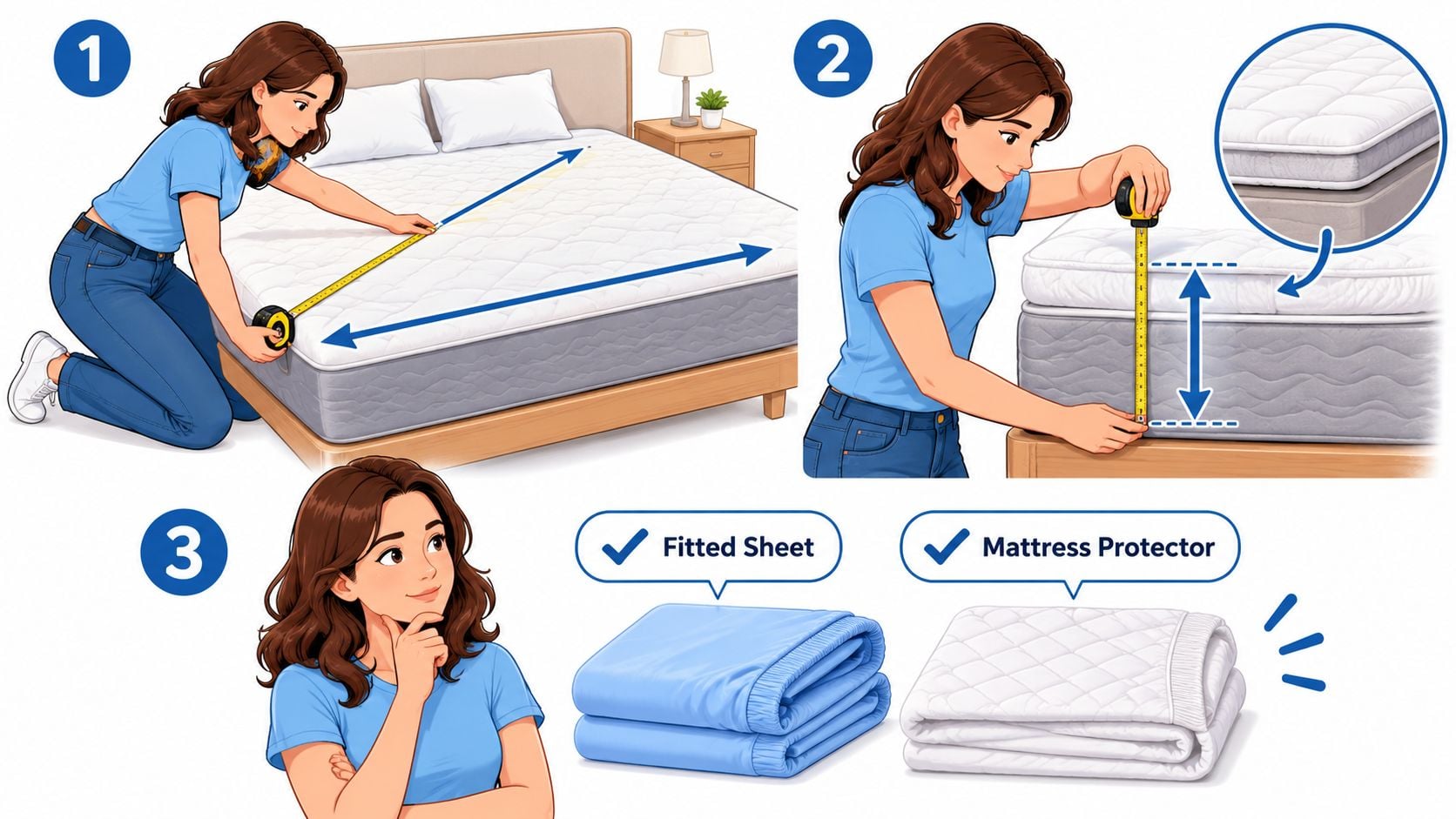
A five-step measuring routine
- Measure the mattress, not the name on the tag. Queen, full and king are nominal labels, and actual dimensions vary between manufacturers. This walkthrough for measuring a mattress lays out the order to work in.
- Measure height at the edge, with everything on. Include a pillow top, an egg-crate pad or a topper. The deepest point is the number that matters, not the height at the middle of the bed.
- Choose fitted or six-sided. A fitted protector shields the sleep surface. A six-sided encasement also covers the sides and the zipper perimeter, which is what allergen and pest work requires.
- Confirm pocket depth clears that deepest point. Twelve inches of pocket on a fifteen-inch mattress will not stay put, no matter how strong the elastic feels in the package.
- Check the base and the mattress type. If the bed sits on an adjustable base, look for a protector rated for one. A two-sided or flip-able mattress needs coverage on both faces, since both get slept on over the years.
Step four is also where labels get slippery. The word waterproof is a marketing adjective until a test method backs it up. ASTM D3393 defines waterproofness for coated fabrics through a minimum hydrostatic-resistance criterion, so a description that names a test tells you more than one that repeats the adjective. Comfort claims work the same way. ASTM lists D737 as a standard test method for textile air permeability, but no universal comfort threshold exists for mattress protectors, so lab values are useful mainly when two products were tested under the same method.
The recurring mistakes are predictable. Buying by nominal size only. Underestimating pocket depth on a deep mattress. Choosing a laminate that crinkles with every turn. Skipping the care label and shrinking a cover two sizes in the first hot wash.
A cover that needs two people to install, or that wrinkles the moment the sheet goes on, is the wrong size, not a fussy design.
Then test it physically, in the room where it will live. Lay the cover on flat, pull a corner up and let go, and walk the perimeter looking for gaps. A keeper sits smooth under the sheet, stays where you put it and closes without a gap anywhere along the zipper.
Materials, Waterproofing and Breathability Trade-offs
Protection level pulls against heat, moisture, noise and fit, and every material choice trades one for another. That's the entire decision in one sentence.
Cover materials compared by protection and comfort
| Material | Protection level | Heat and moisture | Watch for |
|---|---|---|---|
| Polyurethane membrane under a cotton or knit top | Strong waterproof barrier | Can trap heat and moisture | Choose a thicker top layer to improve comfort |
| Thick cotton top with waterproof backing | Good liquid protection | Usually more comfortable than a bare membrane | Confirm the waterproof layer is rated, not just described |
| Woven allergen-impermeable cover | Strong allergen barrier | Breathes far better than a coated film | Woven construction holds up better than nonwoven |
| Nonwoven fabric | Weaker barrier | Light and airy, less clammy than a membrane | Some nonwoven materials allow mites to colonize the fibers |
| Ordinary cotton sheet | Allows substantial allergen leakage | Breathes well with no heat build-up | Not a barrier and not a substitute for a protector |
The pattern in that table comes from laboratory work rather than marketing copy. Testing reported in the journal Allergy's comparison of cover materials found that plastic and polyurethane-coated covers were the strongest barriers to mites and allergens, that ordinary cotton sheets allowed substantial allergen leakage, and that some non-woven materials let mites colonize the fabric fibers.
A bare membrane under a thin sheet feels like a plastic bag by 3 a.m. A thicker cotton face over that same membrane keeps the waterproofing and loses most of the clamminess, which is why hot sleepers with occasional spills do better with a laminated cotton cover than with the thinnest film available. Treat the word cooling on a package as a description, not a measurement, because no agreed test sits behind it. If night sweats are the reason you're shopping, this guide to cooling mattress covers is the better starting point.
Chemical comfort is a separate question, and it has a real answer on the label. OEKO-TEX STANDARD 100 tests every thread, button and accessory against a list of more than 1,000 harmful substances, and the requirements get stricter as skin contact becomes more intensive. Bed linens fall in Product Class 2, the category for direct skin contact. A certified protector has passed that testing, and the certificate says nothing about whether the cover is waterproof, quiet or deep enough for your mattress, so it's one line on the checklist rather than the whole decision.
A workable rule: occasional spills justify a breathable, water-resistant cover. Repeated accidents call for a true waterproof membrane. Allergy containment needs sealed edges and a zipper.
What Allergy and Bed-Bug Covers Can and Cannot Do
A sealed mattress cover can reduce the dust-mite allergen held in a mattress, but that does not guarantee fewer allergy symptoms. The distinction matters when a product's packaging promises health benefits.
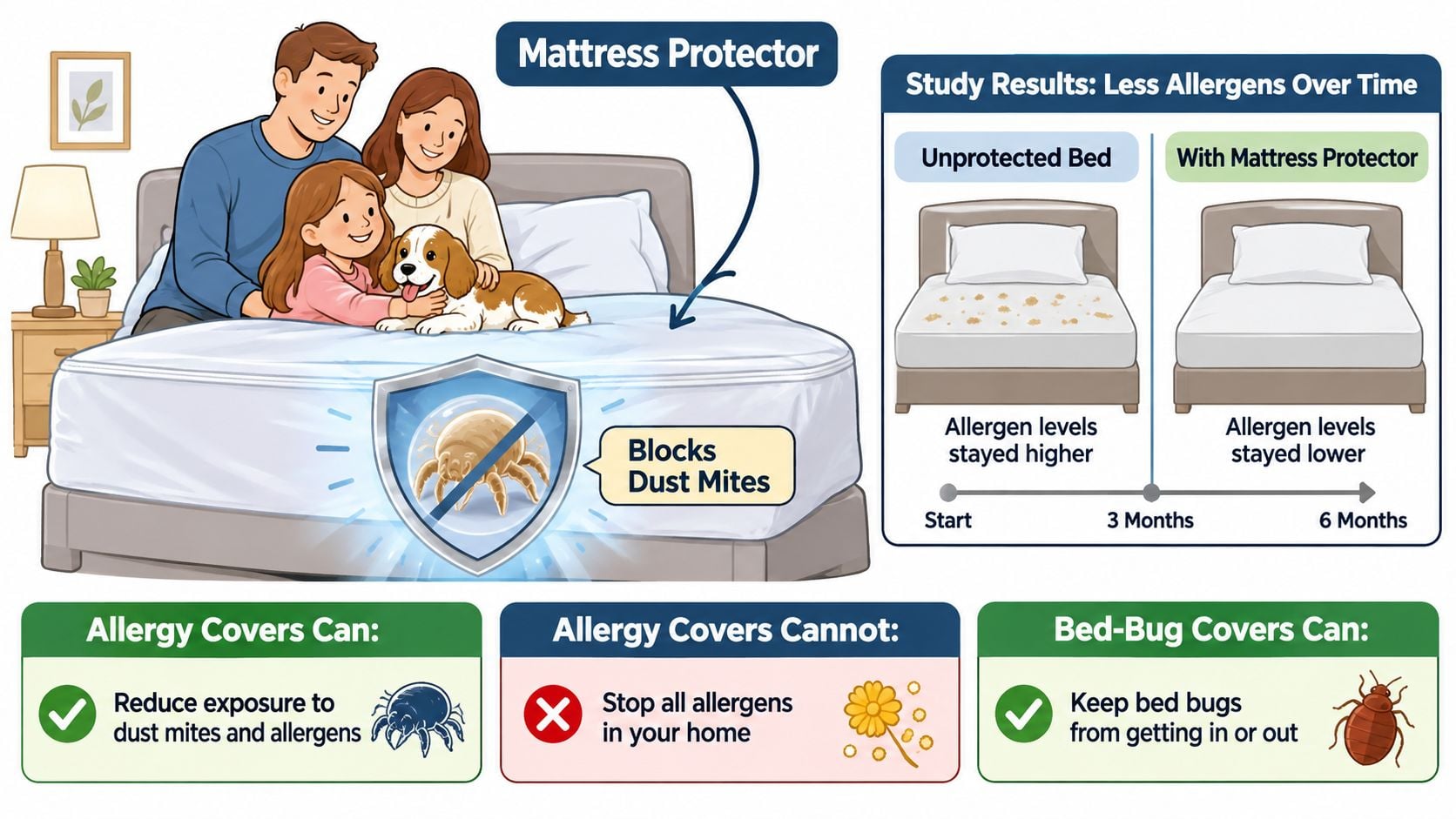
The PIAMA study of 810 children with allergic mothers compared allergen-impermeable encasings with placebo covers on children's and parents' beds. After 12 months, mattresses with active covers held approximately half as much Der 1 allergen per square meter as mattresses with placebo covers, according to the study. Der 1 combines the major dust-mite allergens Der p 1 and Der f 1. Researchers described the reduction as significant but modest, since starting allergen levels were generally low. The four-year follow-up to the PIAMA study found no reduction in sensitization or atopy, and the allergen-lowering effect had disappeared for one of the measured mite allergens.
What the allergen studies measured
| Study | Allergen result | Clinical outcome |
|---|---|---|
| PIAMA study, 810 children, encasing vs placebo | About half the Der 1 per square meter after 12 months, as reported in the PIAMA study | No reduction in sensitization or atopy at four years, according to the PIAMA follow-up |
| Randomized placebo-controlled trial | Allergen at 31% of baseline vs 82% in controls after 12 months, as reported in the New England Journal of Medicine trial | Rhinitis outcomes did not improve in the New England Journal of Medicine trial |
| Double-blind study | Der p 1 reduced 2.1 times; Der p 1 plus Der f 1 reduced 2.5 times after 12 months, as reported in the University of Groningen research record | No significant improvement in atopic dermatitis, according to the University of Groningen research record |
The three trials measured allergen levels and symptoms separately. In the placebo-controlled trial published in the New England Journal of Medicine, impermeable covers lowered allergen concentrations, but rhinitis outcomes did not improve. The double-blind study recorded by the University of Groningen found lower mite-allergen levels without significant improvement in atopic dermatitis. Choose an encasement to limit allergen exposure at the mattress, with the understanding that it may not relieve symptoms on its own.
The bed bug standard is stricter
A bed-bug encasement must contain insects, not just block allergens. EPA bed bug prevention guidance recommends leaving an encasement in place for a full year and using monitoring devices such as interceptors to check whether an infestation is gone. Choose a cover designed to resist tearing, then inspect it periodically for holes or split seams. A small opening can defeat the barrier.
For allergy containment, look for a zipper that closes around all six sides, documented allergen impermeability rather than a vague “hypoallergenic” badge, and full mattress coverage. Pillows, duvets, carpets and upholstered furniture can also hold allergens. A 2024 systematic review of house-dust-mite avoidance strategies covered 35 clinical trials and 2,419 patients, underscoring that mattress encasement is only one part of a wider plan. These tips for maintaining a dust- and allergen-free bedroom cover other parts of the room.
Cleaning, Durability and Care Label Checks
Heat and harsh wash cycles can wear down a protector's barrier. Check the care label before the first wash; it sets the limits for washing temperature, drying and shrinkage.
A wash routine that keeps the barrier intact
- Follow the label. Use the stated wash temperature and drying method rather than relying on the marketing insert.
- Wash warm only if permitted. Consumer Reports notes that washing bedding above 130°F can kill dust mites and recommends woven allergen-impermeable covers, which are more durable than nonwoven covers (Consumer Reports' guide to reducing indoor allergens). If the care label sets a lower temperature, follow it.
- Use low heat or air-dry if the label allows. Repeated high heat can damage a waterproof layer.
- Check the seams, zipper and corners after washing. Look for split stitching, zipper gaps and elastic that has gone slack.
- Wash sheets and bedding regularly too. A clean protector does not keep the bed fresh if the bedding on top needs laundering.
Replace the cover when its barrier fails, even if the fabric looks fine. A zipper that gaps, a separated seam or liquid passing through signals that the protector can no longer do its job. Keep a spare on hand so the mattress stays covered while the other one is being washed.
BILTRITE Furniture-Leather-Mattresses provides written care information with mattress purchases. For practical guidance on caring for the mattress itself, see the mattress cleaning and maintenance tips. Check the protector's label today and keep its washing instructions with your spare cover.
Confirm Your Choice and Visit Our Greenfield Showroom
A protector for spills may be a poor choice for pest containment. Before you buy, confirm that the cover suits the hazard, fits your mattress depth, and can be cleaned according to its care label.
At BILTRITE Furniture-Leather-Mattresses, the Mattress Center showroom in Greenfield offers an expanded gallery of flip-able, two-sided and heavy-duty mattresses. Bring your mattress measurements and any specific concern, such as spills, allergens or bed bugs, so the team can help you compare a fitted protector with a full encasement. A free mattress protector or a free heavy duty bed frame is included with select model sets, so ask which sets qualify.
The right choice depends on the job: a waterproof surface barrier addresses spills, while allergy or bed-bug containment requires a cover designed for that purpose. Check the product label for its intended use and care instructions before deciding.
Visit BILTRITE Furniture-Leather-Mattresses in Greenfield to explore the mattress selection and ask questions about choosing a protector. All mattresses are USA made, 100% handmade, brand new and factory fresh.