Heavy Duty Mattress Cover Guide for Better Sleep


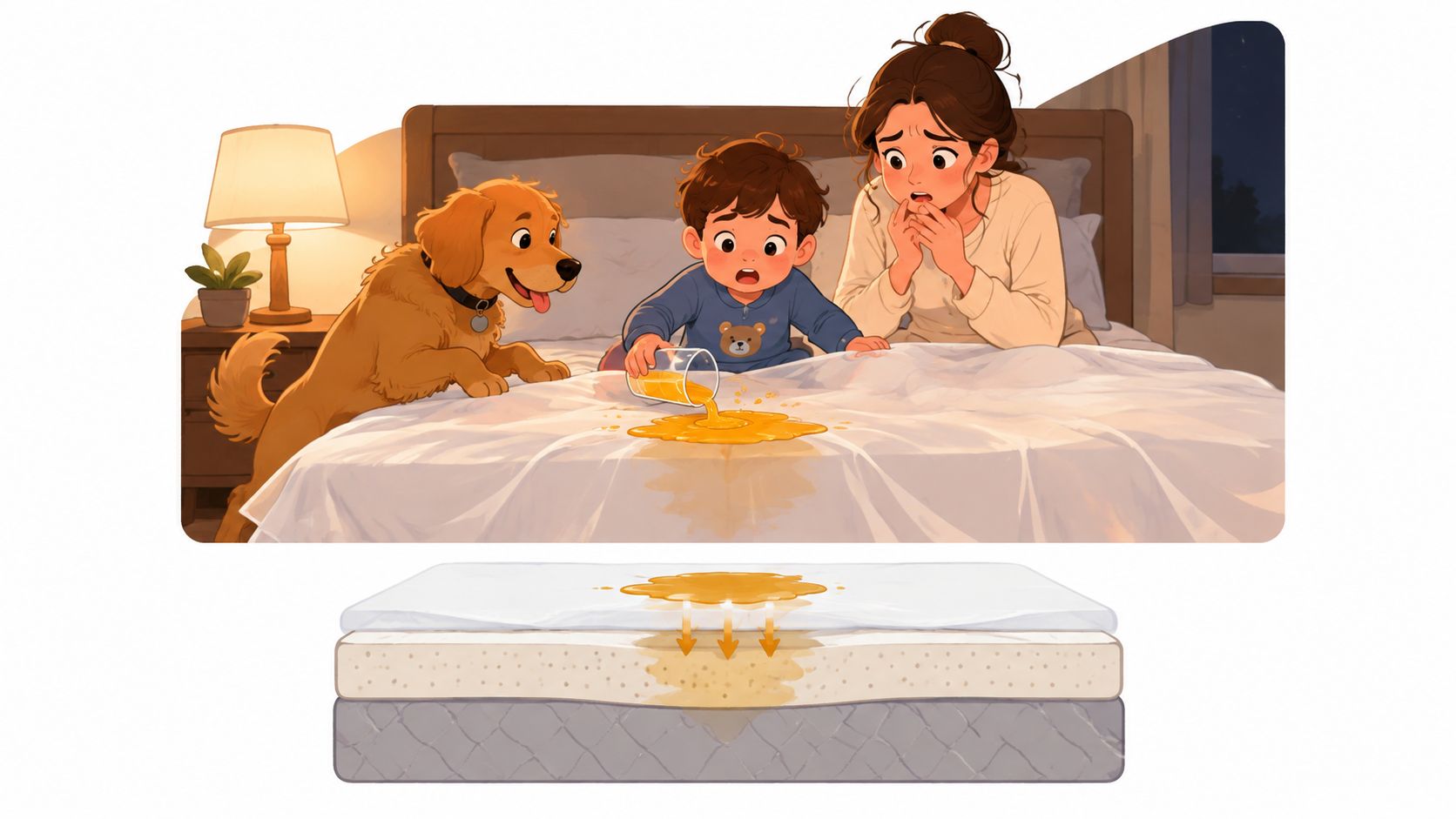
A juice cup tips over during a busy Milwaukee bedtime. A dog jumps onto the mattress with damp paws, or a child climbs in after a long day carrying crumbs, sweat, and the occasional mystery stain. A thin sheet may hide the mess for a moment, but it won't stop liquid, allergens, or wear from reaching the mattress underneath.
That's where a heavy duty mattress cover earns its place. Unlike a basic fitted protector, it's built as a working barrier, with a surface fabric, a waterproof layer, reinforced seams, and sometimes a zipper that closes around the entire mattress. The right design can make cleanup easier, help manage heat and moisture, and protect a mattress through years of family life.
BILTRITE has helped Metro Milwaukee families choose mattresses and bedroom furnishings since 1928. A useful starting point is the household's actual situation: mattress thickness, children or pets, allergies, frequent washing, senior care, or a guest room that needs quick turnover. For broader sleep habits, the BILTRITE guide to having a good night's sleep offers a helpful companion.
Table of Contents
- What a Heavy Duty Mattress Cover Really Is
- Materials and Construction Compared Without the Jargon
- How to Choose the Right Fit and Features for Your Bed
- Installing and Caring for Your Cover So It Lasts
- Real World Use Cases From Family Homes to Care Settings
- Shopping Smart in Milwaukee and Visiting BILTRITE in Greenfield
What a Heavy Duty Mattress Cover Really Is
A mattress protector and a mattress encasement solve related problems, but they aren't built the same way. A fitted protector usually covers the top and wraps around the sides, leaving the underside exposed. A six-sided zippered encasement surrounds the top, bottom, and edges, creating a closed shell around the mattress.
Think of the difference between a rain-resistant seat cover and a rain jacket. The seat cover protects one main surface. The jacket surrounds the person, and its zipper and seams matter as much as its fabric. A heavy duty cover works in the same way. The barrier may be waterproof, but an open edge, weak seam, or poorly designed zipper can leave a path for spills, pests, or moisture.
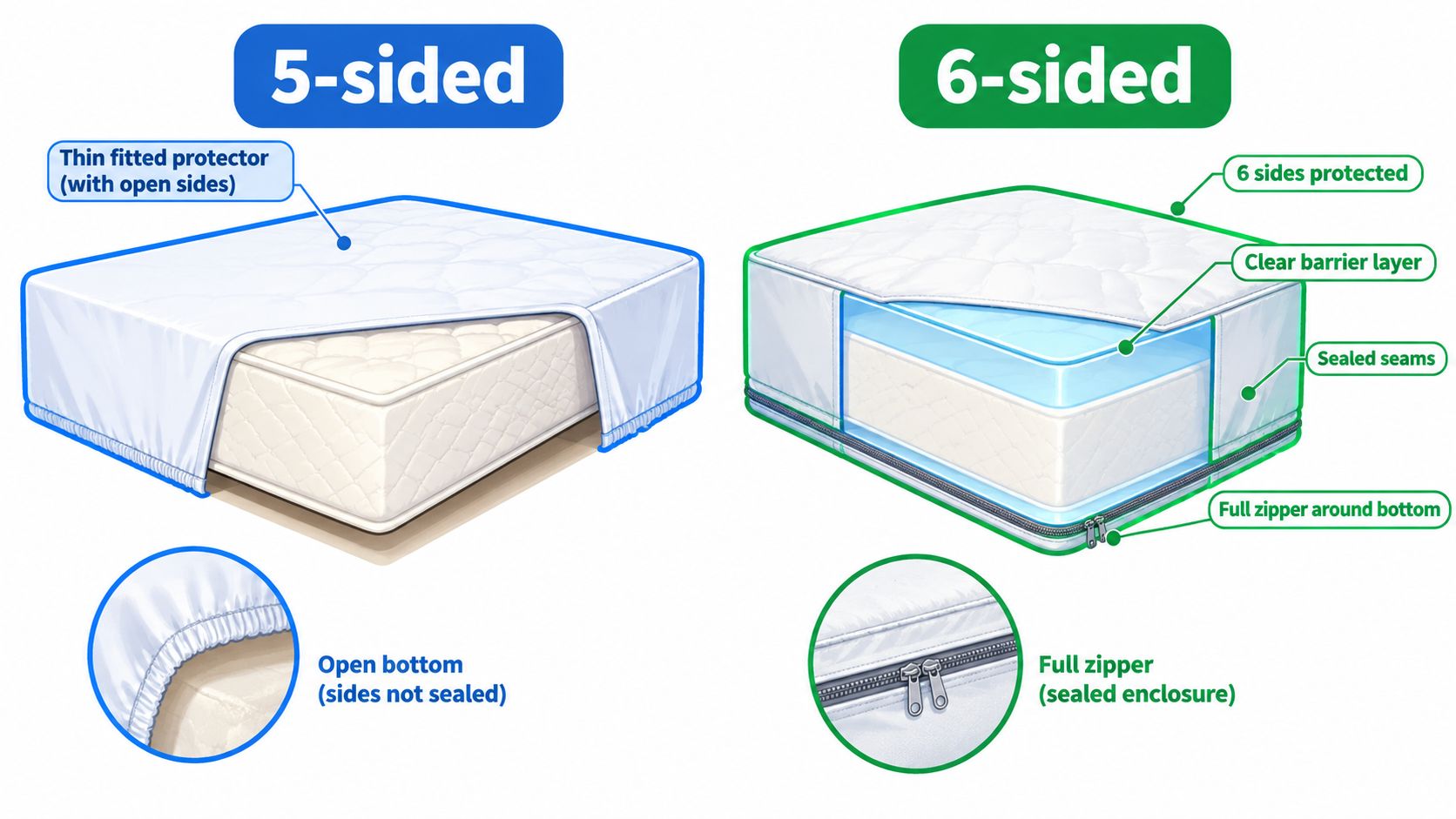
The parts that make the system work
A serious cover combines several pieces:
- Face fabric: This is the layer against bedding and the sleeper. Cotton-terry can feel soft and familiar, while synthetic fabrics may emphasize abrasion resistance and easy cleaning.
- Barrier film: Polyurethane, often called PU, can block liquids while allowing water vapor to pass through. Vinyl and PVC can create a firm, wipe-clean barrier, though they may feel less breathable.
- Seams: Stitching and sealing must preserve the barrier where panels meet. A small failure can matter more than a large intact surface.
- Closure: A zipper is a practical weak point in a full encasement. The zipper track, end stops, and surrounding seams need to close securely.
Some full encasements are marketed as 100% waterproof, bed bug proof, six-sided, and hypoallergenic, but shoppers should still check the product's construction and care instructions rather than relying on a single label. A bed-bug barrier depends on the fabric, zipper, and zipper seams working together. Testing documentation for one protective cover describes no bed bugs feeding through the laminated fabric, zipper enclosure, or zipper seams, illustrating how demanding a true pest-barrier claim can be. The documented mattress-cover testing details provide useful context for evaluating closure design.
Fire resistance needs careful reading
Fire safety is another area where shoppers can get confused. Federal mattress rules include 16 CFR 1632, the cigarette-ignition standard in effect since 1973, and 16 CFR 1633, the open-flame standard effective July 1, 2007. The open-flame framework uses a 200 kW peak heat-release threshold during a 30-minute test and a 15 MJ total heat-release limit during the first 10 minutes, according to this history of mattress flammability regulations.
Those standards concern the finished mattress system, not automatically a standalone cover placed over it. A cover may have its own ignition or flame-related testing, but that doesn't mean it changes the compliance status of every mattress underneath. Buyers should ask what was tested, under which standard, and as part of which product system.
Materials and Construction Compared Without the Jargon
The surface and barrier determine how a cover feels at night, how it handles spills, and how it holds up during cleaning. There isn't one material that suits every Milwaukee household. A hot sleeper may prioritize vapor movement, while a care setting may place more value on sealed seams and wipe disinfection.
Cotton-terry with a polyurethane laminate is a familiar combination. The terry surface feels more like bedding than plastic, and the PU backing provides liquid resistance. Laminated polyurethane fabrics can also offer waterproof protection with breathability, abrasion resistance, and resistance to chemical agents, fats, oils, and urine, according to this technical description of mattress-protector fabric.
Vinyl and PVC covers take a different approach. They can be practical for quick wipe-downs and high-abuse environments, but they may feel firmer, sound noisier, or manage heat less comfortably than a breathable laminate. Care instructions matter because some vinyl products are intended for wiping rather than machine laundering.
Why vapor permeability matters
A waterproof layer doesn't have to behave like a plastic bag. A breathable barrier allows some water vapor to pass through while blocking liquid water. That can reduce the damp, warm microclimate that develops when heat and humidity have nowhere to go.
One polyurethane-laminated cover specification reports water-vapor permeability above 600 g/m²/24h under ASTM E96, alongside tear and tensile testing under ISO and EN methods. The figure belongs to that specific product specification, not every PU cover, but it shows what shoppers should look for when comparing breathability claims. The polyurethane cover specification sheet also demonstrates why technical sheets can reveal more than the word “waterproof.”
| Material Construction | Best For | Trade-offs to Know |
|---|---|---|
| Cotton-terry with PU laminate | Family bedrooms, softer feel, everyday spills | May require more careful laundering and drying |
| Vinyl or PVC barrier | Wipe-clean care settings and heavy moisture exposure | Can feel warmer or noisier, and may not be designed for machine washing |
| Laminated polyurethane fabric | Sleepers who want liquid resistance with more breathability | Quality varies by film, fabric, seam construction, and care limits |
Construction matters more than a label
Abrasion resistance helps the face fabric tolerate movement, bedding changes, and repeated handling. Chemical resistance can matter in homes managing accidents or in settings using approved disinfectants. But those features only help if the seams and closure remain intact.
A commercial specification may list fire standards such as BS 6807 ignition source 5, BS 7175 ignition source 5, California T 19, DIN 4102 B1, CAN ULC S109, and EN 13501-1, together with tensile-strength testing for the cover fabric. That kind of documentation supports a broader lesson: a heavy duty cover is a system, not merely a waterproof top. This heavy-duty cover specification shows why seams, fabric, coatings, and closures deserve equal attention.
For a plain-language overview of protectors, bedding layers, and comfort choices, the BILTRITE bedding and mattress-protector guide can help shoppers organize the options.
How to Choose the Right Fit and Features for Your Bed
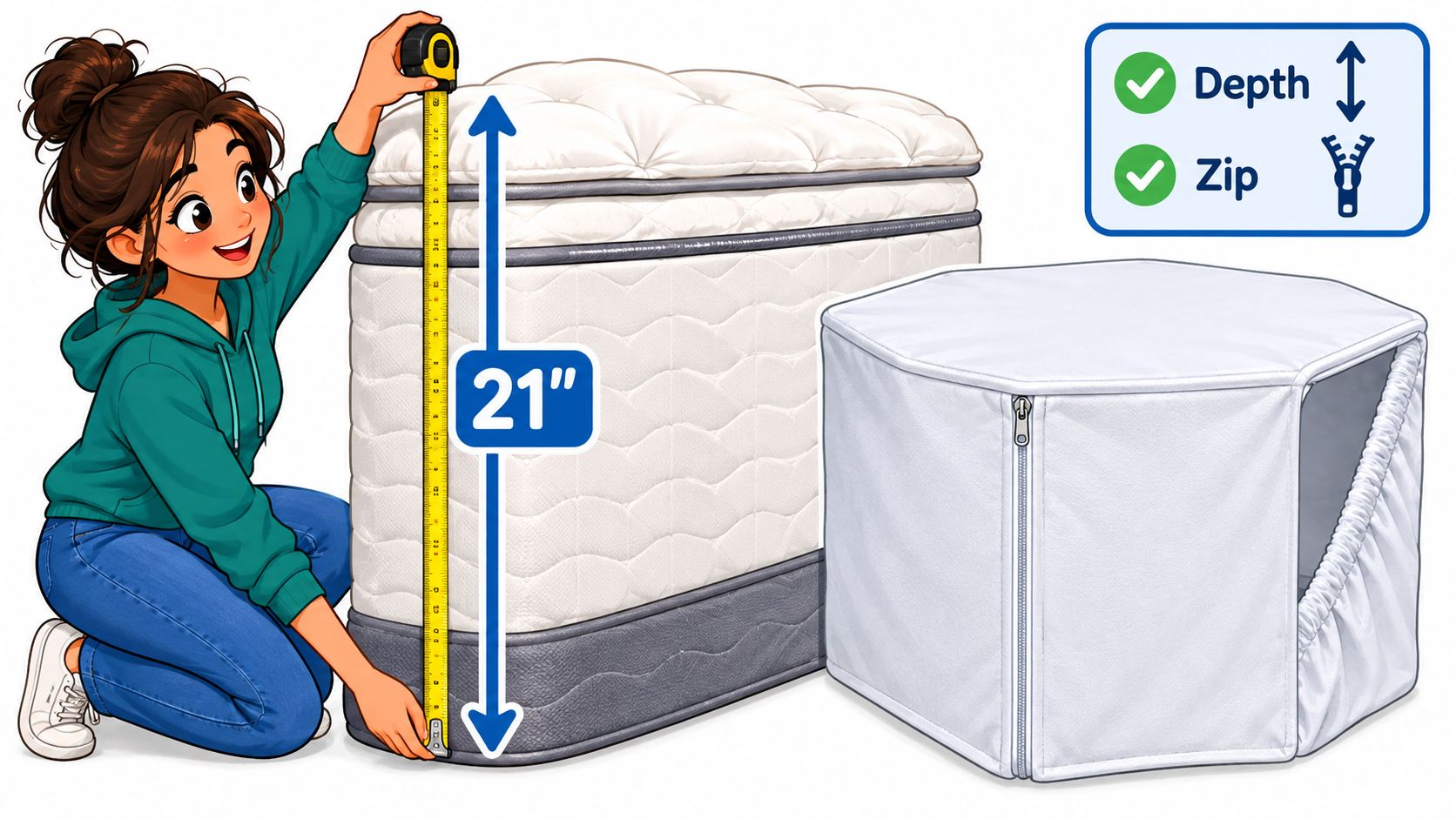
The first decision isn't fabric. It's fit. A cover that's too short can strain the zipper or pull the barrier away from the mattress corners. A cover that's too loose may bunch, slip, or create noise beneath the sheets.
Measure the mattress from the floor or foundation to the highest point, including a pillow-top or built-in comfort layer. Product listings commonly show fitted covers designed for mattresses up to 16 inches or 21 inches thick, so shoppers should compare the measured depth with the actual product range, not guess from the mattress size alone.
Use the bed and household as the checklist
A fitted protector is simpler to put on and remove. A zippered encasement takes more effort, but it covers all six sides and can make sense when pest sealing or full-mattress liquid protection matters.
Shoppers should look for:
- Correct depth: Include pillow-tops and any permanent mattress padding.
- Barrier level: Decide whether the bed needs protection from occasional spills or full liquid containment.
- Breathability: Look for a stated vapor-permeability method or a clear breathable-film description, especially for warm sleepers.
- Noise and feel: Ask whether the barrier is soft, crinkly, smooth, or firm.
- Closure security: Inspect the zipper path and the fabric around it.
- Care limits: Confirm whether the cover can be machine washed, wiped clean, disinfected, or only handled in a specific way.
- Material testing: Shoppers concerned about chemical exposure can ask about Oeko-Tex certification and PFAS testing rather than assuming either one applies.
Practical rule: Choose the two or three features that solve the household's main problems. Chasing every possible feature can make the decision harder without improving daily comfort.
Match priorities to real routines
| Household Priority | Features to Put First | What to Question |
|---|---|---|
| Heavy sleepers or warm sleepers | Breathable PU laminate, low-noise surface, secure fit | A fully sealed material with no comfort information |
| Families with children or pets | Waterproof barrier, easy removal, durable seams | A cover that protects the top but leaves vulnerable edges exposed |
| Seniors or caregivers | Simple installation, wipe-clean or washable care, secure closure | Maintenance instructions that don't mention disinfectant or heat limits |
| Allergy or pest concerns | Full encasement, sealed seams, dependable zipper construction | Broad claims without details about the closure and testing |
Warranty language can reveal how seriously the maker treats long-term use. A useful warranty won't replace careful handling, but exclusions for heat, cleaning chemicals, zipper damage, or incorrect sizing tell shoppers where the product may be vulnerable.
Market demand also reflects this broad range of needs. An independent report values the global medical mattress protection covers segment at USD 13.75 billion in 2024 and projects USD 26.5 billion by 2032, implying about 8.45% compound annual growth. The same report estimates the global waterproof bed sheet market at about US$104 million in 2024, with a projection of US$126 million by 2031 at 2.9% CAGR. These are projections and market estimates, not guarantees for an individual cover, but they show why protective bedding now serves homes, healthcare, hospitality, dormitories, and other high-use spaces. The market and product-specification report provides that category context.
Installing and Caring for Your Cover So It Lasts
A good cover can fail early if installation stretches the fabric or care instructions get ignored. The mattress doesn't need to be wrestled into place. A calm setup protects the zipper, corners, and barrier.
Fitted protectors
- Remove sheets and toppers so the protector can sit directly on the mattress.
- Identify the head and foot ends before lifting corners.
- Pull one corner over at a time, then smooth the top before securing the remaining corners.
- Check that the elastic isn't twisted and that the barrier isn't pulled tightly across one edge.
- Add the fitted sheet and check for bunching before sleeping on the bed.
Six-sided encasements
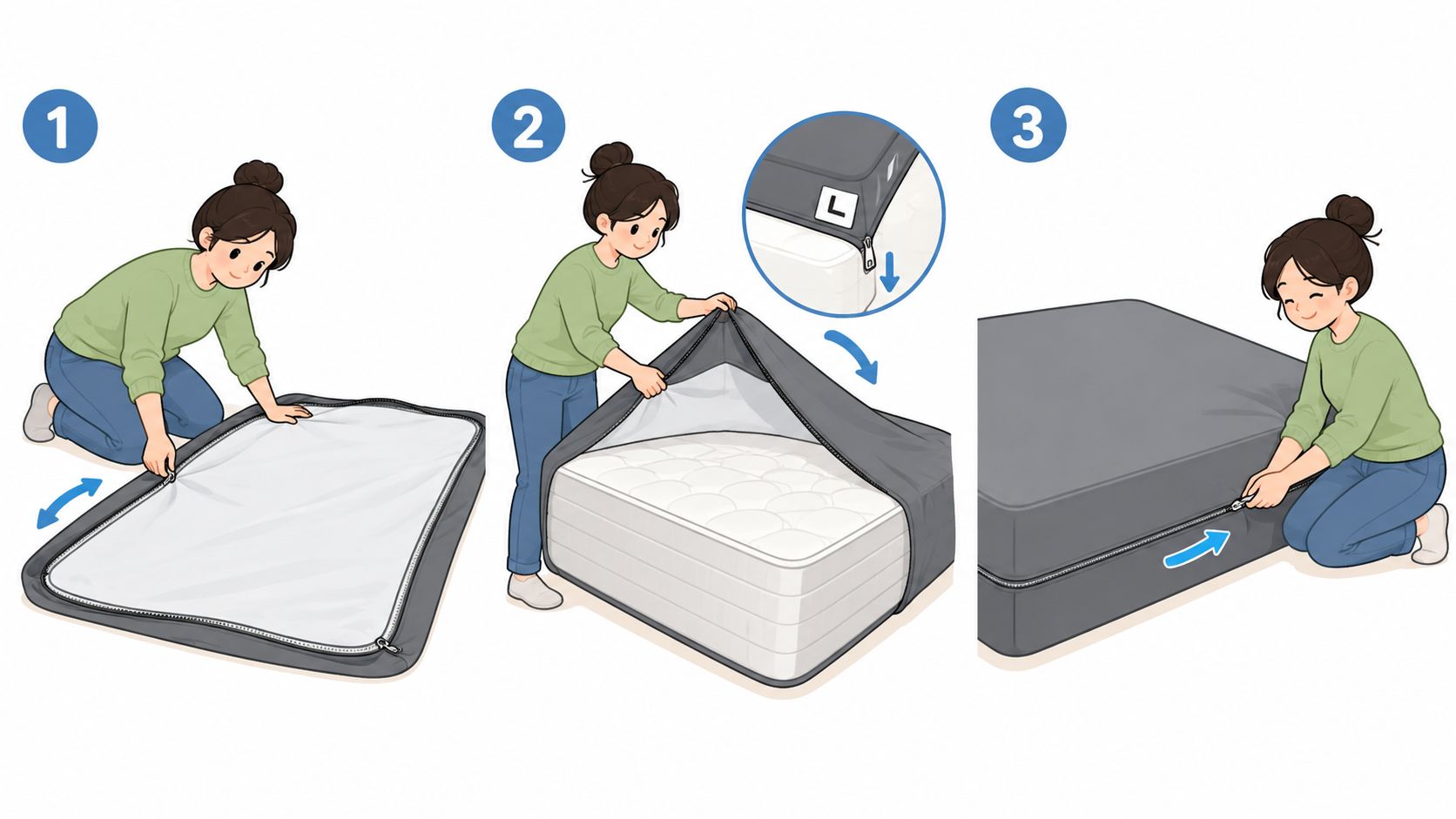
For a zippered encasement, place the empty cover on the bed with the zipper fully open. If possible, two people should lift the mattress slightly while a second person aligns the corners. Lower the mattress into place, smooth the panels, and close the zipper slowly while keeping fabric away from the teeth.
Don't force a zipper around a tight corner. A strained closure can become the first failure point, particularly when the cover is under tension.
Cleaning requires a product-specific routine
Some covers are machine washable. Others are designed for wiping and shouldn't be placed in a washer. Temperature, drying, and disinfectant instructions can differ, so the care label matters more than a general laundry habit.
Hospital research found that uncovered mattresses became significantly more contaminated during use, while covered mattresses stayed much cleaner. The same research concluded that terminal cleaning alone didn't remove bacteria from hospital mattress surfaces. The hospital mattress-cover study supports a simple care principle: the barrier should be cleaned routinely, not treated as a substitute for cleaning.
- For washable covers: Follow the stated temperature and drying limits, and avoid returning the cover while it's damp.
- For wipe-clean covers: Use only approved cleaning products and allow the surface to dry fully.
- For repeated laundering: Inspect the laminate, seams, elastic, and zipper after washing. Repeated heat and chemicals can shorten barrier life.
- For slipping: Recheck depth and corner alignment before replacing the sheet.
- For crinkling: Smooth trapped folds and review whether the barrier material suits the sleeper.
- For odor: Look for trapped moisture, incomplete drying, or a cover that doesn't allow enough vapor movement.
Additional guidance on keeping a mattress fresh appears in BILTRITE's mattress maintenance and cleaning tips.
Real World Use Cases From Family Homes to Care Settings
A family with young children and a dog may not need the same cover as a senior caregiver or a furnished rental. Heavy duty doesn't automatically mean “most protection available.” It means the construction matches the work the cover must perform.
The active family bedroom
A child spills milk, a pet tracks in moisture, and sheets need frequent changes. A fitted protector with a soft terry surface and PU barrier may provide a comfortable daily layer if the mattress itself doesn't need full pest or underside protection. Machine-washable construction can be more useful here than a wipe-only surface because family bedding needs regular refreshing.
The senior bedroom
A senior or caregiver may prioritize simple cleaning, secure placement, and a surface that doesn't feel hot or noisy. A breathable laminated polyurethane cover can make sense when moisture resistance and comfort both matter. If the mattress needs full enclosure because of allergy or pest concerns, a zippered design may be worth the extra installation effort.
Pressure relief comes from the mattress and support setup, not from a protector alone. A cover should protect that sleep surface without bunching or creating uncomfortable ridges.
The guest room or rental
Quick turnovers favor straightforward maintenance. A wipe-clean cover may save time between guests, but the product's care instructions must allow the cleaning routine used in that setting. A washable barrier can be useful where the team has access to laundry and wants a reusable layer rather than a surface that only tolerates wiping.
Care and healthcare settings
Institutional beds face repeated fluid exposure, frequent cleaning, and mechanical stress. These environments commonly use laminated polyurethane or PVC barriers, with requirements that can include waterproof resistance, vapor permeability, tear strength, tensile strength, and flammability testing.
A care setting should also inspect the complete system after use. The fabric may look intact while a zipper seam, corner, or closure has weakened. That is why a heavy duty cover's service life depends on routine inspection as much as on the original material choice.
The right construction varies by task. Breathable PU may suit a sleeper who spends every night on the bed, while wipe-clean vinyl or PVC may suit a high-turnover care environment. Full encasement makes more sense when all-sided sealing matters. A top-only protector may be enough for ordinary family spills.
Shopping Smart in Milwaukee and Visiting BILTRITE in Greenfield
Metro Milwaukee shoppers can make a better decision by handling the materials rather than judging a product description alone. The difference between soft terry, smooth polyurethane laminate, and a firmer wipe-clean barrier is easier to understand in person. Fit also becomes clearer when a sleep specialist asks about mattress depth, pillow-tops, bedding layers, and the household's cleaning routine.
BILTRITE Furniture is a fourth-generation, family-owned business serving the Metro Milwaukee community since 1928. The showroom focuses on affordable, better-quality furniture, with USA-made, Amish-made, and solid-wood options, along with small-scale pieces for apartments and senior living spaces and heavy-duty furniture and mattresses for demanding households.
The mattress department includes over 60 models, with 500+ mattresses in stock, and the store's sales associates bring over 400 years of combined experience. Their role is to help shoppers compare comfort, support, mattress height, protection needs, and value without pressure. Select mattress sets may include a complimentary protector or heavy-duty frame, and qualifying purchases may include free white-glove delivery and old mattress removal when the old mattress is in donatable condition.
A local showroom also helps connect the cover to the bed underneath. A thick pillow-top may need a deeper fitted design. A senior living setup may call for easier cleaning. A family with pets may want a washable barrier, while a household concerned about pests may ask about a six-sided zipper and sealed seams.
Details about the Greenfield showroom and service area are available through BILTRITE's locations page. The store is located at 5430 West Layton Avenue in Greenfield, Wisconsin, and is closed on Sundays and Mondays so the family-owned team can protect family time.
BILTRITE Furniture-Leather-Mattresses offers mattress protectors, a large mattress selection, heavy-duty mattress options, and helpful in-store guidance for matching protection to comfort and daily use. Visit BILTRITE Furniture-Leather-Mattresses in Greenfield to measure the mattress, compare cover materials, and talk with a sleep specialist about the right fit for the household.