Mattress Sinking in the Middle? Our Family’s Guide to Fixing It!

Is your bed developing a dreaded dip? That feeling of rolling into a trench in the middle of your mattress is a story we hear all the time in our showroom. If your mattress is sinking in the middle, it's usually a sign of one of two things: the natural breakdown of materials like foam or coils over time, or an unsupportive foundation doing a poor job.
This wear and tear eventually creates body impressions right where you sleep, leading to that dip that can really mess with your sleep. But don't worry, we're here to help you figure it out!
The Real Reasons Your Mattress Is Sinking
That sinking feeling in the middle of your bed—it’s a story we hear all the time. Here at BILTRITE, a family business serving our Metro Milwaukee neighbors since 1928, we've helped countless people solve this exact problem. We want you to get a great night's sleep!
A mattress that sags in the middle isn't just an annoyance; it’s a clear signal that your sleep support is failing. Figuring out why it’s happening is the first step toward getting back to restful nights.
To help you troubleshoot, here's a quick rundown of the most common culprits we see.
Quick Guide to Common Sinking Causes
| Common Cause | What It Looks Like | Can It Be Fixed? |
|---|---|---|
| Normal Body Impressions | A slight, shallow dip (less than 1.5 inches) where you sleep. | No, this is normal wear. But you can slow it down with regular rotation. |
| Failing Foundation | A noticeable dip or "V" shape in the very center of the bed. | Yes! A new, supportive foundation or frame can often solve this. |
| Low-Quality Materials | Deep, permanent sagging that doesn't spring back. Feels unsupportive. | No, once the materials break down, the mattress needs to be replaced. |
Understanding these distinctions can save you a lot of guesswork and help you zero in on the real issue.
Normal Wear and Body Impressions
Let's be honest, your mattress puts in a lot of work every single night! Over the years, the materials inside naturally start to soften and compress under your body weight. This is especially true in the spots where your hips and shoulders rest.
These dips are called body impressions, and a little bit of settling is a normal part of a mattress’s life. But when those impressions turn into deep valleys, they can throw your alignment out of whack and lead to aches and pains. The quality of the materials plays a huge role here. A well-built mattress, like many of the USA and Amish-made models we carry in our showroom, will use higher-density foams and stronger coils to resist sagging for much, much longer.
The Foundation is Failing
Sometimes, the mattress isn't the villain—the real culprit is hiding underneath! An inadequate foundation or a weak bed frame is one of the biggest reasons for premature sagging. If your frame doesn't have proper center support legs (which are a must for queen and king sizes!), the middle of the foundation can bow downwards, taking your mattress right along with it.
A weak or broken foundation forces the mattress into a dip, no matter how new or well-made it is. It’s like building a house on shaky ground—it’s just not going to hold up!
Low-Quality Materials Giving Up
Unfortunately, not all mattresses are created equal. A lot of mattresses, especially the super cheap ones, use less-dense foams and thinner-gauge steel coils that simply can’t withstand years of use. Industry surveys show that up to 30% of mattress owners see noticeable sagging within the first five years, a problem that’s far more common in lower-cost options. You can read more on mattress market trends to see how widespread this is.
At BILTRITE, we focus on affordable, better-quality furniture and mattresses because we truly believe your comfort is a long-term investment. We want you to love your purchase for years to come!
Is It the Mattress or the Foundation?
Before you decide your mattress is ready for retirement, let's play detective for a minute. We've seen this countless times in our family's store since we started in 1928: a great mattress gets blamed when the real culprit is hiding underneath! An old or improper foundation is one of the top reasons we see for a mattress sinking in the middle.
Think of it this way—your mattress needs a strong, flat surface to do its job. If the support system underneath it is weak, broken, or bowing, your mattress has no choice but to sink right along with it. A few simple checks can help you figure out if the problem is your mattress or what’s holding it up.
Simple Home Inspection Checks
You don't need any special tools to investigate, just a few minutes. Here are the key things our team, with over 400 years of combined experience, recommends looking at:
- Check the Bed Frame: For queen, king, and California king beds, a center support leg (or several!) is non-negotiable. If your frame doesn't have one, or if it's bent or broken, that's almost certainly your problem. The frame is likely bowing under the weight.
- Inspect the Box Spring or Foundation: Take the mattress off the bed and look at the foundation. Press down firmly in the middle. Does it feel soft, spongy, or do you hear any creaking or cracking? It should feel firm and solid all the way across. For more tips on this, you can learn more about why you really do need a box spring for your bed.
- Perform the Floor Test: This is the ultimate test! Move your mattress off the frame and place it directly on the floor. Lie on it in your usual spot. Does the sag disappear or feel much less noticeable? If so, congratulations—your mattress is likely fine! The issue is with your foundation or frame.
This handy decision tree can help you visualize the process of figuring out if it's normal wear or a foundation issue causing your mattress to sink.
As the chart shows, identifying whether the sinking is due to age or poor support is the first step toward finding the right solution.
Sagging is a widespread issue; in the U.S. mattress market, which is valued at $11.57 billion, it’s the second biggest reason for returns. In fact, sagging accounts for a whopping 25% of all warranty claims, a problem often seen in mattresses with weaker support layers.
Identifying the true source of the problem is a critical step that can save you a lot of frustration (and money!). If it turns out your foundation is the issue, that's a much easier fix than buying a whole new mattress.
Practical Fixes You Can Try at Home
So, you've confirmed that dreaded dip is definitely there. Now what? Before you start shopping for a brand-new mattress, there are a few practical, family-tested tricks you can try right at home. Think of these as temporary solutions to help you get a better night’s rest while you figure out your next move.
These fixes won't reverse the internal wear and tear, but they can often buy you some valuable time and make a noticeable difference in comfort. It’s all about making your bed as cozy and restful as possible!
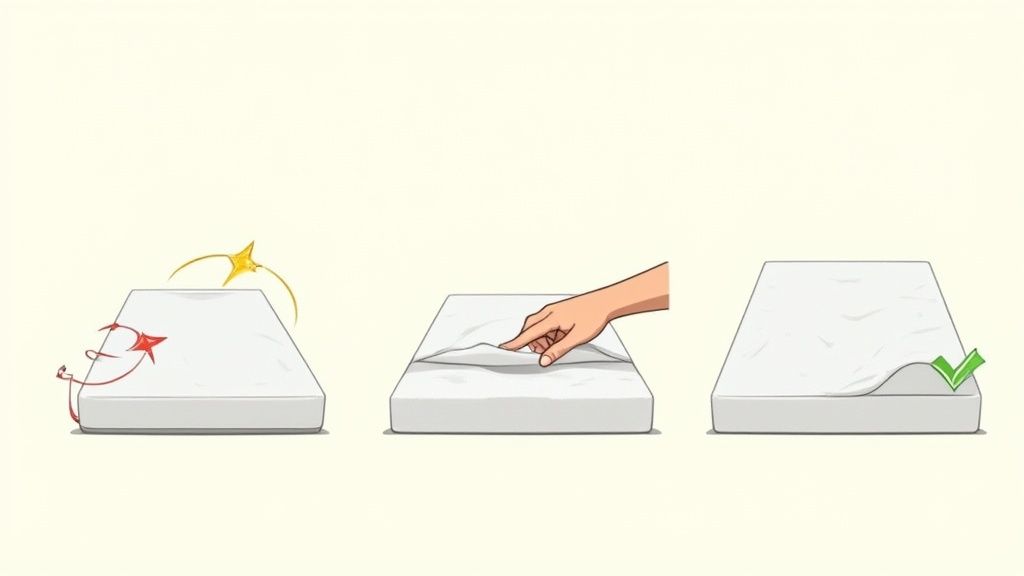
Rotate Your Mattress Regularly
This is the easiest and most effective first step you can take. Regularly rotating your mattress helps to even out the wear from your body, preventing one area from breaking down faster than the others. We all tend to sleep in the same spot night after night, so this simple spin can work wonders.
Here's our simple guide:
- Give it a 180-degree spin: The goal is to move the area where your head rests down to where your feet were.
- Do it every 3-6 months: Set a reminder on your calendar to make it a habit. It only takes a few minutes!
This simple rotation distributes the pressure and can significantly slow down the development of deep body impressions. Even if a sag has already started, rotating the mattress can still provide a fresher, more supportive surface to sleep on.
Flip It If You Can
Back in the day, almost all mattresses were two-sided. Today, most are designed to be one-sided, but here at BILTRITE, we still believe in the lasting value of a flippable mattress! If you have a two-sided model, flipping it over entirely gives you a brand-new sleep surface to work with.
There are many benefits of a two-sided mattress, and durability is at the top of the list.
BILTRITE Family Tip: A great routine is to rotate your mattress one quarter and flip it the next. This gives you four unique sleeping surfaces to cycle through, dramatically extending its comfortable life!
Consider a Quality Mattress Topper
If rotating and flipping aren't quite cutting it, a quality mattress topper can be a fantastic short-term fix. A topper is simply a thick layer of cushioning—often made from memory foam, latex, or a down alternative—that you place right on top of your existing mattress.
A good topper (at least 2-3 inches thick) can help fill in that sunken area, creating a more even and comfortable sleep surface. It won't fix the broken-down support deep inside the mattress, but it can mask the discomfort of a minor sag and add a fresh layer of comfort. It’s a great way to improve your sleep while you plan for a more permanent solution.
How to Choose a Sag-Resistant Mattress
When it's finally time to get a new mattress, the last thing you want is to find yourself back in the same sinking boat a few years down the road. Picking a durable, sag-resistant mattress is one of the smartest investments you can make for your sleep quality and overall health. But with a sea of options out there, how can you tell which one will truly hold up?
That’s a question we’ve been helping our Metro Milwaukee neighbors answer since my great-grandpa started this business way back in 1928! We genuinely believe the best way to find a great mattress is to try it out in person, which is why we don't sell online. It gives us a chance to share what we know and help you feel totally confident in your choice.
Understanding Different Mattress Types
Not all mattresses are created equal, and some are definitely more prone to sinking than others. How a mattress is constructed has everything to do with whether it will develop that dreaded dip in the middle.
Take innerspring mattresses, for example. They make up about 66% of the global market, but their coils can compress over time, making them more susceptible to sagging. In fact, one industry analysis found that a staggering 35% of innerspring owners reported sagging within just four years, a much higher rate than for foam and latex. You can see more mattress industry statistics for a deeper dive.
Let's break down the main types you'll come across:
- Innerspring: The classic workhorse. The better-quality models use thicker, stronger coils that provide fantastic support and durability. Many of the USA-made options we carry are built like a tank.
- Memory Foam: Famous for that body-hugging, contouring feel. The secret here is the foam's density—denser foams are far more resilient and much less likely to develop permanent body impressions.
- Latex: A real standout when it comes to durability! Natural latex is incredibly resilient and supportive, making it one of the most sag-resistant materials you can find.
- Hybrid: These mattresses aim for the best of both worlds, pairing a supportive coil system with cushy layers of foam or latex on top for comfort.
What to Look For in a Durable Mattress
As you're shopping, a few key details can tell you a lot about how well a mattress will fight against sagging over the years.
For innerspring and hybrid models, pay close attention to the coil count and gauge. A higher number of coils and a lower (which means thicker) gauge steel create a much more robust and supportive core. When you're looking at foam mattresses, always ask about the foam density. A higher density, measured in pounds per cubic foot, signals a more durable foam that will resist sagging for years to come. These are exactly the kinds of quality details we love to point out in the American-made furniture and mattresses in our showroom.
Your sleep position and body type also play a huge role in finding the right mattress. A mattress that feels firm to one person might feel too soft to another, which is why finding the right firmness level is so important for long-term support and comfort.
Choosing the right firmness isn't just about what feels good at first; it's about ensuring proper spinal alignment to prevent the aches and pains that come from sleeping in a dip. To get a better handle on this, you can check out our guide on mattress firmness before you stop by.
Ultimately, the surest way to prevent your next mattress from sinking is to invest in quality from the get-go. We'd love to show you the difference firsthand. Come on down to our Greenfield showroom, where our friendly team can help you test out some of our 60+ models and find a great match for your home.
Preventing Future Sagging with Proper Support
So, you found a great new mattress and you're excited for years of amazing sleep. We love seeing that excitement in our showroom! Now, let's talk about the single most important thing you can do to protect that investment and stop that dreaded middle sag before it ever starts.
It all boils down to a rock-solid support system. Your mattress and its foundation are a team—if one part isn't pulling its weight, the whole setup fails. As a family business that’s seen it all since 1928, we can tell you with total certainty that a proper foundation is non-negotiable for the life of your mattress.
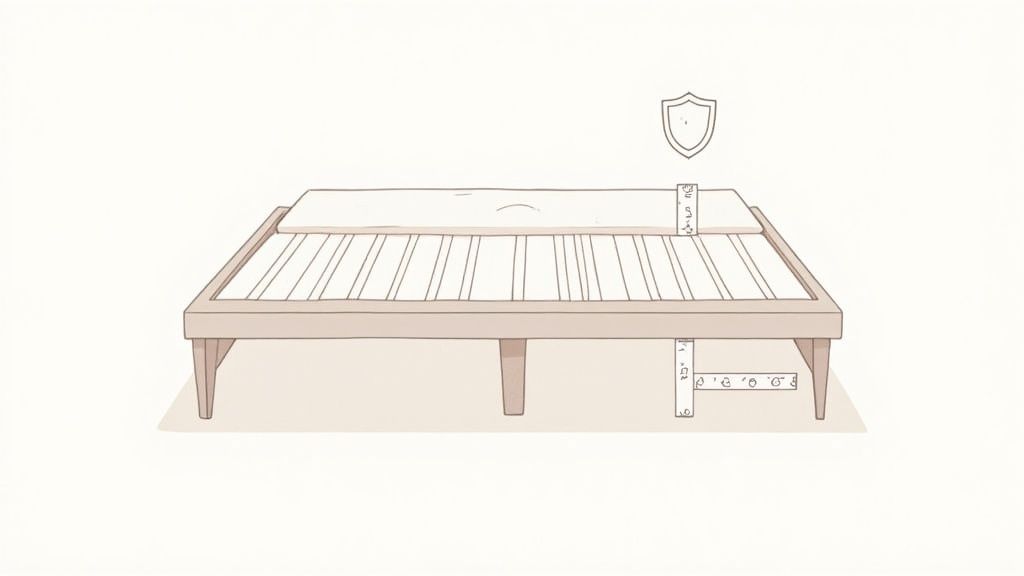
Matching the Foundation to Your Mattress
The days when every mattress automatically went on a traditional box spring are long gone. Today’s mattresses have very different needs, and pairing them with the right base is absolutely key to preventing future sagging. It's not just about getting the bed to the right height; it’s about giving it a flat, rigid, and supportive surface to live on.
Here’s a quick rundown of what we see works best:
- For Memory Foam & Hybrid Mattresses: These heavier beds demand a solid or slatted foundation. If you're using slats, make sure they are no more than 2-3 inches apart. Any wider than that, and the foam can start to push down between the gaps over time, creating dips.
- For Innerspring Mattresses: A classic box spring (which has some flex) or a solid foundation (which is rigid) both do the job well here. The goal is to provide consistent, even support across the entire bottom of the mattress.
- For Adjustable Bases: These are fantastic and compatible with most modern mattresses like foam, latex, and hybrids. By design, they provide excellent, continuous support.
No matter which type you have, your foundation needs to be in great shape. An old, worn-out box spring from your last mattress is a recipe for disaster. Its internal structure is likely already compromised, and it will cause your new mattress to break down prematurely. Starting fresh is always the best bet!
The Critical Role of the Bed Frame
Now, let’s get to the bed frame itself, because this is where we see problems pop up most often. The foundation sits inside this frame, and if that frame can't handle the combined weight of the mattress, foundation, and sleepers, everything will start to bow and sink.
The number one cause of premature mattress sagging that we see is a bed frame without adequate center support. For any mattress size Queen or larger, center support legs that reach the floor are an absolute must-have!
Without that support in the middle, the foundation—and the mattress right on top of it—will inevitably start to sag downwards into a "V" shape. This puts a massive amount of strain on the mattress and is often the real culprit behind that sinkhole in the middle. In fact, many mattress warranties are voided if the bed isn't supported by a proper frame that includes center support.
Ensuring your mattress is properly supported from the get-go is a huge part of its upkeep. For more great advice, you can explore our helpful mattress care tips to keep your bed in great shape.
By setting up your new bed for success from day one, you’re ensuring years of comfortable, supportive sleep. If you ever have questions about the right support for your mattress, please come see us! Our team has over 400 years of combined experience and we’d love to help you out in our Greenfield showroom.
Common Questions About Mattress Sinking
We get a lot of great questions in our Greenfield showroom every day. After all, we've been helping our Metro Milwaukee neighbors find better sleep since 1928, and a mattress sinking in the middle is a topic that comes up a lot! Here are a few things our team, with over 400 years of combined experience, is often asked.
How Long Should a Mattress Last Before It Sinks?
That's the million-dollar question, isn't it? A better-quality mattress should give you a solid 8 to 10 years of supportive sleep without any major, problematic sinking.
Of course, the real-world answer depends on the mattress type, the quality of its materials, and how you take care of it. A well-made latex or high-density foam mattress might even push past that decade mark. On the flip side, some introductory innerspring models can start showing their age much sooner. Investing in quality from the get-go, like the materials found in many of the USA and Amish-made mattresses we carry, really does pay off in the long run.
Can a Mattress Topper Really Fix a Sinking Mattress?
A mattress topper can be a fantastic temporary fix! If your mattress has developed a noticeable dip that's messing with your sleep, a good, thick topper can help even out the surface and add a fresh layer of cushion. It can absolutely make your bed more comfortable while you figure out your next move.
Think of it as a helpful band-aid, though. It covers up the symptom—that uncomfortable sag—but it can't fix the root problem, which is usually broken-down support deep inside the mattress itself. It's a great way to buy yourself some valuable time.
Does Body Weight Affect How Quickly a Mattress Sinks?
Yes, body weight is definitely a big factor. Every single mattress compresses under weight over time—that’s just physics! For heavier individuals or couples, mattresses built with lower-density foams or less beefy coil systems might start to sag more quickly.
This is exactly why we make a point to carry a huge selection of heavy-duty mattresses. These are specifically built with stronger support systems, denser foams, and more durable coils to provide lasting comfort for every body type. You should never have to settle for a bed that isn't built to support you properly.
Is a Sinking Mattress Covered by a Warranty?
It often is, but you absolutely have to read the fine print! Most mattress warranties cover sagging, but only if the dip measures a certain depth (usually 1.5 inches or more) and the mattress is free of stains.
The most important part of any mattress warranty is the support requirement. A warranty is almost always voided if you haven't used a proper support system—meaning the right foundation and a bed frame with adequate center support.
So, if an old, weak foundation is what caused the sag, the warranty won't cover the mattress. When that dip is just one of the top signs you need a new mattress, it might be time to start fresh. We're always happy to walk you through these details in our showroom!
At BILTRITE Furniture-Leather-Mattresses, we believe in finding the right solution for your family. If you're tired of that sinking feeling, we'd love to see you in our store! Come on down to our Greenfield showroom, say hi, and let us help you find the lasting comfort you deserve. Visit us at https://www.biltritefurniture.com to learn more