Difference in Mattresses: A Friendly Guide to Types

It's 2 a.m., and someone's awake again, shifting from one side to the other and wondering whether a different mattress would make a difference. The answer isn't “buy a firmer bed” or “choose memory foam.” The feel and construction of a mattress affect how a sleeper settles, moves, and manages pressure and heat through the night.
The useful question is which mattress suits the person sleeping on it. Here's a quick comparison to start with, followed by practical ways to judge firmness, construction, temperature, and durability in person.
| Mattress type | What it feels like | A useful starting point |
|---|---|---|
| Innerspring | Responsive and bouncy | Consider it if easy movement and airflow matter |
| Memory foam | Close contouring, slower to spring back | Consider it if pressure relief and motion control matter |
| Latex | Buoyant and quick to respond | Consider it if a sleeper wants bounce and easier repositioning |
| Hybrid | A blend of coil response and cushioned comfort layers | Compare the specific feel and construction |
| Two-sided, flippable | Designed to be turned to use both sleeping surfaces | Consider it if sharing wear across surfaces matters |
Those are broad tendencies, not guarantees. A mattress category doesn't tell the whole story: firmness, body weight, sleep position, and personal comfort all affect how a particular bed feels.
Table of Contents
- Why the Difference in Mattresses Matters for Your Night
- The Main Mattress Types Explained
- Understanding Firmness on a 1 to 10 Scale
- Comparing Mattress Types Side by Side
- Heat, Pressure, and How Foam and Coils Behave
- Durability, Lifespan, and the Case for Two-Sided Mattresses
- Matching Mattress Types to Your Sleep Style
- Finding Your Mattress the Old-Fashioned Way
Why the Difference in Mattresses Matters for Your Night
At 2 a.m., a mattress isn't an abstract collection of materials. A side sleeper may be trying to get comfortable without pressure building at the shoulder. Someone who sleeps hot may be kicking off the covers. A partner's movement may be enough to interrupt a light sleeper. These everyday annoyances can have different causes, so the label on the mattress won't diagnose the problem.
Construction matters because mattresses don't all respond to body weight in the same way. Some contour closely; others feel more buoyant and make it easier to change positions. Firmness affects how much the surface gives, while the layers beneath it shape the overall support. Heat and long-term wear matter, too. A mattress that feels pleasant for a moment in a store may not feel as comfortable after a full night in a sleeper's usual position.
Research supports taking individual response seriously. In a study of 128 healthy adults, mattress firmness significantly affected 9 of 11 key sleep measures, including sleep duration, sleep quality, and indicators of daytime functioning. The mattress associated with the best sleep varied from person to person, which is why a broad label like “firm” can't predict how a bed will feel for every shopper. The study on mattress firmness and sleep measures reinforces a straightforward point: the sleeper's response matters.
A practical rule: Judge a mattress by how it feels under the whole body, not by a label or a quick press of the hand.
The difference in mattresses is really a difference in how their materials and firmness suit a particular sleeper. A good comparison starts with construction, then considers position, comfort, temperature, and wear. That's a more useful way to shop than chasing hype.
The Main Mattress Types Explained
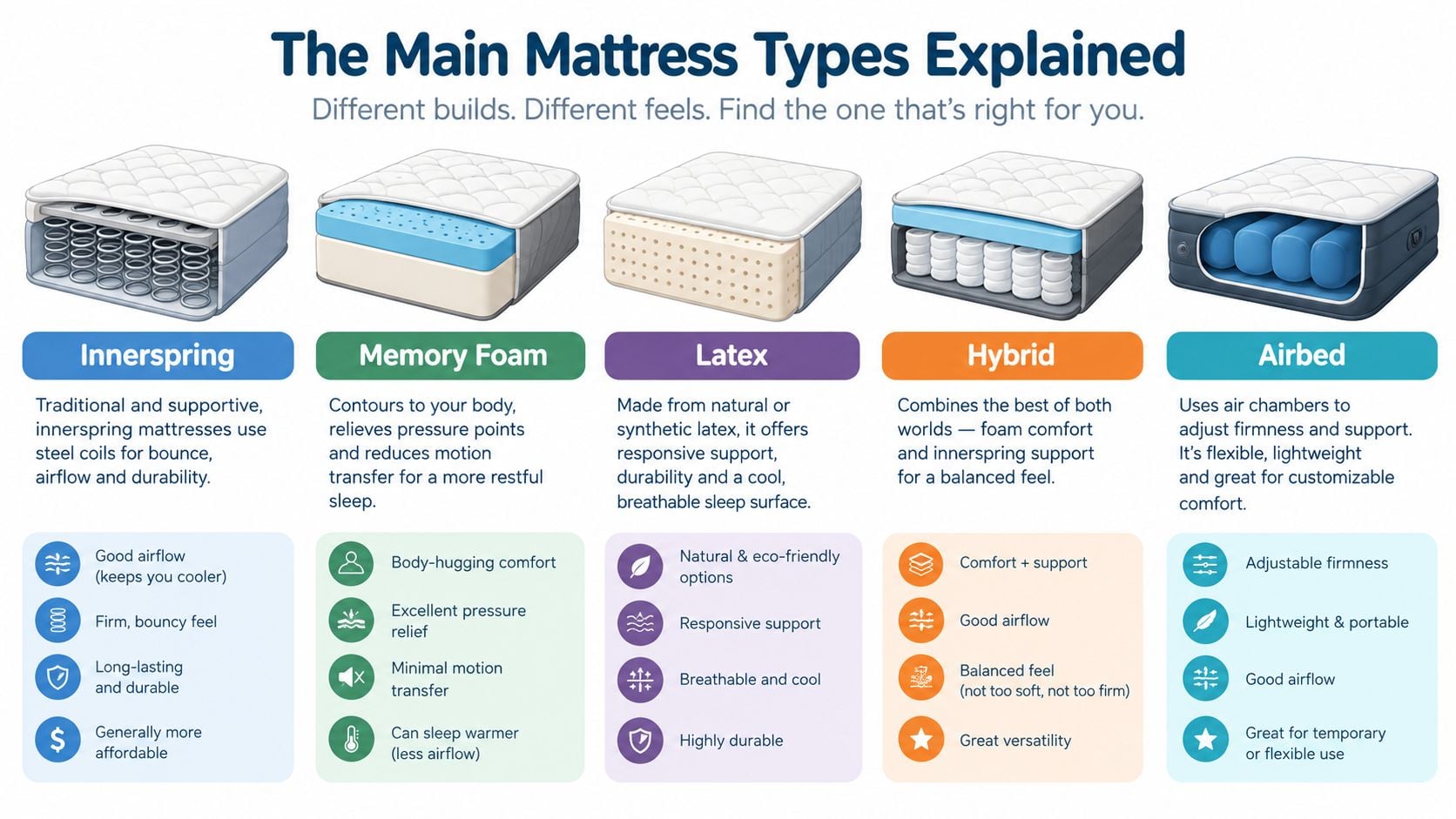
Start with the support structure. Innerspring mattresses use an array of coils as their main support, with comfort layers above them. Their feel is generally more responsive than slow-recovery foam, so turning and getting in or out of bed can feel easier. The amount of cushioning depends on the layers over the coils.
Pocketed coils are individual coils wrapped separately. They can move more independently than a connected coil system, so pressure in one area doesn't necessarily make the whole surface move in the same way. The feel still depends on the complete mattress, including its comfort materials and firmness.
Memory foam is viscoelastic polyurethane foam. It responds gradually to heat and pressure, conforming closely to the body and recovering more slowly when the sleeper changes position. That close contour can feel cradling, but some sleepers prefer a faster, less enveloping response.
Latex uses processed rubber as a core or major comfort material. It generally responds more quickly than memory foam, with more bounce and easier repositioning. Hybrids combine coil support with foam or latex comfort layers, aiming to blend contouring with a more responsive base. For a closer look at that construction, see how a hybrid mattress combines materials.
A different construction, built for a different kind of wear
Two-sided mattresses have a sleeping surface on each side, so the mattress can be flipped as well as rotated when its design allows. They aren't a separate feel category. Their defining difference is that the sleeper can use both surfaces over time, rather than relying on one side alone.
No construction wins for everyone. The useful comparison is how a mattress supports a sleeper's body, how much it contours, and how readily it responds to movement. That's why it helps to lie down and compare rather than choosing from the name alone.
Understanding Firmness on a 1 to 10 Scale
Mattress firmness commonly uses a 1-to-10 scale, with 1 extremely soft and 10 extremely firm. Medium-firm is typically around 6.5, and general health guidance often places medium-firm choices between 5 and 7. Those numbers are a starting point, not a promise that every mattress marked 6.5 will feel the same. A guide to mattress firmness ratings gives shoppers a useful reference for comparing labels.
A side sleeper often needs enough give around the shoulder and hip to feel comfortable, while a stomach sleeper generally needs a more resistant surface to limit excessive sinking at the hips. For average-weight sleepers, suggested firmness is about 6 to 6.5 for side sleeping and roughly 7 to 7.5 for stomach sleeping, according to that same guide. Sleep position is only part of the decision, though. Body weight and the mattress's contouring also affect how firm it feels in practice.
Firmness is not the same as support
A firm surface can feel too hard in pressure-sensitive areas, while a softer surface can feel comfortable at first but allow more sinking than a sleeper wants. Support depends on how the complete mattress responds beneath the body, not on whether the tag says “firm.” A good test is to lie in the usual sleep position and notice whether the surface feels comfortable through the shoulders, hips, and lower back.
For shoppers with chronic, nonspecific lower-back pain, a clinical trial offers a reason not to assume that the firmest option is best. In a controlled study of 313 adults, medium-firm mattresses produced better outcomes than firm mattresses for pain in bed, pain on rising, and disability; the reported odds ratios were 2.36, 1.93, and 2.10, respectively. The trial comparing firm and medium-firm mattresses informs a sensible starting point, not a guarantee for every person or mattress.
Medium-firm is a useful benchmark, not a rule every sleeper has to follow.
Comparing Mattress Types Side by Side
The chart below gives a quick way to compare construction, but the “best for” column should be treated as a starting question rather than a verdict. A mattress with the right materials can still feel wrong if its firmness doesn't suit the person lying on it.
| Type | Feel | Motion isolation | Temperature | Firmness range | Best for |
|---|---|---|---|---|---|
| Innerspring | Bouncy, responsive | Often more movement can travel through the surface | Coils can support airflow; comfort layers still matter | Varies by model | Sleepers who like easier movement and a traditional coil feel |
| Memory foam | Close contouring, slower response | Often absorbs movement well | Close conformity may retain heat | Varies by model | Sleepers who want a hugging feel and movement absorption |
| Latex | Buoyant, quicker response | Depends on the construction | Often feels more open than closely conforming foam | Varies by model | Sleepers who want bounce and easier repositioning |
| Hybrid | Combines cushioning and coil response | Depends on coil and comfort-layer design | Depends on materials and airflow | Varies by model | Sleepers who want both contour and a responsive support core |
| Two-sided, flippable | Varies by materials and firmness | Depends on construction | Depends on materials | Varies by model | Shoppers who want to use both sleeping surfaces over time |
Start with the question that matters most
If movement from a partner interrupts sleep, compare how much motion each mattress absorbs while someone shifts position. If changing positions feels awkward, pay attention to how quickly the surface rebounds. If temperature is the main concern, don't assume a material name alone tells the whole story; the complete construction and the sleeper's own experience matter.
Two-sided designs stand out for a different reason. Their value comes from having more than one sleeping surface to use, not from a guaranteed feel or a promise of a fixed lifespan. For any category, the firmness label is only one part of the comparison. Use the chart to narrow the choices, then test actual models in the way the bed will be used.
Heat, Pressure, and How Foam and Coils Behave
A mattress has to manage several competing needs. Close contouring can spread pressure across more of the body, but it can also make the surface feel warmer or harder to move on. A more responsive construction can make turning easier, yet may feel less enveloping to a sleeper who wants a close cradle.
Memory foam's response to heat and pressure lets it conform around the body. That may ease localized pressure, particularly for someone who feels discomfort at the shoulders or hips. The same close contact can restrict airflow around the sleeper. Coil-based constructions and latex often feel more responsive, but the whole mattress matters: comfort layers and covers can change the surface feel and temperature experience.
Check three things during a trial
- Pressure relief: Lie in the usual position and notice whether the shoulders, hips, or other pressure-sensitive areas feel uncomfortable.
- Heat retention: Pay attention to the surface and cover materials, especially if a warm bedroom or sleeping hot is already an issue.
- Ease of movement: Roll over and change positions naturally. A mattress that feels comfortable while still may feel different when the sleeper moves.
Engineered cooling features can make a difference, but they aren't magic. An experimental study found that incorporating phase-change materials into both high- and low-density polyurethane foams improved thermal regulation compared with comparable foam configurations without phase-change material or ventilation. Research on phase-change materials in polyurethane foam supports looking beyond a broad material label and asking how the finished mattress manages heat. Shoppers comparing gel-infused and traditional foam can also review how gel mattresses differ from memory foam.
For a hot sleeper, test the mattress in a realistic way and ask about its layers, cover, and heat-management features. For someone with shoulder pressure, focus on whether the surface cushions without letting the body sink more than feels comfortable. For a restless partner, try changing positions and observe how the other side responds.
Durability, Lifespan, and the Case for Two-Sided Mattresses
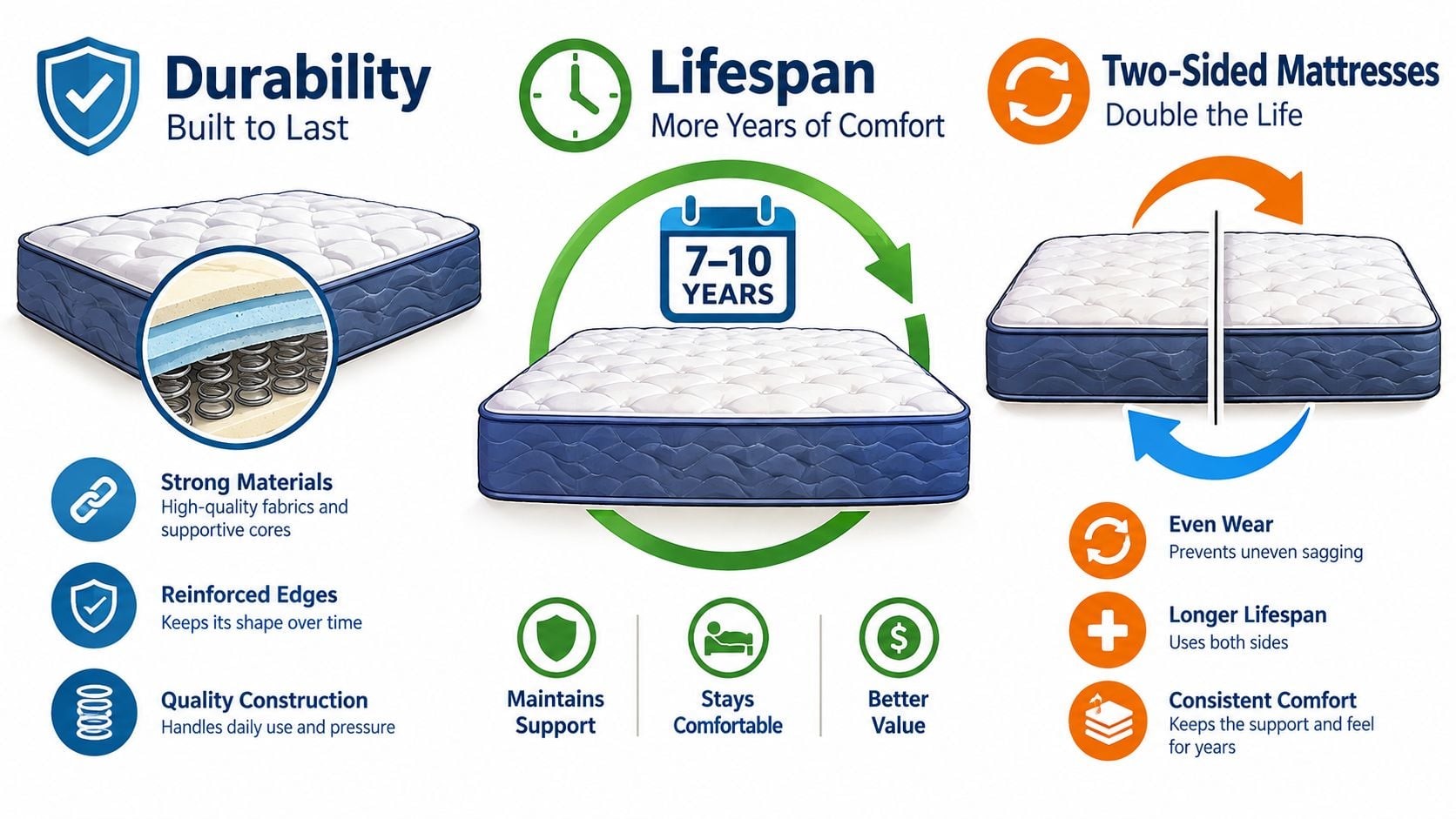
A mattress's lifespan isn't set by a single calendar rule. Material density, support construction, sleeper weight, and daily use all affect how a bed wears. Consumer guidance describes replacing a mattress after seven years as a rule of thumb, not a lifespan established by a fixed test. Visible sagging or damage in the areas where the body rests is a more useful warning, especially when the bed no longer supports comfortable alignment. Guidance on mattress replacement and the seven-year rule explains why condition matters more than a date alone.
Weight affects the pressure placed on a mattress, so a general lifespan estimate may not fit every sleeper. Denser foams, natural latex, and strong coil construction are material and design details worth asking about when durability is a priority. Couples may also want to consider how much of the bed gets regular use, while people who sit on the edge frequently should check how the edge feels and holds up.
What flipping can and can't do
A two-sided mattress lets sleepers use both sleeping surfaces. Flipping or rotating the mattress, when its design allows, can distribute wear across different areas or surfaces. It doesn't prevent every impression or restore support that has already been lost. A mattress that keeps sagging, feels uneven, or no longer supports comfortable sleep still needs a careful assessment.
- Inspect the sleeping area: Look for permanent impressions or visible damage where the body rests.
- Check the warranty terms: Find out how the manufacturer defines covered sagging or structural problems, since terms vary.
- Follow the care directions: Rotate or flip only as the mattress design allows. Advice on when to flip a mattress can help shoppers understand that maintenance depends on the model.
The thickest or firmest mattress isn't automatically the most durable. Construction, material quality, use, and upkeep all matter. For heavier sleepers or couples, ask direct questions about support and wear rather than relying on firmness or thickness as a shortcut.
Matching Mattress Types to Your Sleep Style
The most useful mattress recommendation depends on what a sleeper needs the bed to do. A side sleeper who notices pressure at the shoulder may want a surface with more cushioning, while a stomach sleeper will often prefer greater resistance so the hips don't sink too far. Back sleepers should compare how the mattress feels under the lower back and hips, rather than relying on a “firm” label.
For chronic, nonspecific lower-back pain, the evidence discussed earlier makes medium-firm a reasonable starting point to try instead of assuming very firm is better. That trial doesn't determine what's right for every person, and ongoing pain deserves advice from a qualified health professional. For shoppers who want to connect body type with mattress feel, guidance on choosing a mattress for your body type can help frame the comparison.
Choose based on the trade-off
A hot sleeper may prefer to start with a more breathable-feeling construction, or compare foam models with engineered heat-management features. Someone who wants close contouring can focus on foam, then check whether turning still feels comfortable. A couple should decide whether reducing movement across the bed matters more than a springier surface response.
Heavier sleepers can ask about denser materials and the mattress's support construction, rather than assuming firmness alone determines durability. Seniors and caregivers may want to consider ease of movement and how the bed feels when getting in and out, along with the sleeper's preferred position and comfort. Two-sided options are worth considering when spreading wear across both sleeping surfaces is a priority.
There isn't one construction that suits every side sleeper, couple, hot sleeper, or heavier person. A shortlist based on sleep position and comfort needs can make showroom testing more focused. Then the body gets the final say: lie down, roll over, and notice how the mattress feels under the areas that need the most support or cushioning.
Finding Your Mattress the Old-Fashioned Way
Two mattresses with similar labels can feel entirely different once you lie down. As the research cited earlier showed, the mattress that supports good sleep varies from person to person. Judge the feel against your own response, not the label.
A showroom visit gives you a practical comparison. Lie in your usual sleep position, roll over, and pay attention to pressure, warmth, and ease of movement. Ask how the mattress is built and cared for. This hands-on guide to testing a mattress can help you make the visit count.
BILTRITE has served Metro Milwaukee since 1928 as a fourth-generation, family-owned business. Its mattress center carries more than 60 models, and the team has more than 400 years of combined sales experience. BILTRITE sells in person, not online, and closes on Sundays and Mondays for family time. Visit during showroom hours to compare beds and talk with the team face to face.
BILTRITE Furniture-Leather-Mattresses offers a range of mattresses and in-person help comparing construction, firmness, and comfort. Visit the Greenfield showroom, try beds at your own pace, and ask questions without pressure to buy.