3 Piece Sectional with Cuddler Guide


After a long day, most families want the same thing: a comfortable place where someone can stretch out, children can pile in for movie night, and nobody has to balance on the edge of a cushion. A 3-piece sectional with cuddler can create that shared landing spot, but its success depends on more than plush cushions or a generous footprint. The room layout, delivery route, upholstery, and daily accessibility all matter.
A cuddler sectional can be especially useful in Metro Milwaukee homes, including older houses with narrow doorways, basements, and tight stair turns. The right configuration offers deep lounging space without forcing a household to accept a permanently joined piece that can't be moved through the home.
Table of Contents
- What Makes a Cuddler Sectional So Special
- Measuring Your Room and Delivery Route
- Planning the Best Layout for Your Space
- Choosing Upholstery for High-Traffic Lounging
- Adapting to Smaller Homes and Changing Needs
- Experience the Comfort at Our Greenfield Showroom
What Makes a Cuddler Sectional So Special
A family may start shopping for “a bigger sofa” after one too many evenings spent competing for the comfortable seat. One person wants to recline, another needs room for a child, and the dog has already claimed the corner. A cuddler changes that arrangement by creating an oversized, deep seat at the corner of the sectional, giving one or more people room to curl up, lean back, or stretch their legs.
A typical three-piece layout combines a sofa, a corner or cuddler module, and a chaise, loveseat, or additional seating section. The cuddler acts as a bridge between the two sides, but it feels different from a standard wedge corner because it offers more usable lounging depth and width.
Cuddler, chaise, and corner seat differences
A chaise usually extends from one end of a sofa and gives one person a long place to put their legs. It works well for solo lounging, reading, or napping, but it can make the arrangement feel directional.
A traditional corner wedge joins two seating sections at an angle. It helps create an L-shaped arrangement, yet its angled space may be less comfortable than a full seat. A cuddler fills that corner with a wider, deeper sitting area, so the corner becomes a destination rather than leftover space.
That distinction matters during movie nights. A chaise generally favors one person, while a cuddler can support shared lounging. The household still needs to test the depth and firmness, because a very deep seat may feel relaxing for a tall adult but awkward for a child or someone who has trouble standing.
Comfort check: The cuddler should feel inviting without swallowing the person sitting there. Seat depth, cushion support, arm height, and the ease of standing all deserve a hands-on test.
The interest in this format reflects a broader move toward flexible, family-sized seating. Recent U.S. consumer research found that more than one-third of respondents were considering adding a sectional to their shopping list within the following year, while approximately 22% of sectional shoppers specifically wanted a chaise or extended lounge component. See the sectional sofa research on chaise preferences for that consumer benchmark.
A three-piece cuddler configuration is therefore more than a decorative accent. It can anchor television viewing, casual entertaining, family conversations, and quiet weekend lounging, provided the room and delivery route can handle it.
Measuring Your Room and Delivery Route
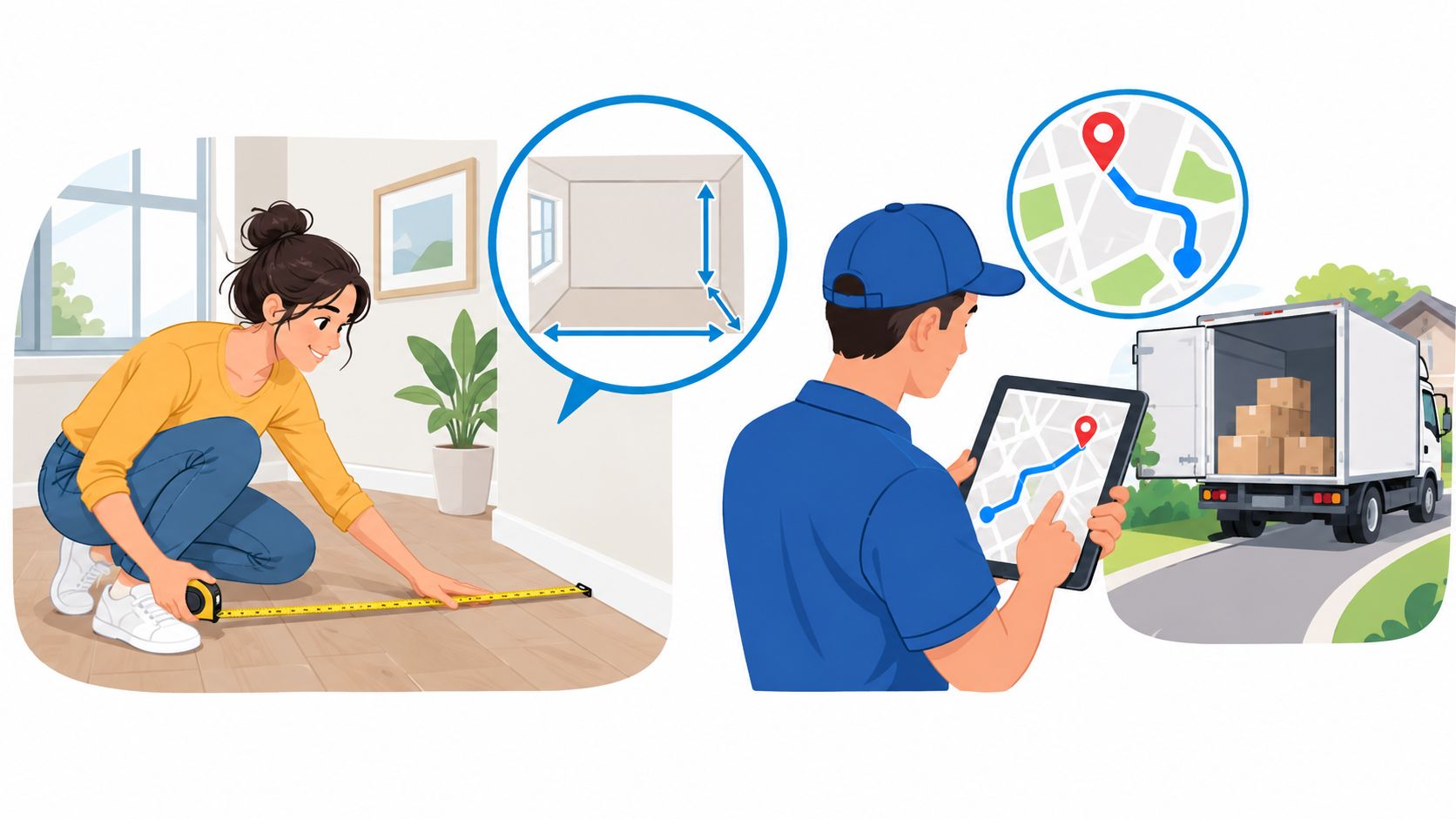
A sectional can fit beautifully against a living-room wall and still fail before it reaches the room. The trouble may appear at the front door, a hallway turn, a stair landing, or an elevator. The safest approach measures the complete route before anyone falls in love with a particular configuration.
Start with the room
Mark the sectional's proposed length, depth, and cuddler projection on the floor with painter's tape. This simple outline shows whether the furniture will crowd a doorway, block a heating register, or interfere with a television path more clearly than a rough glance at the wall.
Measure the route in this order:
- Exterior entry: Record the clear width and height with the door fully open.
- Interior doors: Measure every opening between the entry and the final room.
- Turns and hallways: Check the narrowest passage, not the widest section.
- Stairs and landings: Measure the landing, ceiling height at turns, railing position, and available maneuvering room.
- Final placement: Confirm that the component can turn into its intended position without scraping walls or blocking another passage.
Before ordering, measure the narrowest clear opening at every doorway, hallway turn, and stair landing, and preserve at least a 2-inch handling allowance for packaging and maneuvering, as explained in this sectional measuring guide.
Ask for the dimensions that actually matter
Advertised assembled dimensions describe the sectional after installation. They don't necessarily reveal whether the sofa, cuddler, or corner unit can pass through a tight doorway. Request each component's packaged width, height, depth, and diagonal clearance, then compare those figures with the smallest clear opening on the route.
A come-apart sectional reduces delivery risk because the three modules can travel separately and be connected inside the home. That doesn't mean every three-piece sectional will fit automatically. The cuddler may still be the tallest or deepest component, and carton packaging can add bulk.
For a room-by-room checklist, use BILTRITE's guide to how to measure for a sectional sofa. Families in older Metro Milwaukee homes should pay special attention to fixed backs, stair turns, door trim, hinges, handles, thresholds, railings, and wall projections. The actual clear passage matters more than the outside frame.
Planning the Best Layout for Your Space
The best layout gives the sectional a clear job. It might face the television, define a conversation area, separate the living room from a dining space, or create a cozy family zone in an open plan. The cuddler's projection then becomes the key factor because it reaches farther into the room than a standard corner seat.
A left-facing configuration places the extended section on the viewer's left when facing the sectional. A right-facing configuration places it on the opposite side. Retail descriptions can confuse shoppers because “left-arm facing” and “right-arm facing” are based on the position of the arm when facing the piece, so a quick showroom explanation can prevent an expensive orientation mistake.
Compare the traffic patterns
A cuddler pointed toward a doorway may create a pinch point even when the wall length looks acceptable. Turning it toward a less-used wall can preserve the route between the entry, kitchen, television, and other frequently used rooms.
For the seating area, mark the entire L-shaped footprint rather than only the back edge. Keep at least 30 inches of clear walking space around major furniture paths, and allow 36 inches at a doorway when two people need to pass, based on the available sectional planning guidance. A coffee table should sit approximately 15 to 18 inches from the seating edge for comfortable legroom, according to the same L-shaped sofa sizing guidance.
Use the room's natural center
In a smaller living room, placing the sectional directly against every available wall can leave an awkward, unusable center. A better arrangement may float one side slightly, face the television, and use the cuddler to close the conversation area without blocking the main passage.
In a larger room, the sectional can help divide zones. The sofa side might face the television while the cuddler faces an open area for conversation. A rug can visually connect the pieces, but the taped floor outline should come first. If the tape makes family members squeeze past the cuddler, the finished furniture will create the same problem.
Families with children and pets should test the most-used routes at different times of day. A path that works when the room is empty may become cramped once a coffee table, toy basket, floor lamp, or pet bed joins the arrangement.
Choosing Upholstery for High-Traffic Lounging
The cuddler often becomes the household's favorite position, which means its cushion, inside arm, and nearby corner receive concentrated use. A family may sit there for television, naps, reading, gaming, and afternoon visits, so upholstery should be selected for the actual loading pattern rather than appearance alone.
Fabric durability tests can help narrow the choices, but they shouldn't be treated as a promise of a certain service life. The Association for Contract Textiles identifies 15,000 Wyzenbeek double rubs or 20,000 Martindale cycles as a benchmark for lower-traffic private upholstery, while higher-wear applications use approximately 30,000 double rubs, as described in its abrasion performance guidelines.
Read the durability label in context
A double-rub or Martindale figure is a comparative screening tool. It helps shoppers distinguish fabrics made for lighter use from materials intended for more demanding environments, but it doesn't predict exactly how long a particular sectional will look new.
The same guidance cautions that results above 100,000 double rubs don't reliably demonstrate proportionally longer service life. A fabric can score highly and still show marks from body oils, sunlight, spills, pet activity, or repeated cleaning.
For a busy family room, shoppers should examine:
- Abrasion rating: Choose a documented rating that matches the household's activity.
- Cleanability: Ask what can be removed, what cleaning method is approved, and whether cushion covers come off.
- Colorfastness: Consider sunlight and the likelihood of repeated spot cleaning.
- Seams and construction: Inspect stitching around the cuddler cushion and inside arm.
- Cushion maintenance: Check whether cushions can be rotated or replaced.
A performance fabric may be a practical choice for families with pets or frequent lounging. BILTRITE's information on performance fabric furniture can help shoppers understand the role of cleanability and everyday wear before selecting a material.
Leather can also suit a high-use room, but it still needs evaluation for softness, finish, care requirements, and how it feels against bare skin. The showroom test should include sitting in the cuddler, shifting position, leaning against the arm, and checking whether the cushion immediately feels compressed or unsupported.
Adapting to Smaller Homes and Changing Needs
A modular sectional earns its keep when a household changes. The room may be rearranged for a new television position, a child may need more floor space, or the family may move to a home with a different living-room shape. Separate components offer more options than a permanently joined seating system, especially when the pieces can be transported independently.
Recent market reporting indicates that modular and multifunctional furniture is gaining traction as homes become smaller, with more than 60% of renters preferring modular options for space constraints and mobility. That context appears in this market reporting on modular furniture preferences.
Comfort must include accessibility
A deep cuddler can feel wonderfully relaxed, but depth and softness can also make transfers harder for older adults, caregivers, or anyone with limited mobility. A higher, firmer seat may provide easier support, while a low, deep seat may favor reclining rather than standing.
Households should test:
- Whether both feet can reach the floor.
- Whether the seat edge provides enough support.
- Whether the arm offers a stable place to push from.
- Whether a caregiver can assist without being blocked.
- Whether the cuddler leaves enough room for walking and transfers.
Accessibility isn't only about a recliner or lift chair. The everyday seating arrangement can either make movement easier or create another obstacle. A showroom trial gives each household member a chance to sit, stand, turn, and share the space before the furniture arrives.
The configuration should also fit future use. A young family may prioritize sprawling movie nights today, while a multigenerational household may need easier transfers later. BILTRITE's selection of sectional sofas for small spaces includes a useful starting point for comparing compact scale with family comfort.
Experience the Comfort at Our Greenfield Showroom
Measurements can identify whether a sectional will enter the home, but only a hands-on visit can answer whether the cuddler feels supportive, whether the seat depth suits the family, and whether the arm height works for everyone. A few minutes sitting in the actual position can reveal more than a product description.
BILTRITE Furniture-Leather-Mattresses is a fourth-generation, family-owned business serving the Metro Milwaukee community since 1928. The Greenfield showroom includes affordable, better-quality furniture, USA-made and Amish-made options, solid-wood pieces, small-scale furniture for apartments and senior living, and heavy-duty choices for families who need additional support.
Helpful guidance without pressure
BILTRITE's sales associates bring over 400 years of combined experience. Their role is to help shoppers compare comfort, scale, orientation, upholstery, and delivery access without turning the visit into a rushed decision.
The team can help a household:
- Compare a cuddler with a chaise or standard corner.
- Check left-facing and right-facing layouts.
- Discuss come-apart construction for narrow entries.
- Review packaged dimensions and route concerns.
- Test seat depth, height, firmness, and transfer ease.
- Coordinate a sectional with other living-room pieces.
The showroom also includes a large mattress department with over 60 models, making it possible for families to handle multiple home-furnishing needs in one local visit. In Wisconsin, power lift recliners are exempt from sales tax, which can make mobility-focused seating more affordable for eligible shoppers.
BILTRITE doesn't sell online, so the in-store experience matters. The store is closed on Sundays and Mondays to support family time, and the team welcomes shoppers who want to sit, measure, ask questions, and think through the decision at their own pace. Location details and showroom information are available on the BILTRITE locations page.
BILTRITE Furniture-Leather-Mattresses offers affordable, better-quality sectionals, come-apart furniture, USA-made and Amish-made pieces, small-scale options, and supportive seating for changing household needs. Visit BILTRITE Furniture-Leather-Mattresses in Greenfield for a no-pressure, hands-on visit, test the cuddler for yourself, and talk with the team about making it through your home's tightest doorway.