





Lift Chairs Electric Guide for Comfort and Safety


A loved one may be sitting comfortably in a recliner, yet the hardest part of the visit is helping that person stand. Knees hurt, balance feels uncertain, and a simple transfer can turn into a tense moment for everyone. That's where electric lift chairs can make daily life easier, provided the chair matches the person, the room, and the way it will be used.
BILTRITE has helped Metro Milwaukee families choose supportive furniture since 1928. As a fourth-generation, family-owned business, our approach is practical and personal: understand the user's mobility needs, measure the space, test the chair, and choose useful quality instead of paying for features that may sit untouched. The guide below explains how lift chairs work, how their positions differ, which dimensions matter, and what families should check before bringing one home.
Table of Contents
- Introduction to Electric Lift Chairs and Who They Help
- How Electric Lift Chairs Work in Simple Terms
- Types of Electric Lift Chairs Compared
- Motor Power Frame Strength and Sizing That Matters
- Safety Tips and Simple Care for Daily Use
- Features Seniors and Caregivers Actually Use Every Day
- How to Choose Your Lift Chair and Try Before You Buy in Greenfield
Introduction to Electric Lift Chairs and Who They Help
After lunch, a daughter notices her mother trying several times to stand from the living-room chair. Her mother still wants to answer the door, walk to the kitchen, or settle in for television without asking for help each time. An electric lift chair can tilt and raise the seated person forward, creating a smoother path from sitting toward standing.
That support may suit an older adult with limited strength, someone recovering from a procedure, or a caregiver trying to reduce repeated lifting and pulling. It does not remove every mobility risk, and it may not fit every user. The person still needs enough balance, coordination, and understanding to follow the chair's movement safely.

What independence looks like at home
Independence can include the right support for one difficult movement, such as rising from a low seat. A lift chair may help a person begin standing with less strain, while a family member stays nearby when supervision is needed.
The recliner family also has a long history. The modern recliner is commonly traced to 1927–1928 in Michigan, when Edward Knabusch and Edwin Shoemaker formed a furniture company and patented an early reclining chair. The first recliner with a lift-assist mechanism is described as reaching the market in the early 1980s. Improved electronics in the 1990s helped make controls more flexible and accessible, as outlined in this history of lift and recline chairs.
Before choosing a model, families should ask:
- Who will use it: Can the user operate a hand control and follow the standing sequence?
- What movement is difficult: Is the main challenge standing, reclining, leg elevation, or finding a comfortable sitting angle?
- Where will it go: Does the room have space for the chair's full movement, not only its closed footprint?
- How often will it be used: Occasional assistance may call for a simpler chair, while all-day use may justify more positioning flexibility.
A practical overview of lift chair benefits can help families begin the conversation. An in-person trial still matters. A chair may look inviting in a photograph yet feel too deep, too tall, or difficult to control. Sit in it, test the hand control, check the user's foot position, and confirm that the chair fits both the person and the room.
How Electric Lift Chairs Work in Simple Terms
A lift chair helps with two linked tasks: changing position and preparing the body to stand. Pressing the hand control starts a measured sequence. The seat rises and moves forward, giving the user a steadier path from sitting to standing. The movement should feel controlled, like a platform being raised into place, rather than a sudden push.
The movement from sitting to standing
Most users operate the chair with a hand control. One button raises the seat toward its lift position, while other buttons recline the back or raise the footrest. The user should keep both feet positioned as instructed and wait for the chair to reach the intended angle before standing.
The motor provides steady movement, so the user does not have to lift their body with arm strength alone. A sturdy frame carries the load, and a lifting linkage changes the seat's angle and height. These parts must be matched to the user's size and weight. A chair that fits the room but feels too deep, narrow, or difficult to control may still be the wrong choice.
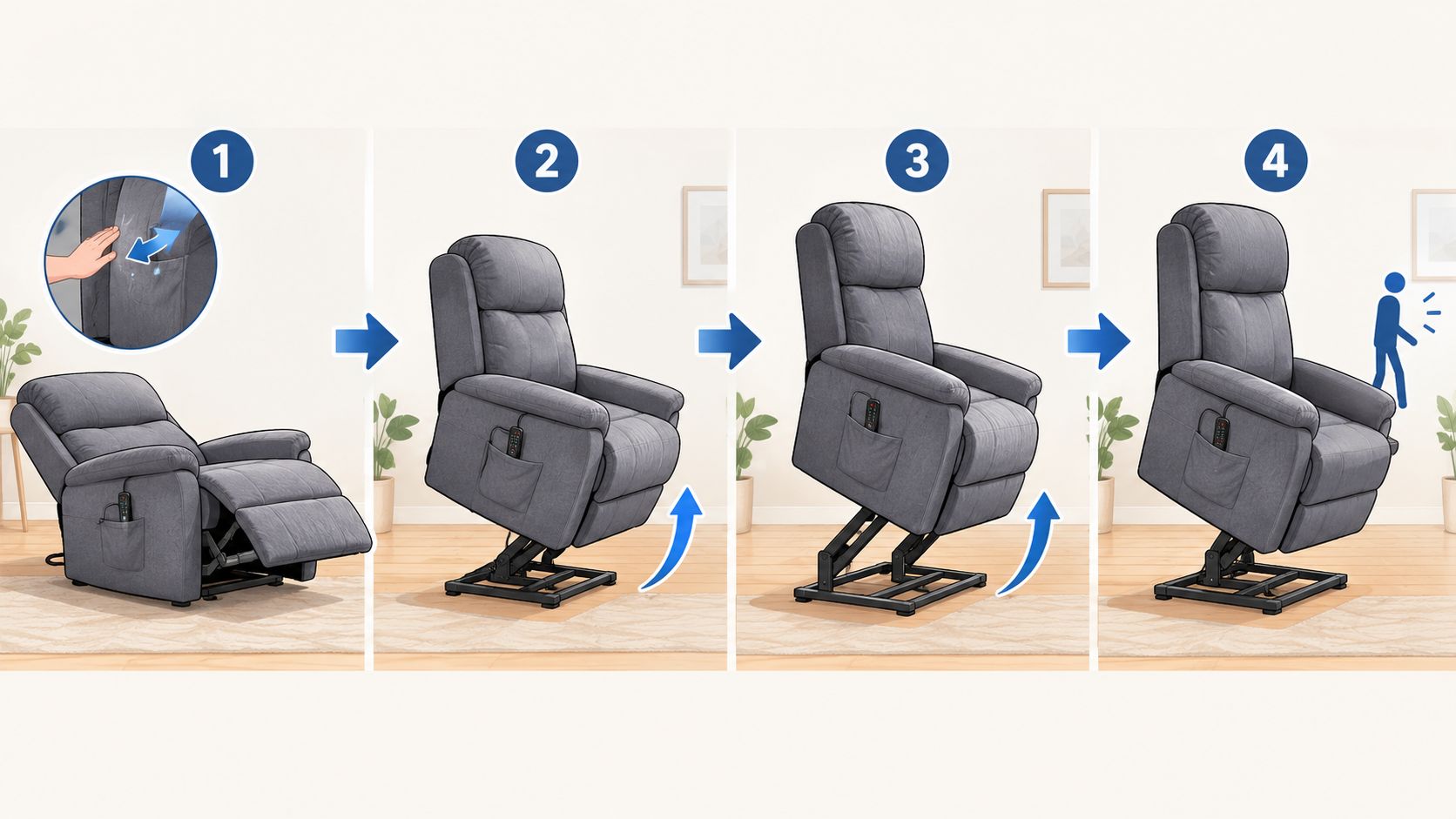
Check the full travel path before placing the chair. The back may move toward the wall as it reclines, and the seat needs clear space in front as it rises. This simple room check helps prevent blocked movement and keeps the chair easier to use every day.
Why low-voltage systems matter
Electric lift chairs commonly use a low-voltage drive system. One referenced design takes 240V AC from the home, changes it to 24V DC, and sends that lower voltage to the motors and hand control. The transformer sits outside the motor, separating power conversion from the moving mechanism. The design details appear in this electric lift chair construction example.
For the person sitting in the chair, the practical sequence is simple. Household power reaches the transformer, the transformer converts it, and the chair uses the lower-voltage output for movement and controls. The setup supports repeated lifting and reclining while keeping the control wiring suited to a home environment.
What the hand control should feel like
A useful control should be easy to recognize and operate without confusion. Large, clearly separated buttons may help more than a remote crowded with features. Caregivers should confirm that the user knows which button raises the chair, which lowers it, and when to pause.
Families comparing powered seating can review types of power reclining seating to see how lift chairs relate to other motorized seating. The key distinction is standing assistance. Reclining changes position for comfort, while lifting helps the user move out of the chair. A hands-on trial can reveal whether the control, seat height, and movement suit that particular person.
Types of Electric Lift Chairs Compared
The main lift chair categories differ by how far the chair reclines and whether the back and footrest move together or separately. A person who mainly needs help standing may not need the same mechanism as someone who spends much of the day reading, resting, or elevating the legs.
| Chair Type | Positions and Movement | Best For |
|---|---|---|
| Two-position | Upright sitting, lift-assisted standing, and a limited recline | Users who want straightforward standing help and basic relaxation |
| Three-position | Upright sitting, lift-assisted standing, and a deeper recline for extended resting | Users who read, watch television, or nap in the chair |
| Infinite-position or zero-gravity | More independent adjustment of the back and footrest, depending on the model | Users who need highly tailored positioning for comfort or leg elevation |
| Single-motor | Back and footrest move together in a coordinated sequence | Shoppers who prefer simple operation |
| Dual-motor | Back and footrest can adjust independently | Users who value separate control over the upper body and legs |
Two-position chairs
A two-position model keeps the decision process simple. It can assist with standing and provide a modest recline, but it won't offer the same lounging range as a deeper-reclining design. This style may suit a user who sits upright for reading or conversation and mainly wants help getting out of the chair.
Its straightforward operation can be a strength. Fewer movements and fewer control choices may help a user who finds complicated remotes frustrating.
Three-position chairs
A three-position model adds a deeper recline for longer rest. The back and footrest generally move together, so the user won't adjust each part independently. That limitation may be perfectly acceptable for someone who wants a familiar sitting-to-reclining sequence and a comfortable place to nap.
Room size still matters. A deeper recline can require more travel behind or in front of the chair, so the model should be tested or measured before delivery.
Infinite-position and dual-motor designs
A dual-motor chair separates back movement from footrest movement. That allows a person to raise the legs while keeping the back more upright, or adjust the back without changing the footrest. The extra flexibility can be useful when the user's comfort depends on a very specific posture.
The phrase “zero gravity” can sound technical, but the practical idea is simple: the chair helps distribute the body into a supported position with the legs raised. Families can explore lift chairs with zero-gravity positioning while keeping the user's actual routine at the center of the decision.
Motor Power Frame Strength and Sizing That Matters
A lift chair should match the person and the room, not just the feature list. Seat height, width, depth, weight capacity, motor design, and clearance affect whether the chair feels steady and supportive. A deep seat can leave the user's feet poorly placed. A narrow seat can make sitting and standing uncomfortable.
Start with the person
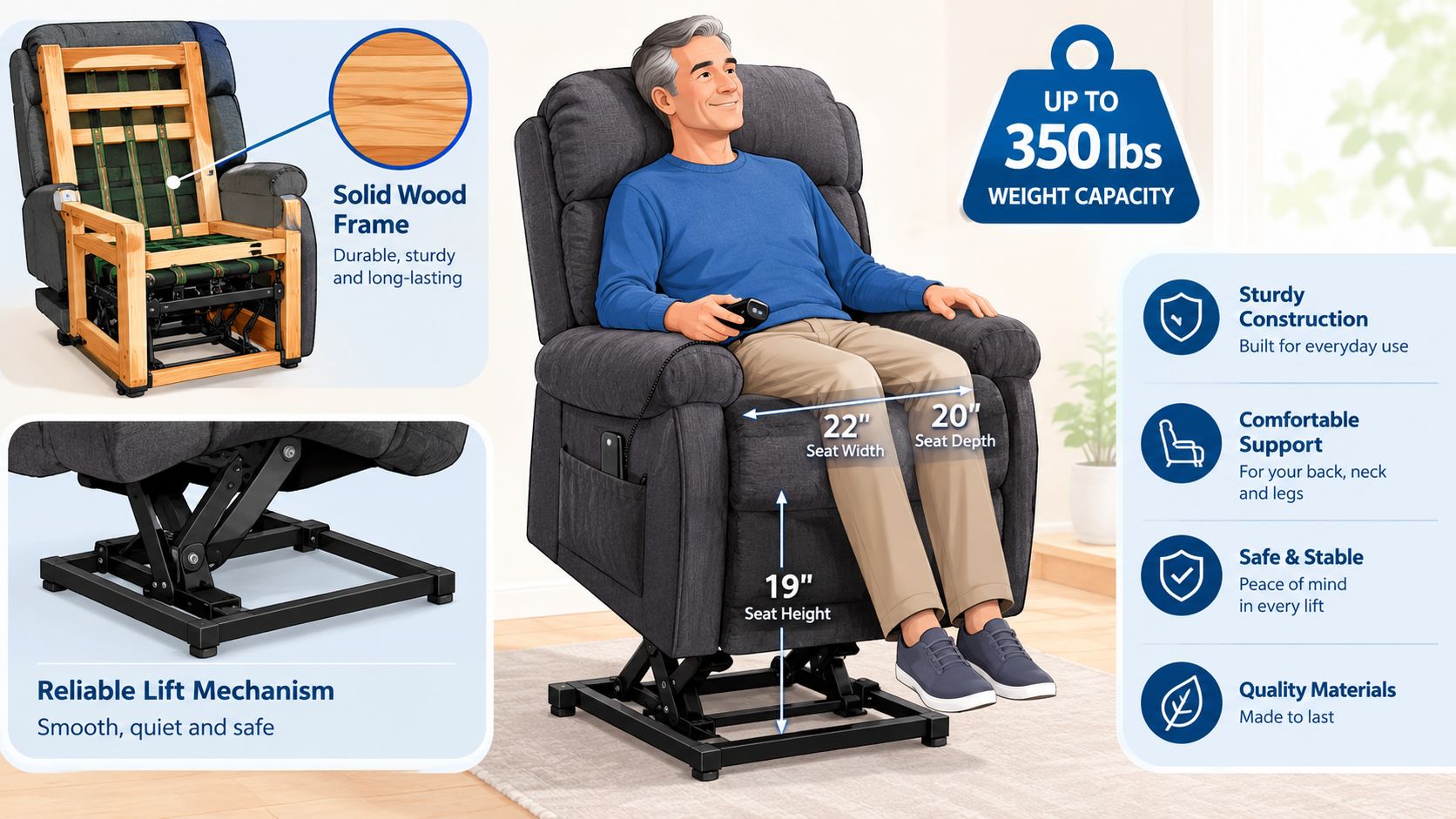
Published examples show how much chair dimensions vary. Electric lift chairs may have seat heights around 49–52 centimeters, seat widths near 49.5–60 centimeters, seat depths around 48–53 centimeters, and maximum supported weights of roughly 140–150 kilograms or 320–400 pounds, depending on the model class. These examples appear in the lift chair sizing and clearance specifications.
Another model lists a 20-inch seat width, 20-inch seat depth, 18.5-inch seat height, 16 inches of back clearance, and a 300-pound capacity. Those measurements are examples, not a universal fit. Families should compare the user's body, posture, and mobility needs with the chair's published specifications instead of choosing by appearance.
Have the user sit naturally and check:
- Feet: Both feet should maintain a stable relationship with the floor.
- Knees: The seat should not force the knees noticeably higher or lower than a comfortable position.
- Back: The user should reach the back support without sliding forward.
- Arms: Armrests should support the arms without lifting the shoulders.
- Seat width: The user should sit securely without shifting from side to side.
Small differences matter. A chair that fits like a well-sized shoe can feel supportive, while one that is too large or too small can make transfers harder.
Match the frame to the job
The lift mechanism works repeatedly, so the frame and its supporting structure deserve attention. BILTRITE's showroom includes furniture with USA-made, Amish-made, and solid-wood construction, as well as smaller and heavy-duty choices. Solid wood alone does not confirm that a chair suits a particular user, but construction details can provide useful context about support and furniture quality.
Weight ratings also vary widely among lift chairs. Published examples include capacities of 500 pounds and 700 pounds. A high rating does not replace a proper fit. The chair still needs to support the user's width and posture while fitting the available room.
Measure the room in motion
A lift chair needs more than enough floor space when closed. One model specifies about 71 centimeters behind the chair and 95 centimeters in front for operation, while another lists 16.5 inches of back clearance. Use the model's own measurements as the final guide, since motor movement and recline paths differ.
Measure the route from the delivery entrance to the intended room. Mark the chair's approximate position with painter's tape, then allow for the back moving, the footrest extending, and the seat rising. A nearby table or tight wall can block movement even when the chair fits at rest.
Before ordering, review the guidance on choosing a lift chair by weight capacity and, when possible, have the user try the chair in person. A short test can reveal fit problems that measurements alone may miss.
Safety Tips and Simple Care for Daily Use
A lift chair helps with standing only when the person, chair, and room work together. A user may lose balance by rising before the chair reaches its lift position, reaching for a control while twisting, or operating a model that does not match their strength and judgment. Test the movement with the user present, and ask a healthcare professional whether solo use is appropriate.
The recline-to-stand transition deserves particular care. Keep the back in the recommended position, bring the chair fully upright or into its lift position, and supervise anyone who is frail, unsteady, or easily confused. A chair supports a transfer plan. It does not replace one.
A caregiver's daily checklist
- Use supervision when needed: Stay nearby during transfers if the user has poor balance, limited strength, or confusion.
- Follow the movement sequence: Return the back and footrest to the recommended position before standing.
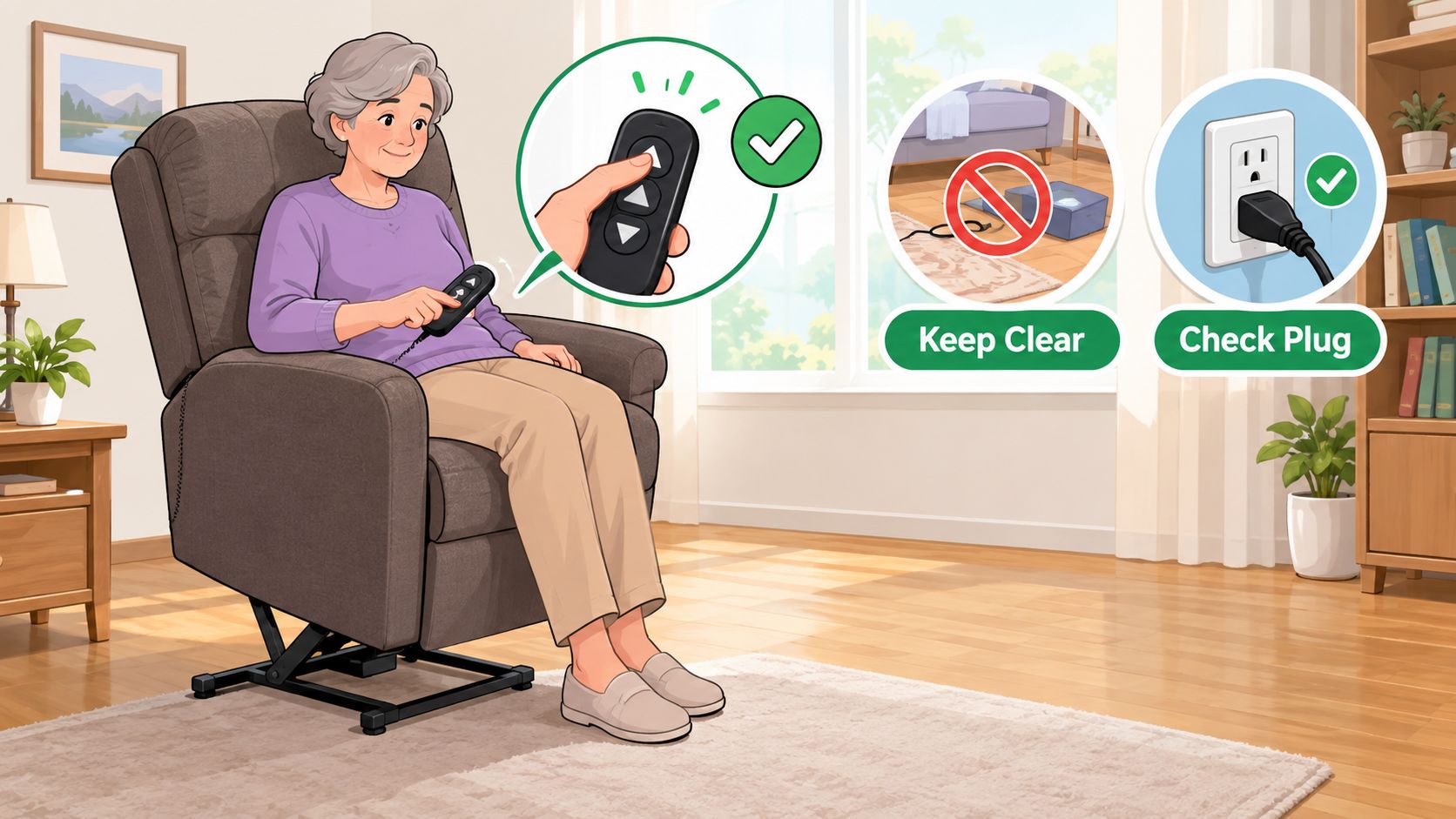
- Clear the movement zone: Remove footstools, baskets, cords, small tables, toys, pets, and loose blankets from the footrest and lift path.
- Protect the cord: Keep it away from pinch points and walking paths. Stop using the chair if the wiring is damaged.
- Keep the control close: The user should not twist, lean, or stand on an unstable surface to reach it.
- Listen and watch: Stop operation and request service guidance if the motor hesitates, sounds unusual, or moves unevenly.
A simple rule helps: if the chair does not move as expected, stop and check it rather than trying to force the cycle.
Care for the upholstery and mechanism
Vacuum dust and crumbs gently, then follow the upholstery instructions for spills. Avoid soaking the fabric or bringing moisture near electrical components. Check beneath and around the chair regularly, since small objects can enter the moving mechanism.
Power outages need a plan for anyone who spends long periods in the chair. Families can review models with battery backup for lift chairs and ask what the backup can operate, how to activate it, and how its batteries should be maintained. Backup power can help during an outage, but it does not make an unsafe transfer safe.
Room fit matters during daily use. Leave enough space for the back, footrest, and rising motion, and keep the control where the user can reach it without leaning. A short in-store trial can reveal whether the seat angle, control, and lift movement suit this person better than measurements alone.
Features Seniors and Caregivers Actually Use Every Day
A chair can look impressive in a showroom and still be wrong for the person who uses it each day. Start with the repeated task: standing with less strain, resting at a comfortable angle, or reaching a control without twisting. The useful feature is the one that makes that task easier in the actual room.
Start with movement and control
Seat fit and lift movement deserve attention before entertainment extras. Clearly marked buttons may suit a user with hearing, speech, memory, or technology concerns better than voice control. A battery backup can also help during an outage, especially if the user cannot safely rise from a reclined position without assistance.
Heat and massage may make rest more comfortable. USB charging can keep a phone nearby. Bluetooth and smart-home connections may suit some households, yet they bring added settings and cost. A simple control is often easier for a caregiver to explain and for a senior to use consistently.
Ask whether the person will use a feature regularly, and whether the room supports it. A feature that sounds helpful on a list has little value if the buttons are hard to see, the chair crowds a walkway, or the user needs help operating it.
Match features to the daily routine
For caregiving, easy-clean upholstery and a straightforward remote may matter more than connectivity. During recovery, supportive seating, suitable seat height, and a position that makes rising less painful may take priority. For aging in place, a quiet mechanism and an uncluttered setup can matter more than premium add-ons.
The chair should also match the user's body and habits. Someone who reads for long periods may need a steady reclined position, while someone who mainly transfers in and out may care more about controlled lifting and stable support. A taller or broader user may need different proportions from a smaller user, even when both want the same basic function.
Coverage can add another layer of confusion. Medicare generally does not cover the full chair. In some cases, it may cover only the motorized seat-lift mechanism as durable medical equipment when a doctor finds it medically necessary. The frame, upholstery, and features outside that mechanism may remain separate costs. Families can review this Medicare lift chair coverage guide and this coverage explanation, then confirm current requirements with the medical provider and plan administrator.
The lift chair market feature analysis describes multifunctional models with heat, massage, USB charging, Bluetooth, voice control, and smart-home integration. Those options can be useful, but they should follow the person's needs, room layout, and ability to use the controls. A short in-store trial often answers those questions better than a feature list.
How to Choose Your Lift Chair and Try Before You Buy in Greenfield
The most reliable buying process begins with the person, not the remote or fabric sample. A shopper should identify the transfer problem, note how long the user sits each day, and decide whether the chair needs basic lifting, deeper reclining, or independent back and leg adjustment.
The room comes next. Measure the doorway, the route into the room, the chair's intended position, and the clearance needed for movement. A small apartment may call for a compact design, while a larger user may need a heavy-duty frame and wider seat. Neither choice is better in the abstract. The right chair is the one that supports the user without crowding the room.
What to test in the showroom
A showroom visit gives the user a chance to answer questions that measurements alone can't solve.
- Sit fully back: Check whether the seat depth supports the legs without pressing behind the knees.
- Test the lift motion: Notice whether the user feels stable as the chair rises and moves forward.
- Try the hand control: Make sure the buttons are easy to see, reach, and understand.
- Check the recline: Confirm that the preferred resting position feels supported.
- Ask about delivery: Discuss access through doorways, room placement, assembly, and clearance.
- Bring the caregiver: A second person can observe posture, control use, and transfer confidence.
BILTRITE is a fourth-generation, family-owned showroom serving Greenfield and Metro Milwaukee with affordable, better-quality furniture. The selection includes USA-made and Amish-made pieces, solid-wood furniture, small-scale choices for apartments and senior living spaces, and heavy-duty options for families with larger sizing needs. The store also has a mattress department with over 60 models, while its sales associates bring over 400 years of combined experience to customer conversations.
A chair that feels right in the showroom gives a family more useful information than a photograph ever can.
The showroom is located at 5430 West Layton Avenue in Greenfield. BILTRITE doesn't sell online, and the store is closed on Sundays and Mondays for family time, so shoppers should plan a visit when the team is available. Come on down, let the user test the lift and recline positions, and talk through the room measurements before making a decision.
BILTRITE Furniture-Leather-Mattresses offers lift chairs alongside affordable, better-quality furniture, USA-made and Amish-made solid-wood pieces, and a mattress department with over 60 models. Visit BILTRITE Furniture-Leather-Mattresses in Greenfield to sit in the chairs, compare the fit, and get friendly guidance from a local team.