Lift Chair Benefits That Actually Make Daily Life Easier


A parent is sitting at the kitchen table after breakfast, staring at the short trip to the living room like it's a hill. Getting upright takes both hands, a careful lean, and a quiet request for help. A spouse hovers nearby, ready to catch an elbow. An adult child starts wondering whether one ordinary transfer could become a fall, a strained back, or a call for emergency help.
That's where lift chair benefits become practical rather than decorative. A lift chair isn't merely a plush recliner with extra buttons. It's a transfer aid designed to help someone move from sitting to standing with less effort, while still providing a comfortable place to rest. The right chair can support independence in a real home, including a smaller apartment, a narrow hallway, or a household with one caregiver.
Families should still shop carefully. A lift chair won't replace physical therapy, solve every balance problem, or fit automatically through a difficult doorway. The best choice matches the user, the transfer challenge, and the room.
A Morning That Starts with a Lift Chair
Breakfast is finished, but standing up feels like pushing through wet concrete. The kitchen chair stays tucked beneath the table while both hands grip the edge. A spouse says, “I've got you,” and braces a shoulder blade as the person tries to shift weight onto sore knees.
Then the small fumbles begin. A coffee lid drops onto the floor because one hand lets go too soon. A morning dose gets missed because the effort of reaching the counter turns into a rest on the sofa. A phone slides under the table, and the person decides it can wait. On another morning, the bathroom trip takes so much planning that the person almost doesn't call for help, even though the transfer feels unsafe.
This isn't a dramatic worst-case scenario. It's a typical Tuesday in many households where lower-body weakness, painful joints, or unsteady balance turns repeated chair transfers into a negotiation. A major U.S. primary-care review found that 29.4% of adults age 65 and older reported using an assistive device outside the home during the previous month, while 26.2% reported using one inside the home. The review also explains that properly matched devices can improve balance, reduce pain, increase mobility and confidence, and decrease fall risk. Families can read the full clinical discussion in this primary-care review of assistive devices for older adults.
Practical rule: If standing from a familiar chair has become a daily struggle, the chair deserves evaluation as a mobility aid, not just as living-room furniture.
With a lift chair, the morning transfer starts differently. The user sits back, places both feet securely, and presses the hand control. The seat rises and tilts forward, helping bring the body over the feet so the person can finish standing with less pushing and pulling. The coffee lid may still fall occasionally, but the chair isn't adding another difficult transfer to the morning.
The mechanical details matter because they explain why a lift chair can make ordinary routines easier. The chair's job is simple, focused, and useful: help the body move through the hardest part of getting up.
What a Lift Chair Actually Does
A regular recliner changes position for comfort. Its back tilts backward and its footrest rises, but the user still has to supply the strength needed to leave the seat. A lift chair adds a powered seat-lift mechanism that raises the seat and tilts the person forward toward standing. That difference is the reason a lift chair can function as a transfer aid.

A simple before-and-after picture helps:
- Before: The person is planted on a kitchen chair, shoulders pulled back, hands gripping the table edge, and feet searching for stability.
- After: The person leans forward naturally while the seat moves upward and forward, placing more body weight over the feet before standing.
The controls and movement
A small hand control operates the motor. One direction raises the chair, another lowers it, and separate controls may adjust the reclining position. The user should stop the movement whenever the position feels stable. There's no need to rush through the transfer.
Peer-reviewed rehabilitation research evaluated electric lifting chairs as disability-assistive products as early as 2011. That research described the electric lifting chair as a typical assistive product for people with weakened muscular systems and reported that its hip-up function could reduce muscle force during standing. It also identified the sit-to-stand and stand-to-sit motions as moments when the chair may help prevent falls. The 2011 rehabilitation research on electric lifting chairs provides that early research context.
Details that affect everyday use
Before choosing a model, families should check the weight capacity, the seat width, and the direction the chair faces while raised. A chair that extends into a doorway can create a traffic problem, particularly in a compact apartment. Battery backup matters for a person who lives alone or needs the chair during a power outage. A manual backup lever or release can also provide reassurance if the remote stops working.
The chair still reclines, swivels on selected models, and looks like ordinary living-room furniture, but its first job is helping the user complete a safer, less demanding transfer.
The Biggest Day-to-Day Lift Chair Benefits
The strongest lift chair benefits appear in small moments that happen repeatedly, not only in emergencies. A controlled rise can change how a person approaches a bathroom trip, a meal, or an evening visit with family.
Independence at the moment it matters
At two in the morning, a person may need to use the bathroom without waking a spouse. A lift chair doesn't guide someone across the room, but it can make the first transfer more manageable. That distinction matters. The user still needs a clear path, suitable lighting, and enough balance to walk with or without an aid.
Older adults already use assistive devices indoors and outdoors in substantial numbers, and the clinical review linked earlier explains that a properly fitted device can support mobility and confidence. A lift chair fits that broader aging-in-place pattern because it helps with a specific movement inside the home.
Less strain during standing
A knee-replacement recovery morning can make a standard recliner feel too low. Arthritis can make the first push upward painful. Biomechanics research found that assisted transfers reduced trunk, hip, and knee angles, lowered peak hip and ankle joint moments, and reduced peak muscle activity compared with unassisted transfers. The clinical study of assisted sit-to-stand transfers supports the practical conclusion that powered assistance can reduce mechanical demand during the rise.
Another feasibility study reported reduced muscle activation during assisted sit-to-stand movement, including a 37.27% decrease on the left and a 17.98% decrease on the right for the erector spinae. It also reported reductions for the quadriceps, tibialis anterior, and gastrocnemius muscles. Those exact findings appear in the pressure-sensing assistive chair study.
Lower fall exposure during transfers
A controlled rise can reduce the hurried rocking, grabbing, and backward collapse that sometimes happen when someone tries to stand alone. It won't catch a person who loses balance halfway to the kitchen, and it doesn't replace a walker, cane, therapy, or supervision when those are needed.
The chair also requires space. Families should allow roughly 18 inches of clearance behind the chair for reclining, then confirm the exact requirement for the selected model before delivery. More room may be needed in front for a safe standing path.
Elevation and caregiver relief
Leg elevation can feel useful after a long day or during periods of swelling, but claims about circulation, edema, and sleep deserve careful medical judgment rather than automatic promises. A lift chair may position the legs comfortably, yet it isn't a treatment plan for an underlying condition.
For caregivers, the benefit is direct. Catching a parent under the arms can twist a back, especially when the transfer happens several times daily. A lift mechanism removes much of that manual hoist, though a caregiver may still need to spot the user and follow clinical guidance.
For shoppers comparing positioning options, BILTRITE's lift chairs and zero-gravity models offer a useful starting point for comparing transfer support with reclining comfort.
Lift Mechanisms and Comfort Features Worth Knowing
A lift chair should fit the person, the room, and the transfer they need help with. Mechanisms differ in recline range and in whether the back and footrest move together or separately. The transfer function comes first. Reclining options matter because a parent may use the chair for reading, a short rest, television, or longer periods of sitting.
Four common position tiers
| Feature Tier | Recline Range | Best For | Cost Impact |
|---|---|---|---|
| Two-position | Upright to a modest recline | Reading, conversation, and short rests | Usually the simplest option |
| Three-position | Upright to a deeper, near-flat recline | Napping and longer relaxation | Adds positioning flexibility |
| Infinite-position | Back and footrest adjust independently | Users who need precise posture changes | Usually increases the price |
| Zero-gravity | Legs are raised high while the body takes a supported position | People seeking the comfort of raised legs | Often adds a premium feature cost |
A two-position chair suits someone who mainly needs help standing and wants a gentle recline. The controls stay simple, and the chair can work well in a small apartment or living room. A three-position chair gives more space to nap or stretch, without the extra controls of an infinite-position model.
An infinite-position chair lets the user adjust the back and footrest independently. That flexibility helps during a long evening, but only if the person can operate the controls comfortably. In a narrow room, extra movement and control placement also deserve attention before delivery.
Zero-gravity positioning can feel supportive for raised legs. Families should ask a clinician about persistent swelling or circulation concerns rather than treating a furniture position as medical care. Check the chair's footprint and doorway access too, because a feature has little value if the chair cannot reach its intended room.
Features worth paying for
Heat may loosen stiff hands or an achy back on a cold morning. Lumbar support can improve comfort when the chair's proportions match the user. Battery backup matters more for someone living alone or in a home where reaching the outlet is difficult. A USB port is convenient, but it does not improve transfer safety.
Massage is a comfort add-on, not the reason to buy a lift chair. An extended footrest can help taller users, while easy-clean upholstery makes sense when the chair is used every day. In a small home, prioritize a manageable footprint and controls the user can understand.
Families should also compare the chair's weight capacity with the user's actual needs, rather than choosing by appearance alone.
Store-floor advice: A feature earns its place when it solves a daily problem. Extra buttons are not automatically extra value.
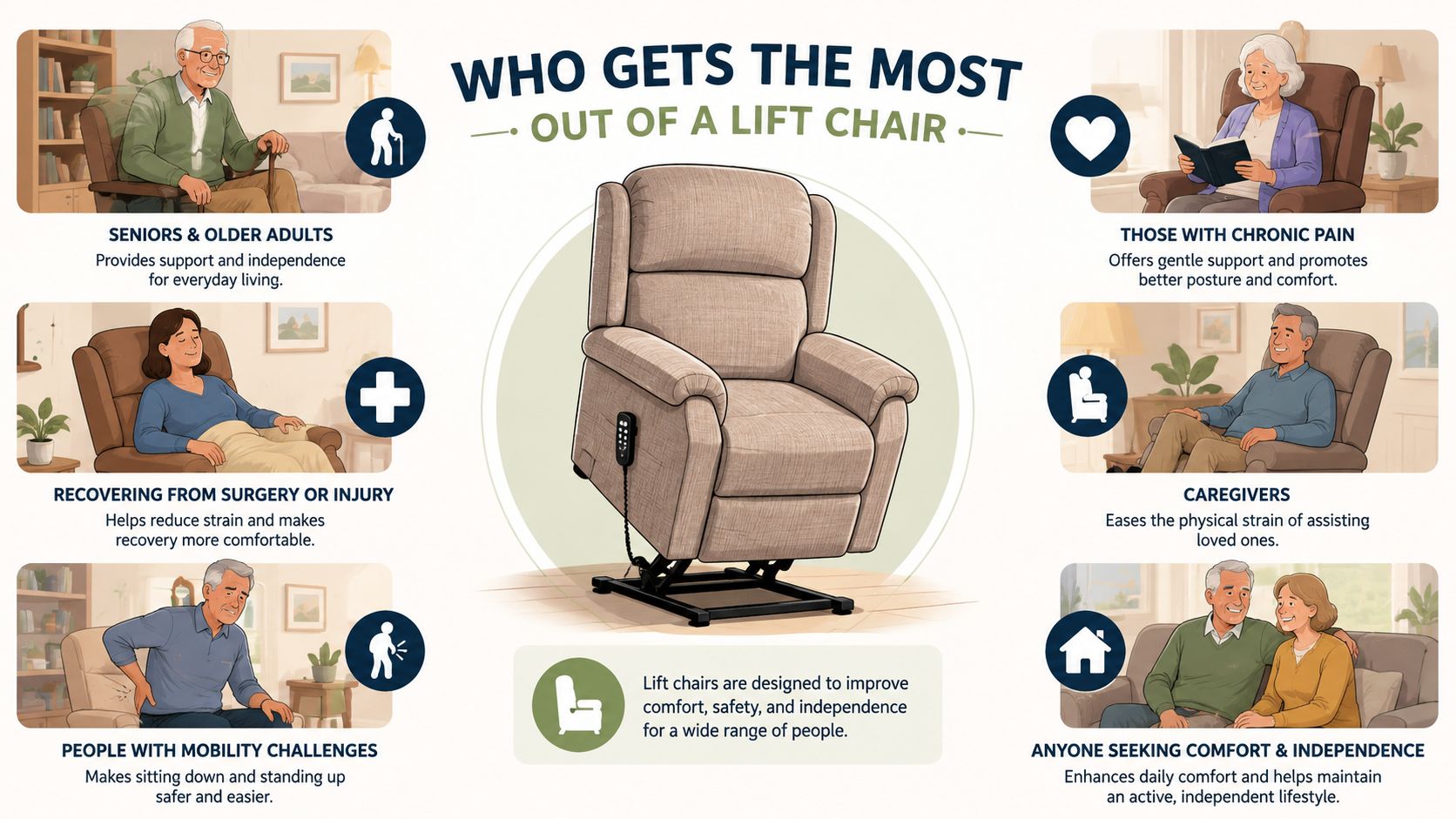
Who Gets the Most Out of a Lift Chair
A lift chair makes the most sense when a person struggles with a predictable transfer. The chair's value becomes clearer when matched to the exact user and the exact moment.
Aging in place
A senior who wants to remain at home may use the chair for morning standing, evening relaxation, and nighttime bathroom transfers. The goal isn't to eliminate every mobility challenge. It's to preserve control over one repeated movement and reduce the need to ask for help each time.
Recovery after surgery
After hip, knee, or back surgery, sitting down and standing up can place uncomfortable demand on healing areas. A lift chair can support the transition while the person follows the surgeon's movement restrictions and therapy plan. It shouldn't be selected without checking whether the seat height, depth, and recline positions fit those restrictions.
Arthritis and chronic weakness
Arthritis can turn the first push out of a low chair into the most painful part of the day. A powered rise reduces the need to drive upward through sore knees, hips, or hands. The user still needs a stable standing path and may need other assistive equipment beyond the chair.
People living with COPD, Parkinson's disease, or multiple sclerosis may appreciate a more controlled transfer when fatigue, stiffness, or weakness changes throughout the day. Someone with Parkinson's might use the lift function before a nighttime walk, while a person with COPD may value a seating position that makes rest easier. Neither condition makes a lift chair automatically appropriate. The person must be able to understand the controls and complete the next movement safely.
The single caregiver
A spouse or adult child who handles daily transfers may be protecting the family member while also risking a back injury. A lift chair can reduce the need for underarm lifting and make one-person caregiving more manageable, but it doesn't turn an unsafe transfer into a safe one without proper instruction.
The chair may not suit someone with significant cognitive decline who could become frightened by the motorized movement or press controls unpredictably. It may also be a poor choice when the home layout cannot accommodate the chair, its power cord, or the user's walking route. BILTRITE's lift chairs for elderly users can help families begin that discussion with the user's actual needs in mind.
Lift Chair Cost, Medicare, and Real Value
Price should be openly discussed because the chair is both furniture and assistive equipment. The precise purchase amount depends on construction, upholstery, size, mechanism, and added features, so families should compare the complete chair rather than focusing on one advertised component.
Medicare Part B may help pay for the motorized lifting device, not the entire chair, when a doctor determines that the equipment is medically necessary. After the Part B deductible is met, Medicare typically pays 80% of the Medicare-approved cost for the lifting mechanism, leaving the shopper responsible for the remaining 20% plus the non-covered chair costs. The Medicare coverage explanation for lift chairs outlines that distinction.
| Cost or Coverage Item | Typical Range or Rule | Reader Takeaway |
|---|---|---|
| Motorized lifting device | Medicare may cover part of the approved mechanism cost | Ask the doctor and supplier about documentation |
| Chair frame and upholstery | Not covered as the durable medical equipment portion | Budget for the furniture itself |
| Comfort features | Generally part of the shopper's chair cost | Pay for features tied to daily use |
| Supplier requirement | Coverage typically requires an enrolled or approved supplier | Confirm supplier status before ordering |
Eligibility generally involves severe arthritis of the hip or knee or a severe neuromuscular disease. Medicare also generally requires that the person cannot stand from a regular armchair or another chair in the home but can walk once standing, even with a cane or walker. The coverage eligibility guidance for lift mechanisms describes those clinical conditions.
Medicare doesn't cover the full furniture portion, including the frame, upholstery, or comfort features, and the mechanism generally must come through an approved supplier. The durable medical equipment explanation for lift chairs reinforces that the chair itself isn't treated as fully covered furniture.
The value question is simpler than a spreadsheet. If the chair is used every day to reduce painful transfers, protect a caregiver's back, and preserve time at home, its value comes from repeated practical use. Families should still compare the chair against other support options, discuss the need with a clinician, and review lift chair cost considerations before choosing features.
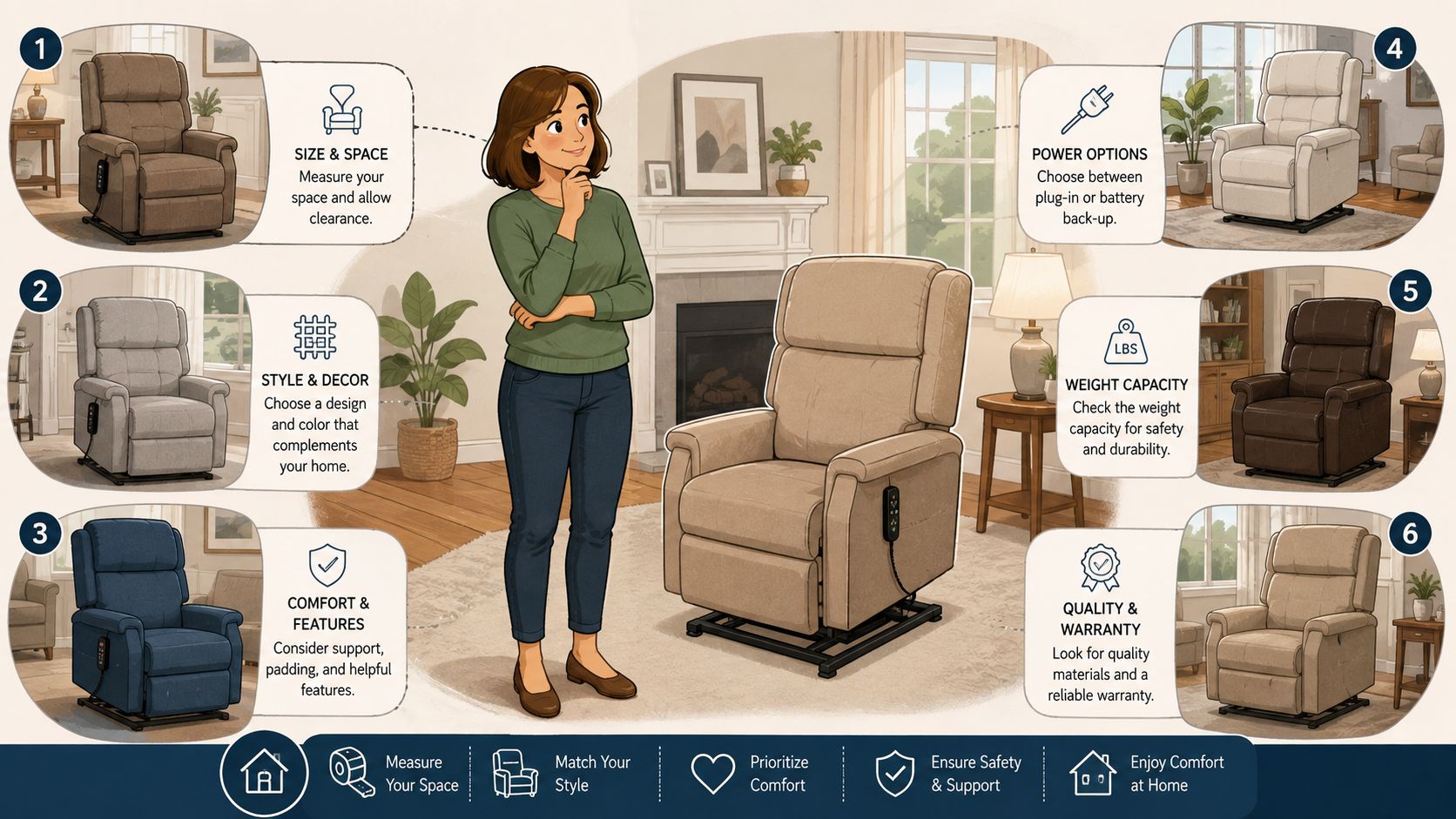
Matching the Right Lift Chair to Your Home
A lift chair that doesn't fit the room becomes an expensive obstacle. A chair that fits the user, clears the doorway, and leaves a safe walking path is far more likely to become part of the daily routine.
Start with the delivery route, not the living-room wall. Measure the doorway, hallway turns, stair landings, and the tightest corner. Check threshold strips and the distance to the nearest outlet. A narrow 28-to-30-inch doorframe can make delivery difficult, especially when the route includes a sharp 90-degree turn or a landing with little maneuvering room.
A pre-measure checklist
- Door openings: Measure the narrowest doorway, including trim and the available clearance with the door open.
- Hallway turns: Note every corner where the chair must pivot, not only the straight hallway width.
- Stair and landing space: Measure landings and identify railings or walls that limit movement.
- Chair footprint: Record the available width and depth where the chair will sit.
- Recline clearance: Confirm the model's required rear clearance before placing it near a wall.
- Standing path: Leave a clear route from the raised chair toward the bathroom, kitchen, or bedroom.
- Power access: Identify the closest outlet without placing the cord across the walking path.
- User measurements: Bring the user's height, approximate weight, and preferred sitting posture.
A compact two-position model may suit an apartment, assisted-living room, or narrow living area better than a large infinite-position chair. In an open-plan home, a larger model may fit comfortably, but it still shouldn't block the main path between rooms. A wall-hugger can save space when the chair must sit close to a wall, while a swivel base may help the user turn toward a table or caregiver.
An existing recliner can sometimes serve as a transfer point if the user can rise safely from it. If hands are gripping furniture, knees are painful, or another person is regularly pulling the user upright, the recliner isn't solving the central problem.
BILTRITE offers small lift chairs for compact spaces alongside broader furniture choices, including small-scale pieces and options designed for difficult delivery routes. The useful comparison happens with a tape measure in hand, not from a guess about what might fit.
Trying a Lift Chair in the Showroom
A showroom visit should be a transfer test, not a quick sit followed by a color choice. The actual user should come whenever possible, wearing the shoes normally worn at home. A caregiver can explain the difficult moments, but the user's body should make the final judgment.
Start in the fully raised position. Have the user approach, turn, feel the seat behind the legs, and lower into the chair. Then test the lift motion from a normal sitting position. The salesperson should act as a spotter, not pull the user upward.
The hands-on test
- Test the full lift: Check whether the motion brings the user forward enough without creating fear or instability.
- Reach for the controller: Make sure the hand control is usable from the seated position and that the buttons are easy to distinguish.
- Watch the footrest timing: The footrest shouldn't force an awkward movement or trap the user's feet.
- Listen to the motor: A quieter movement may feel less startling, especially during nighttime use.
- Try the recline: Check whether the head, lower back, and legs feel supported in the user's usual rest position.
- Practice the route: Ask whether the raised chair faces the correct direction for the doorway and walking path.
Questions about the motor warranty, battery backup, upholstery cleaning, and service turnaround deserve clear answers. A responsible salesperson should also volunteer the measured seat depth, confirm that the weight capacity matches the user, and state directly whether a simpler model meets the need. More features aren't useful if the user can't operate them.
BILTRITE is a fourth-generation, family-owned furniture business serving Greenfield and Metro Milwaukee since 1928. Its showroom includes lift chairs, small-scale furniture, heavy-duty options, USA-made and Amish-made furniture, and a mattress department with over 60 models. The sales associates bring over 400 years of combined experience, and the store's local, in-person approach gives families room to test a chair rather than make a decision from a photograph.
The right chair should make the opening morning feel less complicated. The user should be able to sit, press the control, rise with less strain, and continue toward breakfast or the bathroom with a clear plan. That's the standard worth testing.
BILTRITE Furniture-Leather-Mattresses offers lift chairs, small-scale furniture, heavy-duty choices, USA-made pieces, Amish-made furniture, and supportive mattresses for families planning comfortable homes around changing mobility needs. Visit BILTRITE Furniture-Leather-Mattresses in Greenfield with the user's measurements and walking shoes, and let the team help compare lift mechanisms, fit, and everyday comfort in person.