Dimensions of a Sofa Bed


A lot of shoppers start in the same place. A spare bedroom turns into a home office, the kids claim every extra corner, and then family announces they're coming to stay. Suddenly the dimensions of a sofa bed become a very real question, not just a product detail on a tag.
That's especially true in Metro Milwaukee, where many homes have personality, older door frames, tighter stair turns, and rooms that have to work hard every day. A sleeper can solve a big problem, but only if it fits the room, opens properly, and makes sense for the people using it. Since 1928, the family at BILTRITE has helped neighbors work through exactly those puzzles with honest guidance, better-quality furniture, and practical options for real homes.
A sofa bed isn't just a sofa plus a bed. It's a moving piece with two sets of dimensions, one for daytime and one for overnight use. That's where many shoppers get tripped up. A model may look modest when closed, then need much more floor space when opened. It may also have a sleeping surface that sounds like a standard bed size, even though the actual mattress dimensions are different.
Table of Contents
- Finding Your Fit A Fun Guide to Sofa Bed Sizes
- Understanding Standard Sofa Bed Dimensions
- How to Measure Your Space for a New Sofa Bed
- Exploring Different Sofa Bed Mechanisms
- Our Family's Best Tips for Sofa Bed Shopping
- Ready to Find Your Multitasking Masterpiece?
Finding Your Fit A Fun Guide to Sofa Bed Sizes
A sofa bed usually enters the conversation when a room has to do two jobs. One day it's a TV room, office, or den. The next day it needs to sleep a guest comfortably enough that nobody wakes up regretting the visit.
That's why size shopping gets confusing so fast. It's often assumed there's one simple answer to the dimensions of a sofa bed, but there are really several. There's the outside width of the sofa, the depth while it's closed, the footprint once it opens, and the mattress size tucked inside. Those aren't always neatly matched.
A shopper might see a sofa that looks right for the wall and think the decision is almost done. Then the open bed blocks a walkway, lands too close to a coffee table, or leaves no room to move around the mattress. That's the kind of headache a little planning can prevent.
A sofa bed has to fit three moments: delivery day, everyday living, and overnight use.
For many households, the right answer isn't the biggest model. It's the one that fits the room, suits the guests, and still lets the space feel easy to live in. Smaller-scale designs often make more sense than people expect, especially in condos, bungalows, duplexes, and older city homes.
BILTRITE has long helped Milwaukee-area shoppers sort through those tradeoffs with a practical guide to sofa dimensions. That kind of planning matters because a sleeper needs to work as furniture first and a guest solution second, not the other way around.
Understanding Standard Sofa Bed Dimensions
Size names sound familiar until a sleeper sofa has to fit a real house.
A “queen” sofa bed, for example, may not match the queen mattress in a bedroom. Sleeper sizing is shaped by the folding frame inside the sofa, so the sleeping surface is often shorter and thinner than people expect. According to this sofa bed sizing reference, a common modern sleeper mattress size is 60 in x 72 in, with other common replacement sizes including 58 in x 72 in, 54 in x 72 in, and 52 in x 72 in.
That difference matters in everyday shopping. A sofa can look roomy enough for movie night, then open into a bed that feels better suited to one guest than two adults. In older Milwaukee homes, where spare rooms are rare and living rooms do extra work, that mismatch shows up fast.
Why the label can be misleading
Sleeper sofas work like folding guest beds built inside regular seating. The frame, hinges, and mattress all have to tuck into the body of the sofa without damaging the upholstery or making the seat uncomfortable. That is why sofa bed mattresses are usually thinner than standard bedroom mattresses.
The same sizing reference notes common replacement widths of 38 in twin, 48 in 3/4, 52 in full, 60 in queen, and 64 in queen wide, generally with a 72 in length. It also notes an average mattress thickness of about 11 cm (4.5 in). Those numbers help explain why a sleeper labeled “queen” may still feel compact once it is opened.
Typical Sofa Bed Dimensions
The chart below gives a practical starting point. Use it to compare sleeping space first, then confirm the exact outside dimensions on the model you are considering.
| Sleeper Size | Typical Sofa Width (Closed) | Typical Mattress Size (Open) |
|---|---|---|
| Twin | Varies by frame | 38 in x 72 in |
| 3/4 | Varies by frame | 48 in x 72 in |
| Full | Varies by frame | 52 in x 72 in |
| Queen | Varies by frame | 60 in x 72 in |
For many households, full is the sweet spot. It gives guests more room than a twin without asking the room to carry the bulk of a larger sleeper. If that sounds like your situation, our full sleeper sofa options for guest-ready everyday seating show why this size is so often the practical middle ground.
At BILTRITE, we also see a second size question that spec charts do not solve. Will the sofa make it through the front door, around the turn in the stairway, or into a second-floor den in a bungalow or duplex? That is where exact model design matters as much as mattress size. Come-apart sofas and smaller-scale sleeper styles can solve delivery problems that a standard one-piece frame cannot.
Practical rule: shop by three measurements. The sleeping surface, the closed outside size, and the size of the actual piece that has to get into your home.
Numbers start the conversation. Real-life fit finishes it.
How to Measure Your Space for a New Sofa Bed
A sofa bed can fool you in the showroom. It sits there like a regular sofa, then gets to your house in Bay View, Wauwatosa, or an older Milwaukee duplex and suddenly practical questions surface. Will it clear the front door. Can it turn on the stairs. Once it opens, can anyone still walk through the room without stepping sideways?
Measure the room first
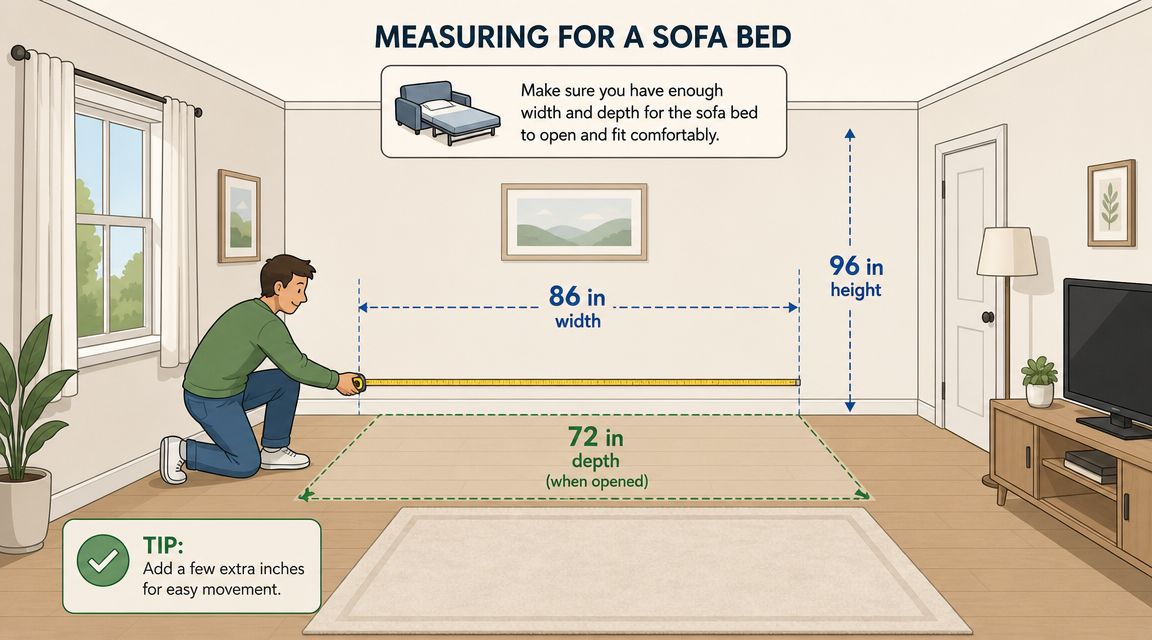
Start where the sofa will live every day. Measure the wall width, then measure how far the bed will extend into the room when it is fully open. A sofa bed works a lot like a reclining chair in this respect. The closed size only tells part of the story. The open position decides whether the room still functions.
Now look at the room the way a guest will use it at night. Check the walking path to the doorway, the distance to a coffee table, and whether an opened mattress crowds a radiator, bookshelf, or TV stand. In many homes, the problem is not that the sofa bed is too large. The problem is that it lands in the one spot where daily movement gets pinched.
A simple floor outline helps. Painter's tape, newspaper, or even flattened boxes can stand in for the opened bed so you can see the footprint before you buy.
Measure the path into the home
This is the step many families skip, and in older homes, it is often the step that decides which models are feasible.
At BILTRITE, we have helped people furnish classic Milwaukee bungalows, upstairs flats, and basement family rooms where access is tighter than the room itself. A sofa can fit the space perfectly and still fail at the front steps or the basement turn. That is why we always tell shoppers to measure the travel path, not just the destination.
Check these points carefully:
- Entry doors, including the opening width with the door fully open
- Interior doorways along the route
- Hallways at the narrowest point
- Stairways, including width, headroom, and railings
- Corners and landings where the frame has to pivot
- Ceiling height in tight stairwells or basement entries
If you want a clear method, our step-by-step furniture measuring guide for doors, stairs, and room layouts walks through the process.
Match the measurements to the right kind of sofa bed
Numbers translate into practical decisions.
If your room is modest but your delivery path is easy, a standard sleeper may work well. If the room is generous but the stairway is narrow, the better answer may be a come-apart sofa or a smaller-scale sleeper designed for tighter access. Those options matter in older southeastern Wisconsin homes because they solve a real delivery problem, not a style problem.
It helps to separate your notes into three buckets:
- Closed size for everyday seating
- Open size for sleeping space
- Access size for getting the piece into the home
That third number is often the tie-breaker.
A quick measuring checklist
Keep your notes simple and specific:
- Measure the sofa wall from side to side.
- Measure the open bed footprint into the room.
- Leave enough walking space to reach doors and move around the bed.
- Trace the delivery route from the entry point to the final room.
- Write down obstacles like low ceilings, tight turns, radiators, and stair rails.
- Ask whether a come-apart or small-scale design would make delivery easier.
Measure for real life, not just showroom life. That habit saves time, avoids delivery surprises, and makes it much easier to choose a sofa bed that fits your home the first day and still works well when guests stay over.
Exploring Different Sofa Bed Mechanisms
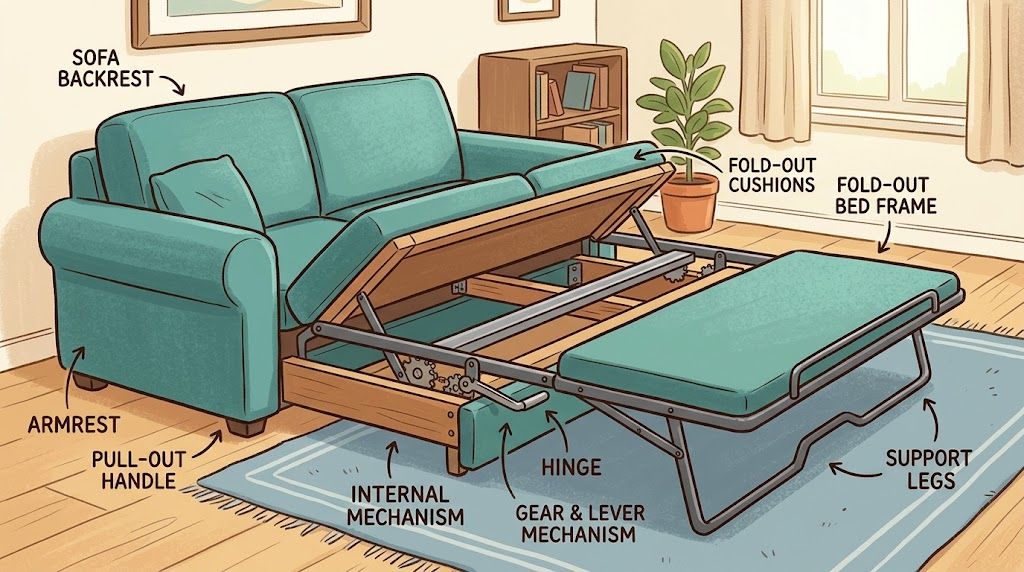
The mechanism inside a sleeper does more than open and close. It shapes the dimensions, affects the mattress thickness, and changes how the sofa feels in everyday use.
Why the mechanism changes the dimensions
A traditional pull-out sleeper usually hides a folded mattress inside a metal frame. That setup tends to create a larger outside body because the sofa has to hold the mechanism and the mattress. It can be a strong option for households that want a familiar sleeper format, but it often asks more from the room.
Other convertible styles can use the sofa's seating surface as the bed or rely on a simpler fold-down action. Those designs may reduce bulk, though the feel and support can be very different from a dedicated pull-out mattress. That's why dimensions of a sofa bed should never be separated from the way the bed works.
Support and compatibility are closely tied to the frame architecture. Independent sizing guidance shows common sleeper mattress widths such as 52 to 55 inches for full, 58 to 62 inches for queen, and 74 to 76 inches for king, while typical sofa-bed mattress thickness averages about 4.5 inches, according to this sleeper mattress size guide. The same guidance notes that the key specification isn't only mattress width, but also the exact frame cutout, mattress thickness limit, and whether the sofa can be delivered in modular or come-apart sections to fit narrow hallways.
Why come-apart construction matters in Milwaukee homes
This is one of the most practical sleeper features for older houses and tighter urban layouts. A sofa can be roomy and comfortable, but if it can't make the turn at the bottom of the basement stairs, it doesn't matter how nice it looks on the showroom floor.
Come-apart construction solves that problem by allowing the piece to travel in sections. That gives shoppers more flexibility without forcing them into a tiny model they don't really want. It's also useful for upper-level condos, split-level entries, and homes with sharp hallway turns.
One example shoppers may want to look at is The Transformer sleeper sofa, which connects directly to that practical issue of sleep space and delivery fit. In the broader category, modular and come-apart designs can open up choices that would otherwise seem impossible in compact homes.
The smartest sleeper isn't always the smallest one. It's the one that can get into the house, open fully, and still let the room breathe.
Our Family's Best Tips for Sofa Bed Shopping
After generations of helping families furnish homes, one lesson keeps showing up. Shoppers who focus only on the size label usually miss the details that matter most once guests sleep on the piece.

Comfort beats the label
A bigger labeled size doesn't automatically mean better sleep. Recent guidance notes that mechanism design and mattress thickness can matter more than the size name, and that thicker mattresses of 14 cm or more are increasingly recommended for frequent sleeping, as noted in this discussion of sofa bed comfort and thickness.
That's a useful reminder for households shopping for regular overnight use. If one model has a better mechanism, steadier support, and a mattress suited to repeat sleeping, it may be the better choice even if another piece carries a larger label.
Shoppers often assume they're choosing between “small but uncomfortable” and “big but better.” Real life isn't that neat. A compact, well-built sleeper can outperform a larger one if the support is better and the mattress works more cleanly with the frame.
What shoppers should test in person
A sofa bed is one of those pieces that deserves a hands-on look. Photos don't show how easily the mechanism moves, whether the seat height feels comfortable, or how the mattress transitions at the fold points.
A strong in-store test includes:
- Sit like real life. Don't perch for five seconds. Sit the way the room will be used.
- Open the bed. Watch how much floor space disappears and whether the motion feels manageable.
- Check the edges. Some sleepers feel supportive in the center and weaker near the sides.
- Ask about construction. USA-made and Amish-made options often appeal to shoppers who care about durability and long-term value.
- Think about frequency. Occasional guest use and regular sleep use aren't the same assignment.
For broader planning, this sofa buying guide for the living room can help shoppers compare comfort, scale, and construction before narrowing down a sleeper.
The value question matters too. Better-quality furniture often costs more than entry-level pieces, but it can make more sense for families who want solid support, dependable use, and a piece that doesn't feel worn out too soon. That's where quality construction, small-scale options, and heavy-duty choices become much more important than a flashy size label.
Ready to Find Your Multitasking Masterpiece?
A sofa bed often sounds simple until moving day. In a lot of Milwaukee-area homes, the question is not only whether the sleeper fits the room. It is whether it can make it through an older front door, turn on a narrow stair landing, or reach a finished basement without scraping every wall on the way down.
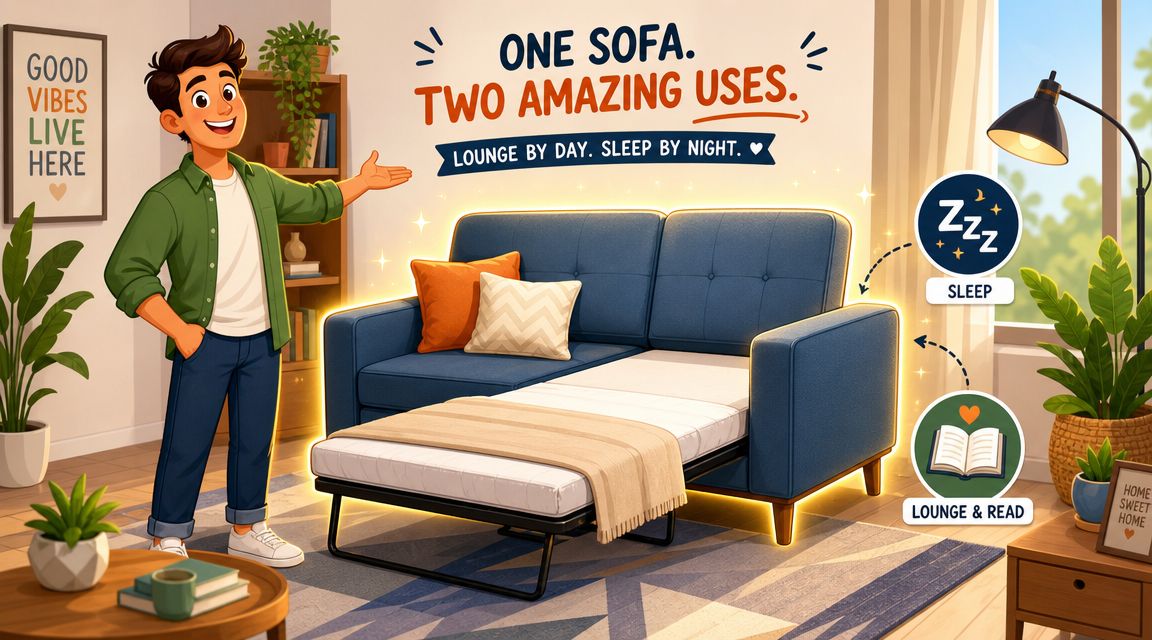
That is why sofa bed dimensions need a real-life test, not just a tape-measure test. The width matters. The open depth matters. The delivery path matters just as much. A sleeper works a little like a suitcase. The outside size tells part of the story, but you also need to know how it opens, how much room it takes while in use, and whether you can get it where it needs to go.
A good final check usually comes down to a few practical questions:
- Will it fit the room when closed? The sofa has to live comfortably in the space every day, not only during guest visits.
- Will it fit the room when open? Guests need walking space, not just a mattress unfolded wall to wall.
- Will it fit the house on delivery day? Doorways, staircases, low ceilings, and tight corners cause plenty of surprises in older homes.
- Will the mechanism match how you plan to use it? An occasional guest sleeper and a frequent-use bed are different jobs.
- Will the scale suit the people using it? Sometimes a smaller, well-built sleeper serves a home better than a bulkier model.
BILTRITE's experience offers practical solutions for common challenges. Families shopping in Metro Milwaukee often need answers for tricky layouts, smaller rooms, and awkward entry routes. Come-apart sofas can solve a problem that a one-piece sleeper cannot. Small-scale designs can make a den, office, or upstairs bedroom work without making the whole room feel crowded.
That kind of fit is hard to judge from photos alone.
For shoppers who want to compare styles before visiting, BILTRITE offers a helpful look at its selection of sleeper sofas and daybeds. Then bring your measurements into the showroom. That gives the team something concrete to work with, so the conversation can focus on your room, your doorway, your stairs, and how the sleeper will be used.
BILTRITE has served Metro Milwaukee since 1928, and that long family history shows up in the way advice is given. The goal is not to rush the decision. It is to help shoppers sort out scale, comfort, construction, and delivery realities before they bring a sofa bed home.
If a new sleeper sofa is on the list, BILTRITE Furniture-Leather-Mattresses would love to help. Visit the showroom in Greenfield, bring measurements, and talk through the practical details with a team that knows Milwaukee homes, small-scale spaces, come-apart solutions, and better-quality furniture built to last.