Beds for People with Disabilities: BILTRITE Guide

A lot of families start this search the same way. Someone isn't getting in and out of bed safely anymore. A favorite mattress suddenly feels too high, too low, too soft, or too hard to manage. A spouse is straining a shoulder during transfers. An adult child is trying to help from across town. And everyone is asking the same question: what kind of bed will make daily life easier?
Beds for people with disabilities sit at the crossroads of comfort, safety, dignity, and routine. That's why this choice can feel so emotional. It's not just about sleep. It's about getting dressed in the morning, reducing falls at night, making caregiving less exhausting, and helping a person feel more at home in their own room.
We've been helping Metro Milwaukee families furnish their homes since 1928, and when a bed has to do more than “just be a bed,” people usually want a real conversation. They want to talk through the room size, who's helping with transfers, whether the bed needs to look less clinical, and how all of this will work day after day. That's where a local, in-person approach helps.
Finding Comfort and Safety is a Family Matter
One of the hardest moments for a family is when a familiar routine stops working. A bed that felt fine a year ago may now create stress every single night. A daughter notices her dad can't reposition easily. A husband realizes his wife is avoiding naps because getting settled has become too difficult. Small signs like these usually point to a bigger need.

Families often tell us they feel overwhelmed by the language alone. Adjustable. Profiling. Low bed. Hospital bed. Rail system. Transfer height. It can sound cold and technical when what you really need is a calmer morning and a safer bedtime.
That's why we try to talk about the human side first.
What families are really choosing
A supportive bed can help protect independence. It can also reduce the daily friction that wears people down. The right setup may help someone sit up with less effort, make transfers feel steadier, or give a caregiver better access without awkward bending and reaching.
The need is far more common than many people realize. The CDC says about 1 in 4 U.S. adults lives with a disability in its disability impacts infographic. That helps explain why access, comfort, and safety aren't fringe concerns. They're everyday household concerns.
Beds for people with disabilities often become a family project, even when one person is the primary user.
We've seen that again and again over generations here in Metro Milwaukee. Our family has been part of this community for a long time, and our history matters because trust matters in conversations like this. You can learn more about our family story and roots in the Milwaukee area.
Why in-person guidance helps
A bed can look sensible on paper and still be wrong for the home. Maybe the rails interfere with a side transfer. Maybe the height range doesn't match the wheelchair. Maybe it fits the bedroom, but there's no room left for a helper to move safely.
Those are the details neighbors talk through face to face. We think that kind of conversation is worth slowing down for. No pressure. Just practical help from people who know this decision affects the whole household.
Understanding the Different Types of Specialty Beds
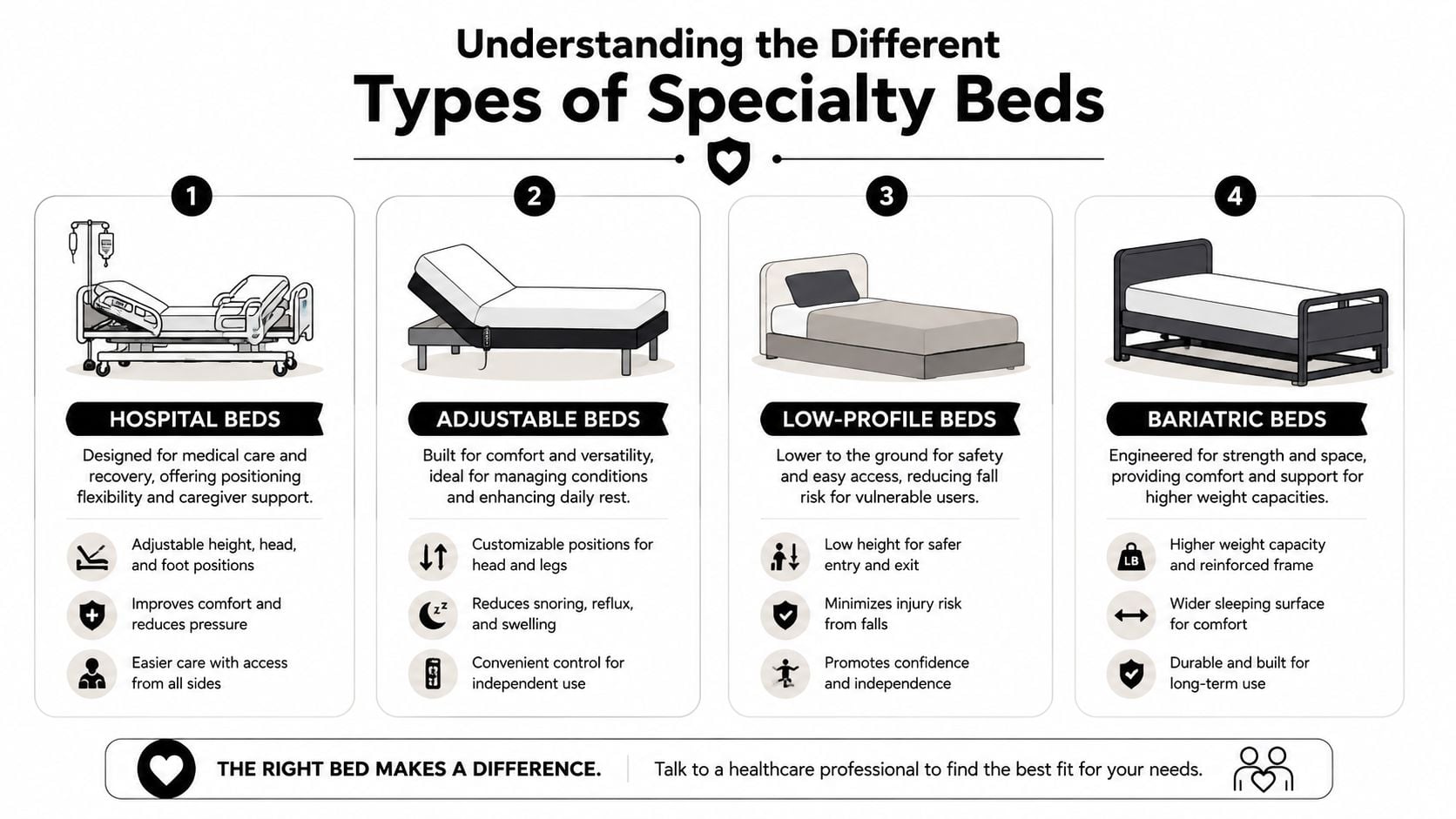
Most confusion starts with one mistaken idea. People assume beds for people with disabilities are all the same, just with different price tags. They aren't. Each type solves a different problem.
Adjustable beds for comfort and easier positioning
An adjustable bed usually means a home-style base that raises the head and feet. For some people, that alone makes a big difference. It can help with getting comfortable, changing position, reading, watching TV, or settling into a breathing-friendly posture.
If the person using the bed is still fairly independent, this style may feel familiar and less medical. It tends to blend into a bedroom more naturally too. If you want a look at one common home option, this full-size adjustable bed example shows the general category.
Profiling or hospital-style beds for transfers and care
For many households, the key feature isn't the head or foot adjustment. It's height adjustability.
As described in Opera Beds' guide to beds for disabled users, the ability to raise or lower the whole bed surface is central for transfers, caregiver access, and positioning. In plain terms, a bed that comes up to a workable height can make dressing, assisting, and moving much safer. A bed that lowers can help with getting in and out more securely.
These beds are often called profiling beds or hospital-style beds for home use. They're usually the better fit when a person needs:
- Transfer support: Moving to and from a wheelchair, walker, or commode
- Caregiver access: Help with dressing, repositioning, or personal care
- More positioning control: Backrest and leg-rest changes through the day
Practical rule: If transfers are difficult, start by asking about bed height range before you ask about fabric, finish, or mattress feel.
Low beds for fall concerns
A low bed is designed to sit closer to the floor. This category matters when nighttime falls are a major concern. It won't solve every safety issue, but reducing the distance to the floor can reduce the hazard if a person rolls out or gets up unsteadily.
Low beds are often useful when a family says, “The biggest worry is what happens at night.” They may also work well when a household wants a simpler solution and doesn't need every medical-style function.
Bariatric and heavy-duty beds for support and stability
A bariatric or heavy-duty bed is built for higher support needs. People sometimes think that only means width. In practice, it also means frame strength, stability, working load, and room for comfortable repositioning.
For some users, a larger sleep surface improves movement and comfort. For others, it's about durability and a bed that doesn't feel strained by everyday use.
Enclosed and specialty safety beds
A smaller category includes enclosed safety beds and other specialty designs. These are often considered when a user has cognitive or physical needs that make standard side rails insufficient. Some families looking after children or adults with developmental disabilities ask about these because nighttime wandering, climbing, or active movement in bed creates specific safety concerns.
This is one of the most specialized areas, and it usually calls for careful discussion rather than a quick product comparison.
Key Features That Make a Real Difference
Two beds can look similar across the room and behave very differently in daily life. That's why features matter more than appearance.
Height range matters more than most people expect
When a family says, “We need a safer bed,” they often mean one of three things. They need easier transfers, less caregiver strain, or less fall risk. Height adjustment touches all three.
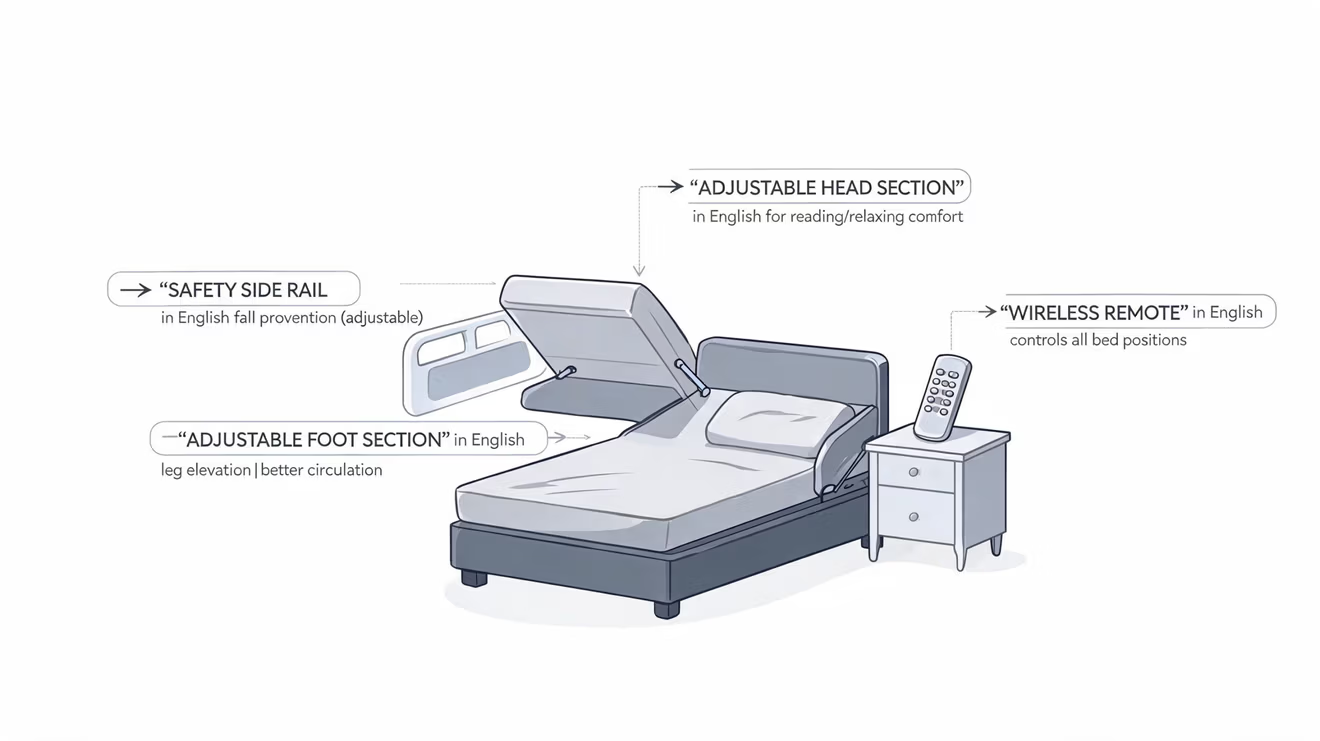
A bed that raises can bring the sleep surface closer to wheelchair height or caregiver working height. A bed that lowers can help with nighttime safety and getting feet firmly planted before standing. The same bed may need to do both in a single day.
That's why we encourage families to test motions, not just mattress comfort.
Rails and side access should match the person, not the brochure
Side rails can be helpful, but they're not one-size-fits-all. Some people use rails as a cue for bed boundaries. Others use them for turning or pushing up. In some situations, rails can get in the way of transfers if they don't lower or open in the right way.
A good rail setup depends on how the person moves, how much supervision is needed, and whether the caregiver needs side access for dressing or repositioning.
Here are a few questions worth asking:
- Does the rail support movement or block it? A transfer-friendly setup is different from an anti-fall setup.
- Can the caregiver reach the user safely? A rail should help protect, not create awkward lifting angles.
- Does the mattress fit tightly? Gaps can create hazards.
Safety features should support normal daily use, not just emergency situations.
Entrapment protection is built into the design
This is one of those technical topics that sounds abstract until you realize what it means. A well-designed safety bed pays attention to spaces where a person could become trapped between the mattress, rail, or frame.
SleepSafe Beds are described as meeting or exceeding FDA guidance for the 7 zones of entrapment on the SleepSafe product page. The same page describes features such as full-length rails and tightly fitted mattresses. That's the sort of engineering detail families should ask about, especially when the user is active in bed or has limited ability to reposition safely.
Controls should be simple enough to use when tired
Remote controls don't need to be fancy. They need to be easy to understand in the middle of the night.
Look for buttons that are clear, predictable, and comfortable in the hand. If a person has limited dexterity, small or crowded controls can become frustrating quickly. If a caregiver is helping, straightforward controls also reduce mistakes and hesitation.
A bed should feel easier after a long day, not more complicated.
You can read more about adjustable base benefits and common functions if you want a broader look at how these mechanisms are used in home settings.
Dont Forget the Mattress Finding the Right Match
A supportive frame and the wrong mattress can cancel each other out. We see that happen all the time. Someone chooses a bed with the right functions, then puts a mattress on it that bends poorly, creates pressure points, or feels unstable near the edge.
Think of the bed and mattress as one system
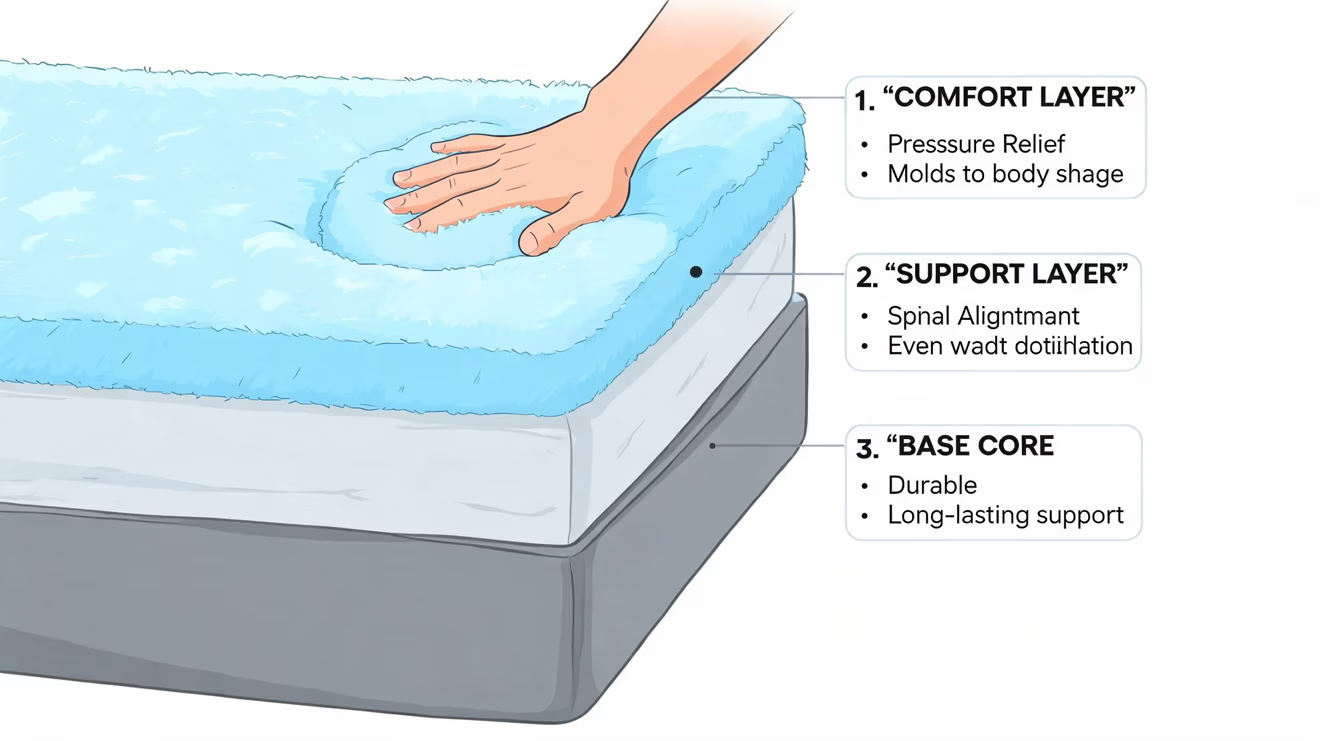
Beds for people with disabilities often need the mattress to do several jobs at once. It may need to flex with an adjustable base, support easier repositioning, cushion pressure-sensitive areas, and still feel stable when someone sits on the edge to transfer.
That's why shopping for the frame first and the mattress later can create trouble. Compatibility matters. A mattress that's too rigid may not articulate well. One that's too plush may feel harder to move on. One that's too tall may change how rails or side access work.
A mattress can feel comfortable for ten minutes in the store and still be the wrong partner for a specialty base.
What to ask when comparing mattresses
You don't need medical jargon here. Start with practical questions.
- Will it flex well on the base? Adjustable and hospital-style setups need mattresses that move with the frame.
- How easy is it to reposition on? Some surfaces “hug” the body more than others.
- What does the edge feel like? Stronger edge support can help during transfers.
- How does it balance softness and support? Pressure relief matters, but so does stability.
Many families like foam or hybrid designs because they tend to pair well with adjustable movement. But feel still matters. A caregiver may prioritize easier turning. The user may prioritize cushioning at shoulders or hips. Both concerns are valid.
Why trying mattresses in person saves frustration
This is one area where hands-on testing really helps. Our store has a large mattress department with over 60 models, which gives families room to compare feel, flexibility, and support side by side. We can talk through what kind of bed base you're considering and narrow the field to mattresses that make sense for that setup.
If you want a starting point before visiting, our guide on how to choose the right mattress walks through the basics in plain language.
Caregiver Comfort and Home Safety Considerations
A bed can be comfortable for the sleeper and still be punishing for the helper. That's a problem, because caregiver strain usually builds slowly. A twist here, a deep bend there, another awkward reach at bedtime, and before long someone's back, neck, or shoulders are paying the price.
The bed has to work for two people sometimes
Many buying guides stop at feature lists. They say rails, height adjustment, and side access are available, but they don't always explain how those details change daily tasks. That gap matters. The Vivid Care discussion of beds for disabled adults points to exactly this issue by focusing on how bed height, side access, and rail design affect real caregiving jobs.
In everyday terms, that means a good bed should make these moments easier:
- Morning transfers: Sitting up, pivoting, standing, or moving to a wheelchair
- Dressing and personal care: Reaching the person without overextending
- Nighttime support: Helping someone settle back into position with less lifting
Measure the room before you fall in love with the bed
This part gets skipped more often than it should. Families measure the bed footprint, but not the working space around it.
Try to think beyond whether the frame fits. Ask whether there's room for a wheelchair to approach at the needed angle. Ask whether a helper can stand on the side they use. Ask whether drawers, dressers, or nightstands block rail movement or transfer paths.
A home-style setup should still function like a safe care environment when needed.
Watch the path around the bed
The floor area matters almost as much as the bed itself. Loose rugs, narrow clearances, lamp cords, and crowded furniture can undo the benefit of a supportive bed.
Sometimes the smartest change isn't the fanciest bed. It's the right bed, placed the right way, with enough open room for steady movement.
If a caregiver has to “make do” with awkward angles every day, the setup isn't finished yet.
Some families also pair the bed decision with seating changes in the same room or nearby spaces. A lift chair designed for easier sitting and standing can complement the overall routine when mobility is limited.
Home feel still matters
People don't stop caring about their surroundings because they need more support. The bed may need to work hard, but it still lives in a bedroom, not a warehouse.
That's especially true in Milwaukee-area homes where space can be tight, bedrooms may be upstairs, and families want the room to feel warm rather than clinical. A successful setup respects both safety and the emotional comfort of home.
Navigating Funding Insurance and Local Options
This is usually the murkiest part of the process. Families ask whether insurance will help, and the honest answer is: sometimes, but it depends on the diagnosis, documentation, supplier rules, and the specific type of bed being considered.
The big point to understand is that healthcare systems classify beds by purpose. In Northern Ireland's inpatient reporting, occupied beds are sorted into categories such as Acute and Assessment and Treatment in the 2023/24 inpatient statistics release. That same idea carries into funding decisions more broadly. Coverage often follows a medically defined bed category, not necessarily the home-friendly style a family wants.
What that means in practical terms
Insurance-supported equipment may be tied to a durable medical equipment pathway. That can mean specific paperwork, approved suppliers, and narrower choices. Sometimes that works well. Sometimes it leads to a bed that meets the medical requirement but doesn't fit the room, the décor, or the family's day-to-day preferences.
A furniture showroom works differently. It can be a direct-purchase path for families who want more say in appearance, feel, and home fit. In that setting, BILTRITE Furniture-Leather-Mattresses is one local option for supportive home furnishings, including adjustable sleep products, mattresses, heavy-duty selections, and senior-living-focused pieces.
A simple way to think about the choice
Use this basic split:
| Path | Usually fits families who need |
|---|---|
| Medical supplier route | Diagnosis-based equipment and insurance coordination |
| Retail furniture route | More control over home style, comfort, and immediate room fit |
If you're unsure which path applies, start by asking what the user medically needs first. Then compare that with what the household can realistically live with every day.
Come See For Yourself Let Our Family Help Yours
There's only so much you can learn from a screen. A bed can sound right in a description and feel completely different when you sit on the edge, test the controls, or picture a real transfer happening in your own home.
That's one reason we don't sell online. Families making this decision usually want to talk it out, try things, and ask follow-up questions that don't fit neatly into a product filter. They want to know whether a mattress bends smoothly, whether the bed height feels workable, whether the bedroom can still look like home, and whether delivery and setup will be manageable.
Why the showroom matters
When you visit in person, you can do the things that matter most:
- Test the motion: Raise and lower the bed, not just the head section
- Compare feel: Try different mattress constructions on supportive bases
- Talk through the room: Bring measurements, photos, and questions
- Think about the helper too: We'll talk openly about caregiver access and strain
Our team isn't here to rush anybody. We've got over 400 years of combined experience on the floor, and that kind of knowledge helps when a family is balancing mobility, comfort, appearance, budget, and timing all at once.
A local conversation is different
We're a fourth-generation family business that's been serving Metro Milwaukee since 1928. We're proud of our USA-made and Amish-made furniture, our better-quality approach, and our belief that good guidance should feel neighborly. We're also closed on Sundays so our own families can be together, and we think that says something important about how we do business.
If you're sorting through beds for people with disabilities, come in with your questions. Bring the measurements. Bring the concerns you think are too small to mention. Those “small” details are often the ones that lead to a safer, more comfortable setup.
We'd be glad to sit down with you and help you think it through, one practical step at a time.
If you're ready to talk through options in person, visit BILTRITE Furniture-Leather-Mattresses in Greenfield. We'd love to help your family compare supportive beds, mattresses, and mobility-friendly furniture in a relaxed showroom setting, with real guidance from people who've been serving Metro Milwaukee families for generations.